Datagnome
Who Is the Company Behind Datagnome?
- Seller: Datagnome
- HQ Location: N/A
-
LinkedIn® Page: www.linkedin.com
2 employees on LinkedIn®
Total Products under this Category: 142
Last updated: October 26, 2026
Why You Can Trust G2's Software Rankings:
G2's software rankings are built on verified user reviews, rigorous moderation, and a consistent research methodology maintained by a team of analysts and data experts. Each product is measured using the same transparent criteria, with no paid placement or vendor influence. While reviews reflect real user experiences, which can be subjective, they offer valuable insight into how software performs in the hands of professionals. Together, these inputs power the G2 Score, a standardized way to compare tools within every category.
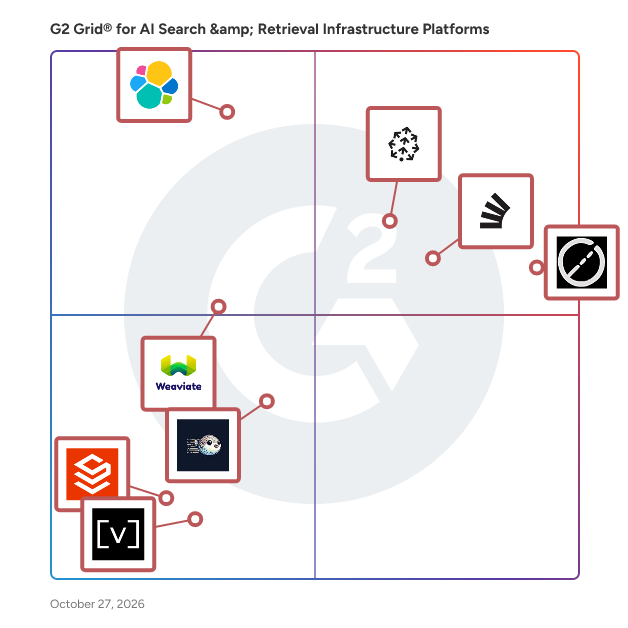
Highlighted products: cloro, Stack Internal, Pinecone, Elasticsearch, Weaviate, Turbopuffer, Vectorize.io, and SearchStax.
Underlying data: [Grid® JSON](https://www.g2.com/categories/ai-search-retrieval-infrastructure-platforms/grids.json?focus%5B%5D=cloro&focus%5B%5D=stack-internal&focus%5B%5D=pinecone&focus%5B%5D=elastic-elasticsearch&focus%5B%5D=weaviate&focus%5B%5D=turbopuffer&focus%5B%5D=vectorize-io&focus%5B%5D=searchstax)
Dewey is a full-service AI platform that turns expert content libraries into conversational Q&A for audiences. Every answer is sourced exclusively from the customer's approved content — never the open internet — with full citations back to the original source material. Dewey's closed-loop architecture eliminates hallucinations by design. Experts maintain editorial control: pre-write answers to critical questions, lock responses on sensitive topics, and set boundaries where the AI says "I don't know" rather than guessing. An analytics dashboard and Knowledge Requests queue surface what audiences are actually asking, turning unanswered questions into content opportunities. Deployed across health, parenting, civic journalism, education, and publishing — including organizations where getting the answer wrong has real consequences. 1M+ answers served across 30+ live knowledge bases. Dewey is full-service: we build, deploy, and manage every implementation.
Connect G2 to Claude or ChatGPT for answers grounded in G2's trusted reviews, comparisons, and pricing from real user insights.
Exabase is the data layer for AI agents. It gives your agents persistent memory, cloud storage, and semantic search so they can remember users, store files, and retrieve context across sessions. The Memory API is a self-organizing memory system that stores facts, preferences, and events, then builds a living knowledge graph that tracks relationships, resolves contradictions, and evolves with every interaction. It's not a vector database. It's real, self-improving memory. The Resources API provides a cloud-native filesystem for agents and users. Store files, notes, bookmarks, and documents with full CRUD, folders, tags, and semantic search built in. The Bases API lets you create isolated cloud workspace instances on demand. Each one comes with its own memory, files, and search, fully controlled by your app and auditable through the API or web console. Stop building memory infrastructure from scratch. Give your agents a place to work.
Ext-Infer is a PHP 8.3+ extension designed to generate embeddings for in-process vector indexing and approximate-nearest-neighbor search. It forms the generation half of a fully local Retrieval-Augmented Generation (RAG) stack for PHP, working in tandem with ext-turbovec, which indexes and searches the embeddings. This setup eliminates the need for external vector databases, Python sidecars, or data leaving the machine, ensuring a streamlined and secure process. Key Features and Functionality: - In-Process Embedding Generation: Ext-Infer allows for the creation of vector embeddings directly within the PHP environment, facilitating efficient data processing without external dependencies. - Seamless Integration with Ext-Turbovec: Designed to work alongside ext-turbovec, Ext-Infer enables a cohesive workflow for indexing and searching embeddings, enhancing the performance of PHP applications. - Elimination of External Dependencies: By operating entirely within the PHP ecosystem, Ext-Infer removes the need for external vector databases or additional programming languages, simplifying deployment and maintenance. Primary Value and Problem Solved: Ext-Infer addresses the challenge of integrating efficient vector embedding generation within PHP applications. By providing an in-process solution, it eliminates the complexities associated with external dependencies and data transfers, offering developers a streamlined, secure, and efficient tool for implementing advanced search and retrieval functionalities directly within their PHP projects.
Findola is an AI-native enterprise search platform designed to unify information across over 200 applications, including Slack, Notion, Google Drive, Salesforce, Jira, and GitHub. By integrating these tools, Findola enables users to retrieve precise answers to their queries in under two seconds, complete with citations, permission controls, and an audit trail. This solution addresses the common challenge of knowledge workers spending approximately nine hours weekly searching for information across multiple platforms. Key Features and Functionality: - Comprehensive Integration: Seamlessly connects with more than 200 applications, allowing for a unified search experience across various platforms. - Cross-Application Entity Resolution: Recognizes and consolidates related information from different systems, such as identifying that "acme.com" in Salesforce, "@acme" in Slack, and "Acme_MSA_v3.docx" in Drive pertain to the same entity. - Permission-Aware Retrieval: Ensures that search results respect existing access controls, displaying only information that the user is authorized to view. - Cited Responses: Provides answers with direct citations to their sources, enhancing transparency and trustworthiness. - Agentic Workflows: Supports multi-step workflows managed by AI agents, facilitating tasks such as drafting renewals, escalating incidents, and briefing executives. - Observability and Evaluation: Offers detailed insights into query performance, including latency, cost, accuracy, and trace history, along with regression tests for model and prompt changes. Primary Value and User Solutions: Findola significantly reduces the time employees spend searching for information by providing a centralized, intelligent search interface that spans multiple applications. This consolidation leads to increased productivity, as users can quickly access the information they need without switching between platforms. Additionally, the platform's permission-aware retrieval and cited responses ensure that users receive accurate and relevant information, maintaining data security and integrity. By streamlining information retrieval and supporting complex workflows, Findola empowers organizations to operate more efficiently and make informed decisions promptly.
FrameSeek is an AI-powered visual intelligence layer, part of Verify, built for media organisations, press agencies, stock libraries and rights holders that manage large visual archives. It brings high-precision search to millions of images: teams find any image by its visual content, not just by keywords or filenames, using five search modalities in one layer, reverse image search, semantic search, OCR, person recognition and similar-image search. FrameSeek also monitors where those images appear across web and print, even after cropping, resizing, compression or editing, with near-100% accuracy. Built and hosted in Europe with EU data residency, aligned with the GDPR and the EU AI Act. FrameSeek focuses on images and is not a video search tool. Dutch national news agency ANP uses FrameSeek to track image reuse across web and print.
