bCloud AI Search
Who Is the Company Behind bCloud AI Search?
- Seller: bCloud AI Search
- Year Founded: 2026
- HQ Location: Columbus, US
-
LinkedIn® Page: www.linkedin.com
6 employees on LinkedIn®
Total Products under this Category: 142
Last updated: October 26, 2026
Why You Can Trust G2's Software Rankings:
G2's software rankings are built on verified user reviews, rigorous moderation, and a consistent research methodology maintained by a team of analysts and data experts. Each product is measured using the same transparent criteria, with no paid placement or vendor influence. While reviews reflect real user experiences, which can be subjective, they offer valuable insight into how software performs in the hands of professionals. Together, these inputs power the G2 Score, a standardized way to compare tools within every category.
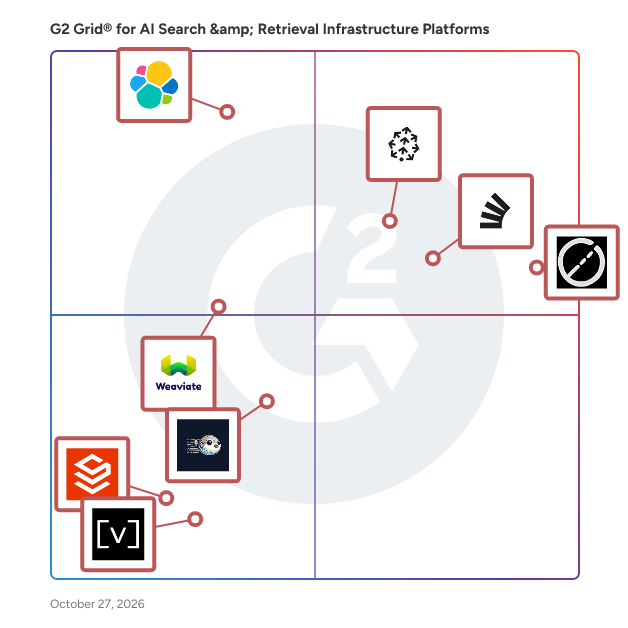
Highlighted products: cloro, Stack Internal, Pinecone, Elasticsearch, Weaviate, Turbopuffer, Vectorize.io, and SearchStax.
Underlying data: [Grid® JSON](https://www.g2.com/categories/ai-search-retrieval-infrastructure-platforms/grids.json?focus%5B%5D=cloro&focus%5B%5D=stack-internal&focus%5B%5D=pinecone&focus%5B%5D=elastic-elasticsearch&focus%5B%5D=weaviate&focus%5B%5D=turbopuffer&focus%5B%5D=vectorize-io&focus%5B%5D=searchstax)
Bioz is an advanced AI-powered search engine designed to revolutionize life science experimentation by providing researchers with data-driven product recommendations and insights. By analyzing vast amounts of scientific literature, Bioz helps scientists in academia and biopharma make informed decisions, ultimately accelerating drug discovery and the development of disease cures. Key Features and Functionality: - Comprehensive Database: Bioz offers access to over 300 million products from 50,000 suppliers, covering a wide range of life science tools and reagents. - AI-Driven Insights: Utilizing artificial intelligence, including natural language processing and machine learning, Bioz extracts and structures data from hundreds of millions of scientific articles to provide evidence-based product recommendations. - Bioz Stars Rating System: Products are ranked based on factors such as frequency of use in experiments, recency of usage, and the impact factor of the journals in which they were cited, resulting in an objective scoring system. - User-Friendly Interface: Researchers can efficiently search for and identify the most suitable products for their experiments, saving time and resources. Primary Value and Problem Solved: Bioz addresses the challenge researchers face in selecting reliable and effective tools for their experiments. By providing objective, data-driven product recommendations, Bioz reduces the time spent on product selection, enhances the quality of research outcomes, and accelerates the pace of scientific discovery and drug development. This leads to more efficient research processes and faster advancements in finding cures for diseases.
Connect G2 to Claude or ChatGPT for answers grounded in G2's trusted reviews, comparisons, and pricing from real user insights.
Bolo AI is an AI-powered document and search assistant tailored for professionals in heavy industries, such as Oil & Gas. It enables users to efficiently locate, retrieve, and analyze critical documents within their organizations, reducing manual search efforts and enhancing decision-making processes. Integrated seamlessly with platforms like Microsoft Teams, Microsoft 365, and Outlook, Bolo AI ensures that relevant insights are readily accessible while maintaining compliance and operational efficiency. Key Features and Functionality: - Natural Language Search: Users can pose questions in plain English and receive AI-driven, context-aware responses. - Document Parsing: The system supports the upload and analysis of Word (.doc, .docx) and PDF files, extracting summaries and key details for quick reference. - Integrated Source Verification: Provides direct access to original documents, ensuring transparency and accuracy in information retrieval. - Feedback Mechanism: Users can enhance AI responses through a thumbs-up/down rating system, allowing continuous improvement. - Microsoft Teams Integration: Facilitates querying and retrieving document results within Teams chats and channels, eliminating the need to switch between platforms. Primary Value and Solutions Provided: Bolo AI addresses the challenge of navigating vast collections of documents in heavy industries by offering a smart knowledge discovery tool. It reduces the time spent on manual searches, minimizes downtime, and accelerates decision-making by instantly retrieving key insights from company documents. This ensures that teams have the right information at the right time, leading to improved operational efficiency and compliance.
Calypso is a fully managed Retrieval-Augmented Generation (RAG) platform designed to transform unstructured data—such as PDFs, documents, screenshots, charts, diagrams, help content, and images—into reusable source memory for AI agents. By providing source-backed AI answers with verifiable citations, Calypso ensures that users receive accurate and trustworthy information. Key Features and Functionality: - Buckets: Organize and store multimodal unstructured knowledge in named Buckets, allowing for efficient indexing and retrieval. - Agents: Hosted RAG agents with curated memory that search selected Buckets, follow scoped behavior, and return citation-ready responses. - Integrations: Seamlessly connect knowledge across various platforms, including websites, APIs, MCP clients, n8n workflows, and product UIs, ensuring consistent and grounded answers. - OpenAI-Compatible API: Utilize Calypso Agents through OpenAI-style clients and agent frameworks without the need to rebuild retrieval systems. Primary Value and User Solutions: Calypso addresses the challenge of managing and retrieving information from diverse and unstructured data sources. By converting these sources into structured, searchable knowledge, it empowers AI agents to provide accurate, context-aware, and verifiable answers. This capability enhances decision-making processes, improves efficiency, and reduces the time spent searching for information, making it an invaluable tool for organizations seeking to leverage AI for informed and reliable insights.
CatchAll is a recall-first web search API that finds all real-world events for deep research, agentic workflows, and continuous monitoring. It addresses the issue of AI systems relying on SERP-style APIs that surface only ranked results. CatchAll searches tens of thousands of pages per request, groups real-world events, removes duplicates, and returns clean, structured data.
Dashworks is an AI-powered knowledge assistant designed to streamline information retrieval and enhance productivity within organizations. By integrating with various tools and platforms, Dashworks provides a centralized hub where users can quickly access company-wide knowledge, documents, and data. This eliminates the need to search through multiple applications, saving time and reducing frustration. Key Features and Functionality: - Unified Search: Dashworks connects with numerous applications, enabling users to perform a single search across all integrated tools and platforms. - AI-Powered Assistance: The platform leverages artificial intelligence to understand user queries and deliver relevant information efficiently. - Seamless Integration: Dashworks integrates with a wide range of tools and platforms, ensuring that users can access information from various sources without leaving the platform. - Enhanced Productivity: By providing quick access to information, Dashworks helps users complete tasks more efficiently, reducing the time spent searching for data. Primary Value and User Solutions: Dashworks addresses the common challenge of information fragmentation within organizations. By offering a centralized, AI-driven search experience, it empowers teams to find the information they need swiftly, leading to improved collaboration and productivity. This solution is particularly beneficial for companies with diverse tools and data sources, as it simplifies knowledge management and ensures that critical information is always within reach.
