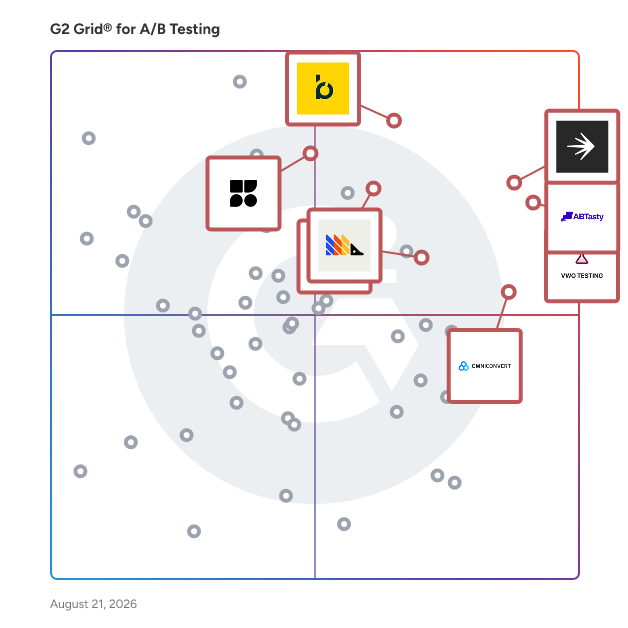
# Best A/B Testing Tools - Page 10

*By [Alanna Iwuh](https://research.g2.com/insights/author/alanna-iwuh)*

VWO Testing is the top-ranked A/B testing software in 2026, rated 4.4 out of 5 on G2 based on 900+ verified reviews. For teams prioritizing progressive feature releases without code redeployment, LaunchDarkly and Bloomreach both lead at 4.6 stars, while Webflow edges ahead at 4.8 stars for designer-led testing workflows.

1. VWO Testing — 4.4/5 (900+ reviews): Visual website testing and conversion validation
2. AB Tasty — 4.4/5 (400+ reviews): No-code web experiments with targeting control
3. LaunchDarkly — 4.5/5 (700+ reviews): Progressive feature release control
4. Bloomreach — 4.6/5 (700+ reviews): Personalized commerce testing and journey optimization
5. Webflow — 4.4/5 (900+ reviews): Designer-led website changes for testing readiness

*Updated June 2026. Based on 2026 G2 verified review data across 5 products.*


A/B testing tools, also known as split-testing software, help businesses test different variations of their website or digital experiences to identify the best-performing version based on their business goals. Each variation can test a different idea or goal by modifying website elements such as headlines, images, layouts, landing pages, colors, text, calls to action, and displayed or hidden content. Organizations use A/B testing tools to improve website performance, increase conversion rates, and understand how website changes impact user engagement and conversion.

Marketers use A/B testing tools with [personalization software](https://www.g2.com/categories/personalization) to personalize web experiences based on segmentation data, such as visitor demographics or traffic source. These platforms often integrate with [digital analytics software](https://www.g2.com/categories/digital-analytics) to track engagement, as well as [heatmap tools](https://www.g2.com/categories/heatmap-tools) and [session replay software](https://www.g2.com/categories/session-replay) to understand where users click and which website elements they interact with most.

Development and product teams can also use A/B testing tools with [feature management software](https://www.g2.com/categories/feature-management) to selectively roll out website changes or features to specific user groups and track performance and other engagement metrics.

To qualify for inclusion in the A/B Testing category, a product must:

- Conduct split-traffic experiments on websites with defined, trackable goals to determine the best-performing variation
- Deploy multiple versions of website content or webpage elements in real time
- Perform split-URL experiments
- Adjust and manage traffic volume to experiment with variations
- Provide tools for both technical and non-technical users to perform website experiments


## Top A/B Testing Tools at a Glance
| # | Product | Rating | Best For | What Users Say |
|---|---------|--------|----------|----------------|
| 1 | [VWO Testing](https://www.g2.com/products/wingify-vwo-testing/reviews) | 4.4/5.0 (915 reviews) | Visual website testing and conversion validation | "[Amazing No-Code Visual Editor That Makes Test Variations Fast](https://www.g2.com/survey_responses/vwo-testing-review-12795530)" |
| 2 | [AB Tasty](https://www.g2.com/products/ab-tasty/reviews) | 4.4/5.0 (404 reviews) | No-code web experiments with targeting control | "[Standout Support and Fast Response Times, with Steady New Feature Development](https://www.g2.com/survey_responses/ab-tasty-review-12305095)" |
| 3 | [LaunchDarkly](https://www.g2.com/products/launchdarkly/reviews) | 4.5/5.0 (740 reviews) | Progressive feature release control | "[Operational agility at scale — deploys replaced by toggles](https://www.g2.com/survey_responses/launchdarkly-review-12870973)" |
| 4 | [Bloomreach](https://www.g2.com/products/bloomreach-bloomreach/reviews) | 4.6/5.0 (760 reviews) | Personalized commerce testing and journey optimization | "[Two implementations, one clear conclusion: best CDP+automation combo for retention teams](https://www.g2.com/survey_responses/bloomreach-review-12720180)" |
| 5 | [Webflow](https://www.g2.com/products/webflow/reviews) | 4.4/5.0 (979 reviews) | Designer-led website changes for testing readiness | "[Best webdesign building platform](https://www.g2.com/survey_responses/webflow-review-7038852)" |
| 6 | [Omniconvert](https://www.g2.com/products/omniconvert/reviews) | 4.6/5.0 (177 reviews) | Fast onsite copy and variant tests | "[Powerful A/B Testing with Truly Hands-On Support That Feels Like a Partnership](https://www.g2.com/survey_responses/omniconvert-review-12303892)" |
| 7 | [PostHog](https://www.g2.com/products/posthog/reviews) | 4.5/5.0 (1,044 reviews) | Product analytics with built-in experiments | "[PostHog Gives a Complete, Connected View of the Customer Journey](https://www.g2.com/survey_responses/posthog-review-12905573)" |
| 8 | [MoEngage](https://www.g2.com/products/moengage/reviews) | 4.5/5.0 (509 reviews) | Lifecycle campaign testing and segmentation | "[MoEngage Turns Raw Event Data into Actionable, Visual Campaign Journeys](https://www.g2.com/survey_responses/moengage-review-12502802)" |
| 9 | [Agentforce Marketing (formerly Salesforce Marketing Cloud)](https://www.g2.com/products/agentforce-marketing-formerly-salesforce-marketing-cloud/reviews) | 4.0/5.0 (4,378 reviews) | — | "[Powerful, Data-Driven Marketing Automation for Enterprise Teams](https://www.g2.com/survey_responses/agentforce-marketing-formerly-salesforce-marketing-cloud-review-12434861)" |
| 10 | [Harness Platform](https://www.g2.com/products/harness-platform/reviews) | 4.6/5.0 (277 reviews) | — | "[Harness - World of automation](https://www.g2.com/survey_responses/harness-platform-review-11792426)" |

---
## What Are the Most Common Questions About A/B Testing Tools?
*AI-generated · Last updated: May 26, 2026*
### What top A/B Testing tools for SaaS companies measuring feature impact on user retention and upsell?
Based on G2 reviews, buyers evaluating A/B Testing Tools for SaaS use cases often focus on platforms that help teams validate feature changes, monitor behavior, and connect experiments to product decisions. According to verified users, Statsig stands out for feature flags, controlled rollouts, and impact measurement, while reviewers say PostHog is valuable for combining analytics, session replay, experiments, and feature flags in one workflow. G2 reviewers mention VWO Testing for straightforward test setup, visual editing, and conversion-focused experimentation, especially when teams want to reduce guesswork and iterate faster. Across these products, users consistently highlight faster learning cycles, data-backed release decisions, and less reliance on intuition when testing product changes.

**Here are some of the top-rated products on G2:**

- [Statsig](https://www.g2.com/products/statsig/reviews/statsig-review-11460134) – used for feature flags, product experiments, and impact measurement with fast analysis workflows
- [PostHog](https://www.g2.com/products/posthog/reviews/posthog-review-12624413) – suited for teams wanting analytics, session recordings, feature flags, and experiments in one platform
- [VWO Testing](https://www.g2.com/products/wingify-vwo-testing/reviews/vwo-testing-review-11531965) – helpful for running landing page, cart, and feature experiments with strong support and reporting


### Which A/B Testing platforms let non-technical PMs set up and launch variants in under an hour?
Based on G2 reviews, [VWO Testing](https://www.g2.com/products/wingify-vwo-testing/reviews/vwo-testing-review-11537425) is the strongest fit for non-technical PMs who want to launch variants quickly. According to verified users, its visual editor, intuitive interface, and low developer dependence make it easier to create and analyze tests without heavy engineering support. G2 reviewers mention that teams can set up A/B, multivariate, and split tests with limited developer involvement, and several users specifically call out straightforward onboarding and responsive support. Reviews also note that simple UI changes, landing page tests, and hypothesis validation can be done quickly, while more advanced scenarios may still require some learning. For buyer research, that makes it a practical option for PM-led experimentation.


### What A/B Testing solutions with audit trails and rollback capabilities for safely reverting problematic experiments?
Based on G2 reviews, buyers looking for safer experiment control often prioritize platforms with fast rollback, feature control, and visibility into flag changes. According to verified users, LaunchDarkly is repeatedly praised for letting teams decouple deployment from release, roll back problematic features instantly, and manage targeted releases without redeploying. G2 reviewers mention that audit logging, flag tracking, and kill-switch capabilities help reduce deployment risk and simplify recovery when experiments or releases misbehave. While many reviews frame LaunchDarkly as feature management first, users also describe using it for A/B testing and controlled experimentation. For teams worried about bad variants affecting production, reviewers consistently point to fast reversibility and granular release control as key strengths.


### What A/B Testing tools supporting multivariate tests, segmentation, and audience targeting without complex configuration?
Based on G2 reviews, several A/B Testing Tools are praised for balancing targeting depth with practical usability. According to verified users, VWO Testing supports multivariate testing, segmentation, split URL tests, and audience targeting with a visual editor that reduces developer reliance. G2 reviewers also describe AB Tasty as an all-in-one platform for experimentation, personalization, and segmentation, especially useful for marketing teams and non-technical users. Statsig is mentioned for scalable experimentation and feature targeting, though some users note a steeper learning curve for advanced workflows. Across reviews, buyers most often value intuitive setup, flexible audience rules, and the ability to personalize experiments without overly complex configuration or heavy engineering effort.


### What best A/B Testing tools for product teams running experiments without needing data science or analytics expertise?
Based on G2 reviews, product teams without deep analytics expertise tend to prefer platforms that simplify setup, reporting, and interpretation. According to verified users, VWO Testing is frequently described as intuitive, with a visual editor and clear reporting that help teams test ideas without heavy technical support. G2 reviewers also mention Statsig for making experimentation easier to run at scale, though some note that statistical concepts can still require orientation. PostHog is valued for combining analytics, session replay, and experiments in one place, helping teams avoid juggling multiple tools. Reviewers consistently say the strongest options reduce guesswork, make metrics easier to understand, and let non-specialists launch and learn from experiments faster.

**Here are some of the top-rated products on G2:**

- [VWO Testing](https://www.g2.com/products/wingify-vwo-testing/reviews/vwo-testing-review-11577789) – good for teams that want no-code test creation and clear reports without heavy analytics expertise
- [Statsig](https://www.g2.com/products/statsig/reviews/statsig-review-12030406) – useful for product teams that need simple dashboards and safer experiment rollouts
- [PostHog](https://www.g2.com/products/posthog/reviews/posthog-review-11752532) – fits teams that want experiments, analytics, and session replay in one accessible workflow


### Which A/B Testing platforms prevent bugs that could ship bad variants or break existing user flows?
Based on G2 reviews, [LaunchDarkly](https://www.g2.com/products/launchdarkly/reviews/launchdarkly-review-12864876) is the clearest match for teams focused on preventing bad variants from reaching users. According to verified users, it supports gradual rollouts, targeting rules, and instant rollbacks, which helps teams test safely in production and quickly disable problematic changes without redeploying code. G2 reviewers mention kill switches, segment-based releases, and controlled feature exposure as major benefits for reducing deployment risk. Reviews also describe stronger release confidence, fewer all-or-nothing launches, and better collaboration between engineering and product teams. For buyers prioritizing safety and rollback over traditional visual experimentation, LaunchDarkly is consistently positioned as a reliable control layer for safer experimentation workflows.


### What most trusted A/B Testing platforms by growth teams based on user reviews?
Based on G2 reviews, trust is usually tied to ease of use, dependable support, reliable data, and low-friction experimentation. According to verified users, VWO Testing is widely trusted for intuitive setup, responsive support, and helping teams make data-backed website decisions. Statsig is frequently praised for rigorous experimentation, reliable metrics, and strong support for feature rollouts and product testing. AB Tasty earns trust from teams that want an all-in-one platform for personalization, segmentation, and experimentation, with several reviews emphasizing helpful support and usability. G2 reviewers also describe LaunchDarkly as dependable for controlled releases and safer experimentation. Across these platforms, users most consistently trust tools that combine clear workflows, stable performance, and responsive vendor support.

**Here are some of the top-rated products on G2:**

- [VWO Testing](https://www.g2.com/products/wingify-vwo-testing/reviews/vwo-testing-review-8844002) – trusted for intuitive experimentation, onboarding support, and validating UX improvements before launch
- [Statsig](https://www.g2.com/products/statsig/reviews/statsig-review-11957257) – trusted for automated analysis, experimentation rigor, and responsive support for product teams
- [AB Tasty](https://www.g2.com/products/ab-tasty/reviews/ab-tasty-review-11856369) – trusted for easy setup, straightforward reporting, and strong support during experimentation programs


### What A/B Testing platforms with clear statistical reporting and automatic stopping rules to avoid false positives?
Based on G2 reviews, buyers looking for stronger statistical confidence often gravitate toward platforms that surface experiment health clearly and reduce manual interpretation. According to verified users, Statsig is repeatedly praised for clear results visualization, statistical depth, diagnostics, and support for sequential testing that helps teams make decisions without waiting for rigid sample windows. G2 reviewers mention that its dashboards help stakeholders understand experiment outcomes faster, and several users value its rigor around experiment analysis and confidence signals. VWO Testing is also noted for clear reports and easy-to-understand results, though reviews more often emphasize usability than advanced statistical controls. Overall, Statsig is the product reviewers most strongly associate with transparent experiment analysis and disciplined decision-making.


### What highest rated A/B Testing tool for product managers needing reliable, fast experiment validation before shipping?
Based on G2 reviews, [Statsig](https://www.g2.com/products/statsig/reviews/statsig-review-12022356) is a strong fit for product managers who need reliable and fast experiment validation before shipping changes. According to verified users, it supports rapid experiment setup, feature rollouts, and impact measurement with reliable metrics and clear dashboards. G2 reviewers mention that Statsig helps teams ship features safely, validate changes with data, and move from launch to decision faster. Reviews also highlight real-time diagnostics, strong support for feature gates, and workflows that reduce operational complexity compared with internal tooling. For product managers balancing release speed with decision confidence, users consistently describe Statsig as a practical platform for fast validation and safer rollouts.


### Which A/B Testing solutions integrate seamlessly with Google Analytics, Mixpanel, and product analytics platforms?
Based on G2 reviews, the most commonly mentioned integrations in this category involve analytics and product measurement tools. According to verified users, VWO Testing integrates with GA4, GA, GTM, Mixpanel, and CMS tools, making it useful for teams that want experimentation tied closely to existing analytics workflows. G2 reviewers also mention AB Tasty integrations with marketing and analytics tools, including Mixpanel and Heap Analytics, while users of VWO specifically call out smooth analytics integrations for reporting and segmentation. Statsig is often described as fitting well into existing pipelines and data workflows, though reviews more often emphasize experimentation and analytics together than specific third-party app mentions. Overall, VWO appears most consistently connected to Google Analytics and product analytics integrations in recent reviews.


## How Many A/B Testing Tools Products Does G2 Track?
**Total Products under this Category:** 122

### Category Stats (Jun 2026)
- **Average Rating**: 4.49/5 (↑0.03 vs May 2026) The average rating of products in this category, based on all submitted ratings
- **Top Trending Product**: Analytics Toolkit (+0.82%) - Among all products in this category, Analytics Toolkit recorded the largest rating increase compared to last month
*Last updated: June 10, 2026*


## How Does G2 Rank A/B Testing Tools Products?

**Why You Can Trust G2's Software Rankings:**

- 30 Analysts and Data Experts
- 18,200+ Authentic Reviews
- 122+ Products
- Unbiased Rankings

G2's software rankings are built on verified user reviews, rigorous moderation, and a consistent research methodology maintained by a team of analysts and data experts. Each product is measured using the same transparent criteria, with no paid placement or vendor influence. While reviews reflect real user experiences, which can be subjective, they offer valuable insight into how software performs in the hands of professionals. Together, these inputs power the G2 Score, a standardized way to compare tools within every category.


## Which A/B Testing Tools Is Best for Your Use Case?

- **Leader:** [VWO Testing](https://www.g2.com/products/wingify-vwo-testing/reviews)
- **Highest Performer:** [EngageBay](https://www.g2.com/products/engagebay/reviews)
- **Easiest to Use:** [EngageBay](https://www.g2.com/products/engagebay/reviews)
- **Top Trending:** [PostHog](https://www.g2.com/products/posthog/reviews)
- **Best Free Software:** [VWO Testing](https://www.g2.com/products/wingify-vwo-testing/reviews)


---

**Sponsored**

### Contentful

Contentful is a digital experience platform (DXP) designed for marketers, developers, and digital teams who need to build, personalize, and deliver impactful experiences across every channel—quickly and at scale. By combining its headless CMS with native, contextual AI, Contentful enables rapid creation, seamless management, and consistent omnichannel delivery of on-brand, data-driven content. Contentful empowers teams to adapt, reuse, personalize, and publish modular content and design components without reliance on developers, enabling rapid iteration and real-time targeting, experimentation, and optimization at the component level. Complemented by a robust ecosystem, and built on an infinitely-extensible, API-first platform, Contentful gives teams the freedom to easily build or deploy new experiences and integrations quickly to meet the ever-evolving needs of their brand. Trusted by global market leaders, Contentful is engineered for enterprise reliability, extensibility, and future-proof growth—helping organizations maximize ROI and outperform in today’s competitive digital landscape.


[Visit website](https://www.g2.com/external_clickthroughs/record?secure%5Bad_program%5D=ppc&amp;secure%5Bad_slot%5D=category_product_list&amp;secure%5Bcategory_id%5D=630&amp;secure%5Bdisplayable_resource_id%5D=630&amp;secure%5Bdisplayable_resource_type%5D=Category&amp;secure%5Bmedium%5D=sponsored&amp;secure%5Bplacement_reason%5D=page_category&amp;secure%5Bplacement_resource_ids%5D%5B%5D=630&amp;secure%5Bprioritized%5D=false&amp;secure%5Bproduct_id%5D=4941&amp;secure%5Bresource_id%5D=630&amp;secure%5Bresource_type%5D=Category&amp;secure%5Bsource_type%5D=category_page&amp;secure%5Bsource_url%5D=https%3A%2F%2Fwww.g2.com%2Fcategories%2Fa-b-testing-tools%3Fpage%3D14&amp;secure%5Btoken%5D=69892aed6d5e1c1ddd0e862b6ad1a6d90a444e85724a4ae9e68144acf100fbe0&amp;secure%5Burl%5D=https%3A%2F%2Fwww.contentful.com%2Fproducts%2Fpersonalization%2F%3Fnt_experiences%3D9BZdShPA4TYFUwHsEmNZi%3D0%26utm_source%3Dg2%26utm_medium%3Dpaid%26utm_campaign%3Dfy27-q1-global-inbound_competitor&amp;secure%5Burl_type%5D=book_demo)

---


## What Is A/B Testing Tools?

[Conversion Rate Optimization Tools](https://www.g2.com/categories/conversion-rate-optimization-tools)

## What Software Categories Are Similar to A/B Testing Tools?

- [Heatmap Tools](https://www.g2.com/categories/heatmap-tools)
- [Landing Page Builders](https://www.g2.com/categories/landing-page-builders)
- [E-Commerce Personalization Software](https://www.g2.com/categories/e-commerce-personalization)
- [Personalization Engines](https://www.g2.com/categories/personalization-engines)
- [Personalization Software](https://www.g2.com/categories/personalization)
- [Pop-Up Builder Software](https://www.g2.com/categories/pop-up-builder)
- [Feature Management Software](https://www.g2.com/categories/feature-management)


---

## How Do You Choose the Right A/B Testing Tools?

### What You Should Know About A/B Testing Tools

### What are A/B Testing Tools?

A/B testing tools measure how customers interact with a brand’s digital creative content. Through conducting tests on customer interaction, companies can extract real data and metrics to optimize products.

A/B testing tools allow marketers, advertisers, and web developers to test different versions of digital content to find the customer-preferred digital experience and personalization for various personas. Website visitors subconsciously react to every element on a web page—such as the color and aggressiveness of a live chat pop-up, the phrasing of a call-to-action (CTA) button, or the positioning of the search bar. A/B testing solutions give web content creators the tools to deploy the tests, determine the target audience, and analyze the experiment results. These tools are used to improve conversion rate and bounce rates, as well as the overall success of a website.

The main way that digital creativity is tested is through a rotating A/B test. This is done by using two iterations of a design and seeing which one gets the highest click-through rate. A company can conduct a test with version A for 500 users from the target audience and then another test on version B for 500 users with a completely different variant. The company can then see which one gets the highest click-through rate and, ultimately, determine which variant should be used.

A/B testing can offer the following use cases to improve a company’s performance:

- Create the most successful version of the e-commerce site, especially the home page and calls-to-action (CTA)
- Increase website traffic and reduce bounce rates
- Gain insight into user behavior
- Analyze any and all test segments to discover key opportunities
- Increase conversion rates and e-commerce profits
- Tailor e-commerce content and goals through continuous testing
- Determine the consumer impact of differing designs and formats on website optimization

#### What Types of A/B Testing Tools Exist?

**Proprietary A/B testing**

Proprietary solutions will require time and resources but will adapt to very specific case studies and customizations. Proprietary products also provide customer support and streamline the process of setting up, tracking, and analyzing tests.

**Open-source A/B testing**

Open-source solutions come with a very small price tag (if any at all). While open-source software doesn’t offer the same kinds of reports and finetuned features as proprietary solutions, it gives access to an entire community of programmers and developers with bountiful testing experience.

### What are the Common Features of A/B Testing Tools?

**A/B/n testing:** This type of split testing takes A/B testing to the next level by analyzing multiple versions of a creative product, one variable at a time. This allows a company to determine the best variation across a multitude of tests that measure KPIs on several iterations. The analytics tools used for a simple A/B test will also measure the same KPIs for the multiple variations.

**Multivariate testing:** Multivariate testing uses the same methods as A/B testing, but instead of testing only two variables, it tests a higher number. This is essentially like having two tests combined into one. This is a way to conduct test combinations. For example, one multivariate test can test whether the combination of a blue header and white text works better than a red header with grey text. Then, it can test what happens when the combination is flipped—whether a blue header would work better with grey text or a red header would work better with white text. A successfully performed multivariate test would then show which combination had the highest click-through rate. The major benefit of multivariate testing is saving time and ensuring that the best combination with the highest conversion rate is being presented on the website.

**Multipage funnel testing:** Multipage funnel testing is a way to test variations of several consecutive website pages. This is a great way to see if customers are finding what they’re looking for in the quickest way possible. The use case of multipage funnel testing can be easily applicable to retail, e-commerce, and any other website where the company is selling a product. This can test how quickly a user went through the buyer funnel from initial interest all the way to the final goal of purchasing the product. A multipage funnel test can help test the most effective way to convert customer interest into a customer purchase.

**Audience targeting:** Audience targeting provides the ability to choose where the test will run and for whom. A/B test can be conducted to see which visitor conditions to show the experiment to and which specific URLs the experiment should run on the site. To increase engagement from mobile users who are using Google Chrome, audience targeting can conduct the A/B test on these specific users. This helps increase engagement with a particular audience.

**Funnel analysis:** Funnel analysis allows companies to analyze the data in the buyer&#39;s journey and make necessary changes to facilitate conversion rate optimization. A/B test with funnel analysis helps understand if things such as registration pages or website subscription options are driving more people to convert or if they’re turning customers away. This allows the tester to see if they need to make adjustments to certain stages to increase engagement.

**Heat maps:** Heat maps are a very effective tool for visualizing which links users click on when they visit a website. Heat maps applied to an A/B test will show certain links on a webpage in either blue, yellow, or red to indicate how often those links are clicked. This way, testers can analyze how to effectively set up a page and ensure that the most important links are in spots that are being clicked on the most.

**Surveys:** A valuable feature in A/B testing software is surveys. This enables companies to directly ask users which type of variant they prefer through a variety of different questions. The data from the survey can then be translated into graphs or charts, which makes it easier for the tester to visualize the results. This can help companies target which specific variants are working well and which variants are failing. It also may give companies more detail on where to head in order to improve their designs by asking questions that make users explain in detail rather than asking simple yes or no questions.

**Statistical relevance analysis:** Statistical relevance analysis helps confirm if an A/B test has a large enough sample size. Users can track their data in real time and see if the test needs more time or if there’s enough traffic to confirm that one variant performed better than another. This helps users stop the test and not use more time on it than needed. Achieving the right sample size ensures the statistical significance of test results is achieved during the testing process.

**Test scheduling:** A/B testing platforms allow users to schedule tests in advance to ensure that they are conducted during a time when the website is expected to get a lot of traffic.

### What are the Benefits of A/B Testing Tools?

A/B testing software is an essential tool for optimization and growth. The best way to improve a product&#39;s performance is by continuously conducting new trials to see what works and what doesn&#39;t. The following are reasons why vendors benefit from using these tools.

**Higher conversion rates:** Companies can conduct a test to see what will produce the best conversion rate. Rotating A/B tests can give content creators an accurate representation of how quickly users can find what they’re looking for on a website. This can lead to customers purchasing more quickly or subscribing to newsletters more frequently, leading to greater conversions and higher revenue for the company.

**Real-time testing:** A/B testing can save companies plenty of time by testing variations in real time. Instead of having to pull people aside to conduct trials, rotating tests are conducted on users who are currently visiting the website.

**Genuine testing:** Another major benefit of A/B testing is genuine testing. Tests are conducted on actual visitors who are coming to the website, which means that the results are not skewed by incentives or preconceived knowledge within a trial. Since the testing is done on completely random visitors, the company will get the most accurate picture of how customers are behaving in real time.

**Reduced bounce rate:** One of the main goals of A/B testing tools is to test ways to keep people on a website for as long as possible. This can be done by incorporating different page layouts, links that lead back to the website, and CTA buttons. High bounce rates are the main reason for low conversion rates, so testing ways to reduce the bounce rate of a landing page is a critical way to keep customers engaged.

### Who Uses A/B Testing Tools?

While A/B testing tools and personalization software generally integrate with systems that work on both the front end and back end of websites, the software isn’t just for technical website developers who specialize in coding. Users with varying skill sets can use the software to enhance their currently existing websites. Appropriately, A/B testing software vendors clearly advertise either their ease of use (embedding just one line of code) or the flexibility with which their tests can be conducted (conducting split-level experiments). Here are some ways various team members can use these tools to enhance performance:

**Digital marketing teams:** Digital marketing teams can utilize A/B testing software in a variety of ways. They can measure the efficacy of CTAs, headlines, images, and copy to see which variations will have higher click-through rates with users. In addition, they can measure the frequency of cart abandonment to test how likely a customer is to convert into a sale.

**Design teams:** Perfecting the design of a website is an ongoing process. Design teams can utilize A/B testing to optimize a website’s performance and quality of the user experience by making sure visitors are staying on for an ample amount of time. They can do this by testing how quickly people find what they’re looking for, where to place links on a page to get the most clicks, and other web layout adjustments in order to increase customer engagement.&amp;nbsp;

**Research and development teams:** Research teams that focus on optimizing website performance can use surveys within A/B testing tools to see which variants appeal to more users. They can ask about customer desires, demographics, and any other details that they can extract to improve their product and website.

#### Software Related to A/B Testing Tools

A/B testing can be supplemented with a wide variety of other software that also test for conversion rates and lead generation:

[Email marketing software](https://www.g2.com/categories/email-marketing) **:** Email marketing software includes A/B testing features, which can be used to test which of two email campaign options will be more successful. During this process, two variations of an email campaign are sent out to two different pools of recipients. Whichever pool has the higher click rate on the email campaign will indicate which one will be more successful. The results can indicate the open rate, click-through rate, and the number of subscribers that were influenced by the email campaign. This is a great tool to guarantee that the marketing campaign is effective and that it will generate more revenue and happier customers.

[Web content management software](https://www.g2.com/categories/web-content-management) **:** Web content management (WCM) systems allow users to create, edit, and publish digital content such as text, embedded audio and video files, and interactive graphics for websites. WCM tools offer an assortment of templated web pages, from which site administrators can browse and choose. Since the main goal of web content management is to maximize customer engagement, it is a great software to integrate with A/B testing. A/B tests can be conducted on certain web content and provide higher conversion rates.

[Digital analytics software](https://www.g2.com/categories/digital-analytics) **:** Digital analytics software tracks website visitors and measures web traffic. Marketers, web developers, and analysts use digital analytics suites to report on the effectiveness and popularity of web experiences and to determine how visitors are finding and interacting with their sites. Digital analytics supplement A/B testing by showing companies which areas need improvement on their website. This can indicate what areas need help from a test to determine what will improve customer engagement.

[Heatmap tools](https://www.g2.com/categories/heatmap-tools) **:** Marketers and web developers use heat maps and in-page analytics to visualize where on a web page visitors click, hover, and scroll. Heat maps can be integrated with A/B testing software to effectively set up a page and ensure that the most important links are in spots that are being clicked on the most.

### Challenges with A/B Testing Tools

**Ensuring random testing:** It is difficult to ensure that a test is truly random. For example, if a company wanted to conduct an A/B test on page traffic on any random day, it might be difficult to assess whether visitors were less likely to come on that day. If the weather was nice or it was too close to the holidays, people might be less likely to be on their computers, which can skew the test&#39;s results.

**Testing too many variables:** Product teams are constantly trying to reimagine product pages with new designs to increase sales. However, overtesting can be a problem, especially when users are more familiar with one design over another. This can lead product teams to be overfocused on certain website designs that will most likely not have an effect on the user. The best way to avoid this issue is to focus on major design changes, such as page layouts, rather than the font size of certain words.

**Small sample sizes:** Often, A/B tests are conducted on too small a sample. This means that there is not enough data to confidently say that a variation is more successful than another variation because not enough people were tested. The best way to avoid this issue is to conduct a test that is concluded when the test reaches 95% confidence. While this may take some time, it can ensure that it was conducted effectively.

### How to Buy A/B Testing Tools and Software

#### Requirements Gathering (RFI/RFP) for A/B Testing Tools

When searching for the right A/B testing tool, it’s important to create a long list based on products that contain some of the most necessary features for an effective experiment. After the available pool has been segmented based on crucial features, one can then sort based on nice-to-haves, bells and whistles, and industry-specific software requirements.

#### Compare A/B Testing Software Products

**Create a long list**

In order to create a long list, buyers must ensure the products being considered meet these core criteria:

- The software is compatible with one’s technology and computer programs
- Cloud storage is available for experimental data
- The software offers the scalability needed to perform experiments with a certain n-size
- Cost aligns with budget

**Create a short list**

Once a long list based on core features is created, a short list should be further narrowed based on nice-to-haves and bells and whistles:&amp;nbsp;

- What you see is what you get (WYSIWYG) editing
- Little to no coding options for businesses that don’t have employees with a computer science background
- Multivariate testing capacities should experiment with more than one variable need to be tested simultaneously
- Mobile app testing capabilities if a business has mobile content

**Conduct demos**

Buyers must schedule calls with the vendors on the short list to ensure their product is the right fit. The most foolproof way to make the right decision is to actually test out the software. It is important to ask vendors about how their product addresses the business’ most pressing needs.

#### Selection of A/B Testing Tools

**Choose a selection team**

The selection team should include the CEO and other executives from finance, marketing, and IT. The CEO will be there to represent the whole company and its business objectives. Finance will be able to represent the company and IT will determine if the product fits well into existing tech stacks and company technology. Most importantly, representatives from marketing will be able to speak fluently on the goals of A/B testing and company needs with software, since the marketing team will be the end user for these tools.

**Negotiation**

A/B testing software vendors will be bringing their strongest team to seal the deal with a potential client. Therefore, it’s important to come to the negotiation process with questions on certain key features one needs. These include (but are not limited to) multivariate testing and WYSIWYG capabilities, how much coding experience is needed to use the interface, and AI or machine learning. Buyers must ask questions about the total costs and fees associated with purchasing, implementing, and using the product. In order to prevent surprises later, it is crucial to ensure the terms and conditions are read in full and discussed.&amp;nbsp;

**Final decision**

It could be useful to create a scoring template that measures the various features mentioned in the long and short list, as well as notes from calls between the client and vendor.

### A/B Testing Tools Trends

**Calls-to-action (CTA):** CTAs have become the most popular test to conduct within A/B testing. Calls to action are phrases that try to induce urgency in the buyer, like a certain offering will expire soon or must be purchased immediately. More companies are using CTA links, as they help with end-of-funnel marketing and can lead to a sale in the quickest way possible. Common A/B tests to run on a CTA button include bigger text size, brighter button colors, and any other adjustments to make the button more visually appealing or engaging.

**Mobile A/B testing:** These tests are seeing a huge spike in growth as more users are shifting away from desktops and onto their phones. Mobile A/B testing trends can help companies analyze how their mobile app’s layout is performing and how to make mobile purchases for consumers as simple as possible. Since the screen size is so drastic from the desktop to the mobile screen, it’s important to make necessary changes so users can see product offerings on a smaller screen.

**Website personalization:** A/B tests enable users to run tests based on customers’ personal information. Companies can utilize big data to offer tailored content (based on assumptions about the way a visitor will behave) to invoke the feeling of a personalized shopping or browsing experience. Testers can run A/B tests to examine if the tailored content leads to more conversions or engagement.


