Best Key Value Databases

How Many Key Value Databases Products Does G2 Track?

Total Products under this Category: 65

Category Stats (Sep 2026)

  • Average Rating: 4.42/5 The average rating of products in this category, based on all submitted ratings
  • Top Trending Product: Cloudera (+2.13%) - Among all products in this category, Cloudera recorded the largest rating increase compared to last month

Last updated: September 15, 2026

How Does G2 Rank Key Value Databases Products?

Why You Can Trust G2's Software Rankings:

  • 30 Analysts and Data Experts
  • 2,400+ Authentic Reviews
  • 65+ Products
  • Unbiased Rankings

G2's software rankings are built on verified user reviews, rigorous moderation, and a consistent research methodology maintained by a team of analysts and data experts. Each product is measured using the same transparent criteria, with no paid placement or vendor influence. While reviews reflect real user experiences, which can be subjective, they offer valuable insight into how software performs in the hands of professionals. Together, these inputs power the G2 Score, a standardized way to compare tools within every category.

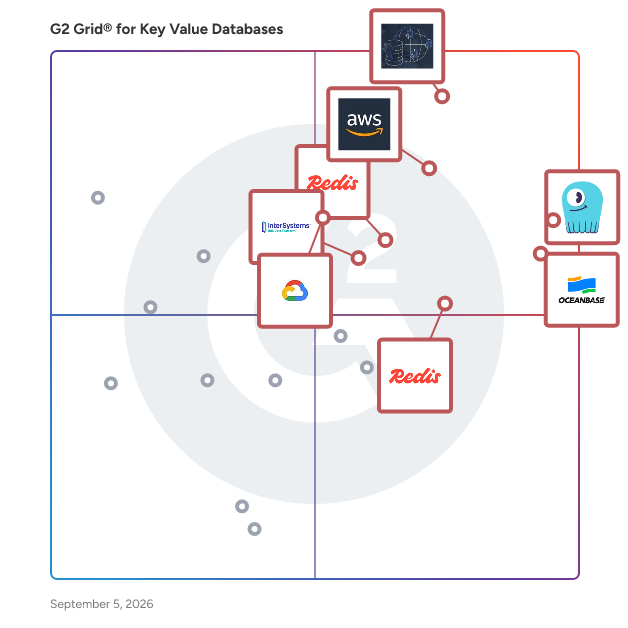
G2 Grid® for Key Value Databases

G2 Grid® for Key Value Databases plotting products by satisfaction and market presence

Highlighted products: Amazon DynamoDB, ScyllaDB, OceanBase Database, Amazon ElastiCache, Redis Software, Redis Cloud, Google Cloud Memorystore, and InterSystems IRIS.

Underlying data: [Grid® JSON](https://www.g2.com/categories/key-value-databases/grids.json?focus%5B%5D=amazon-web-services-aws-amazon-dynamodb&focus%5B%5D=scylladb&focus%5B%5D=oceanbase-database&focus%5B%5D=amazon-elasticache&focus%5B%5D=redis-software&focus%5B%5D=redis-cloud&focus%5B%5D=google-cloud-memorystore&focus%5B%5D=intersystems-iris)

Amazon DynamoDB

Amazon DynamoDB is a pioneering NoSQL, fully managed, serverless database with limitless scalability and single-digit millisecond latency performance enabling customers to develop modern, microservice-based applications through a simple API. Customers enjoy the benefits of DynamoDB’s fully-managed service including broad compliance standards, security integration with AWS Identity and Access Management and numerous disaster recovery services. With DynamoDB Global Tables, customers have a 99.999% highly available, multi-Region, multi-active database supporting local reads and writes for globally distributed users. DynamoDB provides cost management features such as scale-to-zero, Time to Live (TTL) for aging data out, and multiple pricing models including a free tier.

Average Rating: 4.4/5.0

Total Reviews: 498

How Do G2 Users Rate Amazon DynamoDB?

  • Has the product been a good partner in doing business?: 8.9/10 (Category avg: 8.7/10)
  • Auto Recovery: 8.9/10 (Category avg: 8.6/10)
  • Data Model: 8.4/10 (Category avg: 8.8/10)
  • Integrated Cache: 8.5/10 (Category avg: 8.6/10)

Who Is the Company Behind Amazon DynamoDB?

  • Seller: Amazon Web Services (AWS)
  • Year Founded: 2006
  • HQ Location: Seattle, WA
  • Twitter: @awscloud
    2,232,483 Twitter followers
  • LinkedIn® Page: www.linkedin.com
    147,094 employees on LinkedIn®
  • Ownership: NASDAQ: AMZN

Who Uses This Product?

  • Who Uses This: Software Engineer, Senior Software Engineer
  • Top Industries: Computer Software, Information Technology and Services
  • Company Size: 35% Large, 34% Medium

What Do G2 Reviewers Say About Amazon DynamoDB?

AI-generated summary from verified user reviews

Pros
  • Users value the exceptional scalability of Amazon DynamoDB, enabling consistent performance during unpredictable workloads and high traffic.
  • Users appreciate the ease of use of Amazon DynamoDB, benefiting from its fully managed and scalable features.
  • Users appreciate the cost efficiency of Amazon DynamoDB, saving time and reducing operational efforts significantly.
  • Users value the low-latency performance of Amazon DynamoDB, ensuring rapid responses for high-traffic applications.
  • Users value the fully managed services of Amazon DynamoDB, significantly reducing operational burdens and enhancing efficiency.
Cons
  • Users express concerns about the expensive costs associated with DynamoDB's pay-per-request model and configuration complexities.
  • Users face challenges with query complexity, as inefficient designs can lead to high costs and throttling issues.
  • Users find Amazon DynamoDB complex for newcomers, requiring extensive learning and proper data modeling to avoid issues.
  • Users find the learning curve steep, making data modeling and queries challenging for newcomers to DynamoDB.
  • Users face cost management challenges with DynamoDB, needing careful optimization to prevent unexpected expenses.

What Are Recent G2 Reviews of Amazon DynamoDB?

What Are G2 Users Discussing About Amazon DynamoDB?

ScyllaDB

ScyllaDB is a specialty database for workloads that require predictable performance at scale. It’s adopted by organizations that require ultra-low latency, even at millions of features or operations per second, billions of embeddings, or petabytes of storage. ScyllaDB’s shard-per-core architecture taps the full power of modern infrastructure, translating to fewer nodes, less admin, and lower costs. Over 400 companies such as Disney+, Discord, Tripadvisor, Expedia, Zillow, Starbucks, and Comcast use ScyllaDB for their toughest database challenges.

Average Rating: 4.5/5.0

Total Reviews: 426

How Do G2 Users Rate ScyllaDB?

  • Has the product been a good partner in doing business?: 8.6/10 (Category avg: 8.7/10)
  • Auto Recovery: 8.6/10 (Category avg: 8.6/10)
  • Data Model: 8.8/10 (Category avg: 8.8/10)
  • Integrated Cache: 8.8/10 (Category avg: 8.6/10)

Who Is the Company Behind ScyllaDB?

  • Seller: ScyllaDB
  • Company Website:
  • Year Founded: 2013
  • HQ Location: Palo Alto, US
  • Twitter: @ScyllaDB
    29,592 Twitter followers
  • LinkedIn® Page: www.linkedin.com
    214 employees on LinkedIn®

Who Uses This Product?

  • Who Uses This: Software Engineer, Senior Software Engineer
  • Top Industries: Computer Software, Information Technology and Services
  • Company Size: 41% Small, 29% Medium

What Do G2 Reviewers Say About ScyllaDB?

AI-generated summary from verified user reviews

Pros
  • Users appreciate the impressive performance of ScyllaDB, delivering fast results and stability under heavy workloads.
  • Users appreciate the speed and responsiveness of ScyllaDB, making complex queries and analyses simple and efficient.
  • Users appreciate the scalability of ScyllaDB, effortlessly handling millions of requests and high data loads.
  • Users value the low latency of ScyllaDB, ensuring quick results and stable performance under heavy workloads.
  • Users appreciate the ease of use of ScyllaDB, making setup and scaling remarkably straightforward for development.
Cons
  • Users find the learning curve steep, especially for beginners transitioning from other databases, impacting initial usability.
  • Users note the limited features in ScyllaDB compared to MongoDB, which affects usability and functionality.
  • Users find the difficult learning curve for new users frustrating, especially without sufficient beginner resources available.
  • Users find the difficult setup of ScyllaDB challenging, particularly for those unfamiliar with its architecture.
  • Users face a steep learning curve with ScyllaDB, making it challenging for beginners to operate effectively.

What Are Recent G2 Reviews of ScyllaDB?

OceanBase Database

OceanBase Database is a native, enterprise-level distributed database developed independently by the OceanBase team. It provides financial-grade high availability on commodity hardware and introduces a new city-level disaster recovery standard known as "Five IDCs across Three Regions". As the world's first distributed database to pass the TPC-C benchmark test, it can support over 1,500 nodes in a single cluster. Additionally, it features cloud-native architecture, strong consistency, and high compatibility with other popular databases such as Oracle and MySQL.

Average Rating: 5.0/5.0

Total Reviews: 45

How Do G2 Users Rate OceanBase Database?

  • Has the product been a good partner in doing business?: 10.0/10 (Category avg: 8.7/10)
  • Auto Recovery: 10.0/10 (Category avg: 8.6/10)
  • Data Model: 10.0/10 (Category avg: 8.8/10)
  • Integrated Cache: 10.0/10 (Category avg: 8.6/10)

Who Is the Company Behind OceanBase Database?

Who Uses This Product?

  • Who Uses This: DBA, dba
  • Top Industries: Consulting
  • Company Size: 60% Medium, 29% Large

What Are Recent G2 Reviews of OceanBase Database?

Amazon ElastiCache

Amazon ElastiCache is a fully managed service that makes it easy to deploy, operate, and scale an in-memory data store and cache in the cloud. Often working in conjunction with other AWS database and storage services, ElastiCache ensures modern applications meet real-time requirements for high data throughput and sub-milli second response times, while serving millions of simultaneous requests. Amazon ElastiCache supports two open-source in-memory engines: o Redis - a fast, open source, in-memory data store and cache. Amazon ElastiCache for Redis is a Redis-compatible in-memory service that delivers the ease-of-use and power of Redis along with the availability, reliability and performance suitable for the most demanding applications. ElastiCache for Redis is fully managed, scalable, and secure - making it an ideal candidate to power high-performance use cases such as Web, Mobile Apps, Gaming, Ad-Tech, and IoT. o Memcached - a widely adopted memory object caching system. Amazon ElastiCache for Memcached is protocol compliant with Memcached, so popular tools that you use today with existing Memcached environments will work seamlessly with the service. ElastiCache for Memcached is suitable for caching use cases where performance and concurrency is important.

Average Rating: 4.5/5.0

Total Reviews: 84

How Do G2 Users Rate Amazon ElastiCache?

  • Has the product been a good partner in doing business?: 8.7/10 (Category avg: 8.7/10)
  • Auto Recovery: 8.3/10 (Category avg: 8.6/10)
  • Data Model: 8.8/10 (Category avg: 8.8/10)
  • Integrated Cache: 9.3/10 (Category avg: 8.6/10)

Who Is the Company Behind Amazon ElastiCache?

  • Seller: Amazon Web Services (AWS)
  • Year Founded: 2006
  • HQ Location: Seattle, WA
  • Twitter: @awscloud
    2,232,483 Twitter followers
  • LinkedIn® Page: www.linkedin.com
    147,094 employees on LinkedIn®
  • Ownership: NASDAQ: AMZN

Who Uses This Product?

  • Who Uses This: Software Engineer, DevOps Engineer
  • Top Industries: Computer Software, Information Technology and Services
  • Company Size: 35% Small, 33% Large

What Do G2 Reviewers Say About Amazon ElastiCache?

AI-generated summary from verified user reviews

Pros
  • Users highlight the cost efficiency of alternatives compared to AWS, emphasizing better performance at a lower price.
  • Users highlight the lack of responsive customer support, feeling neglected and frustrated by unresolved issues and high costs.
  • Users value the extremely low-latency performance of Amazon ElastiCache, enhancing application response times and handling traffic spikes efficiently.
  • Users love the extremely low-latency performance of Amazon ElastiCache, enhancing application response times significantly.
  • Users appreciate the extremely low-latency performance of Amazon ElastiCache, enhancing application response times significantly.
Cons
  • Users find AWS ElastiCache's cost issues significant, preferring alternatives like GCP for better value and support.
  • Users struggle with downtime issues when scaling large Redis clusters, needing careful planning and rebalancing.
  • Users find AWS ElastiCache overpriced and lacking support, prompting many to switch to more cost-effective alternatives.
  • Users express frustration with poor customer support, leading them to switch to alternatives like GCP for better service.
  • Users find that scaling large Redis clusters can be problematic, needing downtime and careful rebalancing for stateful workloads.

What Are Recent G2 Reviews of Amazon ElastiCache?

What Are G2 Users Discussing About Amazon ElastiCache?

Redis Software

Redis Software is our advanced solution delivering unmatched speed and reliability for on-prem and private cloud environments. It gives you full control over your deployment, ensuring high performance and scalability to meet your specific needs. Redis Software builds on the speed and reliability of Redis Community Edition with advanced features like active-active geo-distribution, advanced query and search capabilities, automated data synchronization, and superior security features. These enhancements provide enterprise-grade performance, reliability, and security, making Redis Software the ideal choice for production-grade applications.

Average Rating: 4.5/5.0

Total Reviews: 132

How Do G2 Users Rate Redis Software?

  • Has the product been a good partner in doing business?: 8.5/10 (Category avg: 8.7/10)
  • Auto Recovery: 8.0/10 (Category avg: 8.6/10)
  • Data Model: 8.7/10 (Category avg: 8.8/10)
  • Integrated Cache: 8.9/10 (Category avg: 8.6/10)

Who Is the Company Behind Redis Software?

  • Seller: Redis
  • Year Founded: 2011
  • HQ Location: San Francisco, CA
  • Twitter: @Redisinc
    44,002 Twitter followers
  • LinkedIn® Page: www.linkedin.com
    1,542 employees on LinkedIn®

Who Uses This Product?

  • Who Uses This: Software Engineer, Senior Software Engineer
  • Top Industries: Computer Software, Information Technology and Services
  • Company Size: 54% Small, 26% Medium

What Do G2 Reviewers Say About Redis Software?

AI-generated summary from verified user reviews

Pros
  • Users love Redis Software as a main cache provider, highlighting its ease of implementation in various projects.
  • Users appreciate the cost efficiency of Redis Software, benefiting from reduced RAM usage and smooth setup processes.
  • Users appreciate the customizability of Redis Software, allowing seamless integration and efficient management of resources and traffic.
  • Users appreciate the efficient data storage capabilities of Redis Software, enabling seamless handling of high traffic and large datasets.
  • Users find the ease of setup with Redis Software ideal for Python, Data, and Large Language Model projects.
Cons
  • Users express concerns over data size limitations in Redis, affecting backup capabilities and large-scale application performance.
  • Users find the expensive licensing fees of Redis Software challenging for SMBs compared to open-source alternatives.
  • Users find limited chart features hinder effective data visualization and analysis within Redis Software.
  • Users find the poor UI of Redis Software struggles with scalability, impacting deployment efficiency and requiring additional tools.
  • Users report slow performance during embedding with large data sets, impacting the efficiency of semantic search.

What Are Recent G2 Reviews of Redis Software?

What Are G2 Users Discussing About Redis Software?

Redis Cloud

Redis Cloud is our fully-managed Redis Enterprise service, delivering unmatched speed, simplicity, and scalability. It's perfect for cloud-native applications requiring real-time data processing, without the hassle of managing infrastructure. Redis Cloud surpasses Redis-compatible cloud services built on open source such as Amazon ElastiCache and Google Cloud Memorystore by offering enterprise-grade features like active-active geo-distribution, advanced query and search capabilities, seamless data synchronization, and multi-cloud support.

Average Rating: 4.6/5.0

Total Reviews: 42

How Do G2 Users Rate Redis Cloud?

  • Has the product been a good partner in doing business?: 9.2/10 (Category avg: 8.7/10)
  • Auto Recovery: 8.3/10 (Category avg: 8.6/10)
  • Data Model: 8.9/10 (Category avg: 8.8/10)
  • Integrated Cache: 10.0/10 (Category avg: 8.6/10)

Who Is the Company Behind Redis Cloud?

  • Seller: Redis
  • Year Founded: 2011
  • HQ Location: San Francisco, CA
  • Twitter: @Redisinc
    44,002 Twitter followers
  • LinkedIn® Page: www.linkedin.com
    1,542 employees on LinkedIn®

Who Uses This Product?

  • Top Industries: Information Technology and Services, Computer Software
  • Company Size: 50% Small, 41% Medium

What Are Recent G2 Reviews of Redis Cloud?

What Are G2 Users Discussing About Redis Cloud?

Google Cloud Memorystore

Cloud Memorystore for Redis provides a fully managed in-memory data store service built on scalable, secure, and highly available infrastructure managed by Google. Use Cloud Memorystore to build application caches that provides sub-millisecond data access. Cloud Memorystore is compatible with the Redis protocol, allowing easy migration with zero code changes.

Average Rating: 4.3/5.0

Total Reviews: 45

How Do G2 Users Rate Google Cloud Memorystore?

  • Has the product been a good partner in doing business?: 8.8/10 (Category avg: 8.7/10)
  • Auto Recovery: 8.3/10 (Category avg: 8.6/10)
  • Data Model: 8.0/10 (Category avg: 8.8/10)
  • Integrated Cache: 8.7/10 (Category avg: 8.6/10)

Who Is the Company Behind Google Cloud Memorystore?

  • Seller: Google
  • Year Founded: 1998
  • HQ Location: Mountain View, CA
  • Twitter: @google
    31,899,995 Twitter followers
  • LinkedIn® Page: www.linkedin.com
    301,144 employees on LinkedIn®
  • Ownership: NASDAQ:GOOG

Who Uses This Product?

  • Top Industries: Computer Software, Information Technology and Services
  • Company Size: 38% Small, 35% Medium

What Are Recent G2 Reviews of Google Cloud Memorystore?

InterSystems IRIS

InterSystems IRIS is a complete cloud-first data platform that includes a multi-model transactional data management engine, an application development platform, and interoperability engine, and an open analytics platform. It is the next generation of our proven data management software.It includes the capabilities of InterSystems Cache and Ensemble, plus a wealth of exciting new capabilities to make it easy to build and deploy cloud based, analytics-intensive enterprise applications with even greater performance and scalability. InterSystems IRIS provides a set of APIs to operate with transactional persistent data simultaneously: key-value, relational, object, document, multidimensional. Data can be managed by SQL, Java, node.js, .NET, C++, Python, and native server-side ObjectScript language. InterSystems IRIS includes an Interoperability engine and modules to build AI solutions. InterSystems IRIS provides features for horizontal scalability (sharding, ECP) and provides High Availability features, Business intelligence, transaction support, and backup.

Average Rating: 4.6/5.0

Total Reviews: 60

How Do G2 Users Rate InterSystems IRIS?

  • Has the product been a good partner in doing business?: 8.8/10 (Category avg: 8.7/10)
  • Auto Recovery: 9.2/10 (Category avg: 8.6/10)
  • Data Model: 9.4/10 (Category avg: 8.8/10)
  • Integrated Cache: 9.4/10 (Category avg: 8.6/10)

Who Is the Company Behind InterSystems IRIS?

  • Seller: InterSystems
  • Year Founded: 1978
  • HQ Location: Cambridge, MA
  • Twitter: @InterSystems
    61,310 Twitter followers
  • LinkedIn® Page: www.linkedin.com
    2,151 employees on LinkedIn®

Who Uses This Product?

  • Top Industries: Computer Software, Hospital & Health Care
  • Company Size: 47% Small, 31% Medium

What Do G2 Reviewers Say About InterSystems IRIS?

AI-generated summary from verified user reviews

Pros
  • Users value the powerful features and flexibility of InterSystems IRIS, enhancing overall performance and user experience.
  • Users find InterSystems IRIS to be very easy to use, with a clean interface and helpful documentation.
  • Users commend the excellent performance and resource efficiency of InterSystems IRIS, enhancing reliability and speed in data handling.
  • Users praise the excellent customer support from InterSystems IRIS, appreciating timely responses and helpful assistance.
  • Users value the easy integrations of InterSystems IRIS, enabling seamless connectivity with various systems and flexibility.
Cons
  • Users find the difficult learning curve of InterSystems IRIS challenging, particularly for those new to the platform.
  • Users note that IRIS is not cheap, with licensing costs and hardware requirements posing challenges for smaller projects.
  • Users find the insufficient documentation for advanced scenarios complicates learning and effective use of InterSystems IRIS.
  • Users find the learning curve steep, particularly with advanced features and complex configurations, which can hinder initial experiences.
  • Users find the poor documentation for advanced scenarios challenging, making it hard to navigate complex features.

What Are Recent G2 Reviews of InterSystems IRIS?

What Are G2 Users Discussing About InterSystems IRIS?

BoltDB

BoltDB is an embedded key/value database for Go.

Average Rating: 4.4/5.0

Total Reviews: 18

How Do G2 Users Rate BoltDB?

  • Has the product been a good partner in doing business?: 10.0/10 (Category avg: 8.7/10)

Who Is the Company Behind BoltDB?

  • Seller: BoltDB
  • HQ Location: N/A
  • Twitter: @boltdb
    318 Twitter followers
  • LinkedIn® Page: www.linkedin.com
    1 employees on LinkedIn®

Who Uses This Product?

  • Top Industries: Information Technology and Services
  • Company Size: 72% Small, 17% Large

What Are Recent G2 Reviews of BoltDB?

Azure Cosmos DB

Azure Cosmos DB is a fully managed, globally distributed NoSQL and vector database service designed to support mission-critical applications with ultra-low latency and elastic scalability. It enables developers to build AI-powered applications and agents by providing seamless integration with AI services, allowing for efficient storage and querying of both NoSQL data and vectors. With its schema-agnostic JSON document model, Azure Cosmos DB simplifies the development process by automatically indexing all data, eliminating the need for manual schema or index management. The service offers comprehensive Service Level Agreements (SLAs), ensuring less than 10-millisecond read and write latencies and 99.999% availability, making it a reliable choice for applications requiring high performance and global reach. Key Features and Functionality: - Global Distribution: Azure Cosmos DB allows for turnkey global distribution, enabling data to be replicated across multiple regions worldwide, providing high availability and low latency access to data. - Elastic Scalability: The service offers elastic scaling of throughput and storage, allowing developers to scale resources up or down based on demand without downtime. - Multi-Model Support: It natively supports multiple data models, including document, key-value, graph, and column-family, catering to diverse application needs. - AI Integration: Built-in vector search capabilities simplify the development of AI applications by efficiently storing and querying vectors alongside NoSQL data. - Automatic Indexing: All data is automatically indexed, facilitating fast and efficient queries without the need for manual index management. - Comprehensive SLAs: Azure Cosmos DB provides industry-leading SLAs covering throughput, latency, availability, and consistency, ensuring predictable performance. Primary Value and Solutions Provided: Azure Cosmos DB addresses the challenges of building and managing globally distributed applications by offering a fully managed database service that ensures high availability, low latency, and elastic scalability. Its integration with AI services and support for multiple data models empower developers to create intelligent, responsive applications without the complexity of managing infrastructure. By automatically handling data distribution, scaling, and indexing, Azure Cosmos DB allows organizations to focus on innovation and delivering value to their users, making it an ideal solution for applications requiring real-time data access and global reach.

Average Rating: 4.2/5.0

Total Reviews: 59

How Do G2 Users Rate Azure Cosmos DB?

  • Has the product been a good partner in doing business?: 8.3/10 (Category avg: 8.7/10)
  • Auto Recovery: 7.5/10 (Category avg: 8.6/10)
  • Data Model: 6.7/10 (Category avg: 8.8/10)
  • Integrated Cache: 6.7/10 (Category avg: 8.6/10)

Who Is the Company Behind Azure Cosmos DB?

  • Seller: Microsoft
  • Year Founded: 1975
  • HQ Location: Redmond, Washington
  • Twitter: @microsoft
    13,091,739 Twitter followers
  • LinkedIn® Page: www.linkedin.com
    232,750 employees on LinkedIn®
  • Ownership: MSFT

Who Uses This Product?

  • Top Industries: Information Technology and Services, Computer Software
  • Company Size: 44% Large, 28% Medium

What Do G2 Reviewers Say About Azure Cosmos DB?

AI-generated summary from verified user reviews

Pros
  • Users appreciate the ease of use of Azure Cosmos DB, finding it simple to configure and effective for teams.
  • Users value the seamless scalability of Azure Cosmos DB, allowing instant resource management without hassle.
  • Users praise the fast performance and vast features of Azure Cosmos DB, enhancing flexibility and integration options.
  • Users find Azure Cosmos DB offers seamless integrations, making it easy to connect with various Microsoft services and APIs.
  • Users value the robust security features of Azure Cosmos DB, ensuring data security and privacy globally.
Cons
  • Users find Azure Cosmos DB to be expensive, often leading to high costs if not managed properly.
  • Users are concerned about the high costs of Azure Cosmos DB, especially with unoptimized storage and partitioning.
  • Users find the complexity issues of Azure Cosmos DB challenging, especially with confusing cost structures and limitations.
  • Users find the complex usage of Azure Cosmos DB challenging, especially for those without advanced database skills.
  • Users find that Azure Cosmos DB can become expensive if storage is not optimized and partitioned effectively.

What Are Recent G2 Reviews of Azure Cosmos DB?

What Are G2 Users Discussing About Azure Cosmos DB?

Azure Redis Cache

Azure Redis Cache is a secure data cache and messaging broker that provides high throughput and low-latency access to data for applications.

Average Rating: 3.7/5.0

Total Reviews: 19

How Do G2 Users Rate Azure Redis Cache?

  • Has the product been a good partner in doing business?: 7.4/10 (Category avg: 8.7/10)

Who Is the Company Behind Azure Redis Cache?

  • Seller: Microsoft
  • Year Founded: 1975
  • HQ Location: Redmond, Washington
  • Twitter: @microsoft
    13,091,739 Twitter followers
  • LinkedIn® Page: www.linkedin.com
    232,750 employees on LinkedIn®
  • Ownership: MSFT

Who Uses This Product?

  • Top Industries: Computer Software
  • Company Size: 36% Large, 36% Medium

What Are Recent G2 Reviews of Azure Redis Cache?

What Are G2 Users Discussing About Azure Redis Cache?

Couchbase

Couchbase’s operational data platform for AI is a scalable foundation for enterprise operational, analytical, mobile and AI workloads that replaces legacy infrastructure and data services.

Average Rating: 4.3/5.0

Total Reviews: 142

How Do G2 Users Rate Couchbase?

  • Has the product been a good partner in doing business?: 8.3/10 (Category avg: 8.7/10)
  • Auto Recovery: 8.0/10 (Category avg: 8.6/10)
  • Data Model: 8.4/10 (Category avg: 8.8/10)
  • Integrated Cache: 8.0/10 (Category avg: 8.6/10)

Who Is the Company Behind Couchbase?

  • Seller: Couchbase
  • Company Website:
  • Year Founded: 2009
  • HQ Location: San Jose, CA
  • Twitter: @couchbase
    136,110 Twitter followers
  • LinkedIn® Page: www.linkedin.com
    849 employees on LinkedIn®

Who Uses This Product?

  • Who Uses This: Senior Software Engineer, Software Engineer
  • Top Industries: Computer Software, Information Technology and Services
  • Company Size: 39% Small, 34% Large

What Do G2 Reviewers Say About Couchbase?

AI-generated summary from verified user reviews

Pros
  • Users find Couchbase easy to use, appreciating its simple implementation and fast real-time data access.
  • Users appreciate the scalability of Couchbase, enabling efficient data management and exceptional performance across applications.
  • Users love the incredible speed of Couchbase, significantly enhancing performance for large datasets and transactions.
  • Users value the flexibility of Couchbase, enabling diverse data storage and seamless integration for various applications.
  • Users value the MongoDB compatibility of Couchbase, appreciating its ease of use and smooth integration.
Cons
  • Users find the complex configuration of Couchbase challenging, especially without dedicated database administrators or expertise.
  • Users find the difficult learning curve of Couchbase challenging, which can complicate setup and usage for novices.
  • Users find the complexity of setup and management in Couchbase to be a significant challenge and hurdle.
  • Users find the limited community growth of Couchbase hampers support and implementation efforts for new users.
  • Users feel the UI is complicated, highlighting a need for improvements to enhance the overall user experience.

What Are Recent G2 Reviews of Couchbase?

What Are G2 Users Discussing About Couchbase?

Coherence

Oracle Coherence is a in-memory data grid solution that enables organizations to predictably scale mission-critical applications by providing fast access to frequently used data.

Average Rating: 4.1/5.0

Total Reviews: 12

How Do G2 Users Rate Coherence?

  • Has the product been a good partner in doing business?: 8.7/10 (Category avg: 8.7/10)

Who Is the Company Behind Coherence?

  • Seller: Oracle
  • Year Founded: 1977
  • HQ Location: Austin, TX
  • Twitter: @Oracle
    827,997 Twitter followers
  • LinkedIn® Page: www.linkedin.com
    207,576 employees on LinkedIn®
  • Ownership: NYSE:ORCL

Who Uses This Product?

  • Company Size: 67% Large, 17% Medium

What Are Recent G2 Reviews of Coherence?

What Are G2 Users Discussing About Coherence?

Aerospike

Aerospike is the real-time state, context, and decisioning platform for operational AI, helping enterprises ground intelligence in the current reality of their business and turn it into action at scale. More than 2 billion people worldwide interact with applications built on Aerospike. Organizations across AI, financial services, telecom, and adtech, including AMD, Mistral AI, and PayPal, rely on Aerospike to ground their most demanding real-time systems in current enterprise reality. To learn more, visit aerospike.com.

Average Rating: 4.4/5.0

Total Reviews: 80

How Do G2 Users Rate Aerospike?

  • Has the product been a good partner in doing business?: 9.2/10 (Category avg: 8.7/10)
  • Auto Recovery: 9.0/10 (Category avg: 8.6/10)
  • Data Model: 9.1/10 (Category avg: 8.8/10)
  • Integrated Cache: 9.0/10 (Category avg: 8.6/10)

Who Is the Company Behind Aerospike?

  • Seller: Aerospike
  • Year Founded: 2009
  • HQ Location: Mountain View, CA
  • Twitter: @aerospikedb
    7,825 Twitter followers
  • LinkedIn® Page: www.linkedin.com
    307 employees on LinkedIn®

Who Uses This Product?

  • Who Uses This: Software Engineer
  • Top Industries: Marketing and Advertising, Information Technology and Services
  • Company Size: 45% Medium, 34% Large

What Are Recent G2 Reviews of Aerospike?

What Are G2 Users Discussing About Aerospike?

Arango

Arango provides a trusted data foundation for Contextual AI — transforming enterprise data into a System of Context that truly represents the business, so LLMs can deliver better outcomes with unlimited scale and cost efficiency. The Arango AI Data Platform gives developers a single, integrated environment to build and scale AI-powered applications without the complexity of stitching together multiple databases and tools. At its core is a massively scalable multi-model database that unifies graph, vector, document, and key-value data with full-text, geospatial, and vector search — creating the System of Context, the bridge between enterprise data and LLMs. The Arango AI Suite includes automated data pipelines, multimodal data ingestion, AIOps and MLOps, LLM integrations, Graph Analytics, agentic frameworks for context-aware Hybrid/GraphRAG, GraphML, natural-language support, and GPU acceleration — enabling repeatable ROI and faster innovation. Trusted by NVIDIA, HPE, the London Stock Exchange, the U.S. Air Force, NIH, Siemens, Synopsys and Articul8, Arango powers enterprise AI with context, confidence, and scale. We are a proud member of the NVIDIA Inception Program and the AWS ISV Accelerate Program. Learn more at arango.ai, LinkedIn, YouTube, and G2.

Average Rating: 4.6/5.0

Total Reviews: 115

How Do G2 Users Rate Arango?

  • Has the product been a good partner in doing business?: 9.0/10 (Category avg: 8.7/10)
  • Auto Recovery: 9.0/10 (Category avg: 8.6/10)
  • Data Model: 9.1/10 (Category avg: 8.8/10)
  • Integrated Cache: 8.0/10 (Category avg: 8.6/10)

Who Is the Company Behind Arango?

  • Seller: Arango
  • Year Founded: 2015
  • HQ Location: San Francisco, CA
  • LinkedIn® Page: www.linkedin.com
    128 employees on LinkedIn®

Who Uses This Product?

  • Who Uses This: Senior Software Engineer
  • Top Industries: Information Technology and Services, Computer Software
  • Company Size: 57% Small, 23% Medium

What Do G2 Reviewers Say About Arango?

AI-generated summary from verified user reviews

Pros
  • Users find Arango remarkably easy to use, appreciating its intuitive interface and quick learning curve for AQL.
  • Users value Arango's seamless data handling, combining graph, document, and key-value seamlessly with excellent documentation.
  • Users appreciate the straightforward query language of Arango, making complex queries accessible and easy to learn.
  • Users praise ArangoDB for its intuitive query language, making it easy for new developers to learn and use effectively.
  • Users value the customization potential of Arango DB, appreciating its flexible query language and versatile design.
Cons
  • Users find the poor usability of ArangoDB challenging, citing complexity in operations and setup as major issues.
  • Users find the difficult learning process challenging, particularly with complex queries and limited community support.
  • Users find the improvement needed for the graphical interface and setup process, wishing for a more intuitive experience.
  • Users find the learning curve steep, especially for complex queries and building new databases with limited support.
  • Users find the steep learning curve challenging, particularly for building complex queries and databases.

What Are Recent G2 Reviews of Arango?

What Are G2 Users Discussing About Arango?

Shalaka Joshi
SJ
Researched and written by Shalaka Joshi
Updated October 3, 2024

Learn More About Key Value Databases

What are Key Value Databases?

Key value databases are arguably the simplest of NoSQL databases. Unlike relational databases, which rely on primary and foreign keys to be able to find and connect data, key value databases utilize a single main identifier—the key—and associate that with a data point, array of data, or blob—a value. Key value databases can only be queried by the key itself. Key names can be uniform resource identifiers or URI, hashes, filenames, or anything else that is entirely unique from other keys. In the same way, values can be just about any data.

Key Benefits of Key Value Databases

  • Simple and lightweight
  • Built for speed
  • Data type-agnostic

Why Use Key Value Databases?

Key value databases are designed for speed. Because they require minimal input for querying compared to other databases, and because they store so simply, key value databases can return query results near instantly.

Key value databases are optimal for situations with constant read/write operations or situations requiring low latency and lower operational demand than a relational database. Some example use cases follow.

E-commerce shopping carts — Key value databases work fantastically for temporary, lightweight listings, which makes them perfect for storing customer shopping carts while they order products online.

Online session information — Need to be able to keep a log of user session data over the course of being logged onto a device, utilizing your website, etc.? Key value databases make it simple to track and store activity information, including which pages were accessed, on-page actions a user took, and more. This information can fuel customer product recommendations, inform trends, and create more data-driven insights for businesses.

Cache — Key value databases are a great option for storing information that gets accessed often but rarely, if ever, gets modified. So, key value databases can serve as effective cache in these situations.

Who Uses Key Value Databases?

Like most other databases, database administrators and teams are the ones who will most often interact with key-value store solutions. That being said, developers and support teams will also use these solutions frequently – developers, for integrating databases with their code, and support teams, for root cause investigation, troubleshooting, etc. Key value databases in particular might not have as wide a usage range outside these groups because of, oddly enough, their simplicity. They’re not as applicable as some kinds of databases—like relational or graph—in more general business settings that lean into more tabular or relationship-oriented data grouping, or that might need often and significant editing.

Key Value Databases Features

In-memory residence — Most value databases are built in such a way that they can be run in-memory as opposed to off a storage drive. This improves transaction speeds and also is a testament to the lightweight nature of these databases.

Speed — Whether a user is writing to the database or querying from it, key-value databases offer greater speed and responsiveness compared to other kinds of databases.

Scalability — No matter how much data may need to go into the database, value databases will be able to keep up.

Integration — Key value databases should be able to integrate easily with other systems and tools. Should there be specific integrations you’d need your key-value store to have, check with both the key-value store vendor and community, as well as those of any solutions with which you might be integrating.

Other Features of Key Value Databases: Audit logs, Authentication, Integrated cache, Multi-model, Role-based authorization

Potential Issues with Key Value Databases

Value returns — Most value databases, when queried, return the entire value associated with a key. While generally this is beneficial, if you’ve stored multiple pieces of information within a single value, querying for its key may return more information than you wanted. If planning to use a key-value database to store multiple items of information within a value, be sure that the database you choose has the ability to sift information out of an array value, or you have an alternate way to compensate for an array of information being returned.

Value updates — Key value databases, by nature of their design, require that the entire value be updated when a value is modified. If you anticipate your values consistently having multiple pieces of information within them, consider a key-value database that will let you have more fine-tuned control over modification, or perhaps consider a different type of database altogether. If you anticipate constant modifications and numerous pieces of information being associated to a single identifying data point (key), perhaps consider a relational, graph, or document database instead.