sampl.space
Who Is the Company Behind sampl.space?
- Seller: sampl.space
- HQ Location: N/A
-
LinkedIn® Page: www.linkedin.com
1 employees on LinkedIn®
Last updated: April 9, 2026
Total Products under this Category: 124
Last updated: November 17, 2026
Why You Can Trust G2's Software Rankings:
G2's software rankings are built on verified user reviews, rigorous moderation, and a consistent research methodology maintained by a team of analysts and data experts. Each product is measured using the same transparent criteria, with no paid placement or vendor influence. While reviews reflect real user experiences, which can be subjective, they offer valuable insight into how software performs in the hands of professionals. Together, these inputs power the G2 Score, a standardized way to compare tools within every category.
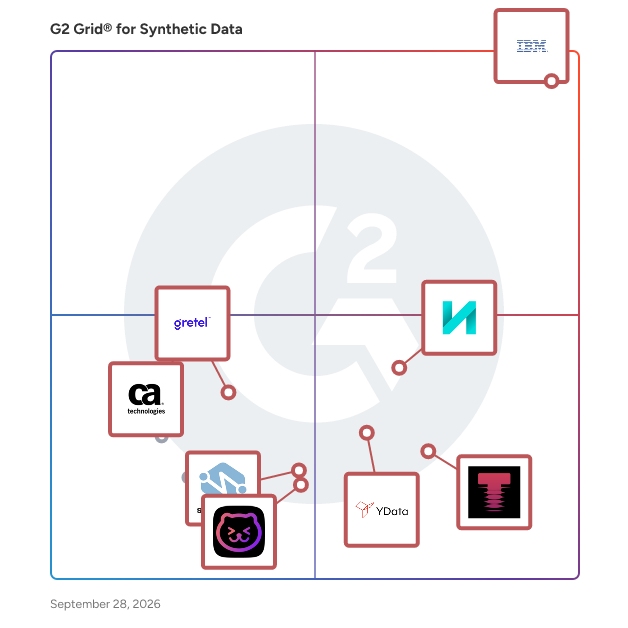
Highlighted products: IBM watsonx.ai, Tonic.ai, Tumult Analytics, YData, CA Test Data Manager, Gretel.ai, Syntheticus.ai | Synthetic Data Generator, and KopiKat.
Underlying data: [Grid® JSON](https://www.g2.com/categories/synthetic-data/grids.json?focus%5B%5D=ibm-watsonx-ai&focus%5B%5D=tonic-ai&focus%5B%5D=tumult-analytics&focus%5B%5D=ydata&focus%5B%5D=ca-test-data-manager&focus%5B%5D=gretel-ai&focus%5B%5D=syntheticus-ai-synthetic-data-generator&focus%5B%5D=kopikat)
SAS Data Maker is a secure, enterprise-grade synthetic data generator designed to create statistically representative data without exposing sensitive or regulation-protected information. It enables organizations to generate synthetic data that mirrors real-world data's statistical, relational, and temporal characteristics, facilitating robust AI model development and data analysis while ensuring privacy and compliance. Key Features and Functionality: - Enterprise-Grade Trust and Capabilities: Leveraging decades of expertise in regulated industries such as banking, healthcare, and government, SAS Data Maker provides multitable source data, time series data, and differential privacy to meet enterprise-level synthetic data requirements. - No-Code Interface: The user-friendly graphical user interface (GUI) democratizes synthetic data generation, allowing business users to create and manage data without extensive technical knowledge. - Built-In Data Quality and Evaluation Tools: The solution includes tools to support various generation methods and evaluate the quality of synthetic data using visual metrics, ensuring statistical fidelity to real-world datasets. - Privacy-Enhancing Technologies (PETs): Users can seamlessly integrate synthetic data into existing workflows without significant changes, enabling the safe use of data without compromising privacy. Primary Value and User Solutions: SAS Data Maker addresses challenges related to data scarcity, privacy concerns, and regulatory compliance by providing a reliable method to generate synthetic data. This capability allows organizations to: - Accelerate AI Development: By filling gaps in training data, organizations can develop and deploy AI models more rapidly and effectively. - Enhance Data Privacy: Synthetic data generation mitigates risks associated with handling sensitive information, ensuring compliance with privacy regulations. - Reduce Costs: Organizations can minimize expenses related to data acquisition and processing by generating synthetic data instead of collecting real-world data or purchasing third-party datasets. By integrating SAS Data Maker into their data ecosystems, organizations can innovate responsibly, leveraging synthetic data to drive insights and decision-making without compromising data privacy or security.
Secludy is an enterprise platform that generates privacy-guaranteed synthetic datasets for training AI models, including large language models (LLMs) and traditional machine learning (ML) systems. By creating synthetic data that mirrors real datasets, Secludy enables organizations to train, test, and evaluate AI models without exposing sensitive personal information, ensuring compliance with data protection regulations. This approach is particularly beneficial for industries like healthcare and finance, where data privacy is paramount. Key Features and Functionality: - Anonymized Synthetic Data Generation: Secludy produces privacy-guaranteed synthetic data across various formats, including structured data, unstructured text, and imaging data. This allows for safe AI model training and testing without the risk of personal data exposure. - Secure AI Gateway: The platform includes a secure AI gateway that prevents personally identifiable information (PII) leakage during inference by redacting prompts and reinserting sensitive data post-response. - Automated Documentation: Secludy offers automatic documentation tailored to regulated industries, providing evidence of leakage testing and verifiable anonymization to support compliance efforts. - Differential Privacy Implementation: Leveraging differential privacy techniques, Secludy ensures that synthetic data maintains rigorous privacy guarantees, making it suitable for use under regulations like GDPR, CCPA, and HIPAA. - One-Click Deployment: The platform is designed for easy integration, allowing for one-click deployment that seamlessly fits into existing workflows, enabling rapid generation of privacy-preserving synthetic data. - Self-Hosting Capability: Organizations can deploy Secludy within their own virtual private cloud (VPC) or on-premises environments, ensuring full control over data and compliance with internal security policies. Primary Value and User Solutions: Secludy addresses the critical challenge of utilizing sensitive data in AI development by providing a solution that generates high-fidelity synthetic data with built-in privacy guarantees. This enables organizations to: - Safely Train AI Models: Develop and fine-tune AI models using synthetic data that accurately reflects real-world datasets without compromising individual privacy. - Ensure Regulatory Compliance: Meet stringent data protection regulations by replacing real PII-bearing records with anonymized synthetic replicas, facilitating compliant data usage and sharing. - Accelerate AI Deployment: Streamline the AI development process with quick integration and deployment, reducing the time and resources required to obtain usable, compliant datasets. - Monetize Sensitive Data: Safely license and share data by providing synthetic versions that retain the utility of the original data while eliminating privacy risks, opening new avenues for data monetization. By integrating Secludy, organizations can harness the full potential of their data assets in AI initiatives while maintaining strict adherence to privacy standards and regulatory requirements.
Connect G2 to Claude or ChatGPT for answers grounded in G2's trusted reviews, comparisons, and pricing from real user insights.
Seedfast fills a development, CI, or demo database with realistic, relational test data generated from the schema itself. One command connects to your database, reads the live schema, and writes a dataset the database accepts on the first insert. Foreign keys point at rows that exist, composite keys and multi-level dependencies resolve, check and unique constraints hold, enums stay inside the values they allow, and triggers are accounted for rather than tripped over. The realism comes from reading the schema first. Seedfast works out what the data is meant to represent from table names, column names, types and constraints before it generates any of it. A table called orders with status, total_amount and placed_at gets plausible order statuses, monetary amounts on a realistic distribution rather than uniform random, and timestamps spread across a sensible window. A table called patients with date_of_birth and diagnosis_code gets medical data instead. There is no per-domain configuration to pick, and no user1@test.com placeholder filler. Scope is plain text, written in whatever language you think in: "seed 500 Slovak customers, +421 phone numbers, emails on acme.sk, invoices numbered INV-2026-0001 upward". Generated values follow the same rule. Ask for Japanese customer names and that is what the column fills with; ask for German postal addresses and they come back shaped the way German addresses are shaped, not a US layout with the words swapped out. Phone country codes, email domains you control, internal SKU patterns, prefixed invoice counters, URLs pointing at a staging host: anything a column holds can be described in a sentence and generated to match. Say nothing about any of it and Seedfast still picks a coherent default out of the schema, then holds it steady for the whole run. Volume belongs to the same scope. Fifty rows for a local branch, a million for load testing, tens of millions when the tables need to weigh what production weighs, enough to reproduce the working set of a large, high-traffic product, where index choices start to matter and a query plan that held over ten thousand rows can flip at fifty million. Realism does not degrade as the row count climbs. Nothing is copied from production, so teams in fintech, healthcare and other regulated settings can work against data that behaves like the real thing without a masking pipeline or a security review to clear first. Seedfast does not copy, mask, or de-identify existing production rows; it generates new ones. When a migration changes the schema, the next run picks it up, so there is no seed file to keep in step. The same command runs locally, as a step in a CI pipeline (GitHub Actions, GitLab CI, CircleCI), or as an MCP server that AI coding agents such as Claude and Cursor invoke as a tool. Pricing is a flat monthly plan that includes a pool of credits denominated in dollars, and each run draws from that pool by how much data it generates. No table limits, no seed limits, no per-row charges. The free plan takes no card, never expires, and refills to $5 of credits every month; paid plans are $16 and $69 a month.
Segmed is a platform that provides access to a vast repository of medical imaging data, enabling healthcare organizations, researchers, and developers to build and train artificial intelligence models efficiently. By aggregating and anonymizing diverse datasets from various institutions, Segmed ensures data privacy and compliance with regulatory standards. This streamlined access to high-quality, labeled medical images accelerates the development of AI applications in healthcare, facilitating advancements in diagnostics, treatment planning, and medical research. Key Features and Functionality: - Extensive Medical Imaging Dataset: Offers a comprehensive collection of anonymized medical images from multiple sources, covering various modalities and conditions. - Data Anonymization and Compliance: Ensures all data is de-identified and adheres to HIPAA and other regulatory requirements, maintaining patient confidentiality. - Customizable Data Access: Allows users to filter and select datasets based on specific criteria, such as modality, pathology, or demographic information. - Seamless Integration: Provides APIs and tools for easy integration with existing workflows and machine learning pipelines. - Scalable Infrastructure: Supports large-scale data processing and model training, accommodating the needs of both small research teams and large organizations. Primary Value and User Solutions: Segmed addresses the critical challenge of accessing diverse and high-quality medical imaging data for AI development. By providing a centralized, compliant, and user-friendly platform, it eliminates the time-consuming and complex process of data acquisition and preparation. This empowers healthcare innovators to focus on developing and deploying AI solutions that enhance diagnostic accuracy, improve patient outcomes, and drive medical research forward.
Sepal AI is a data research company dedicated to advancing human knowledge and capabilities through the development of safe and trustworthy artificial intelligence. By partnering with leading AI laboratories and enterprises, Sepal AI focuses on creating high-quality, domain-specific datasets and evaluation frameworks that enhance model performance in real-world applications. Their platform integrates data generation tools, synthetic data augmentation, and a vast network of over 20,000 experts across various STEM fields and professional services, ensuring the production of reliable and precise datasets. Key Features and Functionality: - Curated Expert Network: Access to a diverse pool of verified professionals, including academic PhDs, medical practitioners, finance consultants, and business analysts, facilitating the creation of specialized datasets. - Integrated Data Development Platform: A unified environment that combines data generation tools, synthetic data augmentation capabilities, and quality control workflows to streamline dataset production. - Domain-Specific Dataset Creation: Tailored benchmarks, evaluations, and training data designed for specialized fields such as finance, healthcare, biology, physics, and professional services. - Flexible Remote Engagement: A gig-based participation model that allows experts to contribute on their own schedule, offering competitive hourly compensation. - Rapid Onboarding Process: A streamlined vetting system with automated identity verification and alignment consultations, granting secure access within days of profile creation. Primary Value and Solutions Provided: Sepal AI addresses the critical need for high-quality, domain-specific data in AI development, which is essential for building models that perform effectively in specialized applications. By leveraging a vast network of experts and integrating advanced data development tools, Sepal AI enables organizations to overcome the limitations of contaminated public benchmarks and generic datasets. This approach ensures the creation of reliable, accurate, and contextually relevant AI models, ultimately leading to safer and more effective AI deployments across various industries.
Simulacra Synthetic Data Studio (SDS) is an advanced AI platform designed to enhance data-driven decision-making across various industries, including consumer packaged goods (CPG), health and body care, advertising, marketing, and political polling. By integrating existing data with expert domain knowledge and cutting-edge generative AI, SDS enables users to rapidly generate high-quality synthetic datasets, conduct new tests on historical data, and predict outcomes for unobserved consumer cohorts. This approach addresses common challenges in traditional consumer behavior research, such as time and financial constraints, biases, misinterpretations, and privacy concerns. Key Features and Functionality: - Synthetic Data Generation: Utilizes a proprietary Zero Shot approach to create statistically accurate synthetic data, enhancing the statistical power of prior consumer and market research studies. - Causal AI and Scenario Modeling: Allows users to run real-time "what-if" scenarios, exploring causal relationships and making predictions based on existing data. - Conditional Generation: Enables integration of new knowledge, rebalancing or boosting specific consumer cohorts, and parameterizing desired attributes into new datasets. - Cost Efficiency: Reduces research costs by up to 80%, allowing companies to reallocate budgets to other critical areas like new product development and product optimization research. - User-Friendly Interface: Designed for various teams, including R&D, marketing, and sales, facilitating easy adoption and collaboration. Primary Value and Solutions Provided: Simulacra SDS empowers organizations to transform existing research into actionable insights without the need for additional fieldwork. By generating high-fidelity synthetic data, it enables users to: - Expand sample sizes, particularly for low-incidence consumer cohorts, leading to more robust analyses. - Conduct predictive simulations and test hypotheses in real-time, accelerating decision-making processes. - Overcome limitations of traditional research methods, such as biases and privacy concerns, by providing a secure and efficient platform for data analysis. In essence, Simulacra Synthetic Data Studio offers a comprehensive solution for organizations seeking to enhance their research capabilities, optimize product development, and make informed, data-driven decisions efficiently.
Singularsity is a privacy-first synthetic data platform designed to generate high-quality artificial datasets that accurately replicate real-world patterns while ensuring complete privacy and regulatory compliance. By leveraging advanced AI algorithms, Singularsity enables organizations to create realistic, privacy-safe synthetic data for various applications, including AI model training, software testing, and analytics. Key Features and Functionality: - AI-Powered Generation: Utilizes advanced generative AI models, such as GANs, VAEs, and transformers, to produce highly realistic synthetic datasets that preserve statistical properties. - Privacy Guaranteed: Employs differential privacy techniques to ensure zero personally identifiable information is present, maintaining compliance with GDPR, HIPAA, and SOC 2 standards. - Lightning Fast: Capable of generating millions of synthetic records in minutes through optimized cloud infrastructure and parallel processing capabilities. - Multi-Format Support: Supports various data formats, including tabular, time-series, text, and image data, ensuring compatibility with major databases and data formats. - API-First Design: Offers RESTful APIs and SDKs for seamless integration into existing machine learning pipelines and development workflows. - Global Scale: Provides enterprise-grade infrastructure with global availability, auto-scaling, and a 99.9% uptime guarantee. Primary Value and Solutions: Singularsity addresses the critical need for high-quality, privacy-compliant data in AI development and data analysis. By generating synthetic data that mirrors real-world datasets without exposing sensitive information, organizations can: - Accelerate AI Development: Reduce data collection time by 87%, enabling faster model training and deployment. - Ensure Privacy Compliance: Achieve 100% privacy compliance with fully synthetic datasets, protecting sensitive data and adhering to regulatory standards. - Enhance Model Performance: Improve model accuracy by 42% through the use of high-quality synthetic training data. - Reduce Costs: Lower data acquisition and labeling expenses by 60% with the use of synthetic data. By providing a secure and efficient solution for generating synthetic data, Singularsity empowers businesses across industries to innovate and scale their AI initiatives while maintaining strict privacy and compliance standards.
Sinkove is an innovative platform that leverages advanced generative AI models to produce high-quality synthetic biomedical images. Designed to address challenges in medical research, such as data scarcity, bias, and inconsistencies, Sinkove enables researchers and healthcare professionals to generate diverse, realistic imaging datasets tailored to specific needs. By simulating human anatomy and physiology, it facilitates faster, more reliable, and cost-effective AI model training and clinical research. Key Features and Functionality: - Synthetic Data Generation: Utilizes diffusion probabilistic models to create realistic digital twins of patients, encompassing various demographics and disease states. - Customization: Allows users to tailor AI-generated datasets to proprietary datasets and specific research requirements. - Bias Mitigation: Generates balanced imaging datasets, reducing biases in patient demographics and disease representation. - Standardization: Converts imaging data from different scanners into a unified, standardized format, ensuring consistency across datasets. - Cost Efficiency: Simulates control groups in drug trials, reducing the need for real patient recruitment and lowering trial costs. Primary Value and Problem Solved: Sinkove addresses critical challenges in medical imaging research by providing an efficient solution to data scarcity and privacy concerns. By generating diverse and high-quality synthetic biomedical images, it accelerates research timelines, enhances the accuracy of AI models across various population groups, and reduces the high costs associated with patient recruitment and data acquisition. This empowers researchers to conduct more inclusive and efficient clinical studies without compromising data integrity or patient confidentiality.
Sixpack is a centralized test data platform that helps teams generate, manage, and provision synthetic test data for automated testing. It is designed for QA engineers, developers, and DevOps teams working in distributed systems and microservices architectures, where managing test data is often complex and time-consuming. Sixpack automates the creation of high-quality synthetic data that replicates production behavior without exposing sensitive information. Through a self-service portal or REST API, teams can instantly request datasets and provision isolated test environments for reliable automated testing. By eliminating manual test data preparation, Sixpack enables faster, more consistent testing in CI/CD pipelines. Teams can generate reusable datasets, reduce dependencies between systems, and ensure tests run with predictable and realistic data across environments.
SymageDocs generates realistic synthetic document data for training, testing, and validating document AI systems without exposing real customer, patient, or financial information. Built for machine learning engineers and data science teams, SymageDocs creates filled documents and structured datasets from coherent synthetic identities. Instead of assembling each field from unrelated random values, the platform preserves the relationships between them. A person’s age aligns with their occupation. Their income matches their tax information. Their address, household, employer, and supporting documents remain consistent across the dataset. That matters when you’re training OCR, intelligent document processing, document extraction, computer vision, or NLP models. Real documents can be difficult to collect, expensive to label, and restricted by privacy requirements. Randomly generated data may be easier to obtain, but it often lacks the statistical structure and cross-document consistency models need to perform reliably in production. SymageDocs gives teams a faster way to generate labeled synthetic training data for tax forms, healthcare claims, invoices, identity documents, insurance applications, legal documents, and other business records. Documents can be generated in typed or handwritten formats and exported as PDFs, JSON, CSV, FUNSD, COCO JSON, YOLOv8, Donut, or BIO token-classification data. Pixel-level coordinates, bounding boxes, field labels, and key-value relationships are created during generation, eliminating manual annotation and fragile conversion scripts. Teams can use SymageDocs to train document understanding models, improve OCR and data extraction, test KYC and onboarding workflows, develop fraud-detection systems, and replace sensitive production records in development and QA environments. Because the data is generated from fictional identities rather than anonymized real records, it contains no underlying personally identifiable information and carries no re-identification risk. The SymageDocs Python SDK also allows developers to request datasets, download generated documents, and feed them directly into automated ML training pipelines. Whether you need a small dataset to test a new model or thousands of labeled documents for production training, SymageDocs helps you generate the document variety, ground-truth annotations, and internal consistency your models need.
