Synthetic data software generates artificial datasets, including images, text, and structured data, based on original data, preserving the mathematical characteristics and statistical relationships of the source while protecting privacy-sensitive information, enabling data scientists and ML engineers to build datasets for testing, model training, and simulation.
Core Capabilities of Synthetic Data Software
To qualify for inclusion in the Synthetic Data category, a product must:
- Generate synthetic data such as images and structured data
- Convert privacy-sensitive data into a fully anonymous dataset while maintaining granularity
- Work out of the box, ensuring the generative model can automatically generate data without being explicitly programmed to do so
Common Use Cases for Synthetic Data Software
Data scientists, ML engineers, and researchers use synthetic data platforms to overcome data shortages and privacy constraints in AI development. Common use cases include:
- Generating training datasets for machine learning models when real-world data is scarce, sensitive, or unavailable
- Testing and validating algorithms in simulated environments that replicate real-world conditions
- Reducing algorithmic bias by supplementing or rebalancing original datasets with synthetic examples
How Synthetic Data Software Differs from Other Tools
Synthetic data software differs from data masking software, which protects private information by obscuring existing data but does not generate artificial datasets or support large-scale dataset creation. Synthetic data platforms can create entirely new data from scratch using methods such as generative neural networks (GANs) and CGI, enabling broader use cases in model training and simulation that data masking cannot address. Some synthetic data tools also relate to the synthetic media category but are specifically focused on structured and unstructured datasets rather than media production.
Insights from G2 on Synthetic Data Software
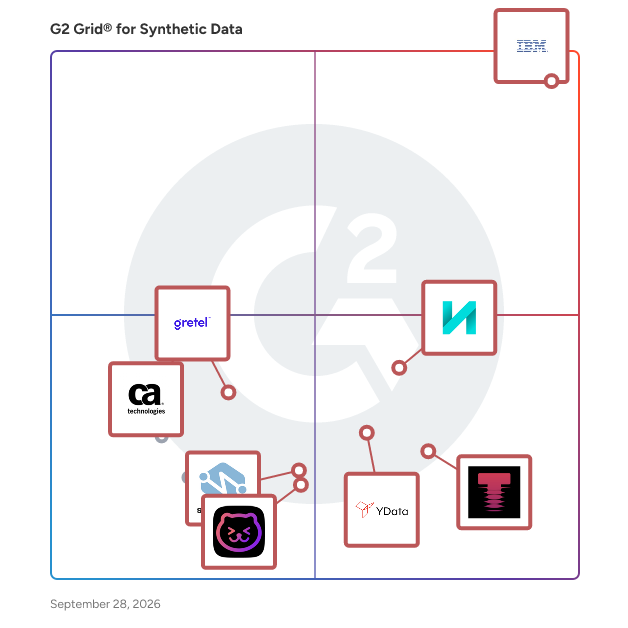
Based on category trends on G2, data privacy compliance and the ability to generate realistic training datasets at scale stand out as standout capabilities. Accelerated model development timelines and reduced dependency on sensitive real-world data stand out as primary outcomes of adoption.