PVP2K
Who Is the Company Behind PVP2K?
- Seller: Agelli Consulting
- HQ Location: N/A
-
LinkedIn® Page: www.linkedin.com
1 employees on LinkedIn®
Total Products under this Category: 1,422
Last updated: October 14, 2026
Why You Can Trust G2's Software Rankings:
G2's software rankings are built on verified user reviews, rigorous moderation, and a consistent research methodology maintained by a team of analysts and data experts. Each product is measured using the same transparent criteria, with no paid placement or vendor influence. While reviews reflect real user experiences, which can be subjective, they offer valuable insight into how software performs in the hands of professionals. Together, these inputs power the G2 Score, a standardized way to compare tools within every category.
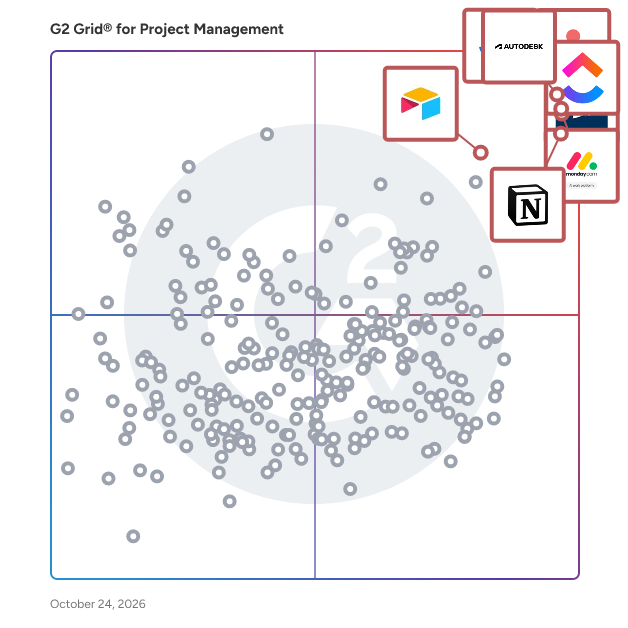
Highlighted products: Jira, Autodesk Forma (formerly Autodesk Construction Cloud), Asana, monday AI Work Platform, Smartsheet, ClickUp, Notion, and Airtable.
Underlying data: [Grid® JSON](https://www.g2.com/categories/project-management/grids.json?focus%5B%5D=jira&focus%5B%5D=autodesk-forma-formerly-autodesk-construction-cloud&focus%5B%5D=asana&focus%5B%5D=monday-com&focus%5B%5D=smartsheet&focus%5B%5D=clickup&focus%5B%5D=notion&focus%5B%5D=airtable)
pylotik is a project delivery platform. It is built for any organisation running projects that carry a committed delivery date and consume people's time: IT services companies, software publishers, engineering firms, IT suppliers, communication agencies, internal project departments, and more broadly any structure whose projects sit between the party that orders and the party that delivers. Scope and planning. Work breakdown structures built from the agreed scope, task interdependencies and their impact on deadlines, an automatically generated critical path recalculated whenever the project changes, reusable and combinable project templates, support for both waterfall and agile methodologies, and multiple project views including Gantt, calendar, portfolio and a client view. Resources and capacity. Resource allocation based on demand and availability, capacity planning, timesheets, monthly travel cost entry, and resource utilisation. Project governance. Formalised roles and responsibilities, a committee structure defined per project with bodies and cadences, and an explicit record of who decides and who is accountable for what. The steering framework is carried by the platform rather than left to local practice. Project cost control. Project budgets compared with actual costs and expenses: internal labour, subcontracting valued at an average daily rate, committed purchases against purchase orders, and travel costs. Live margin tracking, cost management, a structured monthly review, revenue recognition by project, portfolio and business unit, with profitability and risk monitored continuously. Drift becomes readable within the first month rather than at a billing milestone. Commercial and contractual data. Client accounts, opportunities and communications, purchase orders, the contractual elements that delivery is run against (agreed scope, milestones, billing terms), and order and invoicing status. Management and early warnings. A weekly factual, timestamped status raised by the delivery teams alongside the manager's own reading, so that discrepancies surface early, escalation does not require assigning blame, and the person who raises an issue is protected by the record. Register, committees and client portal. Every project is written to a single timestamped register, snapshotted weekly and replayable exactly as it stood. Committee packs and minutes are produced from that live data instead of rebuilt by hand. The built-in client portal gives the customer organisation continuous read access to the same project status the delivery team works from, and tracks the customer's own actions (approvals, access, data) on the same footing as the supplier's. Hosting is neutral: no employee of the publisher accesses project data, and the shared register is open to the customer under its contractual right of consultation. Data onboarding. Projects, tasks with their start and end dates, resources and history where it exists are loaded by import at go-live only. Out of scope. pylotik does not draft, negotiate or store contracts: no clause library, no collaborative drafting, no e-signature, no renewal alerting. It does not handle individual expense claims and digitises no receipts: costs are entered monthly, as a component of project cost. Ticketing and accounting are outside its scope. The register is not rewritten after the fact: no bulk modification of tasks by import is possible once a project is under way. This is a design choice rather than a limitation, since a timestamped register can only be relied upon if its history cannot be rewritten. It does replace spreadsheet-based steering files, generic project management tools and standalone time entry tools. Sovereignty. Built and hosted in France. GDPR native, outside the scope of the US Cloud Act. 2.2. Short version (truncated fields, meta descriptions) Project delivery platform for organisations running projects with a committed date and a human workload. Work breakdown structures from scope, task interdependencies, automatic critical path, resource allocation and capacity planning, timesheets, budgets compared with actual costs, live margins, revenue recognition, purchase orders and invoicing status, formalised project governance, a weekly timestamped project register and a built-in client portal. Built and hosted in France.
Connect G2 to Claude or ChatGPT for answers grounded in G2's trusted reviews, comparisons, and pricing from real user insights.
QPM is project and resource management software that helps teams connect strategic goals with day-to-day execution in one workspace. It supports project planning, task management, workload visibility, Gantt charts, bug and defect tracking, team calendars, notifications, quality control, and role-based resource management. QPM’s autoplanning capability builds and updates plans based on goals, task dependencies, priorities, team availability, company policies, buffers, and review stages. QPM automatically assigns work based on skills, workload, and availability, so tasks don’t just get created. They land with the right people. It’s built for teams that deal with complex, cross-functional work and need to clearly see timelines, ownership, risks, and delivery progress. The platform is used by project, product, operations, and software teams that want to spend less time on manual planning.
QuadForce is a proprietary performance architecture designed to deliver four core advantages simultaneously: speed, stability, scalability, and security. Unlike traditional systems that force trade-offs between these areas, QuadForce integrates them into a single, balanced framework. In practice, QuadForce works by distributing workloads across four parallel processing layers, each optimized for a different priority. This allows the product to handle high transaction volumes without latency spikes, maintain uptime during demand surges, scale seamlessly with your data growth, and enforce granular security controls at every layer — all without degrading performance. Why it matters for you: QuadForce eliminates the "pick two" compromise common in legacy platforms. You no longer have to choose between fast response times and robust security, or between low cost and high availability. With QuadForce, you get all four — out of the box. Key benefits: Speed – Sub-second query responses even on complex datasets Stability – Predictable performance under peak loads Scalability – Linear cost-to-performance growth Security – Built-in encryption and access controls without overhead For teams running mission-critical workflows, QuadForce means fewer surprises, lower operational complexity, and a future-proof foundation.
AI for Project Management: removing organizational friction. Pre-configured AI that lives on top of your existing project management tools to enrich and automate your project management work. -SOWs that rock: prefilled vendor info, pregenerated documents, and approvals all from your uploaded emails, templates, PowerPoints, Word documents, and more. -Smart status updates: Human readable status updates from your tools and emails at a click And more!
RedminePRO is a fully-managed Redmine cloud hosting platform built by HAZERCLOUD for teams that want the power and flexibility of open-source Redmine without running their own servers. Instead of hiring someone to patch, upgrade, and back up a self-hosted instance, teams get a ready-to-use Redmine environment with full native admin access — manage users, roles, workflows, custom fields, and plugins exactly as you would on your own infrastructure, while HAZERCLOUD handles hosting, security patching, backups, and uptime. RedminePRO uses flat, transparent pricing with no per-user fees, starting at $24/month for 25 users and unlimited projects — a stark contrast to per-seat project management tools that get more expensive with every hire. Plans scale from small teams up to organizations needing agile planning, Gantt and portfolio views, cross-project analytics, a built-in helpdesk, and resource management, with Business-tier customers able to bring their own compatible Redmine plugins (BYOP) rather than being limited to a vendor's fixed feature set. Because RedminePRO runs on standard open-source Redmine, there's no proprietary lock-in: data is fully exportable at any time, and customers can self-host again whenever they choose. For teams migrating off self-hosted Redmine, HAZERCLOUD offers a done-for-you migration service to move projects, issues, wikis, files, and plugin data into the cloud with minimal downtime.
