NoSQL Databases Resources - Page 6
Articles, Glossary Terms, and Discussions to expand your knowledge on NoSQL Databases
Resource pages are designed to give you a cross-section of information we have on specific categories. You'll find articles from our experts, feature definitions, and discussions from users like you.
NoSQL Databases Articles
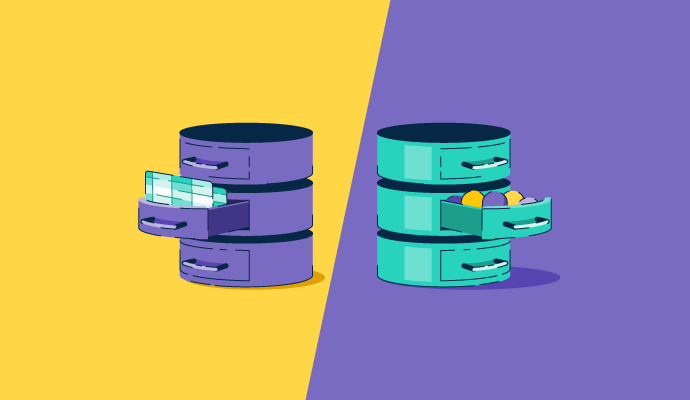
SQL vs. NoSQL in 2027: Which Database Fits Your Workload?
G2 Announces a New Category for Wide Column Databases
What Makes DBaaS the Next Big “As a Service” Offering?
NoSQL Databases Glossary Terms
NoSQL Databases Discussions
MongoDB vs CouchDB vs Firebase for a startup: which is worth the operational overhead of self-hosting versus a managed service? From the document databases category, here is how developers who have actually used these describe the trade-offs:
- MongoDB Atlas (4.5 stars, 850+ reviews): Best for startups that want the full MongoDB document model without managing servers. Atlas is the managed version, so the self-hosting question largely goes away. Reviewers describe getting a cluster connected to a Node.js or Python app in minutes. The free tier is sufficient for early development, though the pricing jump to a dedicated cluster is real and worth planning for. The MongoDB ecosystem, drivers, Mongoose, community, and tooling is one of the most developed in the document database world, which matters when you are a small team and need answers fast.
- CouchDB (3.9 stars, 60+ reviews): Best for startups building applications that need to work offline and sync when connectivity returns. Reviewers describe storing data locally and syncing when devices come back online, which is a specific use case that CouchDB handles well. The REST API interface means queries can be run without writing complex driver code or installing special libraries. Outside of the offline-first use case, reviewers describe query limitations and a smaller community compared to MongoDB, which makes troubleshooting harder.
- Google Cloud Firestore (4.2 stars, 90+ reviews): Best for startups building Firebase-connected mobile or web apps where real-time sync, authentication, and security rules in one managed platform matter more than query flexibility. Reviewers report getting data instantly visible across connected devices, which is genuinely useful for collaborative features. The operational overhead is minimal since it is fully managed by Google. The constraint is that queries are served through pre-built indexes, which limits flexibility as data access patterns evolve.
For startups that moved from one of these to another as the product scaled, what was the data model assumption that caused the most rework?
What is the fastest document database for ad-hoc analytic queries on semi-structured data where query performance on unpredictable schemas matters most? This is a narrower question than it looks. Most document databases can handle structured queries reasonably well when you have defined indexes in place. The harder problem is when the data has an irregular structure, and the query patterns are genuinely unpredictable, which is exactly the scenario where traditional indexing strategies either fail or require you to index everything and pay the write penalty. What actually matters here is how the database handles queries it was not explicitly prepared for.
From reviews in the document databases category focused specifically on analytics and search across semi-structured data:
- Elasticsearch: Reviewers describe running full-text queries across billions of documents and still getting fast results. One team running log analytics at telco scale described centralizing logs from around 1,000 servers and querying them with speed that made manual debugging practical. The inverted index architecture is specifically designed for fast read performance across text-heavy and semi-structured data without requiring you to predefine every query pattern. Reviewers flag that resource requirements, particularly RAM, can be significant, and the aggregation framework adds analytical depth to search.
- MongoDB Atlas: The aggregation pipeline, as described by reviewers, handles filtering, grouping, and transformations directly in the database for dashboards and analytics. For ad-hoc queries, proper indexing, particularly compound indexes, is described as the difference between fast and slow endpoints. Without well-designed indexes, query performance on a growing collection can degrade significantly.
- Amazon DynamoDB: Designed for predictable low-latency access on known access patterns rather than ad-hoc queries. Reviewers consistently describe query flexibility as limited, and full table scans are both slow and expensive. For unpredictable schemas and query patterns, reviewers describe it as a poor fit unless the access patterns are known in advance.
- Arango: The AQL query language supports complex queries across documents and relationships in one pass. Reviewers report excellent performance for complex relationship queries, though some note the need to load subgraphs into memory for especially intensive computations.
For teams running analytics on semi-structured data, what was the schema irregularity that caused the first serious query performance problem?
Which products combine graph and document database capabilities for a team that needs both relationship traversal and flexible schema storage in one system? Most teams that arrive at this question have already tried using a dedicated graph database alongside a document store and discovered what that actually costs: two query languages, two operational surfaces, two sets of connection logic, and data that has to stay in sync across both. A multi-model system that handles graph traversal and document storage in one engine is a different architectural bet, and the question is whether the products that offer it actually deliver on both sides rather than doing one well and the other adequately.
Looking specifically at the document databases category with this lens, here is what teams building graph-plus-document workloads seem to need:
- A single query language that handles both relationship traversal and document retrieval without switching contexts
- Graph performance that does not degrade into full collection scans when the traversal depth increases
- Enough document model flexibility to store semi-structured data alongside the graph relationships
What the reviews show:
- Arango: This is what the product is specifically built for. Reviewers describe using a single query language, AQL, to handle both document retrieval and graph traversal in a single query, which is the core of what the multi-model promise means in practice. One team in a telco context described using it to build and maintain a dynamic model of their entire network topology as a unified landscape, which required both relationship traversal and flexible state storage in one place. Another team is building a clinical knowledge graph described using Arango to handle ontology searches, transactional data, and data science source data with a single data store and a lean team.
- MongoDB Atlas: Handles the document side well, but relationship traversal is handled through the $lookup operator rather than native graph capabilities. Reviewers who need complex multi-hop traversals describe pushing that logic into application code rather than the database, which means the graph layer is not truly native.
- Azure Cosmos DB: Supports multiple APIs, including a Gremlin API for graph queries alongside the document API. Reviewers in Azure-heavy stacks describe using different API endpoints for different access patterns, though maintaining that across a single dataset adds operational complexity.
For teams that evaluated multi-model databases specifically for this combination, what was the performance characteristic that actually made the decision?
Arango is purpose-built for this; the thread confirms it handles both in a single query language. But the real question is whether your team has graph query expertise.
Traversal performance as relationship depth increased would decide it for me. If multi-hop queries stay predictable without pushing traversal logic back into application code, the multi-model architecture is actually doing its job. Arango sounds strongest on that test because graph traversal and document retrieval can stay within the same AQL query.
For us it was being able to run one AQL query that handled both the traversal and the document lookup together. Not having to stitch results from two separate systems in application code was the deciding factor.