NoSQL Databases Resources - Page 5
Articles, Glossary Terms, and Discussions to expand your knowledge on NoSQL Databases
Resource pages are designed to give you a cross-section of information we have on specific categories. You'll find articles from our experts, feature definitions, and discussions from users like you.
NoSQL Databases Articles
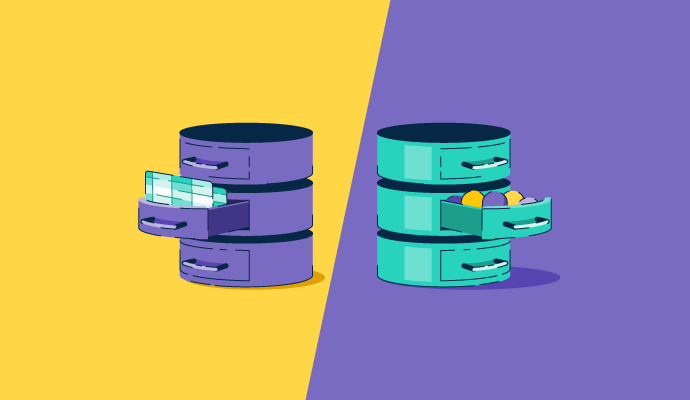
SQL vs. NoSQL in 2027: Which Database Fits Your Workload?


G2 Announces a New Category for Wide Column Databases

What Makes DBaaS the Next Big “As a Service” Offering?
NoSQL Databases Glossary Terms
Data manipulation is the process of organizing, modifying, and transforming data to improve accuracy, usability, and analysis across systems and workflows.
A desktop database stores and manages data on a personal computer. Learn more about its key features, benefits, and when to choose one for your business.
NoSQL Databases Discussions
Which document databases have the most accessible learning curve for engineers who are coming from a relational SQL background and want to ramp up quickly?
Coming from SQL to document databases is not purely a syntax change. It is a mental model shift. Joins, normalized tables, foreign keys, and rigid schemas are how SQL engineers have been taught to think about data. Document databases flip several of those assumptions, and some of the friction of moving to NoSQL is not about the query language at all. It is about unlearning the instinct to reach for a join.
Looking at the document databases category specifically through this lens, here is what SQL engineers seem to find easiest and hardest:
What the transition seems to require:
- A query language close enough to SQL that the concepts transfer without a full relearn
- Clear documentation that explains the document model in terms SQL engineers already understand
- A schema approach that is flexible but does not immediately produce data chaos
What the reviews show:
- MongoDB Atlas: The most commonly described entry point for SQL engineers moving to document databases. Reviewers describe the easy learning curve and the document model as intuitive once you stop trying to force relational patterns onto it. The aggregation pipeline, once learned, is described as powerful enough to replace most of what you would have done with SQL GROUP BY and JOIN operations. The friction point reviewers describe is schema inconsistency: without enforcement, collections can end up with mixed document structures, which can create the kinds of bugs that relational engineers find surprising.
- Amazon DynamoDB: Reviewers coming from SQL consistently flag this as requiring a different way of thinking. The partition key and access pattern design is not analogous to anything in relational modeling, and getting it wrong has performance consequences that are hard to fix later. One reviewer described coming from a SQL world as requiring a significant mindset shift. It is not that it is harder overall; it is that the mental model is genuinely different rather than adjacent.
- CouchDB: Reviewers describe the REST API approach as accessible for developers who are not familiar with complex query languages. There is no driver to install, and there is no syntax that closely resembles SQL, but the HTTP-based interface makes simple operations very direct. For SQL engineers, the lack of a SQL-adjacent query language can actually make the transition easier because there is less temptation to write relational-style queries.
- Google Cloud Firestore: Reviewers describe the interface as user-friendly, though query limitations, particularly around complex filtering and sorting, can feel constraining compared to SQL. For engineers used to writing flexible ad hoc queries, the index-driven query model requires a different way of thinking about data structures upfront.
For SQL engineers who made this transition, what was the first moment where the document model made more sense than the relational model for what you were actually building?
There's a second unlearning that gets discussed less than the join instinct and I think bites harder: relational engineers are used to the database refusing to accept invalid states. Foreign keys, unique constraints, an atomic write across three tables. A lot of that moves into application code, so the ramp-up includes quietly accepting that correctness is now your service's responsibility rather than something the storage layer guarantees. That's not a syntax gap, and no amount of SQL-adjacent query language closes it. It's also why the schema-inconsistency friction people describe on MongoDB isn't really a property of the database, it's what the absence of enforcement feels like to someone trained to lean on it. The engineers who ramp fastest are the ones who reach for schema validation on day one instead of discovering in month three that they wanted it.
MongoDB Atlas tends to have the gentler learning curve for engineers coming from a relational background, its query language and tooling are more approachable than some alternatives. Amazon DynamoDB is another option, though its access patterns lean more NoSQL-native and take more of a mindset shift from SQL.
The conversation about ACID transactions in document databases used to be simple: relational databases had them, NoSQL did not. That is no longer accurate, but the degree to which different systems implement ACID guarantees varies significantly, and for applications where consistency is not negotiable, the difference matters.
From reviews in the document databases category, filtered by consistency, transactions, and use cases where data integrity is a hard requirement, the products with meaningful ACID support are MongoDB Atlas, Google Cloud Firestore, and Azure Cosmos DB.
- MongoDB Atlas: Multi-document ACID transactions are supported, though reviewers note they are not as fully developed as in traditional relational databases. Single-document operations are atomic by default. Reviewers building financial and transactional systems describe using MongoDB for workloads that require consistency, but they also flag that transaction performance at scale requires careful query design and index optimization to avoid degradation.
- Google Cloud Firestore: Reviewers specifically call out ACID transaction support as a built-in capability. One reviewer described it as supporting ACID transactions and being highly scalable without breaking a sweat. Automatic scaling with ACID guarantees is considered a practical advantage for applications where workloads are variable but consistency cannot be relaxed.
- Amazon DynamoDB: Supports transactions via the TransactWriteItems and TransactGetItems APIs, enabling ACID operations across multiple items. Reviewers describe it as one of the most useful options for transactional use cases, particularly for async task management using TTL. The trade-off is that the data model design has to be done correctly up front, or the transactional performance does not hold at scale.
- Couchbase: Supports distributed ACID transactions, which is part of what makes it viable for enterprise workloads that require data consistency across nodes. Reviewers describe the hybrid architecture as combining relational-style consistency guarantees with NoSQL scalability.
- Azure Cosmos DB: Offers configurable consistency levels, including strong consistency, across a globally distributed data set. Reviewers in Azure-centric architectures describe this as genuinely useful for applications that need to balance consistency and latency across regions.
For applications where a single inconsistency would be a production incident, which of these did you trust enough to actually run financial transactions through?
The honest caveat is the case where the same data is genuinely needed by two aggregates, which happens and isn't always a modelling mistake. The usual resolution is deciding which one owns it and letting the other hold a copy allowed to run slightly behind. Uncomfortable the first time you accept it, and less uncomfortable than reaching for multi-document transactions on every write.
For financial transactions, I’d trust MongoDB Atlas or DynamoDB only if the access patterns and transaction boundaries are well understood upfront. The bigger question is less “does it support ACID?” and more whether the consistency model stays predictable under scale, retries, and regional failure.
For a team that needs to dial the consistency tradeoff per use case rather than accept one global setting, Cosmos DB's configurable consistency levels are what I'd want. Choosing strong consistency for the transaction path and something looser elsewhere in the same database is the more flexible answer.
Is MongoDB worth the price of Atlas for a small development team? This one comes up constantly in the document databases category, and the honest answer depends on what "small team" actually means in practice. Putting together a clearer picture from reviews.
- MongoDB Atlas: The M0 free tier is genuinely useful for development and early-stage projects. The gap between free and the first paid dedicated cluster is where reviewers flag pricing concerns. One reviewer described the jump from M0 to M10 as "quite large," particularly for client projects that require a dedicated cluster. On the other side, reviewers who pay for Atlas describe the elimination of infrastructure management, automated backups, monitoring, and the managed CDC streaming as the justification for the cost. One reviewer specifically described using it for web applications and AI embeddings and said the managed aspect removed all the friction of database maintenance. Is the Atlas pricing a concern mainly at the cluster tier jump, or does it become more significant again as storage and operations scale?
- Amazon DynamoDB: A genuinely cheap alternative for small teams that are willing to design their data model correctly up front. The pay-per-request pricing means very low costs during development and low-traffic periods. Reviewers note that costs can escalate quickly if the data model is not optimized or if inefficient scans occur. For a small team on AWS, the operational overhead is minimal, but the upfront architecture investment is real.
- Google Cloud Firestore: Free to start, and the pricing scales with reads and writes. Reviewers describe it as cost-effective at a small scale and practical for small teams because there is nothing to manage. The cost concern arises at scale, particularly for read-heavy applications where per-read pricing can add up faster than expected.
- CouchDB: Open source and free to self-host, which makes it the cheapest option for a team willing to manage infrastructure. Reviewers describe the REST API as straightforward and the installation as relatively simple. The trade-off is that you are responsible for uptime, backups, and scaling, which have real operational costs even if the licensing costs are zero.
For small dev teams that evaluated Atlas pricing and made a call either way, what actually tipped the decision?