Best Feature Management Software - Page 3

How Many Feature Management Software Products Does G2 Track?

Total Products under this Category: 48

Category Stats (Nov 2026)

  • Average Rating: 4.57/5 The average rating of products in this category, based on all submitted ratings
  • Top Trending Product: Amplitude Feature Experimentation (+0.79%) - Among all products in this category, Amplitude Feature Experimentation recorded the largest rating increase compared to last month

Last updated: November 17, 2026

How Does G2 Rank Feature Management Software Products?

Why You Can Trust G2's Software Rankings:

  • 30 Analysts and Data Experts
  • 6,000+ Authentic Reviews
  • 48+ Products
  • Unbiased Rankings

G2's software rankings are built on verified user reviews, rigorous moderation, and a consistent research methodology maintained by a team of analysts and data experts. Each product is measured using the same transparent criteria, with no paid placement or vendor influence. While reviews reflect real user experiences, which can be subjective, they offer valuable insight into how software performs in the hands of professionals. Together, these inputs power the G2 Score, a standardized way to compare tools within every category.

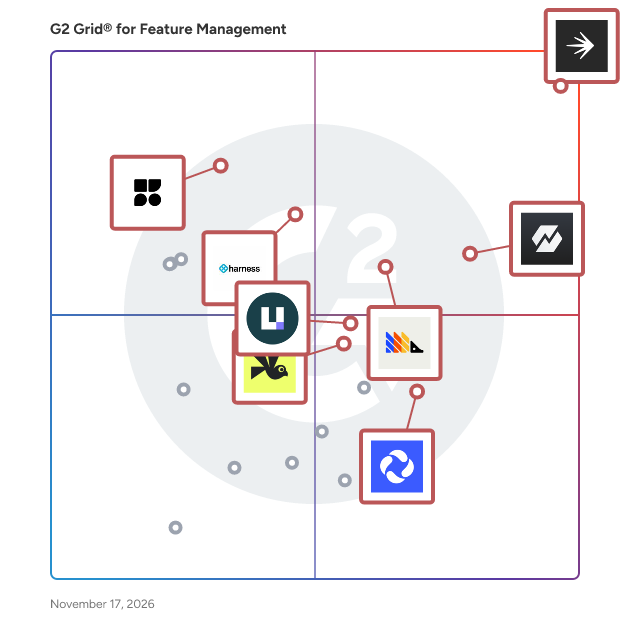
G2 Grid® for Feature Management Software

G2 Grid® for Feature Management Software plotting products by satisfaction and market presence

Highlighted products: LaunchDarkly, Statsig, PostHog, Harness Platform, Confidence by Spotify, Unleash, Featurebase, and Wingify Experimentation.

Underlying data: [Grid® JSON](https://www.g2.com/categories/feature-management/grids.json?focus%5B%5D=launchdarkly&focus%5B%5D=statsig&focus%5B%5D=posthog&focus%5B%5D=harness-platform&focus%5B%5D=confidence-by-spotify&focus%5B%5D=unleash&focus%5B%5D=featurebase&focus%5B%5D=wingify-experimentation)

Atono

Atono is a product engineering platform that keeps the whole product loop in one system — plan, build, feature-flag, measure — instead of a tracker, a flag service and an analytics tool that lose the thread between them. Most teams run at least three. The story lives in the tracker. The flag controlling its rollout lives somewhere else. The usage data proving anyone wanted it lives in a third place. Nothing connects them, so the reasoning behind the work — why this was built, what was decided, which customer the edge case was for — survives only in someone's head or a document nobody updated. Atono puts them on one record. A story carries its acceptance criteria, the feature flag controlling its rollout, the engagement data showing what happened after release, and the decisions behind all of it. WHAT YOU GET Plan. Write stories with an assistant that already knows your product. It draws on your Glossary, past decisions and related work, then turns the conversation into a story with acceptance criteria your team can build from. Ask it to review a story and it flags the gaps — vague criteria, missing edge cases, contradictions — before anyone starts work. Build. Living Stories hold the decisions, design notes and investigations attached to the work itself, not filed separately. When someone joins the team or picks up an unfamiliar area, the reasoning is on the story rather than lost. Deploy. Feature flags are built in, and the flag lives on the story that defined the feature. Roll out by percentage or segment, roll back instantly, and always know which story a flag belongs to and why it exists. No separate flag service to buy, and no stale toggles nobody can trace back to a decision. Measure. Feature engagement data lands on the same story that carried the spec and the flag. You can see whether the thing you shipped was used, by whom, and how that changed after the rollout — without exporting anything or joining two systems by hand. PRODUCT KNOWLEDGE YOUR TEAM AND YOUR AI TOOLS SHARE The Glossary is a permissioned, authored definition of your product's concepts and how they relate — what your team actually means by "account", "workspace", "trial", "active user". Not a wiki page mentioning those words. A definition someone owns. That matters more than it used to. AI coding agents now write a large share of the code, and they write from whatever context they can reach. Reach the wrong context and you get work that looks right, passes review, ships, and fails three weeks later when a real user does the thing nobody specified. The problem is rarely the model. It's that the product's meaning was never written down anywhere the agent could get to it. Atono serves that context to Claude Code, Claude Desktop, Cursor, VS Code and GitHub Copilot, Windsurf and Codex through a native MCP server. Your agents read the story, its acceptance criteria, the glossary terms it depends on and the decisions behind it — then write against the same understanding your team has. They can create and update stories, bugs, epics and subtasks too, so the work stays current without anyone switching windows to file it. MCP is how agents reach your product context. The context itself is the product. RUN IT ALONGSIDE WHAT YOU HAVE You don't have to migrate to start. Most teams begin with one team on Atono next to their existing stack, capturing product context firsthand rather than syncing it from somewhere else. Jira Cloud import and Linear CSV import bring your existing work across when you're ready, one team at a time. WHO IT'S FOR Product managers and product owners who are tired of writing the same context into three tools. Engineering leaders who want to see what was shipped, whether it was used, and what it cost — without assembling that from four dashboards. Engineers and engineering managers running AI coding agents who need those agents to understand the product, not just the codebase. Teams of roughly 10 to 200 building a software product, on Scrum or Kanban, who have outgrown a tracker but don't want three more subscriptions. WHAT MAKES IT DIFFERENT Feature flags and engagement data are native, not integrations. Most trackers connect to a flag tool and an analytics tool. Atono holds the flag and the usage data on the story, which is the only way the loop actually closes. Product context is authored, not inferred. A glossary term has an owner and a definition. It isn't a relationship guessed from years of documents and tickets. AI usage isn't metered. Run the story assistant and the reviewer as often as you want. There's no credit balance to watch and no per-action charge. It replaces tools rather than adding one. The point isn't another place to keep context about all the other places keeping context. It's one system where the plan, the rollout and the result are the same record. PRICING Free — $0 forever, up to 25 users. Starter — $19 per user per month, unlimited users. Growth — $39 per user per month, unlimited users. The MCP server and its tools work on every plan. On Free, product knowledge, AI context and Premier AI features run as a 30-day trial. Feature engagement history is 90 days on Starter and one year on Growth.

Average Rating: 4.5/5.0

Total Reviews: 1

How Do G2 Users Rate Atono?

  • Quality of Support: 10.0/10 (Category avg: 9.3/10)

Who Is the Company Behind Atono?

  • Seller: Atono
  • Year Founded: 2024
  • HQ Location: N/A
  • LinkedIn® Page: www.linkedin.com
    28 employees on LinkedIn®

Who Uses This Product?

  • Company Size: 100% Medium

What Do G2 Reviewers Say About Atono?

AI-generated summary from verified user reviews

Pros
  • Users value the ease of use of Atono, finding it simple to visualize team progress and manage features.
  • Users enjoy the easy visualization and management of team progress and features within Atono's console.
  • Users appreciate the ease of task visualization in Atono, enhancing team management during development sprints.
  • Users value the effective team collaboration tools in Atono, enhancing their project management and visibility during sprints.

What Are Recent G2 Reviews of Atono?

featureflow

Featureflow is runtime control for AI Speed Engineering. It is a leading application feature management tool that allows you to safely and effectively release, manage and evaluate your applications features across multiple applications, platforms and languages, web, mobile and server. Serving millions of flags daily since 2016. When your shipping at Agentic Speeds, the control now sits at runtime. Featureflow allows to deploy at AI speed whilst maintaining control of your releases. * Dark / Silent Release with features turned off * Gradual rollout to a percent of users * Virtual Rollout and Rollback of features * Environment and Component feature itinerary * Target features to specific audiences * A/B and Multi-variant test new features - migrate to the winner All without devops, engineering or downtime. * Release Pipelines - progress your features through predefined release pipelines into production. * Approval gates - comprehensive approval processes to ensure governance into production * MCP Enabled - works directly with Claude Code, Codex, Github, Cursor etc * Integrates with your tooling - Jira, Slack, Amplitude and more through our open API and interoperable SDKs

Average Rating: 5.0/5.0

Total Reviews: 1

Who Is the Company Behind featureflow?

Who Uses This Product?

  • Company Size: 100% Small

What Are Recent G2 Reviews of featureflow?

Rocket Folio

Rocket® Folio is a desktop-based enterprise search and publishing platform with a rich, multi-user editing environment. Publish information with useful features such as jump links and annotation, as well as powerful structure and mark-up capabilities. Ensure appropriate access to the right users at the right time, preventing all unauthorized access.

Average Rating: 4.0/5.0

Total Reviews: 1

How Do G2 Users Rate Rocket Folio?

  • Quality of Support: 10.0/10 (Category avg: 9.3/10)

Who Is the Company Behind Rocket Folio?

Who Uses This Product?

  • Company Size: 100% Small

What Do G2 Reviewers Say About Rocket Folio?

AI-generated summary from verified user reviews

Pros
  • Users appreciate the ease of managing diverse content with Rocket Folio, streamlining efforts in the IT department.
  • Users value the efficient document management capabilities of Rocket Folio, simplifying content handling with minimal IT involvement.
  • Users value the ease of use of Rocket Folio, enabling efficient content management with minimal IT effort.
Cons
  • Users find the learning difficulty of Rocket Folio can be challenging, as it requires time to become familiar with.

What Are Recent G2 Reviews of Rocket Folio?

AI can help you find the answers. G2 helps you trust them.

Connect G2 to Claude or ChatGPT for answers grounded in G2's trusted reviews, comparisons, and pricing from real user insights.

How it works

Runway Team

Runway is a release management platform for mobile teams. Top mobile teams rely on Runway to handle coordination and automate busywork so they can get back to building great apps. Runway was built with mobile releases in mind, and connects with all of your tools to give you one place to manage releases with confidence and without hassles.

Average Rating: 4.5/5.0

Total Reviews: 1

How Do G2 Users Rate Runway Team?

  • Multi-Environment Control: 6.7/10 (Category avg: 8.7/10)
  • Rollout & Rollback Control: 6.7/10 (Category avg: 8.9/10)
  • Quality of Support: 8.3/10 (Category avg: 9.3/10)
  • Flag Management: 8.3/10 (Category avg: 9.0/10)

Who Is the Company Behind Runway Team?

Who Uses This Product?

  • Company Size: 100% Large

What Are Recent G2 Reviews of Runway Team?

Switchover

Switch over is a Software As A Service Solution (SaaS) that companies in every industry can use to accelerate their software development processes. Our clearly arranged flag management feature allows you to switch your functions on and off at any time.

Average Rating: 5.0/5.0

Total Reviews: 1

Who Is the Company Behind Switchover?

Who Uses This Product?

  • Company Size: 100% Large

What Are Recent G2 Reviews of Switchover?

Basestack

Basestack is a modern developer platform built for startups that want to ship faster without extra infrastructure. Today that means Feature Flags and Forms, two products that fit how you already work, so you spend less time on setup and more time building features people love. With Feature Flags, you control releases in real time. Roll a feature out to a slice of users, preview it before launch, and roll it back in one click if things go wrong. Manage flags across environments, track who changed what, and update configuration without a redeploy. SDKs and APIs make it easy to add flags to JavaScript, React, and your stack. Forms let you collect and manage submissions without writing server-side code. Spam protection, email notifications, redirects, exports, and an API are built in, so you can stand up a form in minutes and stay in control. Basestack is built for solo developers, growing teams, and startups. Pick the products you need, plug them into your workflow, and start shipping.

Who Is the Company Behind Basestack?

Coframe

Coframe is an AI-powered platform designed to revolutionize user experience (UX) optimization for websites and applications. By leveraging advanced AI algorithms, Coframe automates the creation of personalized, engaging content and conducts real-time A/B testing to enhance user interactions and boost conversion rates. Its seamless integration requires only a few lines of code, enabling businesses to implement continuous optimization effortlessly. Coframe's mission is to transform digital interfaces into adaptive entities that evolve based on user behavior, ensuring a dynamic and responsive online presence.

Who Is the Company Behind Coframe?

DeployRamp

DeployRamp automatically wraps your riskiest code changes in feature flags, rolls them out gradually, monitors for errors, and cleans up after itself so your team ships faster without breaking production.

Who Is the Company Behind DeployRamp?

FeatureFlags.app

FeatureFlags.app is a privacy-first feature flag platform built for .NET developers. Safely release features, control rollouts, and manage application behavior without redeploying code—all while keeping your data private and your infrastructure under your control.

Who Is the Company Behind FeatureFlags.app?

Featureflip

Featureflip is a feature flag, targeting, and experimentation platform from Canopy Labs LLC. It lets engineering teams decouple deployment from release: ship code behind a flag, turn it on for a percentage of users or a segment, and turn it off instantly if something breaks. What happens after the rollout is what most teams carry forever. Featureflip detects dead flags from each flag's evaluation traffic, then a GitHub Action opens one reviewable pull request per flag and deletes the code path across thirteen languages. The rewrite works on the syntax tree with no LLM, so the same input always produces the same diff, and it refuses what it cannot do safely. Merging it can archive the flag it removed. The platform covers percentage rollouts, condition-group targeting, environment isolation, prerequisites, and audit history, with a real-time evaluation API built for low latency. Thirteen SDKs span server-side (Node.js, Python, C#, Java, Go, PHP, Ruby) and client-side (browser JavaScript, React, Swift, Flutter, Android), with live updates over Server-Sent Events. Flags are manageable as code as well as from the dashboard: a Management API on every plan, free tier included, a Terraform provider on the Registry, an MCP server for AI agents, and OpenFeature providers for Node.js, .NET, Python, Go, Java. Pricing is flat and team-based, with nothing metered: no per-seat charge, no active-user count, no evaluation caps, no overage. Solo is free forever.

Who Is the Company Behind Featureflip?

Flagpool

Flagpool is a modern feature flag and release management platform that helps development teams safely control, test, and roll out software changes. Teams can use feature flags to separate code deployment from feature release, enabling gradual rollouts, targeted releases, A/B testing, and quick feature rollbacks without redeploying code. Designed for modern software teams, Flagpool provides a centralized way to manage feature flags across applications and environments. Developers and product teams can collaborate on releases, reduce deployment risk, and gain greater control over when and how new functionality reaches users. With Flagpool, teams can release with confidence, experiment faster, and respond quickly when something goes wrong - all while keeping feature management integrated into their existing development workflow. Read more on https://www.flagpool.io

Who Is the Company Behind Flagpool?

GeckoFlag

GeckoFlag is a lightweight, self-hosted project management tool designed for modern teams, managers, and software developers. Offered as a one-time purchase with no recurring monthly subscriptions, GeckoFlag runs directly on your own server for complete data privacy and security. It includes Kanban boards, Gantt charts, task tracking, and multi-language support (English, Japanese, Spanish, Portuguese, and more) to keep your team aligned and productive.

Who Is the Company Behind GeckoFlag?

GO Feature Flag

GO Feature Flag is an open-source, lightweight feature management solution designed to simplify the deployment and release of new features in software applications. By decoupling feature releases from code deployments, it enables developers to modify system behavior without altering the underlying codebase. This approach facilitates faster deployments, reduces risk through progressive rollouts, and supports scalable development practices. Key Features and Functionality: - Quick and Easy Setup: GO Feature Flag emphasizes simplicity, offering a straightforward setup process that avoids complex infrastructure requirements. - Comprehensive Feature Management: It allows targeting of specific user segments, environments, and supports advanced rollout strategies such as canary releases, progressive rollouts, scheduled workflows, and A/B testing. - Developer Optimization: Being 100% open-source with no vendor lock-in, it supports multiple programming languages and integrates seamlessly with existing tools. It also aligns with the OpenFeature standard, promoting interoperability and standardization. - Integration Capabilities: GO Feature Flag is cloud-ready, capable of retrieving configurations from various sources like AWS S3, Google Cloud Storage, GitHub, and Kubernetes. It can store usage data in preferred datasets and notify users of configuration changes through platforms like Slack or webhooks. Primary Value and User Solutions: GO Feature Flag addresses the challenges of modern software development by enabling teams to deploy code frequently while controlling feature releases independently. This decoupling allows for testing in production environments, reducing the risk of introducing bugs to all users. It empowers non-technical stakeholders to manage feature releases without developer intervention, fostering collaboration and accelerating innovation. By supporting experimentation and data-driven decisions through A/B testing and progressive rollouts, GO Feature Flag helps organizations deliver personalized user experiences and continuously improve their products.

Who Is the Company Behind GO Feature Flag?

Replane: Dynamic configuration for apps and services

Replane is an open-source, self-hosted platform for feature flags and dynamic configuration. It lets teams change feature toggles, rate limits, and app settings in real-time without redeploying code—updates propagate to connected services in under a second via Server-Sent Events. Key capabilities include version history with instant rollback, override rules for targeting users by plan/region/percentage, JSON Schema validation, and optional approval workflows. Deploy with a single Docker image using PostgreSQL or built-in SQLite. Official SDKs available for JavaScript, React, Next.js, Svelte, Python, and .NET. MIT licensed. Also available as a managed cloud service.

Who Is the Company Behind Replane: Dynamic configuration for apps and services?

Adam Crivello
AC
Researched and written by Adam Crivello
Updated October 3, 2024