Best Decentralized Identity Software - Page 3

How Many Decentralized Identity Solutions Products Does G2 Track?

Total Products under this Category: 66

Category Stats (Jun 2026)

  • Average Rating: 4.35/5 The average rating of products in this category, based on all submitted ratings

Last updated: June 30, 2026

How Does G2 Rank Decentralized Identity Solutions Products?

Why You Can Trust G2's Software Rankings:

  • 30 Analysts and Data Experts
  • 300+ Authentic Reviews
  • 66+ Products
  • Unbiased Rankings

G2's software rankings are built on verified user reviews, rigorous moderation, and a consistent research methodology maintained by a team of analysts and data experts. Each product is measured using the same transparent criteria, with no paid placement or vendor influence. While reviews reflect real user experiences, which can be subjective, they offer valuable insight into how software performs in the hands of professionals. Together, these inputs power the G2 Score, a standardized way to compare tools within every category.

Product Description

Connect your data from web2 platforms and connect it to private AI and other web3 applications.

Pros and Cons

Product Description

Welcome to Affinidi, where we revolutionise data ownership for good. Our vision is crystal-clear: crafting a world where everyone can securely and seamlessly control, manage, and derive value from their data. Our "Holistic Identity" concept encompasses the complete spectrum of discovering, collecting, sharing, storing, and even monetising one’s own personal data in the digital world. We adopt an unwavering user-first approach, providing innovative developer tools with a ‘privacy-by-design’ philosophy within every layer of our tech stack. We emphasise and execute an end-to-end network trust known as the Affinidi Trust Network, underpinning a data environment that is secure and inherently interoperable. This commitment to decentralised identity management transcends borders and industries. Globally anchored in Singapore and supported by our strategic hubs in Bangalore and Berlin, Affinidi is not just a company; it's a movement. For an in-depth look into our technology and vision, visit www.affinidi.com

G2 Advertising
Sponsored
G2 Advertising
Get 2x conversion than Google Ads with G2 Advertising!
G2 Advertising places your product in premium positions on high-traffic pages and on targeted competitor pages to reach buyers at key comparison moments.

Product Description

Block Armour is a Singapore, India, USA, and UK-based award-winning Cybersecurity venture focused on harnessing modern approaches and emerging technologies such as Blockchain to counter growing cybersecurity challenges in bold new ways. Accelerated by Airbus and featured among the Top 25 Cybersecurity innovations worldwide, Block Armour has developed a next-gen Zero Trust security platform and delivers integrated cybersecurity solutions for today’s hybrid enterprise-IT environments.

Product Description

Block-Auth is a SaaS platform that offers blockchain-based authentication and identity management, allowing absolute control of digital identity through a *passwordless* approach.

Product Description

Corepass is building the AI infrastructure that puts research-grade intelligence in the hands of the people who actually close deals. We believe great people, given the right intelligence, can outperform anyone. We build the infrastructure that makes it possible.

Product Description

Providing a secured and decentralized system for Certificate Issuers, Individuals and Employers to store & verify certifications and credentials using Blockchain Technology.

Product Description

IdRamp offers a decentralized identity orchestration platform designed to simplify and secure identity management for enterprises. By integrating decentralized identity solutions, IdRamp enables organizations to manage digital identities without the complexities of traditional centralized systems. This approach enhances security, reduces operational costs, and improves user experience by eliminating the need for passwords and minimizing data replication. Key Features and Functionality: - Decentralized Authentication: Utilizes distributed systems to authenticate users, enhancing reliability and security while eliminating the need for public network-facing identity and access management systems. - Credential Management: Provides digital credentials for various use cases, including identity verification, supply chain management, and product certification, with adaptable workflows to suit business needs. - Password Elimination: Enhances user experience and security by offering password-free access to applications and services, replacing traditional credentials with cryptographic keys. - Interoperability: Seamlessly integrates with existing identity management platforms, such as Azure AD, Okta, and ForgeRock, without requiring significant infrastructure changes. - Zero-Code Deployment: Facilitates easy integration with existing services and systems without the need for custom development, enabling quick adoption across various digital ecosystems. Primary Value and Solutions Provided: IdRamp addresses the challenges of managing an increasing number of digital identities and application relationships by offering a decentralized identity strategy. This approach allows organizations to maintain control over when and how they share information, providing the least access required without exposing networks to partners or third parties. By reducing complexity and distributing attack vectors, IdRamp enhances security and operational efficiency. Additionally, IdRamp's platform supports various use cases, including multi-factor authentication, passwordless authentication, biometric authentication, identity proofing, and account recovery. These capabilities help organizations fortify authentication security, eliminate password-associated vulnerabilities, and automate manual tasks like account creation, thereby improving user experience and reducing operational costs. By leveraging IdRamp's decentralized identity orchestration, enterprises can streamline identity management processes, enhance security, and accelerate digital transformation efforts without the need for extensive infrastructure overhauls.

Product Description

Meeco is building a personal data marketplace of equals. We give people and organisations the tools to control, access and gain value from data.

Product Description

Spherity’s decentralized Digital Twins enable innovative customer journeys across mobility, supply chain transparency, risk assessment, audit trails for data analytics, and many more use cases.

Product Description

Terradoxa Intelligent Horizontal Platform: - creates the digital identity of individuals and businesses (end of identifiers, end of passwords) - simplifies and secures the uses of the digital world (sanctuarisation of data, end of customer journeys) - offers service producers of the platform a RGPD-Privacy by design structure - meets the numerical exclusion - is a link between the generations - creates and redistributes value by betting on ethics and generosity - promotes a circular economy without penalizing neither producers nor consumers

Product Description

TruAnon lets community members Build Trust making your social or consumer marketplace more safe and authentic. Put an end to Fraudsters immediately and permanently ban bad actors forever. Like SSO for identity; TruAnon is a privacy conscious alternative that strengthens your brand and removes risk of privacy compliance violations. TruAnon is transparency that keeps your service safe from fraudsters, masquerading and fake profiles that damage your business. TruAnon immediately creates a trusted ecosystem. It is the one solution that works equally for every member, regardless of language or location. You make it visible and your members make it work.

Product Description

As the blockchain provides features of tamper-proof, immediate verification, paperless operation, and complete traceability, Turing Certs digitalize important certificates and store them on the blockchain for a permanent perseverance on the borderless digital certificate management platform. Turing Certs also obtain ISO certificates for information security and EU GDPR privacy compliance, ensuring high-level security, convenience and confidentiality, providing certificate issuers, receivers and verifiers with streamlined certification and verification processes for reducing labor and time costs and building a ESG sustainable, paperless future. Turing Certs have been implemented to diverse applications, including educational, professional and medical certifications, professional qualifications, carbon credits, agricultural product traceability, ESG sustainability report certifications, real estate agreements, art forgery prevention, among others.

Product Description

A new breed of consultants & technology solutions, for today’s hardest problems. DX, Identity & Credentials, Traceability.

Product Description

SDKR is our Smart Decentralized Key Recovery solution for wallets and other products that require highly secure key management.

Product Description

Bedrock is an application platform that helps you get your ideas to market quickly by reducing the engineering effort of launching a new product. Finding, vetting, testing, and combining disparate technologies into a cohesive whole is a laborious and time consuming task. Bedrock has already done that work so that you can avoid fighting your technology stack and focus on adding value.

Brandon Summers-Miller
BS
Researched and written by Brandon Summers-Miller
Updated December 18, 2024

How Do You Choose the Right Decentralized Identity Solutions?

What You Should Know About Decentralized Identity Solutions

What are Decentralized Identity Solutions?

Decentralized identity solutions are products companies use to manage and verify end-user identities, including employees and customers. Decentralized identity solutions let end-users retain control over their data. This is unlike centralized identity products that house personally identifiable information (PII) and other sensitive information in one location which a company has access to. With decentralized identity solutions, individuals can retain control over data without using a centralized registry, certificate authority, identity provider, or other centralized identity authority.

This end-user control of sharing and revoking access to one’s sensitive data is known as self-sovereign identity (SSI). Decentralized identity solutions often rely on blockchain technology, storing a person’s digital identity and other verifiable credentials in a digital wallet. Implementing blockchain-based technology allows end-users to create, manage, and own their digital identities in ways traditional, centrally-managed identity verification does not. Allowing end-users to have such a degree of control over their data makes it possible for them to retain a higher degree of privacy while also having a more convenient experience sharing and revoking access to their credentials, data, and PII.

Companies may decide to transition to or implement decentralized identity solutions into their operations for several reasons. Reducing user identity fraud, rapidly onboarding new users, and reducing costs associated with provisioning and issuing digital certificates are just a few motivations buyers may choose to decentralize employee identities. Employees also benefit from decentralized identity solutions, as these tools offer a privacy-preserving solution for their identity verifiers and reduce security risks associated with centrally storing identity information, including regulated data such as PII.

What are the Common Features of Decentralized Identity Solutions?

The following are some core features within decentralized identity solutions that can help users:

Credentials: The verifiable credentials stored in end-users' digital wallets validate the wallet owner’s identity for their employers. Identities can be validated using public key infrastructure (PKI) to secure end-to-end PII transmission between employees and their employers. This information can include bank routing information for payroll purposes, mailing address information for communication purposes, vaccination records for on-site work authorization, and more.

Access: A core feature of decentralizing identity management is that it gives individuals more discretion over who can access their PII, when they can access it, for how long they can access it, and whether or not they will be able to continue to access it. Individuals become the arbiters of their most important personal data assets and information by storing digital credentials and sensitive information in an individually-controlled digital wallet.

Distributed ledger technology (DLT) systems storage: DLT is a decentralized record management system that includes static and dynamic data. This form of decentralized identity management allows for improved traceability and increased transparency, as decentralized ledgers and other credentials are visible to multiple users simultaneously instead of being housed in one location. Transactions, modifications, and access logs can be monitored in real time, in several places, and at once.

Blockchain technology is an example of DLT. Decentralized identity solutions utilize DLT and blockchain technology to be just that: decentralized. Forgoing traditional modes of credential storage and identity verification, centralized identity management benefits end-users who prioritize increased transparency and traceability.

What are the Benefits of Decentralized Identity Solutions?

Built on trust: The term “blockchain” refers to the mechanism responsible for how the technology operates. Blocks of information are chained together through a transparent log of transactions, modifications, and other activities. Each block on the blockchain is built upon the block that precedes it until the beginning of the chain is reached—the “genesis block.” Changes to each block, which creates the successor block, are documented through a timestamp and a backlink to the block to which the changes were made.

Blockchain’s designed transparency aids organizational cybersecurity efforts by building digital trust between organizations and the identity data of their employees, customers, students, and more. Since changes in information made on the blockchain are meticulously logged, malicious actors are prevented from falsifying or adulterating credentials. This form of digital identity management makes it easier for end-users to retain confident control over their sensitive data.

Distributing ledger access across multiple entities also helps foster trust. Since the wallet owner has given multiple parties access to view the blockchain, everyone with access can identify when credentials have been altered. Blockchain records themselves can’t be altered, meaning malicious actors can’t falsify or manipulate the owner’s credentials without revealing their activity to anyone who can view the blockchain.

Security: Blockchain technology also relies on cryptography and public keys to reduce the risk of data breaches between the digital wallet’s owner, such as an employee, and the party accessing the information, such as an employer. The principles behind using a decentralized digital identity, which includes its cryptographic nature and the unique chain of blocks that are nearly tamper-proof, make this technology incredibly secure.

Agility: The party who owns the digital wallet containing their credentials can add and revoke access instantly. Additionally, the owner can update, add, and edit information as necessary. Those changes are immediately reflected to all the parties whom the owner has granted access.

Blockchain and DLT’s iteration of self-sovereign identity can allow employees, customers, patients, students, and more to update records without relying on bureaucratic processes present in centralized identity management, instantly improving communication between themselves and enterprises. This can include updating their mailing address, vaccination status, bank account information, and more. 

Who Uses Decentralized Identity Solutions?

There are several use cases for implementing decentralized identity systems.

Employers: Decentralized identity solutions can aid employers in new hire digital identity authentication and help them more quickly onboard new employees into existing company infrastructures. Decentralized identifiers stored within an employee’s digital wallet can include phone numbers, mailing addresses, and other contact information. Additionally, employees can share their credentials with their new employers, like vaccination records for on-site work and professional certifications.

Customers: Having autonomy over one’s digital identity can empower customers to have a firmer understanding of which businesses can access their personal data. For example, patients can offboard from and integrate into healthcare systems with decentralized identity solutions while revoking and granting access to their healthcare records from one provider to the next. Leveraging a decentralized identity solution can help customers secure their digital identities and the parties accessing their sensitive data.

IoT devices: The Internet of Things (IoT) refers to devices embedded with sensors, scanners, actuators, and the like, which are connected to computing systems. These connected devices allow the internet to observe and influence the real world, such as vehicles that can alert friends, family, and emergency services if they have crashed. Decentralized identity solutions can verify devices’ identities while enabling device owners to create access rules for the data the devices record and the processes they implement. Additionally, decentralizing IoT device identity management can make siloed IoT devices interoperable between manufacturers’ proprietary processes. In this way, decentralized identity solutions can prevent malicious actors from accessing IoT devices, stealing their data, and influencing the world around them. This can include digital personal assistants, offices, and labs with locks controlled by smartphones.

Challenges with Decentralized Identity Solutions

There are several decentralized identity platforms to choose from, but there is a lack of standardization across them, which causes several of the following challenges:

Interoperability: Key differences between blockchains create interoperability challenges between decentralized identity systems. This can limit organizations to using a single blockchain for decentralized identity management. New employees with pre-existing digital wallets on other blockchains must adopt the blockchain of choice for their new employer. Additionally, this may cause customers to choose to work with enterprises that accept ledgers from the blockchain their credentials are already stored on.

Security and privacy concerns: Lack of standardization also poses potential security and privacy concerns with blockchain technology. There is no standard protocol for public and private key management related to DLT. Just like conventional PKI, if a malicious actor steals a digital wallet’s private key, they can decrypt and access its contents. Other credentials used for wallet access and asset disbursement, including biometric factors, have no standard method of storage, which concerns privacy watchdogs intent on keeping blockchain user PII private.

User adoption: Scalability can be an issue for users accustomed to centralized identity management. Decentralized identity management systems are more challenging to operate than traditional centralized management systems. Lacking features like usernames and passwords creates complex user experiences for would-be adopters. This has prevented user adoption and affected the concept’s scalability. Decentralized identity management systems also tend to have slower processing speeds than established centralized identity management systems, which also deters enterprises and customers from embracing the concept.

How to Buy Decentralized Identity Solutions

Requirements Gathering (RFI/RFP) for Decentralized Identity Solutions

When selecting a decentralized identity solution, buyers should consider the following factors to best meet their needs:

Scalability: Buyers must prioritize how scalable the decentralized identity solution is. The number of digital identities they want to transfer to the decentralized identity solution from their pre-existing centralized identity management system, in addition to the number of new identities buyers want to create, will ultimately be limited to how easy it is to scale the solution.

Ease for end-users: Many decentralized identity solutions are complex and require end-users to have a savvy understanding of blockchain and distributed ledger technologies to fully grasp how to own their digital identities. Buyers should pay close attention to how easy it will be for end-users to interact with each decentralized identity solution’s interface.

Compare Decentralized Identity Solutions

Create a long list

While some decentralized identity solutions are for general use, some products may be tailored for narrower purposes. Buyers should create a long list tailored to their needs. Does the buyer need to implement a decentralized identity solution for students or employees? Does the buyer need a solution for a variety of use-cases?

Create a short list

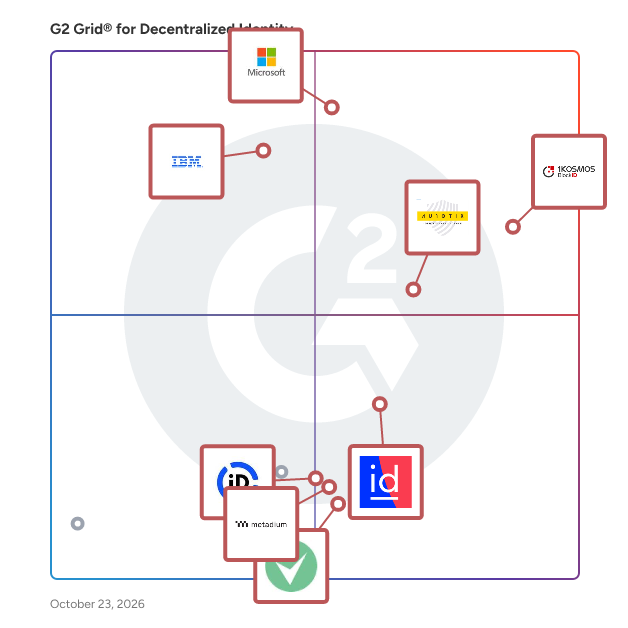
To further narrow the pool of potential products, buyers should read product user reviews from g2.com. Reviews speak to the user experience, the complexity of implementation, costs, and overall functionality of the decentralized identity solution. Beyond reading reviews, buyers are also empowered to leverage the G2 Grid® to see how competing decentralized identity solutions compare to each other.

Conduct demos

By selecting the “Get a quote” button, buyers can often directly contact vendors on g2.com to request a product demo. During each demo, buyers should ask the same questions to fairly evaluate each product against the others the buyer is considering. Buyers should ask decentralized identity vendors about the solution’s processing speeds, user interface, ease of user adoption across an enterprise, how keys are managed, and the typical length of time it takes to move from a centralized identity management system to their specific decentralized identity solution. Buyers should also ask vendors about end-user training, as many are still unfamiliar with blockchain and distributed ledger technology.

Selection of Decentralized Identity Solutions

Choose a selection team

When buyers consider different products, several key stakeholders should be included in the decision-making process. It is important to include the day-to-day administrator of the organization’s current, centralized identity management system so they can ask vendors about phasing out the old system and phasing in the vendor’s product. Software engineers and at least one IT department representative should also be included to learn how to successfully integrate blockchain technology into their enterprise’s pre-existing infrastructure.

Negotiation

It may be possible for buyers to secure a deal with decentralized identity solution vendors. Buyers should ask if better rates are possible based on the number of identities the organization plans to decentralize and the types of identities they plan on decentralizing, including students, customers, and employees. The duration of the agreement between the buyer and the vendor may also be a factor to consider, with longer contracts sometimes allowing buyers to secure better rates.

Final decision

The final decision will come down to the decentralized identity solution’s use cases, scalability, ease of adoption, and end-user confidence in interacting with the blockchain. As identity management is a crucial aspect of business operations affecting administrators and end-users, consensus across the organization may be beneficial. Informing end-users of the advantages of having sovereignty over their digital identities and providing training is imperative to ensuring end-user adoption.

Ultimately, the final decision makers will likely be: the enterprise’s arbiter of identity management, the person responsible for the enterprise’s security, a leader within the software engineering team, and the chief executive or operations officer.