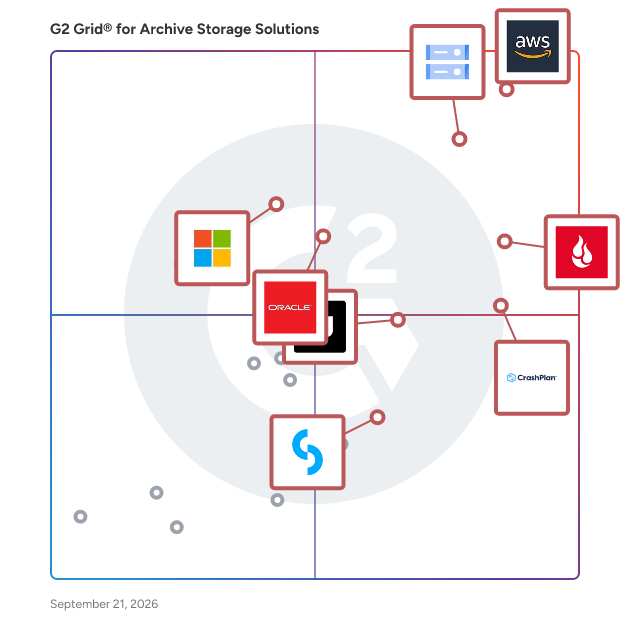
  # Best Archive Storage Solutions - Page 2

  *By [Rachana Hasyagar](https://research.g2.com/insights/author/rachana-hasyagar)*

   Archive storage solutions enable companies to store and retrieve sparsely used data. This data at rest may be used infrequently; however, it may remain vitally important to business operations, making the protection of its storage crucial. This security remains one of the greatest benefits of archival cloud storage to secure backup data and facilitate the transfer of vital information.

Companies use archive storage solutions to keep large amounts of information secure while it rests in the cloud. These tools provide security access control over sensitive information, ensure the availability of archived information, and save companies money by separating rarely accessed data from frequently used sources.

To qualify for inclusion in the Archive Storage category, a product must:

- Provide cloud-based storage for inactive data
- Ensure access control over sensitive information
- Facilitate cold-data retrieval when requested


## How Many Archive Storage Solutions Products Does G2 Track?
**Total Products under this Category:** 38

### Category Stats (May 2026)
- **Average Rating**: 4.4/5
- **New Reviews This Quarter**: 16
- **Buyer Segments**: Small-Business 65% │ Mid-Market 23% │ Enterprise 12%
- **Top Trending Product**: Amazon S3 Glacier (+0.005)
*Last updated: May 25, 2026*

  
## How Does G2 Rank Archive Storage Solutions Products?

**Why You Can Trust G2's Software Rankings:**

- 30 Analysts and Data Experts
- 2,600+ Authentic Reviews
- 38+ Products
- Unbiased Rankings

G2's software rankings are built on verified user reviews, rigorous moderation, and a consistent research methodology maintained by a team of analysts and data experts. Each product is measured using the same transparent criteria, with no paid placement or vendor influence. While reviews reflect real user experiences, which can be subjective, they offer valuable insight into how software performs in the hands of professionals. Together, these inputs power the G2 Score, a standardized way to compare tools within every category.

  
## Which Archive Storage Solutions Is Best for Your Use Case?

- **Leader:** [Amazon S3 Glacier](https://www.g2.com/products/amazon-s3-glacier/reviews)
- **Highest Performer:** [CyberSentriq](https://www.g2.com/products/cybersentriq/reviews)
- **Easiest to Use:** [Backblaze B2 Cloud Storage](https://www.g2.com/products/backblaze-b2-cloud-storage/reviews)
- **Top Trending:** [Unitrends Backup and Recovery](https://www.g2.com/products/unitrends-backup-and-recovery/reviews)
- **Best Free Software:** [Redstor Backup for Microsoft 365](https://www.g2.com/products/redstor-backup-for-microsoft-365/reviews)

  
  ## What Are the Top-Rated Archive Storage Solutions Products in 2026?
### 1. [Archive Manager Files Edition](https://www.g2.com/products/archive-manager-files-edition/reviews)
  Automatically archive, manage and secure all your organization’s files. Metalogix Archive Manager for Files connects to overworked file servers and re-directs documents onto separate, more cost-effective storage tiers, while controlling how long messages are archived in accordance with industry, government and internal regulations. Enable the most flexible and effective way to archive and manage your file systems.


  **Average Rating:** 5.0/5.0
  **Total Reviews:** 1
**How Do G2 Users Rate Archive Manager Files Edition?**

- **Quality of Support:** 10.0/10 (Category avg: 8.8/10)

**Who Is the Company Behind Archive Manager Files Edition?**

- **Seller:** [Metalogix](https://www.g2.com/sellers/metalogix-8952774a-64af-40c2-9ebf-53ce736be301)
- **Year Founded:** 2001
- **HQ Location:** Aliso Viejo, CA
- **Twitter:** @quest (17,129 Twitter followers)
- **LinkedIn® Page:** https://www.linkedin.com/company/metalogix-software/ (44 employees on LinkedIn®)

**Who Uses This Product?**
  - **Company Size:** 100% Enterprise


### 2. [Collabspace CONTINUUM](https://www.g2.com/products/collabspace-continuum/reviews)
  End-to-End Records Management with Collabspace CONTINUUM Connect All Electronic, Physical &amp; Email Sources for Unified Cross-Platform Visibility &amp; Retention Forget migration and stream all your content repositories into a Data Lake for complete and compliant records management, multi-platform search and comprehensive visibility. With Collabspace, users can continue using the systems they’re familiar with while all the records management compliance and backup is automated in the background.


  **Average Rating:** 3.5/5.0
  **Total Reviews:** 1
**How Do G2 Users Rate Collabspace CONTINUUM?**

- **Quality of Support:** 6.7/10 (Category avg: 8.8/10)

**Who Is the Company Behind Collabspace CONTINUUM?**

- **Seller:** [Collabware](https://www.g2.com/sellers/collabware)
- **Year Founded:** 2010
- **HQ Location:** Vancouver, CA
- **Twitter:** @collabware (704 Twitter followers)
- **LinkedIn® Page:** https://www.linkedin.com/company/collabware (21 employees on LinkedIn®)

**Who Uses This Product?**
  - **Company Size:** 100% Small-Business


### 3. [Grotabyte Archive](https://www.g2.com/products/grotabyte-archive/reviews)
  Grotabyte Archive is a comprehensive enterprise information archiving solution designed to help businesses securely store and manage large volumes of data. With support for a wide range of file types and data sources, the platform enables organizations to easily store and retrieve data in a centralized location, improving efficiency and reducing the risk of data loss. In addition to basic archiving capabilities, Grotabyte Archive also offers advanced features such as retention policies, legal hold, data classification, user access to their archives, meeting recordings transcription, and machine learning-assisted review. With its scalable architecture and flexible deployment options, Grotabyte Archive scale as the company&#39;s data grows and needs are evolved.


  **Average Rating:** 4.5/5.0
  **Total Reviews:** 1
**How Do G2 Users Rate Grotabyte Archive?**

- **Quality of Support:** 10.0/10 (Category avg: 8.8/10)

**Who Is the Company Behind Grotabyte Archive?**

- **Seller:** [Grotabyte](https://www.g2.com/sellers/grotabyte)
- **Year Founded:** 2020
- **HQ Location:** Austin, US
- **LinkedIn® Page:** https://www.linkedin.com/company/grotabyte/ (2 employees on LinkedIn®)

**Who Uses This Product?**
  - **Company Size:** 100% Enterprise


### 4. [Librarian](https://www.g2.com/products/librarian/reviews)
  CA Librarian offers change management to enable you to manage software modules on and across multiple mainframe platforms. It also provides a collection of service facilities to help simplify application management. This change management solution has powerful capabilities that offer: Reporting, performance monitoring, security, archiving and recovery to manage applications Comprehensive tracking and control for source code development


  **Average Rating:** 4.0/5.0
  **Total Reviews:** 1
**How Do G2 Users Rate Librarian?**

- **Quality of Support:** 10.0/10 (Category avg: 8.8/10)

**Who Is the Company Behind Librarian?**

- **Seller:** [Broadcom](https://www.g2.com/sellers/broadcom-ab3091cd-4724-46a8-ac89-219d6bc8e166)
- **Year Founded:** 1991
- **HQ Location:** San Jose, CA
- **Twitter:** @broadcom (63,483 Twitter followers)
- **LinkedIn® Page:** https://www.linkedin.com/company/broadcom/ (55,707 employees on LinkedIn®)
- **Ownership:** NASDAQ: CA

**Who Uses This Product?**
  - **Company Size:** 100% Enterprise


### 5. [Navigating.art Archiving Solution](https://www.g2.com/products/navigating-art-archiving-solution/reviews)
  Navigating.art is an all-in-one art information platform providing solutions for the changing needs of 21st-century art professionals. Our platform offers comprehensive functionality for doing business in the art world, creating and managing prestigious collections, preparing and publishing evidence-based catalogues raisonnés, as well as dedicated digital archives. Our Archiving Solutions allows to: - Capture, organize &amp; preserve archival materials of any kind. - Stay compliant with leading standards for archival description (ISAD(G) / EAD). - Automate file management of media items including long-term preservation. - Integrate Getty Vocabularies to ensure data quality &amp; aid search functionalities. - Full-text search with automatic recognition of embedded text.


  **Average Rating:** 4.5/5.0
  **Total Reviews:** 1
**How Do G2 Users Rate Navigating.art Archiving Solution?**

- **Quality of Support:** 8.3/10 (Category avg: 8.8/10)

**Who Is the Company Behind Navigating.art Archiving Solution?**

- **Seller:** [Navigating.art](https://www.g2.com/sellers/navigating-art)
- **Year Founded:** 2024
- **HQ Location:** Berlin, DE
- **LinkedIn® Page:** https://www.linkedin.com/company/navigating-art (9 employees on LinkedIn®)

**Who Uses This Product?**
  - **Company Size:** 100% Small-Business


### 6. [NetApp StorageGRID](https://www.g2.com/products/netapp-storagegrid/reviews)
  NetApp StorageGRID is a software-defined, object storage platform designed to store massive amounts of unstructured data securely, efficiently, and across distributed locations. It provides S3-compatible object storage with intelligent data lifecycle management, allowing organizations to automatically tier, replicate, or move data based on policies, cost, performance, or compliance needs. Built for durability, scale, and multicloud integration, StorageGRID supports long-term data growth without compromising on accessibility or control. StorageGRID is ideal for AI data prep, data lakes &amp; analytics, and data backup &amp; retention - especially compliance-driven datasets, and any workload where data must be retained for long periods at low cost. StorageGRID is also a strong fit for organizations building hybrid or multicloud architectures that want to keep control of their data while integrating with AWS, Azure, or on-premises applications.


  **Average Rating:** 4.5/5.0
  **Total Reviews:** 17
**How Do G2 Users Rate NetApp StorageGRID?**

- **Quality of Support:** 8.8/10 (Category avg: 8.8/10)
- **Has the product been a good partner in doing business?:** 8.3/10 (Category avg: 8.8/10)

**Who Is the Company Behind NetApp StorageGRID?**

- **Seller:** [NetApp](https://www.g2.com/sellers/netapp)
- **Year Founded:** 1992
- **HQ Location:** Sunnyvale, California
- **Twitter:** @NetApp (118,169 Twitter followers)
- **LinkedIn® Page:** https://www.linkedin.com/company/2105/ (12,677 employees on LinkedIn®)
- **Ownership:** NASDAQ

**Who Uses This Product?**
  - **Top Industries:** Information Technology and Services
  - **Company Size:** 53% Small-Business, 35% Mid-Market


#### What Are NetApp StorageGRID's Pros and Cons?

**Pros:**

- Customer Support (3 reviews)
- Features (2 reviews)
- Cost Management (1 reviews)
- Data Security (1 reviews)
- Easy Integrations (1 reviews)

**Cons:**

- Backup Issues (1 reviews)

### 7. [Arvitam](https://www.g2.com/products/arvitam/reviews)
  Protect Your Most Sensitive Archive Data Arvitam is a digital archiving solution for all types of electronically stored information across the enterprise. It preserves your digital assets securely for the long term and is tailored to ensure full compliance with records management policies across a multitude of industries. The safety deposit box for your enterprise Whether it’s invoices, pay stubs, HR records, emails, contracts or images, electronic media of every possible format can reside in Arvitam. Arvitam enables you to define and implement an archiving strategy for each record type, adapted to your business goals or compliance requirements. Classification In Arvitam, you decide how to index and organize records according to your needs. Storage Arvitam supports all media formats – disks, magnetic tape, cloud… You choose where to store which archives, the number of copies you want to keep, the datacenters in which they’ll be stored… Retention Throughout their lifecycle your records must comply with policies and procedures such as retention periods, final disposition, destruction process, workflow… Arvitam orchestrates these phases automatically to ensure that all your records are fully compliant enterprise-wide. Security by Design Authentication, access permissions, integrity checks, traceability, confidentiality policies… Arvitam integrates 15 distinct processes to ensure total security and legal preservation of evidence.


**Who Is the Company Behind Arvitam?**

- **Seller:** [Infotel](https://www.g2.com/sellers/infotel-a5b2f5ae-4f1a-45e9-be5c-359ba8a9f48d)
- **Year Founded:** 1986
- **HQ Location:** Blagnac, FR
- **LinkedIn® Page:** https://www.linkedin.com/company/infotel-software/ (15 employees on LinkedIn®)


### 8. [CA Allocate DASD Space &amp; Replacement](https://www.g2.com/products/ca-allocate-dasd-space-replacement/reviews)
  CA Allocate DASD Space and Placement (CA Allocate) enables more efficient use of DASD by enforcing allocation policies and procedures and redirecting inaccurate allocations for proper grouping, optimum space or best-fit usage.


**Who Is the Company Behind CA Allocate DASD Space &amp; Replacement?**

- **Seller:** [Broadcom](https://www.g2.com/sellers/broadcom-ab3091cd-4724-46a8-ac89-219d6bc8e166)
- **Year Founded:** 1991
- **HQ Location:** San Jose, CA
- **Twitter:** @broadcom (63,483 Twitter followers)
- **LinkedIn® Page:** https://www.linkedin.com/company/broadcom/ (55,707 employees on LinkedIn®)
- **Ownership:** NASDAQ: CA


### 9. [croit unified storage platform](https://www.g2.com/products/croit-unified-storage-platform/reviews)
  Being avid Ceph users ourselves for many years, we were keen to bring all our knowledge about Ceph, Linux and networks into a solution that we believe to be outstanding. We strongly believe that our software not only solves many recurring problems that we have experienced ourselves in any other form of Ceph deployment, but also reduces the total cost of scale-out of storage. Our solution will help you grow your business without worrying about the usual problems. Thanks to the openness of our solution, there are no lock-in effects. You can always use hardware from any manufacturer, as well as seamlessly deploy alternative Ceph solutions in the same storage. This puts you in the unique position to operate state-of-the-art scale-out storage at best conditions with perfect support.


**Who Is the Company Behind croit unified storage platform?**

- **Seller:** [croit](https://www.g2.com/sellers/croit)
- **Year Founded:** 2017
- **HQ Location:** München, DE
- **LinkedIn® Page:** https://www.linkedin.com/company/croit (23 employees on LinkedIn®)


### 10. [Geyser Data](https://www.g2.com/products/geyser-data/reviews)
  Geyser Data specializes in affordable, secure, and sustainable Tape-as-a-Service for long-term data archiving, offering zero egress fees and seamless integration with Amazon S3. Their target clients include industries such as media entertainment, scientific research, video surveillance, and healthcare. With a focus on environmental sustainability, Geyser&#39;s service reduces CO2 emissions and power usage significantly compared to traditional options. The company is recognized for delivering enterprise-class solutions that simplify data archiving while ensuring strong security and control over data residency.


**Who Is the Company Behind Geyser Data?**

- **Seller:** [Geyser Data](https://www.g2.com/sellers/geyser-data)
- **Year Founded:** 2024
- **HQ Location:** Tustin, US
- **LinkedIn® Page:** https://www.linkedin.com/company/geyser-data/ (6 employees on LinkedIn®)


### 11. [Iperius Storage](https://www.g2.com/products/iperius-storage/reviews)
  Iperius Storage - Your Cloud Backup Partner Quick Overview: Optimize your data protection strategy with Iperius Storage. As a key component of the acclaimed Iperius Backup ecosystem, this cloud backup solution safeguards servers, PCs, and virtual machines with ease and efficiency. Features at a Glance: - Advanced Cloud Solutions: Utilizes FTPS and S3 protocols for high-grade cloud storage, suitable for any business size. - Seamless Iperius Integration: Direct integration with Iperius Backup enhances backup processes for applications, databases, and more. - Top-Level Security: Data is stored in ISO 27001 certified and GDPR-compliant Tier III and IV data centers, offering best-in-class security. - Comprehensive Protection: Features include AES 256-bit encryption, customizable upload limits, and robust defenses against ransomware. - Universal Access: Easily manage, share, and access your files from any location, ensuring business operations continue smoothly. Why Opt for Iperius Storage? Iperius Storage stands out by delivering a secure, flexible, and comprehensive cloud backup solution that meets the demands of modern businesses. Ensure your data&#39;s integrity and availability with a platform built on reliability and compliance.


**Who Is the Company Behind Iperius Storage?**

- **Seller:** [Enter](https://www.g2.com/sellers/enter)
- **HQ Location:** Grottammare, AP
- **Twitter:** @enter (2,972 Twitter followers)
- **LinkedIn® Page:** https://www.linkedin.com/company/enter-srl/ (29 employees on LinkedIn®)


### 12. [Portworx Backup](https://www.g2.com/products/portworx-backup/reviews)
  Portworx Backup is a comprehensive data protection solution designed specifically for Kubernetes environments, ensuring the security and availability of persistent data across on-premises and cloud infrastructures. With an intuitive point-and-click interface, it offers centralized management of backup and restore operations, robust data security features—including role-based access control , ransomware protection, and encryption—and supports both in-transit and at-rest data security. Additionally, Portworx Backup provides a unified platform to manage backups for containers and virtual machines running on containers, facilitating seamless data protection and recovery processes. Key Features and Functionality: - Application-Aware and Granular Backup and Restore: Ensures full protection by capturing all application data, configurations, and objects, allowing for container-granular restores. - Centralized Data Protection and Migration: Offers enterprise-level control with centralized backup management across hybrid and multi-cloud environments, providing actionable dashboards for backup and restore health, and facilitating easy application migrations. - Enterprise-Grade Data Security: Implements sophisticated RBAC, delete protection, immutability for ransomware defense, and supports the 3-2-1 backup rule to ensure data availability and integrity. - Self-Service Interface: Empowers developers with a user-friendly platform to set backup policies, perform restores, and manage data protection tasks independently. Primary Value and Problem Solved: Portworx Backup addresses the critical need for reliable and efficient data protection in Kubernetes environments. By providing application-aware, granular backup and restore capabilities, it ensures that organizations can recover applications swiftly and accurately, minimizing downtime and data loss. Its centralized management and robust security features offer enterprises the confidence that their data is protected against threats, including ransomware, and that they can maintain business continuity across diverse and complex infrastructures.


  **Average Rating:** 4.2/5.0
  **Total Reviews:** 16
**How Do G2 Users Rate Portworx Backup?**

- **Quality of Support:** 8.8/10 (Category avg: 8.8/10)
- **Has the product been a good partner in doing business?:** 8.5/10 (Category avg: 8.8/10)

**Who Is the Company Behind Portworx Backup?**

- **Seller:** [Pure Storage](https://www.g2.com/sellers/pure-storage)
- **Year Founded:** 2009
- **HQ Location:** Santa Clara, US
- **LinkedIn® Page:** https://www.linkedin.com/company/pure-storage/ (5,588 employees on LinkedIn®)
- **Ownership:** PSTG
- **Total Revenue (USD mm):** $1,359

**Who Uses This Product?**
  - **Company Size:** 50% Enterprise, 31% Mid-Market


#### What Are Portworx Backup's Pros and Cons?

**Pros:**

- Data Recovery (8 reviews)
- Cloud Backup (6 reviews)
- Backup Services (3 reviews)
- Customer Support (3 reviews)
- Ease of Use (3 reviews)

**Cons:**

- Limited Features (3 reviews)
- Complex Setup (2 reviews)
- Difficult Learning (1 reviews)
- Expensive (1 reviews)
- Integration Issues (1 reviews)

### 13. [Vaultastic](https://www.g2.com/products/vaultastic/reviews)
  Vaultastic can ingest your business data stored from a wide range of active and legacy data sources into a central, unified cloud repository. Vaultastic’s cross-platform architecture integrates easily with various data sources such as M365, Google Workspace, Google Drive, MS Exchange, Zimbra, SalesForce, SendGrid, and many more. On-demand SaaS tools for fast ediscovery, governance, and flexible data extraction increase the visibility and availability of business-critical data.


  **Average Rating:** 4.0/5.0
  **Total Reviews:** 4
**How Do G2 Users Rate Vaultastic?**

- **Quality of Support:** 7.8/10 (Category avg: 8.8/10)

**Who Is the Company Behind Vaultastic?**

- **Seller:** [Mithi Software Technologies](https://www.g2.com/sellers/mithi-software-technologies)
- **Year Founded:** 2000
- **HQ Location:** Pune, IN
- **Twitter:** @connect2mithi (58 Twitter followers)
- **LinkedIn® Page:** https://www.linkedin.com/company/mithi (75 employees on LinkedIn®)

**Who Uses This Product?**
  - **Company Size:** 50% Mid-Market, 50% Small-Business


    ## What Is Archive Storage Solutions?
  [Storage Management Software](https://www.g2.com/categories/storage-management)
  ## What Software Categories Are Similar to Archive Storage Solutions?
    - [Disaster Recovery as a Service (DRaaS) Solutions](https://www.g2.com/categories/disaster-recovery-as-a-service-draas)
    - [Object Storage Solutions](https://www.g2.com/categories/object-storage-solutions)
    - [Online Backup Software](https://www.g2.com/categories/online-backup)

  
---

## How Do You Choose the Right Archive Storage Solutions?

### What You Should Know About Archive Storage Solutions

Archive storage solutions act as storage systems for inactive data that businesses must retain but may only access occasionally. [Data archiving](https://learn.g2.com/data-archiving) or data tiering helps companies store and secure older information for regulatory compliance, information governance, business intelligence, lawsuit management, or future references.&amp;nbsp;

Archive file storage solutions, also known as information archiving solutions, are ideal for structured and unstructured data, such as financial reports, emails, web content, log data, historical data, retired application data, database records, and spreadsheets.

Primary storage demands high input/output operations per second (IOPS) levels for read/write activities. Archive storage systems, however, rely on low-performance, high-capacity storage mediums. These low-cost storage tiers reduce primary storage consumption costs, which is otherwise higher during long-term data retention. The result is cost-effective information storage with efficient data retrieval and transfer.

Some archive systems use write once, read many (WORM) functionality to offer read-only functionality and prevent data modification, while others also provide writing functionality.

### What are the common features of archive storage solutions?

The following are some core features of archive storage solutions that users find helpful:

**Searchability:** Search capability is a must-have feature for data archiving software that lets users search data by type (email, pdf, spreadsheet, etc.), author, source (server, device, application, etc.), creation date, and data structure (social security numbers, bank routing numbers, etc). Archiving solutions also add metadata to each data file to help users find inactive data.&amp;nbsp;

[Data deduplication](https://www.g2.com/articles/reducing-high-data-storage-costs-with-data-deduplication) **:** Archive software also reduce storage overhead by removing redundant data copies from disk, flash, or tape storage. The result is reduced storage capacity requirements, which translate into storage cost savings. Archiving solutions with data deduplication capabilities enable users to keep a baseline copy of changed and unchanged data and experience less redundancy.

**Data lifecycle management:** Many companies create archiving strategies that let them automatically move less frequently accessed data from primary storage to archive storage. This automation capability saves companies time that would otherwise be spent on creating, changing, and auditing archives throughout the data lifecycle.&amp;nbsp;&amp;nbsp;

**Access control:** Organizations with large teams often need different permission levels to allow and restrict certain users from accessing archive data. Most archiving systems feature pre-set user roles to help these companies create role-specific access permissions. These solutions feature access logs for ease of user activity monitoring as well.

**Flexibility:** Archiving platforms also must allow businesses to write and retrieve different types of data, such as application logs, customer service requests, and social media posts, using multiple data platforms.

### What types of archive storage solutions exist?

Archive data storage solutions use different mediums, including tapes, hard drives, cloud, disks, and flash storage. Traditionally, archival systems have been file-based but now use object storage.

#### On-premises archive storage

Companies deploy these solutions in their data centers to have complete control over data, hardware, and software. On-premises archive storage tools use a mix of [object storage solutions](https://www.g2.com/categories/object-storage-solutions), tape storage, and disk storage to archive large volumes of data in a scalable and cost-effective manner.&amp;nbsp;

Financial service providers, government agencies, and healthcare companies use this type of storage to retain sensitive data while meeting audit-related compliance requirements.&amp;nbsp;

#### Cloud archive storage

Cloud archive storage platforms enable large enterprises with global offices to archive and access data securely from different sources and locations. They eliminate the need for buying, or maintaining IT systems for storage, thus reducing long-term storage costs. These solutions also feature built-in encryption and application integration capabilities.&amp;nbsp;

Medical institutes, media companies, educational institutions, and government agencies use cloud solutions to archive patient records, video footage, student documents, and public records. However, businesses may need specialized software for data transfer and must be careful about vendor lock-in.&amp;nbsp;

Archive storage can be divided into the following media types depending on the physical device used for storage.&amp;nbsp;

#### Other archiving storage solutions

Below are other archiving solutions that companies use in a limited capacity but were quite popular.

##### Optical media storage

Optical disks like DVDs and CDs use the WORM technology to store data in a physically immutable manner. They rely on laser beams to write and read the data to and from spinning disks. Besides having a longer shelf life, this media is also portable because of its compact size.&amp;nbsp;

Organizations using optical media often struggle with low storage capacity and slower read/write speeds.

##### Tape archive storage

Tape storage systems use magnetic tapes to record and store data. Businesses use them because of their low cost, reliability, and ability to protect data from malware by working offline. Tapes also make error detection and correction easier with read-after-write verification functionality.&amp;nbsp;

The main challenge is that tapes use sequential access, slowing data searching and retrieval. Plus, tapes deteriorate with use and due to environmental conditions.&amp;nbsp;

##### Disk drive

Disk drives are electro-mechanical devices that use magnetism for data storage and retrieval. They feature data deduplication and remote replication capabilities. Users can also integrate them with indexing engines to search archived items faster.&amp;nbsp;

Despite offering an excellent storage-to-cost ratio, disk drives can be expensive to upgrade and maintain. Moreover, they experience a high failure rate without cooling and air filtering.

##### Removable disk

Removable disk storage features random access capabilities that ensure faster media reading and writing. Small and medium-sized companies primarily use removable disks like external hard drives, universal serial bus (USB) drives, and flash drives because of their portability and ease of usage. However, removable disks offer a poor cost-to-storage ratio and don&#39;t suit enterprises with large volumes of data.

### What are the benefits of archive storage solutions?

The benefits of using an archiving solution include:

**Reduced storage cost:** Organizations with a rapidly growing amount of data spend a fortune on data storage. The cost is even higher as they store primary data in native formats. An effective archiving solution helps them compress and store primary data as cold data, allowing maximum cost savings.&amp;nbsp;

For example, a 2:1 compression ratio reduces hot data storage costs by 50%. Companies can also unlock additional savings by opting for cloud-based solutions.

**Meeting regulatory compliance:** Some companies may have to store data in archives for extended periods, depending on regulatory requirements. For example, the Fair Labor Standards Act (FLSA) requires employers to retain payroll records, sales/purchase documents, and collective bargaining agreements for up to three years. Another example is the Health Insurance Portability and Accountability Act (HIPAA), which requires fee-for-service healthcare providers to retain medical records for up to six years from the creation date.&amp;nbsp;

Data archiving platforms ease data retention and protection with built-in policies. This ease of meeting long-term archival mandates helps organizations prevent premature data destruction.&amp;nbsp;

**Prevention of data loss:** Data archiving moves in-circulation data to archives, limiting users&#39; ability to modify it. Moreover, archive storage solutions feature robust security measures to protect sensitive information from malware infection, cyberattacks, unauthorized access, and breaches.&amp;nbsp;

**Easy audit tracking:** Data archiving solutions also feature audit trail tracking, offering organizations complete visibility over who is accessing and modifying what and when.&amp;nbsp;

**High durability:** Archive storage systems ensure [data integrity](https://www.g2.com/articles/data-integrity) during long-term preservation with redundancy and data replication features that protect companies from data loss.

**Business agility:** Archiving solutions make it easier for businesses to retrieve, extract, and push data to production while deploying new business models.&amp;nbsp;

### Who uses archive storage solutions?

Archive storage solutions are used by the following professionals:

- **IT administrators:** IT admins are responsible for maintaining networks, security systems, and data storage infrastructure. They use data archiving solutions to optimize the process of storing infrequently accessed data throughout its lifecycle. Besides reducing storage costs, these platforms also enable them to provision data and ensure data accessibility at all times.&amp;nbsp;
- **Compliance managers:** Archiving platforms enable compliance professionals to adhere to national and international laws, industry-specific regulations, and data retention requirements. The result is efficient data management and timely response to legal requests.&amp;nbsp;
- **Data analysts:** Data professionals use archiving solutions in tandem with [statistical analysis software](https://www.g2.com/categories/statistical-analysis) to analyze inactive data and discover business insights or historical trends.

Apart from these roles, the following teams use storage archiving systems for different purposes.

- **IT teams** responsible for managing organizational data infrastructure rely on archiving solutions for securely storing inactive data and ensuring it&#39;s accessible.&amp;nbsp;
- **Compliance and legal teams** ensure that their organizations adhere to industry-specific legal regulations. Archive storage helps them meet these data preservation requirements for compliance audits, legal investigations, and data retention.
- **Finance teams** are tasked with improving efficiency by analyzing financial records. They use archiving solutions to maintain audit trails and inspect historical financial data. **Accounting teams** manage historical financial statements and analyze trends using archiving solutions.
- **Backup and recovery teams** combine archiving and [disaster recovery solutions](https://www.g2.com/categories/disaster-recovery) for storing data backups and protecting critical data for an extended period.&amp;nbsp;
- **Data analysis and research teams** rely on archived data for research projects, data mining, trend analysis, and creating historical benchmarks.
- **Security and data protection teams** rely on data archiving platforms and [data security software](https://www.g2.com/categories/data-security) to protect preserved data from unauthorized access and breaches.&amp;nbsp;
- **Healthcare providers and medical records teams** use archive storage platforms to store past patient records and infrequently accessed health data in compliance with state and federal laws.&amp;nbsp;For example, the Health Information Portability and Accountability Act (HIPAA) requires health entities to store patient records for adults for six years and deceased patients for two years. Similarly, they must retain records of newborns until they reach the majority age.
- **Digital asset management teams** that manage digital media at entertainment companies use archiving solutions for long-term retention of media assets like video, audio, and other content. They also use cloud storage solutions to enable users to stream audio or video across distributed regions.

### Archive storage software pricing

The cost of archiving storage solutions depends on factors like:

- Amount and type of data&amp;nbsp;
- Desired data retrieval time
- Security and compliance requirements

Data archiving solutions use one of the three cost models below.

**Linear model:** Vendors following this pricing model charge buyers on a per gigabyte (GB) basis for the data they store. The data storage cost increases linearly in this model, meaning that the cost per GB stays the same regardless of the data a company stores. Linear models are ideal for companies that don’t want the price to grow exponentially as the volume of data increases.&amp;nbsp;

**Asymmetric model:** The cost of storing and retrieving data differs in this model. Cloud-based archive storage solutions use the asymmetric model to charge buyers separately for data storage and retrieval. Companies may opt for this model when they need to archive a high volume of data but retrieve a different amount.&amp;nbsp;

**Symmetric model:** The cost of storing and retrieving data is the same in this model. On-premises archive storage solution providers use this pricing model to offer a fixed data storage and archival cost. This model suits companies that archive and retrieve data frequently.

#### Return on investment (ROI) for archive storage solutions&amp;nbsp;

The ROI of archive storage systems depends on the following factors:

- Vendor discounts
- Promotions
- Pricing structure
- Data growth
- Data retrieval patterns
- Long-term storage plan

Organizations must conduct a thorough cost analysis while budgeting for archive storage solutions. It’s highly recommended that buyers consult with vendors and solution consultants to make informed decisions.&amp;nbsp;

### What are the alternatives to archive storage solutions?

Below are the archive storage software alternatives that companies typically use.

- [Backup solutions](https://www.g2.com/categories/backup) **:** Backup platforms enable companies to copy and store business data from sources such as databases, servers, laptops, and desktops. These solutions provide faster data access than archive file storage solutions and are ideal for storing data for a shorter period. Common types of backup solutions are [online backup software](https://www.g2.com/categories/online-backup), [PC backup software](https://www.g2.com/categories/pc-backup), [SaaS backup software](https://www.g2.com/categories/saas-backup), and [server backup software](https://www.g2.com/categories/server-backup).
- [Object storage solutions](https://www.g2.com/categories/object-storage-solutions) **:** Some organizations may also use object storage systems instead of traditional archive storage software for long-term data retention.&amp;nbsp;
- [Structured data archiving and application retirement software](https://www.g2.com/categories/structured-data-archiving-and-application-retirement) **:** These solutions enable companies to move structured data between databases or warehouses while optimizing storage and maintaining data integrity.&amp;nbsp;
- [Enterprise information archiving software](https://www.g2.com/categories/enterprise-information-archiving) **:** Organizations rely on these solutions for archiving structured or unstructured data using local, on-premises, or hybrid server models.
- **Data archiving software:** Some organizations use these tools to manage the process of moving data into archive storage systems.

### Archive storage solutions vs. backup software

Archive storage systems are different from [backup software](https://www.g2.com/categories/backup).&amp;nbsp;

Data backup involves copying active operational data, which businesses may access or modify regularly. Companies update backup files frequently to have a reliable data restoration source for data protection and disaster recovery. It&#39;s also worth noting that backup and original data often stay in the exact location.&amp;nbsp;

On the other hand, archived data is for retention purposes and may not be updated frequently.&amp;nbsp;

### Software related to archiving storage solutions

Below are some tools teams can use alongside archiving systems.&amp;nbsp;

- [Document management software](https://www.g2.com/categories/document-management) **:** Document management systems help organizations with electronic document storage, sharing, and management from a single location. Some companies may use these tools in tandem with archiving solutions to save space that rarely accessed documents will otherwise consume.
- [Content management system (CMS) tools](https://www.g2.com/categories/cms-tools) **:** CMS systems enable digital media companies to store and manage digital content. These organizations may use archive storage solutions to store historical content.
- [Cloud file storage software](https://www.g2.com/categories/cloud-file-storage) **:** Organizations use cloud file storage systems to store unstructured data at the file level. They can use data archiving solutions to store cloud-based files in an organized manner.
- [Hybrid cloud storage solutions](https://www.g2.com/categories/hybrid-cloud-storage-solutions) **:** Organizations often use hybrid cloud storage to connect on-premises or private cloud with public cloud securely. They rely on archiving solutions to store inactive files that would otherwise take too much space on hybrid clouds.

### Challenges with archive storage solutions

Some common challenges with archive storage solutions are:

**Future data growth:** Archive data growth significantly impacts organizations that produce large volumes of operational data. They end up paying for additional storage capacity while storing unused data for longer periods. The growing volume of archive data also makes it difficult for them to access and retrieve data easily.&amp;nbsp;

The best way to tackle this challenge is to create an archive data management plan for easy data, access, retrieval, and deletion. Organizations can also deploy scalable, cloud-based archiving storage solutions to save administrative time while managing archive data workloads.&amp;nbsp;

**Data security and compliance:** Failing to comply with regulations while keeping data secure is another critical challenge in data archiving.

For example, businesses must determine the laws and regulations for their industry and country of operation. Next, they should set up data security and access control measures besides meeting GDPR and other compliance regulations.&amp;nbsp;

Archiving solutions with robust encryption, audit trail, and access control features ease how companies keep archived data secure and stay compliant.&amp;nbsp;

**Data preservation:** Most archived data undergo an extended retention period, which causes media format obsolescence and data decay.&amp;nbsp;

Moreover, archive systems go through technology upgrades during this time. That&#39;s why enterprises must implement data migration and refresh strategies, periodically validating data integrity.

**Data storage and retrieval cost:** Businesses using archive storage solutions also struggle with storing and retrieving data for extended periods. Companies can significantly reduce storage costs by implementing cost-effective storage tiers, data deduplication techniques, and data lifecycle management policies. Business owners should also consider understanding a solution&#39;s cost structure and factoring retrieval costs in budget planning.&amp;nbsp;

**Data accessibility and format compatibility:** Perhaps the biggest post-implementation challenge is to ensure data remains accessible and compatible with changing technologies. Companies typically solve this problem by periodically reviewing and refreshing data formats and migrating data when necessary.

### Which companies should buy archive storage solutions?

Companies of all sizes use archive storage solutions for storing inactive data. Below are some examples of companies that should consider buying archiving solutions.

- **Financial institutions:** Financial companies like brokerage firms, investment dealers, insurance providers, and banks buy archiving solutions to retain customer records and financial transactions longer.
- **Healthcare organizations:** Healthcare companies, including hospitals, medical homes, pay-as-you-go clinics, and managed care organizations, use archiving platforms for retaining patient records and medical images securely.&amp;nbsp;
- **Legal firms:** All legal practices rely on archive storage solutions to store court records, contracts, and client files.
- **Government agencies:** Data archiving systems also help federal agencies store and protect sensitive information like census data, law enforcement records, and tax documents.
- **Educational companies:** Education industry players use archiving platforms for storing old student records, transcripts, and academic documents in an organized manner.&amp;nbsp;
- **Retail and manufacturing companies:** Retail companies and manufacturers depend on archiving solutions to store purchase records, inventory documents, product design files, and production records cost-effectively.
- **Media companies:** Media and entertainment organizations use archiving platforms to store and retrieve audio and video files, production documents, and other vital data.

### How to choose archive storage solutions

Buyers must evaluate their archived data storage, access, and retrieval requirements before discussing them with vendors. The following explains the step-by-step process that buyers can use to find suitable archiving storage tools.&amp;nbsp;

#### Identify business needs and priorities

Evaluating business needs is the first step in identifying long-term data archiving requirements. Companies start with [business impact analysis](https://www.g2.com/articles/business-impact-analysis) to understand resources they want to archive. At this stage, they also look at factors like asset types, data formats, storage duration, access frequency, and retrieval requirements. This information helps organizations in outlining data archiving service requirements. Moreover, they can use this information to create a standardized data archiving and retrieval policy that meets audit and compliance requirements.&amp;nbsp;

#### Choose the necessary technology and features

This stage requires buyers to create a long list of suitable products that meet their archive data storage requirements. These solutions must have the necessary functionalities, such as:

- Inactive information storage
- Cold data retrieval upon request
- Access control over sensitive data
- Ability to handle growing data volumes
- Indexing and searching for retrieving metadata
- Tiered storage options for cost-effectiveness
- Long-term data integrity and validation options
- Compliance support, along with compliance task automation
- Data protection against unauthorized access and other vulnerabilities

Now, buyers narrow down the long list based on company-specific requirements and must-have functionalities. For example, storage needs will differ for two companies, one storing operational data and another large databases. That&#39;s why it&#39;s best to consider organizational data complexity and expected data growth before choosing a vendor.

When looking for segment-specific archival solutions, buyers can evaluate [small business archiving solutions](https://www.g2.com/categories/archive-storage-solutions/small-business), [archive storage solutions for medium-sized businesses](https://www.g2.com/categories/archive-storage-solutions/mid-market), and [enterprise archiving platforms](https://www.g2.com/categories/archive-storage-solutions/enterprise) on G2.

#### Review vendor vision, roadmap, viability, and support

This stage involves vetting selected vendors and conducting demos to evaluate whether or not a product meets their requirements efficiently. Ideally, a buyer should share detailed requirements in advance so a vendor knows what features to showcase during the demo.&amp;nbsp;

Below are some questions buyers should ask vendors during the demo.

- **Technologies and security protocols:** What procedures does the vendor follow to archive, access, and retrieve data? What security measures do they follow to protect data from unauthorized access? Does the platform support archive containers a company plans to use?&amp;nbsp;
- **Media type, redundancy, and accessibility:** Will the data be stored on a cloud, tape, or disk? What are the accessibility requirements and redundancy options? Does the platform have a native file system format?&amp;nbsp;
- **Data abstraction:** Can the company abstract data from hardware in case of platform obsolescence or vendor lock-in?
- **Administrative requirements:** Does the platform support automation? What&#39;s the labor requirement in case there&#39;s no automation?&amp;nbsp;

#### Evaluate the deployment and purchasing model

Now, buyers bring IT planners and key decision makers into the evaluation discussion to understand whether a platform plugs into the existing workflow or needs to be custom-built for their requirements. The final evaluation should also consider end users’ feedback on workflow integration, usability, and departmental requirements.&amp;nbsp;

Buyers must also fully understand all costs, including data retrieval costs, recurring fees, and any other charges, before inking deals. They can ask the following questions:

- What will be the estimated archiving service cost for a contract period?&amp;nbsp;
- What are the tiered storage options available?&amp;nbsp;
- Does the frequency of data retrieval or archiving influence the total cost of ownership (TCO)?&amp;nbsp;
- What is the data migration cost?

#### Put it all together

A buyer makes a final decision after getting buy-in from everyone on the selection committee, including end users. This buy-in is essential for faster implementation and solution adoption.&amp;nbsp;

### Implementation of archive storage solutions

Companies usually implement archive storage solutions after carefully reviewing organizational requirements and archiving needs. The following section outlines the steps businesses must consider during the implementation.

#### How is archive storage solution implemented?

Creating a data archiving strategy is crucial for efficient implementation of archiving solutions. Buyers start by identifying archiving needs and creating a data inventory. The next step is to create a retention schedule based on the data category.&amp;nbsp;

Finally, they use the data archiving product to store inactive data, maintain data integrity, and keep data secure. Further processes may vary depending on an organization&#39;s requirements and chosen archiving solution.&amp;nbsp;

Businesses must create a team of stakeholders responsible for the software implementation. This team typically comprises chief information officer (CIO), chief information security officer (CISO), compliance team, storage admins, and records management professionals.&amp;nbsp;

#### Who is responsible for archive storage solutions implementation?

IT, data management, compliance, and business teams are jointly responsible for ensuring successful archive storage solution implementation. They also must ensure that data is securely archived, compliant with regulations, and accessible when needed.&amp;nbsp;

#### What does the implementation process look like for archive storage solutions?

The implementation process starts with a detailed plan identifying a company&#39;s data archiving, retention, and retrieval needs. This plan is the foundation of how the solutions implementation team evaluates different archiving products based on capacity, performance, storage media, budget, and other features.&amp;nbsp;

The actual implementation starts with software or hardware installation, system configuration, and data migration to a company&#39;s new solution. Next, the implementation team tests the platform for data archival and retrieval. The post-testing phase involves training end users on archiving and retrieving data.

#### When should you implement archive storage solutions?

Businesses of all sizes usually implement archiving solutions as they experience a need to retain historical data or backups for an extended period. Below are other situations when companies may consider opting for these platforms:

- Running out of primary storage space
- Increased data retention needs
- Infrequently accessed data consuming primary data storage space
- Privacy regulation compliance-related requirements

### Archive storage solutions trends

- **Active archiving emerging as a regular storage alternative:** The increasing cost of cloud storage and affiliated data protection and egress fees are pushing enterprises to search for traditional storage alternatives like active archiving solutions. These systems enable enterprises to store data in one or multiple clouds and automatically ship data to cold storage tape archives after a set period.
- **AI/MLOps for storage system management automation:** With data growing rapidly, it&#39;s increasingly essential for organizations to find efficient ways to manage data storage. That&#39;s why modern enterprises are focusing on AI/MLOps integration to automate storage management processes and reduce administrators&#39; burdens. MLOps-enabled storage platforms train on real-time granular systems logs and event data for automating manual tasks like capacity utilization and component failure management.&amp;nbsp;


