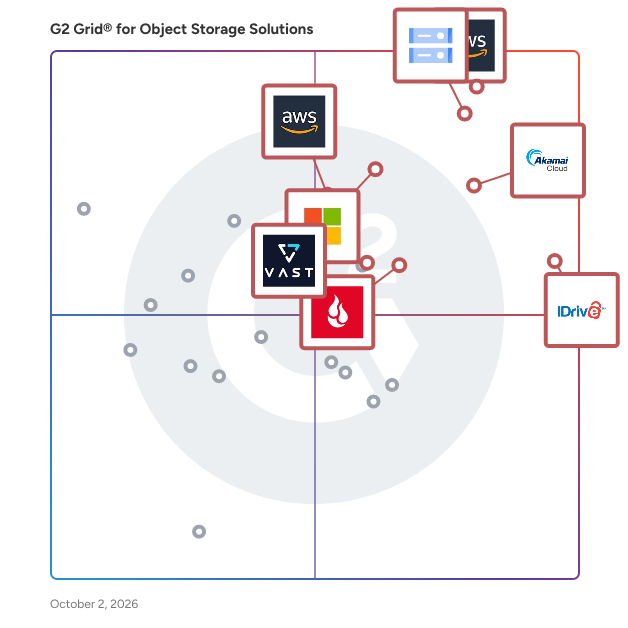
G2 takes pride in showing unbiased reviews on user satisfaction in our ratings and reports. We do not allow paid placements in any of our ratings, rankings, or reports. Learn about our scoring methodologies.
Object storage is a software architecture used to handle large amounts of unstructured data. Under object storage, data is stored as discrete units or objects within a data-connected environment. Each discrete storage unit contains the data being stored since it is the data repository, the metadata (information describing the object), and a globally unique identifier or ID number, allowing applications to access the unit when required. Each object is then aggregated under storage pools with several other objects, allowing for an unlimited scale of storage.
An application programming interface (API) is used to access each object. These APIs are used to create a query for the object’s metadata. The metadata is used to locate the desired object via the internet from any device and from any location. The native API used is an HTTP-based RESTful API. Some of the HTTP commands that are used to control the data include “POST” or “PUT” to upload data within the object, “DELETE” to remove the data, ”GET” to retrieve data from the object, and several other commands.
Traditional file (network attached storage (NAS)) and block (storage area networks (SAN)) software storage methods cannot be used when scalability is a requirement. This is where object storage steps in. Object storage solutions allow companies to store their data by providing scalability up to a terabyte (TB), petabyte (PB), or even higher.
Some common examples of object storage solutions used in daily life include storing playlists on Spotify, photos on Facebook, and documents using Google Drive, Dropbox, Sharepoint, and several other tools.
Object storage is a computer data storage architecture that stores and manages large volumes of unstructured data using distinct data units or objects. Each object has a metadata and a unique identifier that users can use to retrieve and access data. Users can also customize the metadata to add contextual information for easy retrieval later. Object storage systems don’t organize files using a hierarchical path, making storing data in a flat environment easy.
Object storage solutions store data in a global storage pool, meaning users can query and find the exact data they need using RESTful APIs, HTTP, and HTTPS. The flat environment enables users to easily locate the data they need, no matter where it's stored—be it across various devices or in different geographical locations.
The following are some core features within object storage solutions that can help users in several ways:
Scale-out architecture: Object storage software is supported by a distributed scale-out architecture. Within the architecture, several clusters of nodes exist, and these nodes contribute to the total amount of space available for storage. Users can also add nodes independently by parallelly adding them to increase capacity. Adding these nodal points provides massive scaling, even up to petabytes of data.
Metadata: The metadata feature is used in combination with several policy-based management capabilities to manage several data services, such as data protection, placement, compression, retention, deduplication, and deletion.
Multi-tenant nature: Object storage solutions separate infrastructure and users' needs using multi-tenancy. Data cannot be accessed by other tenants sharing the same infrastructure. This is especially useful for businesses that want to provide each department with storage space, with accessibility given to the specific department only.
Global namespace: A namespace is a set of signs that identify and refer to different objects. It ensures that objects are given unique names so that they can be identified easily. A namespace is a global feature, meaning that although data is stored in different locations, it will provide a common view to the user. This feature of object storage ensures nondisruptive performance, load balancing, and increased performance efficiency.
Automation: If a service crashes or a site suddenly becomes unavailable due to faults, the object storage system automatically activates the redundant components and services (duplicates) to prevent operations from being affected. Object storage solutions are, therefore, considered self-healing or auto-healing in nature. This important feature helps companies drastically minimize downtime.
Scalability: Discrete units of data are stored within an object, such as servers or storage boxes, within the data center's infrastructure. In case additional processing is required, the data center infrastructure provider needs to add server boxes parallel to the storage cluster.
Storing large amounts of unstructured data: Big data growth is explosive with the advent of internet communications and is still growing every second. The large amounts of unstructured data being generated require a strong storage architecture to ensure scalability, and object storage software is one of the best options for supporting unstructured data or big data.
Increased efficiency: Accessing data in a file system is a complex task since there are numerous folders and hierarchies to navigate. In the object storage system, information is immediately retrieved via metadata. This results in increased performance since the time to retrieve data is shortened significantly.
Disaster recovery support: Object-based storage solutions allow the user to configure the system to duplicate content. Due to any unforeseen activity or a disaster, the disk within a particular cluster may fail. However, since the data has been replicated, the system will continue to operate without any interruptions. The data can be replicated within nodes and several data centers located at different geographical locations.
Cost-effective: One of the main cost savings comes in the form of no upfront cost since an object storage software provider would manage the hardware or servers. A user does not need to purchase several servers and storage systems and set up an IT infrastructure, thereby saving initial costs. In addition, object storage providers offer the service as a pay-as-you-go subscription fee; therefore, no upfront investment is required.
Compatibility with cloud computing: Object storage is known for its compatibility with cloud computing. Object storage primarily uses cloud services or hosting services to provide storage services. Since the data is stored in the cloud (public cloud or private cloud), the company faces no major upfront cost. In addition, a company can share storage repositories among different departments within the organization, each with a dedicated resource or space.
Simplified manageability: As the amount of data continues to grow, a new approach is required to manage the data, and this is where object storage comes into play. Since object software manages a “name” and not the rack of storage, the difference is huge. The namespace could be located in different locations or local sites, in a single storage box, or within multiple racks. It could be configured in multiple ways, but with all these complexities, it is still manageable via a single pane of glass.
In object storage solutions, the key functionality is storing the data in a single repository instead of files within folders or blocks on servers. Each self-contained repository owns the data.
Object storage software solutions can come with their own set of challenges.
Once a customer has decided that object storage software is best suited for the company’s storage needs and can assist its journey towards cloud storage, some considerations need to be made.
When selecting from various object storage vendors, there are a few key aspects that need to be taken into consideration:
When evaluating vendors for object storage software, ask about compatibility with other software, data security features, authentication methods (like single sign-on and multi-factor authentication), automation capabilities, user roles, and storage tiers. Also, discuss pricing, which may vary based on location, data resilience, storage class, and archival needs. After demos, assess vendor plans to select the storage solution that best meets the company's needs and budget.
Historically, object storage solutions were always considered long-term archiving solutions, massive data lake solutions, or just inexpensive backups. However, the need for object-based storage has been renewed, with unstructured data and data analytics taking center stage.
The primary benefit of object storage is how well it manages unstructured data, making it absolutely critical for modern storage solutions to support data analytics initiatives. With the growth of social media, AI, machine learning, IoT, 5G, and several other technologies and the availability of internet communication to support these technologies, organizations are creating huge amounts of unstructured data.
Finally, the onset of the pandemic has coerced most organizations to work remotely, and therefore, the high availability feature of object storage is key since it replicates data across different nodes in data centers.
Researched and written by Rachana Hasyagar