Best AI Security Solutions Software - Page 13

How Many AI Security Solutions Software Products Does G2 Track?

Total Products under this Category: 304

Category Stats (Sep 2026)

  • Average Rating: 4.53/5 (↓0.05 vs Aug 2026) The average rating of products in this category, based on all submitted ratings
  • Top Trending Product: Patronus AI (+12.83%) - Among all products in this category, Patronus AI recorded the largest rating increase compared to last month

Last updated: September 05, 2026

How Does G2 Rank AI Security Solutions Software Products?

Why You Can Trust G2's Software Rankings:

  • 30 Analysts and Data Experts
  • 2,900+ Authentic Reviews
  • 304+ Products
  • Unbiased Rankings

G2's software rankings are built on verified user reviews, rigorous moderation, and a consistent research methodology maintained by a team of analysts and data experts. Each product is measured using the same transparent criteria, with no paid placement or vendor influence. While reviews reflect real user experiences, which can be subjective, they offer valuable insight into how software performs in the hands of professionals. Together, these inputs power the G2 Score, a standardized way to compare tools within every category.

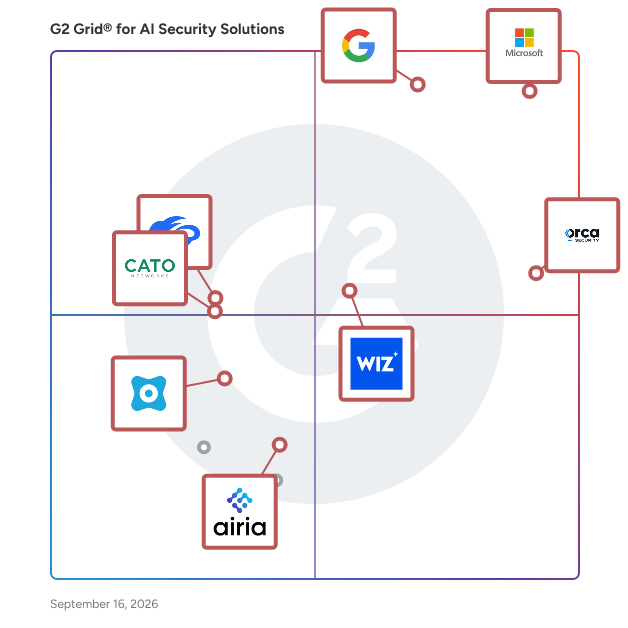
G2 Grid® for AI Security Solutions Software

G2 Grid® for AI Security Solutions Software plotting products by satisfaction and market presence

Highlighted products: Microsoft Defender for Cloud, Google Cloud Model Armor, Orca Security, Wiz, Zscaler Internet Access, Cato SASE Cloud, Securiti, and Airia.

Underlying data: [Grid® JSON](https://www.g2.com/categories/ai-security-solutions/grids.json?focus%5B%5D=microsoft-defender-for-cloud&focus%5B%5D=google-cloud-model-armor&focus%5B%5D=orca-security&focus%5B%5D=wiz-wiz&focus%5B%5D=zscaler-internet-access&focus%5B%5D=cato-networks-cato-sase-cloud&focus%5B%5D=securiti&focus%5B%5D=airia)

LLMSecure

LLMSecure is a comprehensive security solution designed to protect Large Language Model (LLM) applications from prompt injection attacks. By analyzing inputs through both static pattern matching and dynamic behavioral sandboxing, LLMSecure identifies and mitigates potential threats before they reach your LLM, ensuring the integrity and safety of your AI systems. Key Features and Functionality: - Static Pattern Detection: Utilizes regex and keyword-based pattern matching against a curated database of known prompt injection techniques to quickly identify common attacks. - Dynamic Behavioral Analysis: Employs a behavioral sandbox that simulates the execution of inputs within a controlled environment, observing attempted actions such as file reads, network requests, or system commands without executing them, to detect novel and sophisticated attacks. - Comprehensive Input Validation: Supports scanning of various input types, including text prompts, URLs, and files, ensuring all potential vectors are analyzed for security threats. - Customizable Detection Rules: Allows users to define custom detection rules with specific patterns, keywords, and scoring weights tailored to their application's unique requirements. - Real-Time Dashboard: Provides an intuitive analytics dashboard to monitor API requests, detection rates, and threat trends, offering valuable insights into the security posture of your LLM applications. - API Integration: Offers API keys for seamless integration into existing workflows, enabling automated input validation before processing by the LLM. Primary Value and Problem Solved: LLMSecure addresses the critical challenge of prompt injection attacks, where malicious inputs can manipulate LLM behavior to perform unintended actions, potentially leading to data breaches or system compromises. By implementing LLMSecure, organizations can proactively detect and prevent such attacks, safeguarding sensitive information and maintaining the reliability of their AI-driven applications. This proactive defense mechanism is essential for developers, businesses, and organizations integrating LLMs into their systems, ensuring compliance with security standards and protecting against emerging threats in the AI landscape.

Who Is the Company Behind LLMSecure?

LLMtary

LLMtary is an autonomous penetration testing application that leverages large language models (LLMs) to automate the entire security assessment lifecycle. Designed for Windows, macOS, and Linux, it streamlines processes from reconnaissance and vulnerability analysis to active exploit validation and professional report generation. Unlike traditional tools that merely suggest potential vulnerabilities, LLMtary executes real commands to confirm or refute each finding, ensuring accurate and actionable results. Key Features and Functionality: - Autonomous Reconnaissance: Utilizes LLM-guided engines to perform discovery tasks such as port scans, service banner identification, DNS enumeration, and WAF detection, compiling enriched target data for analysis. - Two-Phase Analysis Pipeline: Phase 1 focuses on CVE matching, DNS/OSINT, and network service analysis. Phase 2 conducts targeted assessments on web applications, Active Directory, and specific technologies, building upon Phase 1 insights. - Active Exploit Testing Loop: Employs an iterative process where the LLM plans, executes, evaluates, and adapts real shell commands against targets to confirm or dismiss vulnerabilities. - Attack Chain Reasoning: When multiple vulnerabilities are confirmed, the tool identifies and maps out multi-step attack paths, enhancing understanding of potential security breaches. - Credential Management: Collects discovered credentials session-wide, automatically reusing them for subsequent targets and triggering authenticated re-analysis for deeper insights. - Safety Controls: Incorporates hard blocklists to prevent execution of dangerous commands and offers a command approval mode for user review before execution, ensuring operational safety. - Post-Exploitation Enumeration: Upon confirming remote code execution or significant access, it automatically enumerates users, credentials, network interfaces, running services, and privilege escalation paths. - Professional Reporting: Generates comprehensive reports in HTML, Markdown, or CSV formats, featuring AI-assisted executive summaries, CVSS metadata, discovered credentials, and detailed attack chain narratives. Primary Value and User Solutions: LLMtary addresses the need for efficient, accurate, and comprehensive penetration testing by automating complex tasks traditionally performed manually. By integrating LLMs, it reduces the time and expertise required to conduct thorough security assessments, making it accessible to organizations of varying sizes. Its ability to confirm vulnerabilities through real command execution minimizes false positives, providing security teams with reliable data to prioritize and remediate threats effectively. The tool's structured approach mirrors real-world engagement workflows, ensuring that each phase enriches the next, leading to a holistic understanding of an organization's security posture.

Who Is the Company Behind LLMtary?

Lynx

Tigera Lynx is a unified control plane for Kubernetes-native AI agents. It sits in the path of every agent call — agent-to-agent, agent-to-tool, and agent-to-LLM — to authenticate, authorize, mediate, and audit each one. Lynx plugs into the tools enterprises already run, including their identity provider (EntraID, Okta) or via SPIFFE/SPIRE, and existing observability systems, and is built on open standards rather than proprietary lock-in.

Who Is the Company Behind Lynx?

  • Seller: Tigera
  • Company Website:
  • Year Founded: 2016
  • HQ Location: San Jose, CA
  • Twitter: @tigeraio
    1,951 Twitter followers
  • LinkedIn® Page: www.linkedin.com
    129 employees on LinkedIn®

MCP Security

MCP Security is a robust, open-standard framework designed to enhance the integration of Large Language Models (LLMs) with external systems, emphasizing secure and efficient data exchange. By utilizing the Model Context Protocol (MCP), it ensures real-time state synchronization between LLMs and various data sources, effectively preventing context loss in high-throughput scenarios. Key Features and Functionality: - Core Architecture: Operates on a client-host-server model, employing JSON-RPC 2.0 over multiple transport layers to facilitate seamless communication. - Context Management: Maintains real-time synchronization between LLMs and data sources, ensuring consistent and up-to-date information flow. - Security Architecture: Implements strict access controls, comprehensive audit trails, and isolates server connections with defined permission boundaries to safeguard data integrity. - MCP Servers: Provides specialized servers for integrating with platforms like GitHub, PostgreSQL, and Google Drive, enabling secure and efficient data access. - MCP Clients: Offers client applications such as Claude Desktop, Zed Editor, and MCP CLI, facilitating user-friendly interactions with MCP-enabled services. Primary Value and User Solutions: MCP Security addresses the critical need for secure, real-time integration between LLMs and external systems. By ensuring efficient context management and enforcing stringent security measures, it empowers organizations to leverage LLM capabilities without compromising data integrity or system performance. This solution is particularly beneficial for developers and enterprises seeking to enhance their AI applications with reliable and secure external data interactions.

Who Is the Company Behind MCP Security?

MidLyr

Who Is the Company Behind MidLyr?

  • Seller: MidLyr
  • Year Founded: 2025
  • HQ Location: Los Angeles, US
  • LinkedIn® Page: www.linkedin.com
    8 employees on LinkedIn®

Mindgard

Mindgard is the leader in ai red teaming, helping enterprises identify, assess, and mitigate real-world security risks across AI models, agents, and applications. Founded on pioneering research in AI security, Mindgard was built on the insight that traditional application security approaches cannot protect systems that are probabilistic, adaptive, and deeply embedded into business workflows. As organizations deploy GenAI and agentic systems at scale, risk increasingly emerges from how AI behaves, what it connects to, and how attackers can manipulate those interactions. Mindgard addresses this challenge with an attacker-aligned approach that mirrors how real adversaries perform reconnaissance, map attack surfaces, exploit system behavior, and pivot through tools, data, and infrastructure. Rather than testing models in isolation, Mindgard evaluates full AI systems in context to surface vulnerabilities with real security impact. The Mindgard Platform combines automated reconnaissance, continuous AI red teaming, and runtime detection and response into a single workflow. This enables security teams to discover shadow AI, validate guardrails and controls, measure AI risk over time, and actively defend deployed systems against exploitation. Findings are delivered with clear evidence to support remediation, governance, and compliance. By embedding deep research, offensive security expertise, and behavioral analysis into an enterprise-ready platform, Mindgard empowers organizations to deploy AI confidently, reduce risk, and realize the value of AI without exposing the business to unacceptable security threats.

Who Is the Company Behind Mindgard?

  • Seller: Mindgard
  • Year Founded: 2022
  • HQ Location: Boston, Massachusetts, United States
  • LinkedIn® Page: linkedin.com
    25 employees on LinkedIn®

Mira

Mira is a secure, AI-integrated work browser designed for teams operating within SaaS environments. Unlike traditional browsers, Mira incorporates built-in AI capabilities and enforces strict security policies directly within the browser, eliminating the need for separate applications, virtual desktops, or VPNs. It offers role-based workspaces, AI agents that function across multiple tabs, and zero-trust access, effectively replacing legacy VDI and VPN solutions for browser-based tasks. Key Features and Functionality: - Role-Based Workspaces: Organizes SaaS applications into workspaces tailored to specific team roles, enhancing productivity and focus. - Integrated AI Assistance: Provides an AI side panel that understands active tabs, offering summaries, comparisons, and data extraction across pages. - Strict Governance Controls: Implements fail-closed policies for navigation, downloads, uploads, clipboard usage, and extensions, ensuring secure operations. - Workflow Automation: Enables the creation of WebAgents to automate repetitive web tasks, with each action re-checked against policy before execution. - Data Protection: Utilizes encrypted local storage, data loss prevention (DLP) redaction, prompt-injection blocking, and OS-wrapped key storage to safeguard sensitive information. - Comprehensive Auditing: Offers metadata-only audit events and governance dashboards, providing administrators with visibility into SaaS usage and potential risks. Primary Value and User Solutions: Mira addresses the challenges of secure and efficient SaaS usage by integrating AI and governance directly into the browser. It streamlines workflows through role-specific workspaces and AI assistance, automates repetitive tasks with policy-compliant WebAgents, and ensures data security with stringent governance controls. By replacing outdated VDI and VPN solutions, Mira simplifies remote access, making it particularly beneficial for teams requiring secure, policy-enforced environments without the complexity of traditional remote access tools.

Who Is the Company Behind Mira?

  • Seller: Mira
  • Year Founded: 2026
  • HQ Location: N/A
  • LinkedIn® Page: www.linkedin.com
    1 employees on LinkedIn®

ModelCop

Who Is the Company Behind ModelCop?

  • Seller: ModelCop
  • Year Founded: 2026
  • HQ Location: Dallas, US
  • LinkedIn® Page: www.linkedin.com
    1 employees on LinkedIn®

ModOps.AI

ModOps.AI is an enterprise-grade content moderation platform that seamlessly integrates advanced artificial intelligence with expert human oversight to ensure accurate, safe, and scalable content management. Designed to protect online communities, ModOps.AI offers real-time, compliant decisions by blending AI automation with human review, providing a comprehensive solution from day one. Key Features and Functionality: - Multi-Modal AI Detection: Capable of analyzing text, images, videos, and audio with 98.3% accuracy across 27 categories, delivering definitive decisions rather than probabilities. - Predictive Moderation: Utilizes context-aware analysis of conversation history to predict and flag potential harmful user behavior before content is posted. - Live Policy Builder: Allows users to define and adjust content rules, tailor moderation thresholds, and maintain full visibility with comprehensive audit logs. - Enterprise Security: Ensures enterprise-grade security with a 99.99% SLA uptime and built-in impact analytics. Primary Value and User Solutions: ModOps.AI addresses the critical need for effective content moderation across various industries by reducing harmful content by 99.8%, providing 24/7 coverage, and decreasing moderation costs by 84.8%. It offers specialized solutions tailored to unique industry challenges, including: - Social Platforms: Combats spam, trolling, and offensive content at scale without compromising user experience. - Dating Apps: Prevents manipulation, fake profiles, and explicit messages through real-time AI intervention. - Gaming & Metaverse: Protects users from toxic behavior, bullying, and voice chat abuse, even in fast-paced multiplayer settings. - Online Communities: Stops misinformation, hate speech, and off-topic spam before they derail group trust and engagement. By providing an end-to-end AI moderation platform with built-in compliance and human oversight, ModOps.AI empowers organizations to safeguard their communities effectively, ensuring a safer and more engaging user experience.

Who Is the Company Behind ModOps.AI?

Lauren Worth
LW
Researched and written by Lauren Worth
Updated April 9, 2026