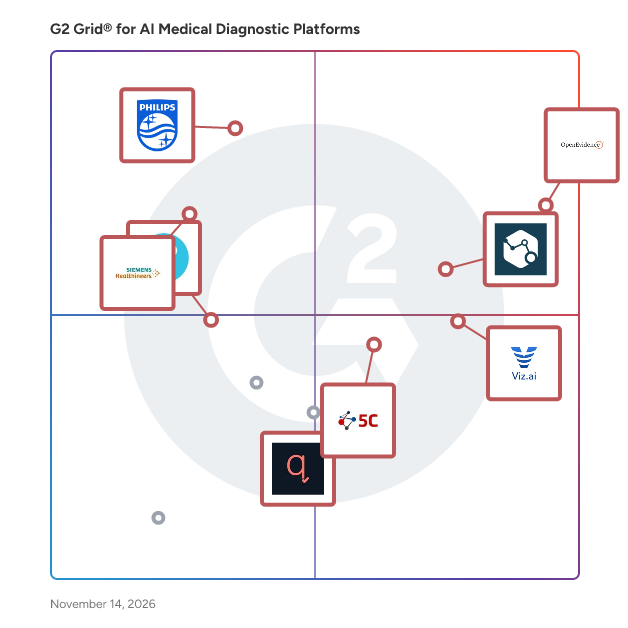
AI medical diagnostic platforms use artificial intelligence to help medical professionals detect diseases, interpret images, and make better diagnostic decisions. These tools review data, such as X-rays, CT scans, lab results, and patient records to identify patterns and flag potential health concerns.
Core Capabilities of AI Medical Diagnostic Platforms
To qualify for inclusion in the AI Medical Diagnostic Platforms category, a product must:
- Use AI or machine learning (ML) to generate diagnostic output or decision support
- Analyze medical data, including imaging, lab results, or clinical records
- Provide output relevant to detecting, classifying, or flagging diseases or health conditions
- Integrate with health care systems such as picture archiving and communication systems (PACS), electronic health records (EHR), radiology information systems (RIS), or clinical workflow tools
- Complies with relevant regulatory standards
Common use cases for AI Medical Diagnostic Platforms
Health care providers use AI-powered diagnostic platforms in hospitals, clinics, imaging labs, and telehealth to help reduce errors, speed up clinical workflows, and prioritize urgent cases. These products support specialists such as radiologists, cardiologists, neurologists, and pathologists by enabling them to review more cases more accurately and efficiently. These tools analyze information within healthcare systems, such as picture archiving and communication systems (PACS), electronic health records (EHR), radiology information systems (RIS), or clinical workflow tools.
Insights from G2 on AI Medical Diagnostic Platforms
Based on category trends on G2, AI-generated diagnostic outputs from imaging, lab results, and clinical data stand out as key strengths. Hospitals, clinics, and imaging labs use these platforms to help specialists review more cases accurately and prioritize urgent ones.