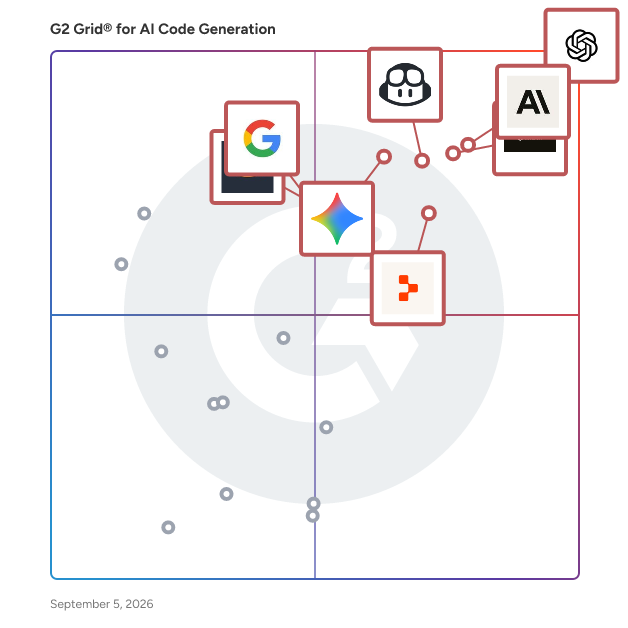
Best AI Code Generation Software - Page 8

How Many AI Code Generation Software Products Does G2 Track?

Total Products under this Category: 116

Category Stats (Jul 2026)

  • Average Rating: 4.47/5 (↑0.02 vs Jun 2026) The average rating of products in this category, based on all submitted ratings
  • Top Trending Product: Genspark AI (+40.0%) - Among all products in this category, Genspark AI recorded the largest rating increase compared to last month

Last updated: July 01, 2026

How Does G2 Rank AI Code Generation Software Products?

Why You Can Trust G2's Software Rankings:

  • 30 Analysts and Data Experts
  • 6,600+ Authentic Reviews
  • 116+ Products
  • Unbiased Rankings

G2's software rankings are built on verified user reviews, rigorous moderation, and a consistent research methodology maintained by a team of analysts and data experts. Each product is measured using the same transparent criteria, with no paid placement or vendor influence. While reviews reflect real user experiences, which can be subjective, they offer valuable insight into how software performs in the hands of professionals. Together, these inputs power the G2 Score, a standardized way to compare tools within every category.

Product Description

Star Command is an AI-powered software development platform that generates complete, production-ready applications from natural language specifications. Unlike code assistants that help you write snippets, Star Command builds entire applications—frontend, backend, database schemas, tests, and documentation—all from your project description.

Product Description

SwytchCode is an AI-powered solutions engineering platform designed to streamline API and SDK integrations for developers. By transforming static API documentation into interactive, AI-driven environments, SwytchCode enables developers to interact with APIs through conversational interfaces, test endpoints in real-time, and generate integration workflows across more than 15 programming languages. This approach significantly reduces integration time, enhances developer experience, and minimizes support overhead for API publishers. Key Features: - 1-Click Ready Code: Automatically generates production-ready API integration code in over 15 programming languages, including Python, JavaScript, Go, Java, and Ruby, allowing developers to integrate APIs swiftly without manual coding. - Custom Workflow Builder: Offers a visual, drag-and-drop interface for creating and managing complex API workflows, facilitating seamless integration within developers' preferred IDEs. - Smart Testing & Mocking: Provides automated testing capabilities, including mock API generation and parameter validation, enabling developers to test and debug integrations efficiently. - Interactive API Playground: Transforms static API documentation into dynamic, interactive environments where developers can test endpoints, generate code snippets, and explore API functionalities in real-time. - Model Context Protocol (MCP) Server: Acts as an intelligent intermediary, allowing AI agents to execute real integrations within codebases while ensuring policy control, determinism, and security compliance. Primary Value and Solutions: SwytchCode addresses common challenges in API integration by automating code generation and workflow creation, thereby reducing the time and effort required for developers to integrate APIs. This automation leads to a 60% reduction in support costs and a 95% developer success rate, as developers can achieve successful integrations in under two minutes. By providing interactive documentation and AI-assisted tools, SwytchCode enhances the developer experience, reduces onboarding friction, and accelerates the adoption of APIs, ultimately benefiting both API publishers and consumers.

G2 Advertising
Sponsored
G2 Advertising
Get 2x conversion than Google Ads with G2 Advertising!
G2 Advertising places your product in premium positions on high-traffic pages and on targeted competitor pages to reach buyers at key comparison moments.

Product Description

Syntha AI is an advanced AI-powered platform designed to enhance developers' coding efficiency by automating various programming tasks. It offers a suite of intelligent agents that assist in generating, explaining, converting, debugging, and optimizing code across multiple programming languages. By integrating state-of-the-art language models like GPT-4.1 and Claude Sonnet 3.7, Syntha AI streamlines the development process, allowing developers to focus on innovation and complex problem-solving. Key Features and Functionality: - Code Generation: Automatically produce code snippets tailored to specific tasks, reducing manual coding efforts. - Code Explanation: Provide clear, plain-language explanations of complex code segments, facilitating better understanding and documentation. - Code Conversion: Effortlessly translate code between over 60 programming languages and frameworks, ensuring compatibility and flexibility. - Code Optimization: Analyze and enhance code performance and quality by identifying and rectifying inefficiencies. - Diagram Generation: Create visual representations of code structures and data flows using Mermaid syntax, aiding in visualization and communication. - Test Generation: Develop automated tests to ensure code reliability and robustness. Primary Value and User Solutions: Syntha AI addresses common challenges faced by developers, such as time-consuming manual coding, language barriers, and code optimization complexities. By automating these tasks, it significantly reduces development time, enhances code quality, and promotes seamless collaboration across diverse programming environments. This leads to increased productivity, faster project completion, and a more efficient development workflow.

Product Description

Tailkits UI is a comprehensive library offering over 200 production-ready Tailwind CSS components designed to streamline the development of modern, responsive web interfaces. By integrating with AI assistants through the Model Context Protocol (MCP), Tailkits UI enables developers to describe desired UIs in plain language and receive clean, consistent code, significantly accelerating the development process. Key Features: - Extensive Component Library: Access over 200 customizable components across 21 categories, including heroes, pricing tables, testimonials, and call-to-actions, all optimized for responsiveness and mobile-first design. - AI Integration via MCP: Seamlessly connect with AI assistants like ChatGPT, Claude, and Cursor to generate and implement UI components directly from natural language prompts. - Framework Compatibility: Components are built using standard Tailwind utility classes, ensuring compatibility with frameworks such as React, Vue, Next.js, and plain HTML, without the need for additional configuration. - Responsive and Mobile-First Design: All components are designed to adapt perfectly to any screen size, ensuring a consistent user experience across devices. - No Configuration Required: Built with Tailwind's default classes, allowing developers to copy and paste components directly into projects without additional setup. Primary Value and Problem Solved: Tailkits UI addresses the challenge of rapidly developing consistent and visually appealing web interfaces by providing a vast collection of pre-designed, responsive components. The integration with AI assistants through MCP allows developers to generate and implement UI elements efficiently, reducing manual coding efforts and accelerating project timelines. This solution is particularly beneficial for teams aiming to maintain design consistency across projects while leveraging the speed and flexibility of AI-driven development.

Product Description

Terminal brings AI to investing.

Product Description

TetreesAI is an innovative platform that revolutionizes the software development process by integrating AI-powered coding assistance with a dynamic code block marketplace. It enables developers to transform plain language ideas into functional code across frontend, backend, mobile, and plugin sessions in real-time. This seamless experience is enhanced by features such as live previews, terminal access, and an intuitive file tree, all within a unified studio environment. Key Features and Functionality: - AI-Powered Coding Studio: Developers can describe their concepts in natural language, and the AI translates these descriptions into working code, facilitating rapid prototyping and development. - Live Preview and Terminal: The platform offers real-time previews and terminal access, allowing developers to test and refine their code instantly. - Code Block Marketplace: Users can browse and purchase verified, installable code blocks across various domains, enabling quick integration of complex functionalities. - Seamless Integration: The AI handles the wiring between frontend and backend components, simplifying the development process and reducing manual configuration. - Monetization for Developers: Creators can package their code sessions as blocks, set their own prices, and earn up to 70% of each sale, with payouts processed via Stripe Connect. Primary Value and User Solutions: TetreesAI addresses the challenges of modern software development by streamlining the coding process, reducing the time and effort required to bring ideas to life. For builders, it offers an AI-assisted environment that accelerates development and fosters innovation. Buyers benefit from access to a diverse marketplace of ready-to-use code blocks, enhancing productivity and reducing development costs. Sellers gain a platform to monetize their expertise, reaching a broader audience and generating income from their code contributions. Overall, TetreesAI empowers developers to build, share, and profit from their creations in a collaborative and efficient ecosystem.

Product Description

Text2SQL.AI is an AI-powered platform that transforms natural language instructions into SQL queries, Excel formulas, and Regex expressions. Designed for both beginners and professionals, it simplifies complex query generation, enhances productivity, and streamlines data management tasks. Key Features and Functionality: - AI-Powered Query Generation: Converts plain English prompts into SQL queries, supporting various SQL dialects such as MySQL, PostgreSQL, and MS SQL. - Query Explanation and Optimization: Provides plain English explanations for SQL queries, offers error correction, and suggests performance improvements to enhance query efficiency. - Custom Database Schema Integration: Allows users to incorporate their own database schemas, ensuring compatibility and precision in query generation. - API Access: Enables integration with other applications, facilitating workflow automation and seamless tool integration. - Support for Excel and Google Sheets: Generates and explains formulas for Excel and Google Sheets, expanding its utility beyond SQL queries. Primary Value and User Solutions: Text2SQL.AI addresses the challenge of writing complex SQL queries by enabling users to generate accurate and optimized queries using natural language. This capability saves time, reduces the learning curve for SQL, and minimizes errors, making data analysis and database management more accessible and efficient for users at all skill levels.

Product Description

vCodeX is an advanced AI-powered code generation platform designed to streamline software development by automating code creation and enhancing developer productivity. By leveraging cutting-edge machine learning algorithms, vCodeX assists developers in writing efficient, error-free code across various programming languages and frameworks. Key features and functionality of vCodeX include: - Intelligent Code Completion: Offers real-time suggestions to complete code snippets, reducing development time and minimizing syntax errors. - Automated Code Generation: Generates boilerplate code and complex algorithms based on user input, accelerating the development process. - Multi-Language Support: Supports a wide range of programming languages, enabling versatility for diverse development projects. - Code Optimization: Analyzes and refactors code to improve performance and maintainability. - Integration with Development Environments: Seamlessly integrates with popular IDEs and version control systems, ensuring a smooth workflow. The primary value of vCodeX lies in its ability to significantly reduce the time and effort required for coding tasks, allowing developers to focus on higher-level design and problem-solving. By automating routine coding activities and providing intelligent assistance, vCodeX enhances code quality, accelerates project timelines, and ultimately leads to more efficient and effective software development.

Product Description

Most AI coding tools make you do all the hard work. You paste in context. You explain the codebase. You manage what gets done next. Then the session ends — and you start all over again. VibeFlow is different. It's an autonomous AI development platform that comes with a full software team built in — a developer, an architect, a product manager, a QA engineer, a security lead, and a DevOps engineer. They all share memory, work together, and keep going even when you step away. Here's what makes it special: 🧠 It remembers everything. VibeFlow stores your project's rules, past decisions, and lessons learned. Agents pick up right where they left off — every single time. 👥 A real team, not just one bot. Six AI specialists work together. The architect designs the system. The developer writes the code. The security lead checks every commit. The QA engineer makes sure it works. All of it happens automatically. 📋 A work queue that runs itself. Agents pull tasks from a structured backlog, claim them, do the work, and move on. No hand-holding needed. 🔒 Built-in compliance tracking. Every step is logged and tagged for SOC 2 and ISO 27001. You get a full audit trail from requirement to git commit. ⚡ 45–65% fewer tokens wasted. VibeFlow loads only the context each task needs — so agents spend less time re-reading files and more time shipping code. 🛑 Humans stay in control. When agents hit a hard call, they pause and ask. You decide. They execute. Whether you're a solo developer who wants to move faster or an engineering team that needs governance baked in — VibeFlow turns AI coding from a helpful assistant into a reliable team member.

Product Description

Zeedle AI is an innovative platform that leverages artificial intelligence to revolutionize the software development lifecycle. By automating tasks from code generation to deployment, it enables developers to produce high-quality code more efficiently, reducing development time and enhancing overall productivity. Key Features and Functionality: - AI Code Generation: Transforms natural language descriptions into production-ready code, understanding context and best practices to deliver accurate results. - Automated Testing: Generates and executes intelligent tests, identifying and addressing bugs before they reach production. - Bug Detection & Fixing: Provides real-time bug detection with automated solutions, analyzing codebases to suggest optimal fixes. - Code Optimization: Automatically identifies performance bottlenecks and refactors code to enhance efficiency. - Smart Collaboration: Facilitates seamless teamwork with AI-powered code reviews and merge conflict resolution. - Team Analytics: Offers insights into team productivity and code quality, supporting data-driven decision-making for improved development workflows. Primary Value and User Solutions: Zeedle AI addresses common challenges in software development by automating repetitive tasks, reducing the likelihood of human error, and accelerating the development process. Developers and teams benefit from faster project completion, higher code accuracy, and continuous AI assistance, leading to more efficient and innovative software engineering practices.

Product Description

Zosma Code is an open-source alternative to proprietary AI coding tools like Claude Code and Claude Cowork. Built upon the minimal coding harness 'pi,' it offers a lean, extensible core that integrates seamlessly with various large language model (LLM) providers, including OpenAI, Anthropic, Google, DeepSeek, and local models. This flexibility allows users to select cost-effective providers, reducing expenses to as low as $5–10 per month. Zosma Code is designed to automate the entire software development lifecycle (SDLC), encompassing project management, development, quality assurance, deployment, and monitoring. Key Features and Functionality: - Open-Source Foundation: Built on 'pi,' a minimal coding harness, ensuring a lightweight and adaptable framework. - LLM Provider Flexibility: Compatible with multiple LLM providers, allowing users to choose based on cost and performance preferences. - Custom Extensions and Skills: Supports the development of tailored extensions and skills to align AI capabilities with specific workflows, proprietary APIs, and compliance requirements. - Comprehensive SDLC Automation: Employs AI agents to autonomously handle tasks across the SDLC, including requirement analysis, code development, testing, deployment, and monitoring. - Cost Efficiency: Optimized token consumption and provider flexibility lead to significant cost savings compared to traditional AI coding tools. Primary Value and User Solutions: Zosma Code addresses the challenges of high costs and vendor lock-in associated with proprietary AI coding tools. By offering an open-source, customizable, and cost-effective solution, it empowers development teams to automate their workflows, reduce team sizes, and accelerate feature delivery. The platform's adaptability ensures that AI integration aligns with existing processes, enhancing productivity without compromising control over data and infrastructure.

Adam Crivello
AC
Researched and written by Adam Crivello
Updated May 8, 2026

How Do You Choose the Right AI Code Generation Software?

What You Should Know About AI Code Generators

AI code generation software encompasses tools that utilize artificial intelligence (AI) and machine learning (ML) to create and write code based on a user's prompt. This code is written based on the best practices for that particular coding language and a natural language description of the expected code.

In short, instead of manually typing out each line of code, the user gives the AI code generation tool a description of what they want the code to do. The software then uses ML and AI to write the code automatically based on user input.

Most tools are generalized, but some AI code generation tools are created for specific use cases, like game or web development.

Developers use AI code generation software to reduce the time and effort spent on repetitive coding tasks. By incorporating these tools into their workflow, developers at all skill levels can improve code consistency and increase productivity. Additionally, this type of software makes coding more accessible to everyone, regardless of skill level or knowledge of programming languages. 

Plus, code generation tools can write code faster and in real time than a human programmer. They’re also more efficient because they can learn any technology or framework represented in their training dataset. 

What are the common features of AI code generation software?

The following are some features of AI code generation software that companies can use to write lines of code on their behalf.

Note that specific features may vary between different products.

  • Automatic code generation: This allows the software to generate code snippets automatically, based on various parameters and details, which can reduce repetitive coding tasks and increase developer productivity.
  • Machine learning capabilities: Machine learning algorithms are used to improve code suggestions and generate more sophisticated and high-quality code snippets based on the context given by the user.
  • Natural language processing (NLP) integration: This feature allows the software to understand and process human language to generate code based on verbal or written descriptions.
  • Support for multiple programming languages: This enables the software to support various programming languages, such as Python, Javascript, Ruby, HTML, and PHP, making it versatile for different development scenarios.
  • Advanced debugging tools: AI-powered code generators often come with advanced debugging tools, which provide detailed insights into the performance of the generated programs. The code editor can also quickly detect errors and vulnerabilities in source code to help programmers identify potential problems before they become significant issues.
  • Code suggestions and autocompletion: This feature offers code completion suggestions to enhance existing code to help developers write more efficiently and learn syntax and functions of languages quickly.

Types of AI code generation tools

There are three types of AI code generation tools a company can choose.

  • Rule-based code generators: These tools generate code based on predefined rules or patterns. These rules can cover syntax, logic, or design patterns. 
  • Machine learning-based code generators: These tools use algorithms and models to generate code. Typically, a user provides the tool with a large dataset of example code snippets or specific programming tasks. From there, the software trains machine learning models, such as neural networks or decision trees, to learn patterns and relationships between input code and output solutions to generate code.
  • NLP-based code generators: This type of AI code generation software enables developers to program computers by speaking natural language commands instead of manually writing lines of code. This allows non-technical users to communicate directly with computers without knowledge of coding languages.

What are the benefits of AI code generation software?

Whether you’re an experienced developer or a user new to the world of writing code, using AI code generation software has numerous benefits.

  • Faster development: These AI tools can drastically reduce the time and effort needed to write code, complete projects, and work on other repetitive tasks. Since AI coding tools speed up the process of writing code, this also means faster project turnovers. 
  • Less task switching: AI code generators reduce the jumping back and forth between writing lines of code and free developers of the smaller tasks on their plate.
  • Boosts productivity: AI code generators streamline the development process for users, as developers can work faster and more efficiently. This saves time, resources, and money, and projects are completed sooner.
  • Frees up developers to work on larger, more complex projects: Since these coding assistants make the most of algorithms that can write code quickly and accurately, the developer is not required to do as much. This reduces the need for smaller, more minute tasks dedicated to writing code and allows developers to focus on more complex projects.

Who uses AI code generation tools?

Several different types of users and teams within organizations can benefit from using AI code generators. 

Individuals:

  • Software developers: Software developers use AI code generators to write the code for software and various applications quickly and with minimal effort.
  • IT administrators: An IT administrator uses this software to automate tasks, manage infrastructure, enhance security, develop custom solutions, and optimize performance. This can streamline workflows, strengthen cybersecurity, and enable efficient problem-solving. 
  • Data scientists: Since these AI models can process large amounts of data efficiently and quickly, data scientists use these tools to produce advanced models without having to write lengthy programs every time a new experiment is in the works.

Teams:

  • IT teams turn to AI code generation tools to assist in troubleshooting efforts and optimizing performance so they can focus on innovation efforts and other strategic initiatives. 
  • Software development teams leverage AI code generation software to automate repetitive tasks, speed up the coding processes, and optimize performance. Additionally, these tools can aid in debugging and generating code for complex algorithms.
  • Data science and machine learning teams use AI code generators to automate tasks like model development, streamlining data processing, and speeding up experimentation. 

AI code generation software pricing

AI code generation software is typically broken into three different pricing models.

  • Subscription model: Users pay a recurring fee to access all features at regular intervals, such as monthly or annually.
  • Freemium model: Offers a free basic version of the software with limited features and functionality. Users can upgrade to a paid version to access additional features when needed.
  • Pay-per-use model: This model allows users to pay for the software based on their usage, data storage, time spent using the tool, seats, or consumption. 

Like most software, the price will vary depending on factors such as the complexity of the program and the features it offers. Basic tools can range from free to a few hundred dollars. More robust enterprise-level tools could be upwards of thousands of dollars. Some tools may also have recurring monthly fees and updates to the software with a price attached.

Before investing in an AI code generation tool, companies need to list their specific needs and the features on their must-have list for more clarity.

Alternatives to AI code generation tools

Before choosing an AI code generation tool, companies can also consider one of the following alternatives for their needs.

  • Low-code development platforms: Low-code development platforms allow businesses to develop software quickly with minimal coding, reducing the need for extensive coding experience. These tools provide base-level code, scripts, and integrations so users can prototype, build, or scale applications without developing complex infrastructures. Some products are geared more toward developers and require coding for functionality, while others provide element libraries for design. 
  • No-code development platforms: These tools offer drag-and-drop functionality, allowing developers to create applications quickly and efficiently without coding expertise. No-code development solutions offer a range of features, including templates for workflows, libraries of elements, and customizable interfaces.
  • Code libraries: A code library is a collection of reusable code modules, functions, classes, or snippets that companies can use to speed up software development. These repositories have the functionality to address common programming tasks, such as data manipulation, user interface design, or network communication. Developers can incorporate code from libraries into their own projects to save time and limit errors.

Software and services related to AI code generation software

There are certain tools related to AI code generation software that have similar features and functionalities and can be useful depending on a business's needs. Some examples of such tools are:

Challenges with AI code generation software

Despite the several benefits users can experience from AI code generation software, there are some challenges to remember, too.

  • Code quality: One of the main challenges of using AI-generated code editors is the code's quality. Since coding AI assistants use regenerative AI technology and predict how code is written based on specific training material, they may produce low-quality and non-functional source code. It also may not comprehend what it’s writing, leading to more errors or broken code.
  • Maintenance: All code needs to be maintained, but code written using an AI code generation tool may be more complex than necessary, making it harder to maintain over time. This overly complex code can lead to unnecessary abstractions, excessive layers of code, or overly intricate logic, making debugging and collaboration challenging. 
  • Less control: Some users worry that relying too heavily on AI assistants could diminish their coding skills and expertise. Additionally, there’s the potential loss of control over the development process, as users may have less input into the written code.
  • Learning curve for developers/organizations: As with using any new software for the first time, there’s a learning curve for both developers and the organization. However, the curve may be steep and take time to master before achieving maximum productivity.

Which companies should buy AI code generation software?

Any company with a development team could benefit from AI code generation tools, but there are specific types of companies that should consider buying this type of software to add to their tech stack.

  • Financial institutions: Banks and financial institutions can utilize AI code generation to automate regulatory compliance, enhance security measures, and develop custom financial processes for risk analysis and fraud detection.
  • Healthcare organizations: Healthcare companies can use AI code generation to develop predictive models, automate medical imaging analysis, and optimize patient care processes.
  • Legal firms: A legal organization can use AI code generation to assist in document automation, legal research and analytics, and compliance monitoring.
  • Government agencies: Government organizations can use these tools to automate administrative tasks, enhance cybersecurity efforts, and develop predictive models for resource allocation and policy planning.
  • Educational companies: Educational institutions and schools can use AI code generation to develop personalized learning platforms, automate administrative tasks like grading and scheduling, and analyze student performance data for insights into how effective the current curriculum is.
  • Retail companies: Retailers can use this software to optimize pricing strategies, automate customer segmentation for targeted marketing campaigns, and develop recommendations for personalized shopping experiences.

How to choose the best AI code generation tools?

The following explains the step-by-step process buyers can use to find suitable AI code-generation tools for their business. 

1. Identify business needs and priorities

Before choosing an AI code generation tool, businesses should identify their top priorities in a tool and what exactly they’ll be using it for. Clear goals and requirements can make the selection process easier and more efficient. Companies should consider factors like how quickly they need to generate results, how much automation will be required, and what level of accuracy is needed.

2. Choose the necessary technology and features

Next, companies should narrow down the features and functionalities they need most. Some essential technology and features a company may be looking for are:

  • Auto completion of code: This provides suggestions and completes code snippets based on context.
  • Code refactoring: With this feature, the tool can restructure existing code to improve performance and readability.
  • Syntax checking: This feature identifies errors and potential bugs in the code.
  • Code analysis: AI code generation tools must identify bottlenecks, security vulnerabilities, and areas for optimization.
  • Machine learning assistants: These enable AI-powered assistants to help developers write code, suggest improvements, or answer coding-related queries.
  • Cross-platform support: This is required for multiple programming languages and development environments so that users can work across different platforms seamlessly.

Once companies short-list services based on their requirements and must-have functionalities, it’s easier to determine which options best suit their needs.

3. Review vendor vision, roadmap, viability, and support

In this stage, a buyer should start vetting the selected AI code generation software vendors and conduct demos to determine if a product meets their requirements. For the best outcome, a buyer should share detailed requirements in advance so a vendor knows what features and functionalities to showcase during the demo. 

Below are some questions buyers should ask vendors during the demo.

  • How does the software handle different programming languages and frameworks?
  • What level of customization and flexibility does the software offer for generating code to fit specific project requirements?
  • How does your software ensure code quality and compliance with coding standards?
  • What support and training options do you provide for users adopting your software?
  • What security measures are in place to protect sensitive code and data processed by your software?
  • Can the tool integrate with existing development tools and workflows, such as IDEs and version control systems?
  • What level of technical support is available, and how responsive is your support team to customer inquiries and issues?

4. Evaluate the deployment and purchasing model

Once a buyer has received answers and is ready to move on to the next stage, they will likely loop in key stakeholders within the organization and at least one employee from each department who will be using the software. For example, with AI code generation, it’s best that the buyer loops in the developers who will be using the software to ensure it covers everything they need for maximum productivity.

5. Put it all together

A buyer makes the final decision after getting buy-in from everyone on the selection committee, including end users. This buy-in is essential for getting everyone on the same page regarding implementation, onboarding, and various use cases. 

AI code generation software trends

Some recent trends that were seen in the field of AI code generation software are:

  • Companies integrating and adopting AI code generation tools for the first time: AI code generation tools are making the most of recent developments in AI and ML for significant improvements regarding their features and functionality. Many companies are learning how to integrate these tools with their current tech stack for the first time. This trend stems from the demand for efficient code, the want to save money, and companies looking for a competitive advantage.
  • AI will aid rather than replace developers: It’s important that developers see AI and AI code generation tools as an aid they can use to speed up the process of writing code, which gives them the opportunity and time to work on other tasks rather than being a replacement. AI can automate repetitive tasks, provide insights, and enhance productivity. Whereas developers and real users will always lean on critical thinking, creativity, and problem-solving skills that AI currently cannot replicate. 

Researched and written by Adam Crivello

Reviewed and edited by Supanna Das