# Best Predictive Analytics Tools and Software - Page 20

*By [Bijou Barry](https://research.g2.com/insights/author/bijou-barry)*


Predictive analytics software mines and analyzes historical data patterns to predict future outcomes by extracting information from data sets to determine patterns and trends. Using a range of statistical analysis and algorithms, analysts use predictive analytics tools to build decision models, which business managers can use to plan for the best possible outcome. Analysts, business users, data scientists, and developers all use predictive analytics solutions to better understand customers, products, and partners and to identify potential risks and opportunities for a company.

Predictive analytics platforms enable organizations to use big data (both stored and real-time) to move from a historical view to a forward-looking perspective of the customer. These tools and techniques can be deployed both on premise (usually for enterprise users) and in the cloud. While the majority of predictive analytics software is proprietary, versions that are based on open-source technology do exist. Recent trends in software for predictive analytics show its integration with [business intelligence platforms](https://www.g2.com/categories/business-intelligence-platforms), [ERP systems](https://www.g2.com/categories/erp-systems), or other [digital analytics software](https://www.g2.com/categories/digital-analytics).

To qualify for inclusion in the Predictive Analytics category, a product must:

- Mine and analyze structured and/or unstructured data 
- Create datasets and/or data visualizations from compiled data 
- Create predictive models to forecast future probabilities 
- Adapt to change and revisions 
- Allow import and export from office suites or other data-collecting channels 
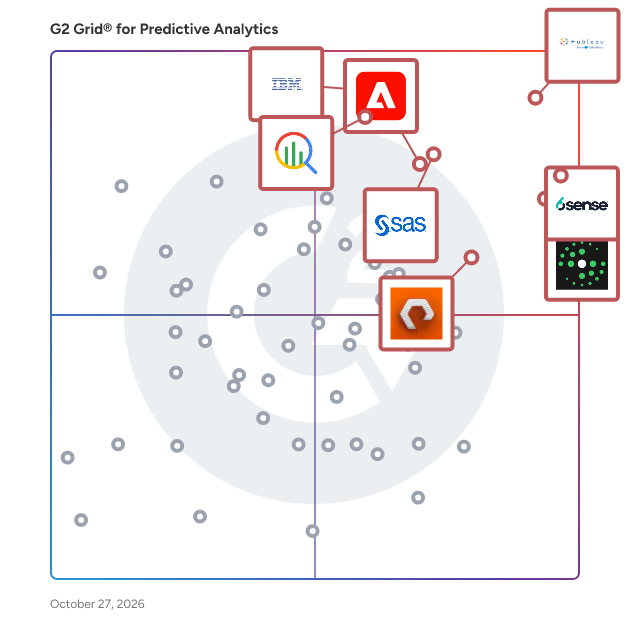


## Top Predictive Analytics Software at a Glance
| # | Product | Rating | Best For | What Users Say |
|---|---------|--------|----------|----------------|
| 1 | [Tableau](https://www.g2.com/products/tableau/reviews) | 4.4/5.0 (3,608 reviews) | Visual data storytelling with drag-and-drop forecasting | "[Intuitive, Interactive Dashboards That Make Complex Data Easy to Understand](https://www.g2.com/survey_responses/tableau-review-12981637)" |
| 2 | [Clari](https://www.g2.com/products/clari/reviews) | 4.6/5.0 (5,501 reviews) | AI-driven revenue forecasting inside Salesforce pipelines | "[Clari has met and exceed our expectations for our GTM Oganization](https://www.g2.com/survey_responses/clari-review-10775002)" |
| 3 | [Google Cloud BigQuery](https://www.g2.com/products/google-cloud-bigquery/reviews) | 4.5/5.0 (1,147 reviews) | SQL-based ML modeling on petabyte-scale datasets | "[Easy-to-Use Cloud Tool with Shareable, Saved Queries](https://www.g2.com/survey_responses/google-cloud-bigquery-review-12958418)" |
| 4 | [SAS Viya](https://www.g2.com/products/sas-sas-viya/reviews) | 4.3/5.0 (757 reviews) | Enterprise ML model governance with low-code deployment | "[Powerful &amp; Transforming Data into Decisions—Effortlessly and Intelligently.](https://www.g2.com/survey_responses/sas-viya-review-12682824)" |
| 5 | [Adobe Analytics](https://www.g2.com/products/adobe-analytics/reviews) | 4.2/5.0 (1,147 reviews) | Cross-channel customer journey analytics with Adobe integration | "[Powerful analytics tool for deep user insights and data driven decisions](https://www.g2.com/survey_responses/adobe-analytics-review-12736389)" |
| 6 | [IBM Cognos Analytics](https://www.g2.com/products/ibm-cognos-analytics/reviews) | 4.1/5.0 (437 reviews) | Enterprise forecasting with governed data models | "[Powerful, Scalable Analytics with Interactive Dashboards and Strong Governance](https://www.g2.com/survey_responses/ibm-cognos-analytics-review-12770018)" |
| 7 | [Amazon QuickSight](https://www.g2.com/products/amazon-quicksight/reviews) | 4.3/5.0 (675 reviews) | AWS-native dashboards with ML-powered forecasting | "[Turns Raw Data into Interactive Dashboards for Better Trend Monitoring](https://www.g2.com/survey_responses/amazon-quicksight-review-12740199)" |
| 8 | [IBM SPSS Statistics](https://www.g2.com/products/ibm-spss-statistics/reviews) | 4.2/5.0 (893 reviews) | Point-and-click statistical modeling for non-programmers | "[Powerful, User-Friendly Platform for Advanced Data Analysis and Reporting](https://www.g2.com/survey_responses/ibm-spss-statistics-review-12803842)" |
| 9 | [SAP Analytics Cloud](https://www.g2.com/products/sap-analytics-cloud/reviews) | 4.2/5.0 (750 reviews) | — | "[Reliable &amp; User-Friendly Analytics Tool](https://www.g2.com/survey_responses/sap-analytics-cloud-review-12885706)" |
| 10 | [SAP HANA Cloud](https://www.g2.com/products/sap-hana-cloud-2025-10-01/reviews) | 4.3/5.0 (522 reviews) | Real-time predictive analytics on SAP transactional data | "[Efficient Transactions, But Time-Intensive Setup](https://www.g2.com/survey_responses/sap-hana-cloud-review-12983922)" |

---
## What Are the Most Common Questions About Predictive Analytics Software?
*AI-generated · Last updated: May 26, 2026*
### Which Predictive Analytics platforms let non-technical analysts build models without writing code?
Based on G2 reviews, several predictive analytics tools are consistently described as approachable for non-technical users because they rely on visual workflows, drag-and-drop interfaces, or low-code model building. According to verified users, SAS Viya stands out for letting teams analyze data, build models, and create dashboards without heavy coding, while still supporting code when needed. G2 reviewers mention Pecan as a way to run predictive models quickly without a dedicated data science team, and Alteryx is often praised for making data preparation and analytics easier for business users who are not coders. These themes point to tools that reduce technical barriers while still supporting practical predictive work.

**Here are some of the top-rated products on G2:**

- [SAS Viya](https://www.g2.com/products/sas-sas-viya/reviews/sas-viya-review-12717278) – supports no-code and code-based analytics with automated reporting and fast model work
- [Pecan](https://www.g2.com/products/pecan/reviews/pecan-review-12160044) – helps teams run predictive models quickly without needing a full data science team
- [Alteryx](https://www.g2.com/products/alteryx/reviews/alteryx-review-12847135) – enables non-coders to prep data, automate tasks, and produce KPI reporting


### Which Predictive Analytics platforms avoid predictions that fail spectacularly in live production environments?
Based on G2 reviews, buyers tend to trust platforms that reviewers describe as reliable in production, easy to validate, and supported by strong deployment workflows. According to verified users, Pecan is frequently praised for getting predictive models live quickly and helping teams use them in sales, fraud, and demand planning use cases without a large data science function. G2 reviewers mention that it is not a black box to the same degree as some alternatives and that support teams help with setup and model improvement, which can reduce production risk. Reviews also suggest that platforms with clear monitoring, data organization, and repeatable workflows tend to inspire more confidence once predictions move into business operations.


### What Predictive Analytics most trusted by analytics leaders and data professionals based on verified reviews?
Based on G2 reviews, Tableau appears most trusted by analytics leaders and data professionals in this review set because it has the strongest concentration of recent verified feedback and is repeatedly described as reliable for turning complex data into clear, actionable insights. According to verified users, Tableau helps analysts build dashboards quickly, connect multiple data sources, and support leadership reviews with interactive reporting. G2 reviewers mention its drag-and-drop workflow, strong visualization capabilities, and usefulness for spotting trends, tracking KPIs, and improving decision-making across teams. While users also note tradeoffs like pricing and learning curve, the recurring trust signal in these reviews comes from its widespread day-to-day use in analytics workflows.


### What Predictive Analytics with explainable results that business teams can trust and confidently act on?
Based on G2 reviews, buyers looking for explainable predictive analytics often favor platforms that make model logic, signals, or statistical outputs easier to interpret for business teams. According to verified users, Pecan is valued because teams can analyze data, build predictive models, and review model behavior with support that helps business users understand results. G2 reviewers mention that GoodData.AI helps turn complex metrics into clearer dashboards and actionable insight, while IBM SPSS Statistics is repeatedly praised for making advanced statistical analysis approachable through structured outputs, tables, and charts. Across these reviews, trust tends to come from platforms that combine prediction with understandable presentation, not just raw model output.


### What most trusted Predictive Analytics by data teams and analysts based on verified user reviews?
Based on G2 reviews, Tableau is the most trusted predictive analytics option in this dataset for data teams and analysts because reviewers repeatedly describe it as a dependable platform for analyzing large datasets, building dashboards, and sharing insights with both technical and non-technical stakeholders. According to verified users, Tableau shortens the time from raw data to decisions with drag-and-drop workflows, strong data connectivity, and interactive dashboards. G2 reviewers mention use cases ranging from forecasting and KPI tracking to supply chain analysis and executive reporting. The strongest trust signal here is not just positive sentiment, but the volume and consistency of recent reviews describing Tableau as part of daily analytics work.


### What Predictive Analytics platforms where models actually improve business decisions instead of sitting unused?
Based on G2 reviews, the platforms that stand out are the ones reviewers say are tied directly to sales, operations, forecasting, or retention decisions rather than isolated experiments. According to verified users, Pecan helps teams prioritize leads, predict churn, forecast demand, and support next-purchase planning, which makes the outputs easier to operationalize. G2 reviewers mention SAS Viya as useful for large-scale analytics, dashboards, and machine learning in one environment, helping teams move from raw data to action more efficiently. Reviews also show that platforms gain adoption when they reduce manual work, fit existing workflows, and let business teams understand results without relying on a separate specialist team every time.


### Which Predictive Analytics tools require less data preparation and programming expertise than traditional approaches?
Based on G2 reviews, several tools are described as reducing the amount of data preparation and coding typically associated with predictive analytics. According to verified users, Amazon Forecast helps teams generate forecasts without needing deep machine learning expertise, while Pecan is valued for letting SQL-capable or semi-technical users create predictive models without a full data science workflow. G2 reviewers mention Alteryx as especially helpful for cleaning, blending, and automating data preparation through a drag-and-drop interface. SAS Viya also appears in reviews as a low-code or no-code option for modeling and dashboarding. Overall, reviewers favor platforms that automate prep work, simplify model setup, and shorten the path from raw data to usable predictions.


### What highest rated Predictive Analytics for driving accurate and actionable business forecasting consistently?
Based on G2 reviews, accurate and actionable business forecasting is most often associated with tools built for repeatable forecasting workflows and clear operational outputs. According to verified users, Nixtla is praised for fast forecasting, zero-shot forecasting across many series, and strong ease of use for sales, energy, and demand forecasting scenarios. G2 reviewers mention Amazon Forecast for reliable demand planning and inventory forecasting without requiring deep machine learning expertise. SAS Visual Forecasting is also highlighted for large-scale automated forecasting that provides a strong baseline. Across these reviews, the most valued forecasting platforms are those that save time, support faster decisions, and make forecasts practical enough to guide planning rather than stay theoretical.


### What is the best Predictive Analytics for teams turning raw data into accurate business forecasts without specialist PhDs?
Based on G2 reviews, Pecan is the best fit for teams that want to turn raw data into usable business forecasts without needing specialist data science expertise. According to verified users, Pecan helps organizations build predictive models quickly through an interface that is approachable for SQL users and semi-technical teams, with strong support throughout setup and deployment. G2 reviewers mention use cases such as sales forecasting, customer lifetime value, churn prediction, lead prioritization, and demand planning. Reviews consistently describe faster time to value, easier onboarding, and practical business outputs. That combination makes it especially appealing for teams that want forecasting capability without building a full in-house modeling function.


### What top Predictive Analytics solutions predicting customer churn before valuable customers leave the business?
Based on G2 reviews, churn prediction is most strongly associated with platforms that help teams identify at-risk users early enough to act. According to verified users, Pecan is repeatedly used for churn risk analysis, customer lifetime value, next-purchase prediction, and identifying high-value customers for more targeted outreach. G2 reviewers mention Amazon Forecast and Nixtla more often for demand and time-series forecasting, while Pecan stands out for customer-focused predictive use cases tied to retention and commercial action. Reviews suggest that churn tools are most valuable when they turn raw customer data into practical signals for sales, marketing, or customer teams, helping them focus on intervention before customers disengage.

**Here are some of the top-rated products on G2:**

- [Pecan](https://www.g2.com/products/pecan/reviews/pecan-review-11579534) – used for churn risk analysis and broader customer behavior prediction
- [Amazon Forecast](https://www.g2.com/products/amazon-forecast/reviews/amazon-forecast-review-12255988) – supports planning with more reliable forecasts for resource and business decisions
- [Nixtla](https://www.g2.com/products/nixtla/reviews/nixtla-review-11514059) – helps teams maintain high-quality forecasts with minimal model overhead


## How Many Predictive Analytics Software Products Does G2 Track?
**Total Products under this Category:** 291

### Category Stats (Jun 2026)
- **Average Rating**: 4.44/5 The average rating of products in this category, based on all submitted ratings
- **Top Trending Product**: KNIME (+0.8%) - Among all products in this category, KNIME recorded the largest rating increase compared to last month
*Last updated: June 09, 2026*


## How Does G2 Rank Predictive Analytics Software Products?

**Why You Can Trust G2's Software Rankings:**

- 30 Analysts and Data Experts
- 30,500+ Authentic Reviews
- 291+ Products
- Unbiased Rankings

G2's software rankings are built on verified user reviews, rigorous moderation, and a consistent research methodology maintained by a team of analysts and data experts. Each product is measured using the same transparent criteria, with no paid placement or vendor influence. While reviews reflect real user experiences, which can be subjective, they offer valuable insight into how software performs in the hands of professionals. Together, these inputs power the G2 Score, a standardized way to compare tools within every category.


## Which Predictive Analytics Software Is Best for Your Use Case?

- **Leader:** [Tableau](https://www.g2.com/products/tableau/reviews)
- **Highest Performer:** [Nixtla](https://www.g2.com/products/nixtla/reviews)
- **Easiest to Use:** [Nixtla](https://www.g2.com/products/nixtla/reviews)
- **Top Trending:** [Tableau](https://www.g2.com/products/tableau/reviews)
- **Best Free Software:** [Altair AI Studio](https://www.g2.com/products/rapidminer-studio/reviews)


---

**Sponsored**

### Alteryx

Alteryx, through it&#39;s Alteryx One platform, helps enterprises transform complex, disconnected data into a clean, AI-ready state. Whether you’re creating financial forecasts, analyzing supplier performance, segmenting customer data, analyzing employee retention, or building competitive AI applications from your proprietary data, Alteryx One makes it easy to cleanse, blend, and analyze data to unlock the unique insights that drive impactful decisions. AI-Guided Analytics Alteryx automates and simplifies every stage of data preparation and analysis, from validation and enrichment to predictive analytics and automated insights. Incorporate generative AI directly into your workflows to streamline complex data tasks and generate insights faster. Unmatched flexibility, whether you prefer code-free workflows, natural language commands, or low-code options, Alteryx adapts to your needs. Trusted. Secure. Enterprise-Ready. Alteryx is trusted by over half of the Global 2000 and 19 of the top 20 global banks. With built-in automation, governance, and security, your workflows can scale and maintain compliance while delivering consistent results. And it doesn’t matter if your systems are on-premises, hybrid, or in the cloud; Alteryx fits effortlessly into your infrastructure. Easy to Use. Deeply Connected. What truly sets Alteryx apart is our focus on efficiency and ease of use for analysts and our active community of 700,000 Alteryx users to support you at every step of your journey. With seamless integration to data everywhere including platforms like Databricks, Snowflake, AWS, Google, SAP, and Salesforce, our platform helps unify siloed data and accelerate getting to insights. Visit Alteryx.com for more information, and to start your free trial.


[Visit website](https://www.g2.com/external_clickthroughs/record?secure%5Bad_program%5D=ppc&amp;secure%5Bad_slot%5D=category_product_list&amp;secure%5Bcategory_id%5D=499&amp;secure%5Bdisplayable_resource_id%5D=499&amp;secure%5Bdisplayable_resource_type%5D=Category&amp;secure%5Bmedium%5D=sponsored&amp;secure%5Bplacement_reason%5D=page_category&amp;secure%5Bplacement_resource_ids%5D%5B%5D=499&amp;secure%5Bprioritized%5D=false&amp;secure%5Bproduct_id%5D=989&amp;secure%5Bresource_id%5D=499&amp;secure%5Bresource_type%5D=Category&amp;secure%5Bsource_type%5D=category_page&amp;secure%5Bsource_url%5D=https%3A%2F%2Fwww.g2.com%2Fcategories%2Fpredictive-analytics%3Fpage%3D20&amp;secure%5Btoken%5D=00496c1cc4cbc7e783caa208fa424eb36c28ea7aaf1ce204c9eb9ca235c0b8ba&amp;secure%5Burl%5D=https%3A%2F%2Fwww.alteryx.com%2Ftrial%3Futm_source%3Dg2%26utm_medium%3Dreviewsite%26utm_campaign%3DFY25_Global_AllRegions_AlwaysOn_AllPersonas_IndustryAgnostic%26utm_content%3Dg2_freetrial&amp;secure%5Burl_type%5D=free_trial)

---


## What Is Predictive Analytics Software?

[Analytics Tools &amp; Software](https://www.g2.com/categories/analytics-tools-software)

## What Software Categories Are Similar to Predictive Analytics Software?

- [Analytics Platforms](https://www.g2.com/categories/analytics-platforms)
- [Embedded Business Intelligence Software](https://www.g2.com/categories/embedded-business-intelligence)
- [Marketing Analytics Software](https://www.g2.com/categories/marketing-analytics)
- [Machine Learning Software](https://www.g2.com/categories/machine-learning)
- [Data Science and Machine Learning Platforms](https://www.g2.com/categories/data-science-and-machine-learning-platforms)
- [Statistical Analysis Software](https://www.g2.com/categories/statistical-analysis)
- [Time Series Intelligence Software](https://www.g2.com/categories/time-series-intelligence)


---

## How Do You Choose the Right Predictive Analytics Software?

### What You Should Know About Predictive Analytics Software

### What are predictive analytics tools and software?

Predictive analytics software is all about making business outcomes predictable. Data scientists and data analysts can do this by using data mining and predictive modeling to analyze historical data. By better understanding the past, businesses can gain insights into the future. [Predictive analytics](https://www.g2.com/articles/predictive-analytics) is a step further than general [business intelligence](https://www.g2.com/glossary/business-intelligence-definition), which companies use to pull actionable insights from their data sets. Instead, users can develop [machine learning algorithms](https://www.g2.com/articles/what-is-machine-learning) and predictive models to help forecast and achieve business-critical numbers.

The reason businesses can hit those critical numbers and become more predictive is due to the boom of big data. Companies can harness their data like never before. By recording and owning more and more historical and real-time data, data scientists have larger sample sizes to work with, meaning they can be much more accurate. Additionally, companies investing in predictive analytics without ensuring that their data is accurate, clean, and accessible will ultimately be wasting their time. However, those who can wrangle their data properly will create a significant competitive edge and hold an advantage in the market.

### Benefits of using predictive analytics tools

- Accurately predict and forecast revenue numbers based on a wide range of variables
- Understand and account for customer churn and retention
- Predict employee churn based on historical factors for turnover
- Make more precise, data-driven decisions in all departments based on available data
- Determine both risks and opportunities that were otherwise hidden within company data

### Why use predictive analytics solutions?

There are a number of applications for predictive analytics software and reasons businesses should adopt them, but they all boil down to understanding what has happened in the past, what could happen in the future, and what should be done to ensure positive business outcomes. These are considered [descriptive analytics, predictive analytics, and prescriptive analytics](https://www.g2.com/articles/types-of-data-analytics).

**Descriptive Analytics (understanding the past) —** Descriptive analytics deals with understanding what has happened in the past and how it has influenced where a business is in the present. This means undergoing data mining on a company’s historical data. This type of analysis can be obtained by using business intelligence tools, big data analytics, or time-series data. Regardless of how it is attained, providing descriptive analytics is a key foundation of predictive analytics and creating data-driven decision-making processes. It requires thorough data preparation and organizing the data for easy descriptive analysis.

**Predictive Analytics (knowing what is possible) —** Predictive analytics allows users and businesses to know and anticipate potential outcomes. Building predictive models based on descriptive analysis can ensure that businesses do not make the same mistake twice. It can also provide more accurate forecasting and planning, which helps to optimize efficiency. Ultimately, this analysis makes the unknown known.

**Prescriptive Analytics (so now what?) —** The final step and ultimate reason for using predictive analytics tools is to make clear actions based on the suggestions and recommendations of the predictive models. This is where machine learning and deep learning functionality come into play. Some predictive analytics solutions can provide actionable insights without human intervention. For example, it can provide a short list of sales accounts that should close quickly based on several variables. Becoming prescriptive takes analytics a step further and is the ultimate reason for adopting advanced, predictive analytics.

### Who uses predictive analytics platforms?

To fully take advantage of predictive analytics platforms, businesses need to hire highly skilled data scientists with knowledge in machine learning development and predictive modeling. These skilled workers are not abundant, so they are often paid very well. Dedicating financial resources to these positions may not be an option for every company, but those who can afford data scientists have a leg up on the competition.

While data scientists or data analysts are the employees tasked with using predictive analytics software, there are many industries and departments that can be impacted by using predictive analytics:

**Manufacturing and Supply Chain—** One area that can be greatly enhanced by using predictive analysis is demand planning for manufacturing companies. With more accurate forecasting, businesses can avoid risks like shortages and surpluses. Additionally, companies can become predictive about quality management and production issues. By analyzing what has caused production failures in the past, companies can anticipate and avoid production breakdowns in the future.

Distribution is another major aspect of the supply chain that can be further optimized with predictive modeling. By better estimating where goods will need to be delivered and the risks that may hold up distribution modes, businesses can provide better service and more efficiently deliver their products to customers. Taking into account historical data, such as weather, traffic, and accident records, shipping can become a more precise science.

**Retail —** Retail is another industry that is ripe for optimization with the help of predictive analytics. Retail predictive analytics can provide businesses with insights on everything from pricing optimization to understanding how shoppers navigate brick-and-mortar stores for better in-store organization of merchandise. E-commerce businesses can track these factors in a much more efficient manner. All e-commerce interactions can be recorded into a database and influenced by predictive models. This is one of the main reasons Amazon has been so successful and disruptive to brick-and-mortar retailers. Every decision can be made predictive with the help of data.

**Marketing and Sales —** Being able to predict the actions of customers and prospects is an invaluable service for any business. Marketing teams can leverage predictive analytics software to project how marketing campaigns may perform, which segment of prospects to target with ads, and the potential conversion rates of each campaign. Understanding how these efforts impact the bottom line is critical to the success of marketing teams and translates into a much more efficient and productive sales team. At the same time, sales teams can leverage predictive modeling in such areas as lead scoring, determining which accounts to target first because they have a higher chance of closing. Ensuring that sales representatives are working smarter instead of harder means more revenue. A few [CRM](https://www.g2.com/categories/crm) and [marketing automation solutions](https://www.g2.com/categories/marketing-automation) provide some level of predictive functionality, but data scientists can separately funnel that data into dedicated predictive analytics tools to find cross-departmental correlations.

**Financial Services—** The banking industry has long been ripe for disruption, but financial administrations are using predictive analytics solutions to better predict risk. Historical data can power predictive analytics software to predict fraudulent transactions and determine credit risks, among other functions.

### Types of predictive analytics software

Predictive modeling is a complex science that requires years of training to understand. There is a reason data scientists are in high demand: not many people have a complete grasp of how to build predictive models. There are two main types of predictive models: classification and regression models.

**Classification Models—** Simply put, classification puts a piece of data into a bucket or a class and labels it as such. Classification models essentially label data based on what an algorithm has already learned. The ultimate goal of classification models is to accurately bucket new data points into the proper classes so that the data can become predictive and prescriptive.

**Regression Models—** Regression models analyze the relationship between two separate data points and help forecast what happens when they are placed side by side. For example, in baseball, teams may perform a regression analysis on the relationship between the number of fastballs thrown and the number of home runs hit.

**Decision Trees —** One common type of classification model is a decision tree. These models predict several possible outcomes based on a variety of inputs. For example, if a sales team builds $1 million in a pipeline, they can close $100,000 in revenue, but if they create $10 million in a pipeline, they should be able to close $1 million in revenue.

**Neural Networks—** Neural networks, known in the AI world as artificial neural networks, are extremely complex predictive models. These models can predict and analyze unstructured, nonlinear relationships between data points. These solutions provide pattern recognition and can help&amp;nbsp;track anomalies. Artificial neural networks were originally created and built to mimic the synapses and neural aspects of the human brain. They are one of the contributing factors to the accelerated growth in artificial intelligence and deep learning.

Other types of predictive modeling include Bayesian analysis, memory-based reasoning, k-nearest neighbor, support vector machines, and time-series data mining.

### Potential issues with predictive analytics software solutions

**Lack of Skilled Employees—** The main issue with adopting predictive analytics software is the need for a skilled data scientist to interact with the data and build the models. There is a distinct skill gap in terms of finding users who&amp;nbsp;understand how to pull data and build models and the implications that the data has on the overall business. For this reason, data scientists are in very high demand and, thus, expensive.

**Data Organization—** Many companies face the challenge of organizing data so that it can be easily accessed. Harnessing big data sets that contain historical and real-time data is not easy in today&#39;s world. Companies often need to build a data warehouse or a data lake that can combine all the disparate data sources for easy access. This, again, requires highly knowledgeable employees.

### Software and services related to predictive analytics tools

Predictive analytics software relates to many other analytics and [artificial intelligence software](https://www.g2.com/categories/artificial-intelligence) categories.

[**Machine Learning Software**](https://www.g2.com/categories/machine-learning) **—** Machine learning algorithms are a key component of building effective predictive models. Many machine learning algorithms are built to provide recommendations or suggestions, which is also the end goal of predictive analytics software. Developers use these tools to embed machine learning inside&amp;nbsp;applications, often to provide predictive and prescriptive analysis.

[**Business Intelligence Platforms**](https://www.g2.com/categories/business-intelligence) **—** These tools are the traditional analytics solutions used to understand a company’s data. Data analysts use BI platforms to visualize and understand how specific actions impact business-critical initiatives. Some of these platforms offer predictive features, but their core purpose is not predictive modeling.

[**Big Data Analytics**](https://www.g2.com/categories/big-data-analytics) **—** Big data analytics software, like business intelligence platforms, often provides predictive modeling functionality. However, these solutions are used more to track real-time data than to understand historical data. Big data analytics software connects to Hadoop or proprietary Hadoop distributions to better understand structured and unstructured data. These same data sources may be important for data scientists who are tasked with building predictive models.


