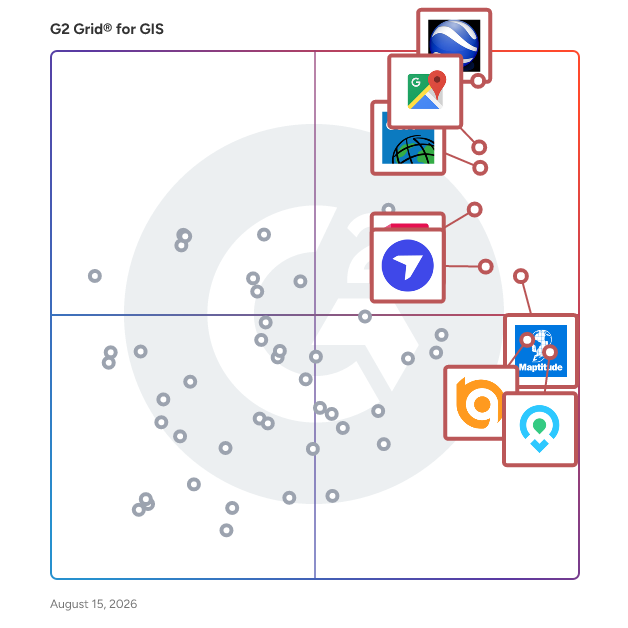
  # Best GIS Software - Page 21

  *By [Daniel Rivera](https://research.g2.com/insights/author/daniel-rivera)*

   A geographic information system (GIS) lets users visualize, question, analyze, and interpret geographical data to help them understand and problem-solve relationships, patterns, and trends. Companies use GIS to manage geographical data in order to improve operations in many geoscience industries as well as land-centric enterprises (e.g. sales territory management, field service dispatching, asset maintenance, transportation or construction). The [best GIS software](https://learn.g2.com/best-gis-software) collects, incorporates and manipulates attribute data from maps to a business’ reporting systems to analyze and assess real-world problems. GIS data usually displays different kinds of data on one map, to facilitate deep analysis and efficiently use as much data as possible. GIS software usually focuses on gathering, analyzing, and displaying geographical data to manage business operations. GIS can be deployed on-premises or in the cloud. Typical implementations can result in a savings in operational expenses. GIS often integrates with CAD, BIM, and other drafting and design software to enhance its analytics capabilities.

To qualify for inclusion in the Geographic Information System (GIS) category, a product must:

- Store, organize, edit, and analyze geographical data
- Include visualization capabilities to display geographical information
- Either have GIS capability or utilize a GIS platform in its solution
- Align and/or manipulate data from maps and sources


## How Many GIS Software Products Does G2 Track?
**Total Products under this Category:** 335

### Category Stats (May 2026)
- **Average Rating**: 4.27/5
- **New Reviews This Quarter**: 43
- **Buyer Segments**: Small-Business 61% │ Mid-Market 25% │ Enterprise 13%
- **Top Trending Product**: Limn Land (+0.25)
*Last updated: May 18, 2026*

  
## How Does G2 Rank GIS Software Products?

**Why You Can Trust G2's Software Rankings:**

- 30 Analysts and Data Experts
- 8,900+ Authentic Reviews
- 335+ Products
- Unbiased Rankings

G2's software rankings are built on verified user reviews, rigorous moderation, and a consistent research methodology maintained by a team of analysts and data experts. Each product is measured using the same transparent criteria, with no paid placement or vendor influence. While reviews reflect real user experiences, which can be subjective, they offer valuable insight into how software performs in the hands of professionals. Together, these inputs power the G2 Score, a standardized way to compare tools within every category.

  
## Which GIS Software Is Best for Your Use Case?

- **Leader:** [Google Earth Pro](https://www.g2.com/products/google-earth-pro/reviews)
- **Highest Performer:** [BatchGeo](https://www.g2.com/products/batchgeo/reviews)
- **Easiest to Use:** [Badger Maps](https://www.g2.com/products/badger-maps/reviews)
- **Top Trending:** [Google Maps Platform](https://www.g2.com/products/google-maps-platform/reviews)
- **Best Free Software:** [BatchGeo](https://www.g2.com/products/batchgeo/reviews)

  
---

**Sponsored**

### Smarty

Smarty offers global address verification, address validation, and geocoding via API, bulk upload, and a collection of 3rd party integrations that transform how organizations handle address data. With real-time address autocomplete, correction, standardization, and validation, it guarantees the accuracy and reliability of addresses. Smarty&#39;s US rooftop geocoding, reverse geocoding, and property data APIs help you enrich and hone your address data. These powerful APIs have far-reaching benefits, from improving the efficiency of your marketing campaigns to enhancing data analysis and operational processes.


[Visit website](https://www.g2.com/external_clickthroughs/record?secure%5Bad_program%5D=ppc&amp;secure%5Bad_slot%5D=category_product_list&amp;secure%5Bcategory_id%5D=362&amp;secure%5Bdisplayable_resource_id%5D=362&amp;secure%5Bdisplayable_resource_type%5D=Category&amp;secure%5Bmedium%5D=sponsored&amp;secure%5Bplacement_reason%5D=page_category&amp;secure%5Bplacement_resource_ids%5D%5B%5D=362&amp;secure%5Bprioritized%5D=false&amp;secure%5Bproduct_id%5D=68353&amp;secure%5Bresource_id%5D=362&amp;secure%5Bresource_type%5D=Category&amp;secure%5Bsource_type%5D=category_page&amp;secure%5Bsource_url%5D=https%3A%2F%2Fwww.g2.com%2Fcategories%2Fgis%3Fpage%3D21&amp;secure%5Btoken%5D=8d2354d0c7f93ada19e7e4d5c0a7e087375f009abf2dd2f641063952e1d62213&amp;secure%5Burl%5D=https%3A%2F%2Fwww.smarty.com%2Flanding%2Fg2&amp;secure%5Burl_type%5D=free_trial)

---

  
    ## What Is GIS Software?
  [CAD &amp; PLM Software](https://www.g2.com/categories/cad-plm)
  ## What Software Categories Are Similar to GIS Software?
    - [Location Intelligence Software](https://www.g2.com/categories/location-intelligence)
    - [Route Planning Software](https://www.g2.com/categories/route-planning-software)

  
---

## How Do You Choose the Right GIS Software?

### What You Should Know About GIS Software

### What is GIS Software?

Geographic information systems, better known as GIS software, are tools that capture, analyze, and display geospatial data to make 2D or 3D maps. These tools act as asset management platforms for the geographic data they capture, meaning GIS technology has the ability to understand patterns and improve operations in land-based operations.&amp;nbsp;

A GIS is a technology rooted in geographic information science that allows users to dig into geospatial data. The first step in this mapping technology is capturing data. These data types include cartographic, photographic, and digital data to provide a complete picture. GIS programs require both hardware and software, such as the desktop needed to display information.

Cartographic data is already in map form and includes information such as the location of rivers, roads, valleys, hills, and more. Data from photographic interpretation analyzes aerial shots of a site. Digital data is collected from satellites that show land use.

All varieties of data can be inputted into GIS mapping tools through data capture. As long as it has been digitized, it can be inputted into a GIS program. Once that data has been inputted, GIS technology can transform it into a map.

### Who Uses GIS software?

GIS tools power location-based services. This technology is prevalent in a number of other professions:

**GIS Specialist** – A GIS specialist is an expert in geographic information systems. They analyze the spatial data stored in the geodatabases within these tools to solve problems related to a specific site or area. For example, a GIS specialist can assess the geospatial data of a region to determine the best escape route and then have the responsibility of mapping out an estimate time needed during a natural disaster. These specialists can create maps of certain areas using GIS technology and use that information to perform duties such as locating special features within a landscape.

A GIS specialist can be a full-time career, as a person in this role can act as a consultant to organizations who can benefit from the data extracted from GIS software. While the majority of this work can be conducted remotely from a computer, GIS specialists are sometimes required to visit a site in order to compare the landscape to the data in the GIS system. Those seeking this career path can obtain a GIS certificate from an accredited program; many universities offer GIS degrees as well.

**Urban Planner** – An urban planner develops procedures and programs for the use of land. The outcomes are typically mapping out plans to build communities, accommodate growth, revamp local physical facilities, and more. For example, an urban planner might approve plans for a new school to ensure it meets the needs of a growing population. As a community grows and changes, urban planners are there to help manage economic, social, and environmental changes that may arise. Urban planners can be utilized for communities of any size—small towns, large cities, and entire counties.

A great deal of data is needed for an urban planner to make an informed decision. They must stay up-to-date on zoning codes, environment regulations, and legal issues. Urban planners must also stay attuned to the landscape in their area and can utilize GIS technology to analyze and manipulate data. GIS software can be used to overlay a land map with population density indicators, which could show the best use for a piece of land. While an urban planner likely needs to perform site visits, they may also utilize a desktop GIS to analyze this data from their own office.

**Environmental Scientist** – An environmental scientist assesses the health and stability of a given landscape. This includes a great deal of fieldwork tests and surveys to gather geospatial data, like soil, water, and air samples. The data collected is then analyzed for negative indicators, such as pollution. An environmental scientist’s findings can be collected into an official report that may be presented to policymakers or other organizations concerned about environmental issues.

Environmental scientists rely heavily on GIS applications to succeed in their work. These tools capture the geographic information necessary to effectively map out the health of a physical area. This mapping technology has the ability to capture data from all aspects of a landscape—aerial, water, land—and then display as a variety of different maps. These solutions can also map changes in a specific area, which is hugely beneficial to an environmental scientist as it can fuel a course of action or anticipate future land conditions.

**Public Health Professionals** – Public health professionals are dedicated to protecting and improving the health of communities. Those in this field are focused more on preventing disease and injury rather than treating it. Public health intersects with a number of more specific fields to improve the health of the community. Epidemiology tracks the distribution and severity of diseases, along with how to prevent them from spreading. Biostatistics applies statistical and mathematical methods to the analysis of public health issues.

Environmental health is concerned with the quality of food supply, water and air pollution, and disease prevention. This is where GIS tools come into play. The use of a GIS and the spatial data it captures can help public health professionals come to decisions as well as predict outcomes. For example, public health officials can use GIS technology to map out potential risk from a contaminated water source. A desktop GIS program can also display information such as drug usage in a certain area.

**Law Enforcement** – Law enforcement officers can track crime trends within GIS software using crime mapping, which maps, visualizes, and analyzes crime incident patterns within their jurisdictions. These crime hot spots can be identified through the usage of GIS programs. Crime analysts can use a desktop GIS to overlay data sets such as census demographics. With this information, police officers are able to identify physical locations and potentially understand the underlying cause of crime in a certain area. GIS mapping software can also be useful for allocating police officers during emergency situations.

### Why Use GIS software?

GIS software is vital for creating maps, but that is not the only application for this technology. These tools capture data that can be utilized by small, mid-sized or enterprise businesses in many fields.

A GIS helps users make more informed decisions. When working with a physical location, you need to understand every aspect of it—air, land, water, surrounding area, and more. A GIS captures this array of data, detailing various aspects of a landscape, and stores it all within one platform. Visualizing this data aids in identifying areas of opportunity and potential issues, such as the best route for an evacuation during an impending hurricane.

The geospatial data stored within these platforms even helps provide answers about things other than the physical landscape itself. Demographics of the surrounding population, social, real-world business problems, and political information can be gathered using a GIS. Features such as overlaying and data visualization connect the dots and create relationships between seemingly unconnected qualities, such populations with geographic features. For example, if a business needs to open up a new storefront, GIS software can be used to find a site of land near a highly populated area. Data can then be manipulated to account for inevitable population change in the surrounding area.

GIS software is specifically designed to visualize data. Reading and understanding statistics and data can be incredibly challenging. Data visualization is a key component of GIS technology, which means that the inputted data will be presented in a clear and comprehensive manner. Using a GIS solution, you can layer your datasets into one image and find the connections between each dataset. Bringing this data to life also allows you to view it from a different perspective, which can provide a fresh insight on a potential problem needing to be solved. You can create multiple maps within GIS platforms, which enables you to track and visualize the change in a certain area over time.

GIS technology can assist in conserving natural resources. GIS software has the ability to manage and maintain agricultural, water, and forest resources. These tools easily manage data on forest conditions as well. The geographic distribution of water resources can be analyzed through GIS technology. These two resources are also connected—as tree cover tends to decrease stormwater runoff.

GIS software allows for better geographic information record keeping. Many organizations are required to maintain thorough geographic records, such government and environmental science agencies. GIS systems are at the foundation of creating policies such as zoning laws, population censuses, and land ownership. Record keeping is vital when creating and upholding these laws, and GIS technology can store the geographic information necessary.

GIS technology can also track the spread of infectious diseases. On top of mapping trends in geographic features, GIS technology is used to follow trends that relate to the spread of disease. Users can leverage desktop GIS solutions to compare geography with other relevant variables and predict where an infectious disease might spread next. This data enables on-the-ground personnel to quickly work to save lives of local residents.

GIS software helps automate previously tedious geographic tasks. Before this technology, gathering data needed for any land, environment, map, pipeline, or city planning could be incredibly time consuming, due to the fact that one platform was unable to capture and store data from various sources. In addition, each data sample was collected and stored individually. However, GIS programs act as a repository for this data and convert it into the correct format, if necessary. GIS technology then takes this one step further and allows users to also design, update, and edit in the same platform where their geographic data is stored. These solutions also provide analysis tools, which gives organizations more time to focus on other urgent and critical tasks.

Governments can use GIS software to plan more cost-effective communities. Governments rely on thorough planning when it comes to building and expanding their communities. However, government organizations, especially smaller municipal ones, can face difficulty when it comes to the economy. Expanding a community while sources are diminishing gets expensive. GIS technology provides a way for government organizations to expand their communities in the most cost-efficient ways possible, as the data provided by GIS software allows them to make more informed choices about decisions such as land usage and locations of physical facilities. Governments can utilize a free GIS solution to continue to drive costs down.

Districts can create more efficient schools with GIS technology. A common issue within communities is needing to redistrict school boundaries as the local population ebbs and flows. GIS programs capture and store addresses for all students at the school. Using feature-based proximity tools, you can manipulate the borders of these zones and a GIS relates the student counts by grade of this proposed boundary. Even after school district zones have been nailed down, these programs can continue to benefit schools. School administrators use GIS technology to analyze the distance students walk to school. If a student lives a certain distance away, GIS tools continue to analyze the data to determine which students are eligible to take school buses. As schools may not a lot of budget dedicated to non-essential technology, they can utilize a free GIS platform for these tasks.

Planning for for natural disasters can be done using GIS technology. One of the main uses of this software is protecting the environment. The flip side of that is protecting citizens from potential dangers of their local environment. GIS tools help with risk management by assessing which areas are at risk for natural or man-made disasters. Communities can then take this data and develop preventive measures. And when natural disasters are unavoidable, GIS technology can still help. These tools aid in the planning of emergency evacuation routes and help estimate the damage from floods. In addition, GIS helps local governments document the needs for federal disaster relief funds.

### GIS Software Features

While specific features may vary across different GIS solutions, the following features are typically found in geographic information systems:

**Data Capture** – This is simply the act of inputting data into a GIS. Relevant data can be grabbed from a number of sources. The software should be able to convert your data to a raster or vector file that will be compatible with your tool.

**Remote Sensing Integration** – Remote sensing is making measurements of a specific location on the earth through airplanes or satellites. These sensors have the ability to collect data in the form of images. As part of its data capture functionality, remote sensed imagery should easily integrate with a GIS.

**Data Warehouse** – GIS software stores the data on geographical features and their characteristics. It uses that data to publish maps. Just as GIS solutions capture data in multiple formats, said data is stored in multiple formats as well. Map city data can be stored as points, road data formatted as lines, boundaries as areas, and so on. Storing this information is what allows a GIS to identify features located in a map.

**Buffer Zone Querying** – Buffer zone querying is the ability to select a point on a map and display any given data within a certain radius. These buffers are used to show an area of influence around a location. For example, a buffer can be used to section off a radius around a school to plan for the transportation of students who live farther away. Some GIS tools may refer to buffer zone querying by other names, such as feature-based proximity tools.

**Editing Data** – The features of the landscapes you study change, which means your data will change as well. A GIS will enable you to keep up with these changes by allowing you to edit your data. Specific revision features and processes will vary in each tool, but they should all offer the ability to edit your data.

**Data Visualization** – The data visualization component of a GIS is what brings your data to life, in either a 2D or 3D format. A GIS displays the data you input as an easy-to-read map right on your desktop. This function may allow for additional features, such as adding pop-ups, charts, and infographics to maps.

**Geocoding** – This feature assigns locations to the addresses you need to keep track of so they may be placed as points on a map. It can be thought of as a interactive digital version of putting a pin on a location on a physical map. Some tools may refer to this feature as address-matching.

**Spatial Analysis** – Spatial analysis is at the core of publishing a map, and may be one of the key features of a GIS. This ability allows users to dig into their data and make informed decisions, predict patterns, and more.&amp;nbsp;

**Overlaying** – Overlaying makes it possible to visualize many different forms of data in one image. This function superimposes multiple datasets into one image to identify the relationships between them. Most GIS software provides overlaying capabilities for both vector and raster data.

**Publishing Maps** – Creating maps is the end goal of GIS software. All of these features, such as overlaying and data editing, contribute to the creation of a map. Once your data is set, you can simply print the map out on a corresponding printer. Some GIS tools may run one final analysis of your data before printing the final map.

### Potential Issues with GIS Software

With its wide range of capabilities and applications, GIS technology offers a plethora of benefits. But that does not mean this software does not come without its challenges.

While the data captured and stored in GIS platforms is incredibly beneficial to users, integrating with traditional maps is&amp;nbsp;extremely complex. It can prove difficult to integrate a traditional map with GIS technology. It may not be possible to grab meaningful geospatial information from a GIS, as many only store and analyze the data collected from the platform itself. Reach out to the GIS vendor you select to determine if this integration is possible.

GIS software is expensive. These tools are hugely beneficial to users, as it collects a massive amount of data from various points. It can cost a lot to gather, input, and connect all of this data. Corresponding hardware, along with potentially needing to hire an expert in GIS, continues to drive those expenses up. While they may have some limited features, budget-conscious users can leverage a free GIS for their business.

Data management can be difficult. It’s great that GIS technology allows users to capture and store large amounts of data, but someone has to comb through all that information. Because there is so much data, this could lead to data generalization, which means you may be at risk for losing information. Large amounts of data also require massive storage space, which increases the cost and manpower required to run your GIS.

### Trends Related to GIS Software

**Drone Usage** – Because drones can be easily maneuvered to capture aerial shots, they are a perfect tool for capturing geospatial data. Drones have become more common with businesses and consumers, as they are easy to use, collect data from aerial vantage points, and can convert data in unique ways. Because use of these tools is becoming more widespread, drones are becoming cheaper.

**Geospatial Analytics and the Internet of Things (IoT)** – As a subset of spatial analytics, geospatial analytics digs into data that identifies the geographic locations of certain features on the earth, such as oceans. Sensors are needed to pick up this data, which is where IoT comes in. IoT powers positioning sensors, which can locate and track objects using a GPS or relative displacement information. Intelligent things, including objects embedded with AI, send data through mobile networks. This can provide real-time data about factors such as the density of a population in a given area.

**Open Data and GIS** – Open data is information that is shared with the public for anyone to freely view and use. This has the potential to be a game changer for GIS software, because that means governments, scientists, city planners, and more can study this information to anticipate how surrounding areas could impact their own community. This technology allows users to understand their environments and how they evolve, as well as anticipate future changes. An open-source GIS has the potential to impact non-land-centric industries. For example, this technology can be used to map out food deserts in specific areas in an effort to combat childhood obesity. If this data is open to the public, health officials can continue to discover additional applications for this information.

### Related Software Categories

With its 3D data visualization applications and focus on the environment, GIS is closely related to software categories such as CAD, BIM, and Forestry.

[CAD Software](https://www.g2.com/categories/cad) — CAD software (computer-aided design) is typically used by those in the architecture, engineering and art fields to create 2D and 3D drawings, along with building 3D models of physical objects. While GIS and CAD are two completely different types of technologies, they should typically integrate with one another, as spatial relationships and components are vital to CAD software users.

[BIM Software](https://www.g2.com/categories/building-design-and-building-information-modeling-bim) — BIM software (building design and building information modeling) is a subcategory of computer-aided design (CAD) products commonly used by architects and those in the construction industry. Many of these products offer tools and libraries specifically targeted for users in these fields, including mechanical, electrical, and plumbing (MEP). These tools offer a model-based process for designing and managing infrastructures. GIS extends the value of BIM software through data visualization and analysis in the context of both the natural environment and building structures. Attributes within BIM data can easily be converted to GIS features.

[Forestry Software](https://www.g2.com/categories/forestry) – Forestry software products are solutions that manage forestry-related tasks like forecasting, operating harvests, tracking inventory and managing contracts. These tools are used to perform functions such as predicting harvest size and assist users in finding the best way to optimize their resources. Companies use the software to predict harvest sizes and optimize their resources, all through a desktop solution. Users can create calendars to manage operations and allocate equipment to complete lumber-related efforts. As both GIS and forestry software concern the environment, these solutions should provide seamless data integration. In fact, some GIS solutions are intended exclusively for forestry work. GIS for forestry offers functions such as the ability to maximize the value of timber, reduce costs, map analytics, and manage forests.


