# Best ETL Tools - Page 13

*By [Shalaka Joshi](https://research.g2.com/insights/author/shalaka-joshi)*

Databricks is the top-ranked ETL tool in 2026, rated 4.6 out of 5 on G2 based on 1,300+ verified reviews. Celigo stands out as the highest-rated option at 4.7 stars, particularly favored by NetSuite-centric organizations seeking seamless app integration and ease of use.

1. Databricks — 4.6/5 (1,300+ reviews): Unified lakehouse pipelines with governance and ML workflows
2. Celigo — 4.6/5 (1,000+ reviews): NetSuite-centered app integration and sync
3. Google Cloud BigQuery — 4.5/5 (1,200+ reviews): Serverless analytics on large cloud datasets
4. Alteryx — 4.6/5 (800+ reviews): Drag-and-drop data prep and reporting automation
5. IBM watsonx.data — 4.4/5 (100+ reviews): Lakehouse querying across object storage

*Updated June 2026. Based on 2026 G2 verified review data across 1,780 products.*


ETL (extract, transform, and load) tools transfer data between databases and external systems, supporting data replication, warehousing, analytics, data cleansing, and structuring, and increasingly support ELT workflows where transformation occurs within the target system rather than before loading.

### Core Capabilities of ETL Tools

To qualify for inclusion in the ETL category, a product must:

- Facilitate extract, transform, and load processes
- Transform data for quality or visualization
- Audit or record integration data
- Archive data for backup, future reference, or analysis

### Common Use Cases for ETL Tools

Data engineering and analytics teams use ETL tools to move and prepare data for reporting, analysis, and business intelligence. Common use cases include:

- Replicating data from source systems into [data warehouses](https://www.g2.com/categories/data-warehouse) for centralized analytics
- Cleansing and transforming raw data into structured, queryable formats
- Building visual data workflows to automate recurring data transfer and integration processes

### How ETL Tools Differ from Other Tools

ETL tools pre-process and transform data before loading it into the target system, distinguishing them from ELT approaches where the target system handles transformation after loading. While [data integration tools](https://www.g2.com/categories/data-integration-tools) cover a broader range of connectivity scenarios, ETL tools focus specifically on structured data movement pipelines with built-in transformation, auditing, and archiving capabilities.

### Insights from G2 on ETL Tools

Based on category trends on G2, visual workflow builders and pre-built connectors stand out as standout features. These platforms deliver reductions in manual data preparation time and improved data quality as core benefits of ETL adoption.
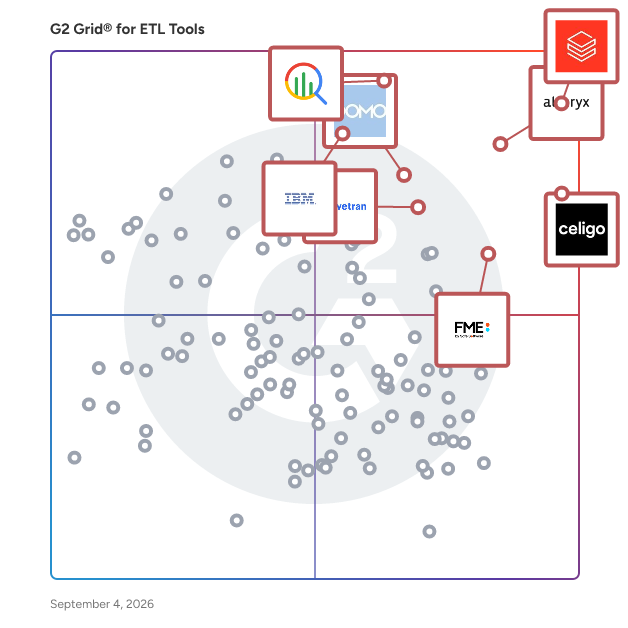


## Top ETL Tools at a Glance
| # | Product | Rating | Best For | What Users Say |
|---|---------|--------|----------|----------------|
| 1 | [Databricks](https://www.g2.com/products/databricks/reviews) | 4.6/5.0 (1,284 reviews) | Unified lakehouse pipelines with governance and ML workflows | "[Powerful Lakehouse for Big Data, Collaboration, and Efficient Pipelines](https://www.g2.com/survey_responses/databricks-review-12946286)" |
| 2 | [Celigo](https://www.g2.com/products/celigo/reviews) | 4.6/5.0 (1,018 reviews) | NetSuite-centered app integration and sync | "[Go for it if you’re looking for a solid integration platform](https://www.g2.com/survey_responses/celigo-review-11876505)" |
| 3 | [Google Cloud BigQuery](https://www.g2.com/products/google-cloud-bigquery/reviews) | 4.5/5.0 (1,147 reviews) | Serverless analytics on large cloud datasets | "[Easy-to-Use Cloud Tool with Shareable, Saved Queries](https://www.g2.com/survey_responses/google-cloud-bigquery-review-12958418)" |
| 4 | [Alteryx](https://www.g2.com/products/alteryx/reviews) | 4.6/5.0 (823 reviews) | Drag-and-drop data prep and reporting automation | "[Intuitive Drag-and-Drop Analytics That Speeds Up Data Prep and Insights](https://www.g2.com/survey_responses/alteryx-review-12983224)" |
| 5 | [IBM watsonx.data](https://www.g2.com/products/ibm-watsonx-data/reviews) | 4.4/5.0 (159 reviews) | Lakehouse querying across object storage | "[Powerful Query Performance and Governance, But a Steep Onboarding Learning Curve](https://www.g2.com/survey_responses/ibm-watsonx-data-review-12836202)" |
| 6 | [FME Platform](https://www.g2.com/products/fme-platform/reviews) | 4.6/5.0 (124 reviews) | Geospatial and multi-format data transformation | "[FME Saves Time with Powerful GIS ETL and Automation](https://www.g2.com/survey_responses/fme-platform-review-12863747)" |
| 7 | [Fivetran](https://www.g2.com/products/fivetran/reviews) | 4.3/5.0 (782 reviews) | Managed connector-based data ingestion | "[Trouble-Free Data Pipelines with Effortless Connections to Nearly Every Service](https://www.g2.com/survey_responses/fivetran-review-12999542)" |
| 8 | [Domo](https://www.g2.com/products/domo/reviews) | 4.3/5.0 (996 reviews) | Self-service ETL feeding business dashboards | "[Interactive Real-Time Dashboards That Make Complex Data Easy](https://www.g2.com/survey_responses/domo-review-13003120)" |
| 9 | [Workato](https://www.g2.com/products/workato/reviews) | 4.7/5.0 (749 reviews) | Low-code workflow automation across SaaS apps | "[Workato helps us building complex integrations at lightning speed.](https://www.g2.com/survey_responses/workato-review-10305521)" |
| 10 | [Skyvia](https://www.g2.com/products/skyvia/reviews) | 4.8/5.0 (322 reviews) | No-code CRM sync, backup, and scheduled ETL | "[Reliable Data Integration Without the Headache](https://www.g2.com/survey_responses/skyvia-review-12998949)" |

---
## What Are the Most Common Questions About ETL Tools?
*AI-generated · Last updated: May 26, 2026*
### How to evaluate ETL tools based on performance and transformation logic?
Based on G2 reviews, buyers evaluating ETL tools for performance and transformation logic should focus on how well platforms handle large data volumes, connect multiple sources, and support dependable transformations without excessive manual work. According to verified users, strong options are often described as fast, scalable, and capable of simplifying complex workflows while supporting SQL, APIs, batch jobs, or real-time processing. G2 reviewers mention that practical evaluation also comes down to how easy pipelines are to debug, how clearly data flows can be monitored, and whether transformations can be reused or automated. Reviews also consistently call out tradeoffs such as steep learning curves, slow troubleshooting, or heavy resource use, so teams should weigh speed and flexibility against maintainability.


### What best ETL platforms with version control and team collaboration features?
Based on G2 reviews, Databricks stands out strongly for ETL teams that want version-aware development and collaboration in one environment. According to verified users, Databricks is frequently praised for shared notebooks, Git-based repo sync, CI/CD support, and a workspace that helps engineers, analysts, and data teams work together on pipelines, transformations, and analytics. G2 reviewers mention that these collaboration features help reduce coordination overhead and make onboarding easier, especially when multiple users are working across notebooks and workflows. At the same time, reviewers also note tradeoffs such as workspace sprawl, UI complexity at scale, and the need for discipline around administration and cost control. Overall, recent reviews point to Databricks as the clearest single-product leader here.

**Here are some of the top-rated products on G2:**

- [Databricks](https://www.g2.com/products/databricks/reviews) – used for shared notebooks, Git-based repo sync, collaborative ETL workflows, and centralized pipeline development


### How to choose an ETL platform for multi-source data integration?
Based on G2 reviews, the best way to choose an ETL platform for multi-source data integration is to look for evidence that users successfully connect databases, SaaS apps, cloud storage, APIs, spreadsheets, and warehouses without heavy custom work. According to verified users, buyers should prioritize broad connector coverage, strong transformation options, scheduling, and reliability once pipelines are live. G2 reviewers mention that teams also care about how easily data can be standardized from fragmented systems into a single reporting or analytics layer. Reviews repeatedly highlight practical concerns such as debugging difficulty, documentation quality, and connector maturity, especially for edge cases. A strong fit is usually a platform that reduces manual exports, centralizes data movement, and keeps downstream reporting consistent.


### Where to buy ETL tools with flexible pricing for startups and enterprises?
Based on G2 reviews, buyers looking for ETL tools with flexible pricing should compare platforms on how predictable costs remain as usage grows, not just on entry price. According to verified users, some tools are valued because they avoid forcing separate purchases for every workflow, while others are praised for fair monthly pricing, startup-friendly plans, or capacity-based structures that make budgeting easier. G2 reviewers mention that pricing friction often appears when usage scales, connectors are gated, or cost models become hard to forecast. For startup and enterprise buyers alike, the practical signal is whether teams feel they can expand integrations without constant pricing surprises. Reviews suggest prioritizing platforms described as affordable, transparent, or cost-effective for real production use.

**Here are some of the top-rated products on G2:**

- [Skyvia](https://www.g2.com/products/skyvia/reviews) – favored by small and mid-sized teams for affordable no-code integrations and predictable data movement workflows
- [Fivetran](https://www.g2.com/products/fivetran/reviews) – chosen for managed connector setup and reliability, though reviews often discuss cost planning as volume grows
- [Celigo](https://www.g2.com/products/celigo/reviews) – used for expanding business integrations with low-code flows and reusable templates across systems


### Where to find cloud-native ETL platforms for modern data stacks?
Based on G2 reviews, cloud-native ETL platforms for modern data stacks are typically the ones users describe as serverless, easy to integrate with cloud warehouses and storage, and well suited for SaaS-heavy environments. According to verified users, these products often support automated syncing into tools like Snowflake, BigQuery, Redshift, or cloud lakehouse environments while reducing infrastructure management. G2 reviewers mention that buyers should look for platforms praised for quick deployment, broad cloud connectors, scheduling, and compatibility with modern analytics workflows. Reviews also show that the best cloud-native fit depends on whether your team prioritizes low maintenance, open-source flexibility, or warehouse-centric transformation. In practice, users favor platforms that shorten setup time and keep pipelines dependable at scale.


### Which ETL tools support real-time streaming data processing?
Based on G2 reviews, Databricks is the clearest match for ETL buyers who need support for real-time or near real-time data processing. According to verified users, Databricks is repeatedly used for streaming alongside batch workloads, with reviewers highlighting scalable Spark-based processing, unified pipeline management, and strong support for handling large or continuously changing datasets. G2 reviewers mention that the platform helps teams bring ETL, analytics, and data engineering into one environment, which is valuable when streaming workflows need to feed downstream reporting or operational systems. Reviewers also note tradeoffs such as cluster startup delays, debugging complexity, and cost monitoring requirements, but recent review volume still makes Databricks the strongest single-winner answer here.

**Here are some of the top-rated products on G2:**

- [Databricks](https://www.g2.com/products/databricks/reviews) – used for both batch and real-time workflows, scalable Spark processing, and unified ETL plus analytics pipelines


### What best ETL software for building scalable data pipelines?
Based on G2 reviews, the strongest ETL software for scalable data pipelines is usually the one users trust for large workloads, multi-source ingestion, and long-running production workflows without constant manual fixes. According to verified users, common strengths include handling high data volumes, integrating cloud services and warehouses, automating scheduling, and supporting reusable pipeline logic. G2 reviewers mention that scalability is not just raw performance; it also depends on monitoring, governance, ease of updates, and whether teams can keep pipelines maintainable as usage grows. Reviews consistently call out Databricks, Fivetran, and FME Platform as examples of tools used for scalable pipelines, though buyers should compare complexity, connector depth, and cost discipline against their own environment.

**Here are some of the top-rated products on G2:**

- [Databricks](https://www.g2.com/products/databricks/reviews) – used for scalable Spark-based pipelines, unified ETL workflows, and high-volume analytics processing
- [Fivetran](https://www.g2.com/products/fivetran/reviews) – used for managed ingestion pipelines from many SaaS sources into cloud warehouses with low maintenance
- [FME Platform](https://www.g2.com/products/fme-platform/reviews) – used for large multi-format workflows, automated transformations, and reliable enterprise-scale data movement


### Who offers ETL tools with low-code interface and drag-and-drop builders?
Based on G2 reviews, several ETL vendors offer low-code interfaces and drag-and-drop builders aimed at making integration work easier for both technical and less technical teams. According to verified users, these tools are especially valued when they reduce scripting needs, speed up pipeline creation, and make workflows easier to explain or maintain. G2 reviewers mention visual builders, reusable templates, and no-code automation as recurring strengths across multiple products. At the same time, reviews show that low-code does not always mean simple at scale, since debugging, customization, or advanced logic can still introduce complexity. Buyers should look for products whose reviews specifically mention intuitive workflow design, easier onboarding, and broad integration support.

**Here are some of the top-rated products on G2:**

- [FME Platform](https://www.g2.com/products/fme-platform/reviews) – used for visual workflow building, drag-and-drop transformations, and automation across many systems and formats
- [Workato](https://www.g2.com/products/workato/reviews) – used for low-code recipe building, connector-based integrations, and workflow automation across business apps
- [Celigo](https://www.g2.com/products/celigo/reviews) – used for low-code integration flows, prebuilt templates, and automating ERP, ecommerce, and SaaS workflows


### What ETL solutions support automated error handling and retries?
Based on G2 reviews, ETL solutions that support automated error handling and retries are usually the ones users describe as reliable in production and strong at surfacing failures before they disrupt downstream reporting. According to verified users, these platforms often include retry logic, monitoring, alerts, or workflow controls that reduce the need for manual intervention. G2 reviewers mention detailed error visibility as a major advantage in products like Celigo, Fivetran, and Workato, especially when teams need to manage frequent integrations across multiple systems. Reviews also note that not every product is equally transparent when something breaks, so buyers should look beyond automation claims and evaluate how easy it is to identify, retry, and resolve failures in real workflows.


### Which ETL tools integrate with popular data lakes and data warehouses?
Based on G2 reviews, Databricks is the strongest single answer for ETL tools that integrate with popular data lakes and data warehouses. According to verified users, Databricks is repeatedly used in environments that combine lakehouse architecture, cloud storage, external warehouses, and downstream analytics tools. G2 reviewers mention integrations with platforms such as BigQuery, Snowflake, cloud ecosystems, BI tools, and governed data layers, all within a unified workflow for ETL, analytics, and machine learning. Reviewers also highlight that the platform reduces fragmentation by bringing multiple workloads into one environment, though they note that cost management and complexity still require attention. For buyers prioritizing broad lake and warehouse alignment, Databricks appears most consistently in recent review evidence.

**Here are some of the top-rated products on G2:**

- [Databricks](https://www.g2.com/products/databricks/reviews) – used with lakehouse architectures, cloud storage, external warehouses, and BI ecosystems in one ETL environment


## How Many ETL Tools Products Does G2 Track?
**Total Products under this Category:** 249

### Category Stats (Jun 2026)
- **Average Rating**: 4.54/5 (↓0.01 vs May 2026) The average rating of products in this category, based on all submitted ratings
- **Top Trending Product**: Maia (+1.11%) - Among all products in this category, Maia recorded the largest rating increase compared to last month
*Last updated: June 24, 2026*


## How Does G2 Rank ETL Tools Products?

**Why You Can Trust G2's Software Rankings:**

- 30 Analysts and Data Experts
- 19,000+ Authentic Reviews
- 249+ Products
- Unbiased Rankings

G2's software rankings are built on verified user reviews, rigorous moderation, and a consistent research methodology maintained by a team of analysts and data experts. Each product is measured using the same transparent criteria, with no paid placement or vendor influence. While reviews reflect real user experiences, which can be subjective, they offer valuable insight into how software performs in the hands of professionals. Together, these inputs power the G2 Score, a standardized way to compare tools within every category.


## Which ETL Tools Is Best for Your Use Case?

- **Leader:** [Databricks](https://www.g2.com/products/databricks/reviews)
- **Highest Performer:** [5X](https://www.g2.com/products/5x/reviews)
- **Easiest to Use:** [Skyvia](https://www.g2.com/products/skyvia/reviews)
- **Top Trending:** [Matia](https://www.g2.com/products/matia/reviews)
- **Best Free Software:** [Fivetran](https://www.g2.com/products/fivetran/reviews)


---

**Sponsored**

### Cloudera

Cloudera is the only hybrid data and AI platform company that large organizations trust to bring AI to their data anywhere it lives. Unlike other providers, Cloudera delivers a consistent cloud experience that converges public clouds, on-prem data centers, and the edge, leveraging a proven open-source foundation. As the pioneer in big data, Cloudera empowers businesses to apply AI and assert control over 100% of their data, in all forms, improving security, governance, and real-time and predictive insights. The world’s largest brands across all industries rely on Cloudera to transform decision-making and ultimately boost bottom lines, safeguard against threats, and save lives. The Cloudera data and AI platform includes: Cloudera AI: Deploy and scale any AI model, anywhere. Cloudera brings compute to governed data where it lives for Private AI anywhere by design. Complete control, security, and governance of mission-critical data, models, agents, and inference ensure faster sovereign AI deployments. Cloudera Data-in-Motion: Make fast decisions from real-time data anywhere. Move data with any structure from any source to any destination seamlessly across hybrid environments, enabling in-the-moment business-critical decisions by processing and analyzing real-time data anywhere, from the edge to AI, as business happens. Cloudera Open Data Lakehouse: Process any data, anywhere, for actionable insights. Make smart decisions with an open data lakehouse powered by Apache Iceberg that delivers trusted, reliable, and unified data to fuel agents, AI applications, and analytics, improving collaboration, breaking silos, and simplifying sharing. Cloudera Unified Data Fabric: Unify security and governance across the entire data estate. Move beyond fragmented data management: Break down silos and connect disparate data sources intelligently and securely to provide a unified view of all organizational data and centralized end-to-end control across complex hybrid data environments.


[Visit website](https://www.g2.com/external_clickthroughs/record?secure%5Bad_program%5D=ppc&amp;secure%5Bad_slot%5D=category_product_list&amp;secure%5Bcategory_id%5D=1181&amp;secure%5Bdisplayable_resource_id%5D=1181&amp;secure%5Bdisplayable_resource_type%5D=Category&amp;secure%5Bmedium%5D=sponsored&amp;secure%5Bplacement_reason%5D=page_category&amp;secure%5Bplacement_resource_ids%5D%5B%5D=1181&amp;secure%5Bprioritized%5D=false&amp;secure%5Bproduct_id%5D=1886&amp;secure%5Bresource_id%5D=1181&amp;secure%5Bresource_type%5D=Category&amp;secure%5Bsource_type%5D=category_page&amp;secure%5Bsource_url%5D=https%3A%2F%2Fwww.g2.com%2Fcategories%2Fetl-tools%3Fpage%3D13&amp;secure%5Btoken%5D=e7e02c9a40e8a95c26047836a7a5070f4f2e01ef2f18a4f2238429e1ae32b292&amp;secure%5Burl%5D=https%3A%2F%2Fwww.cloudera.com%2Fproducts%2Fcloudera-data-platform%2Fcdp-demos.html%3Finternal_link%3Dp18%23get-started&amp;secure%5Burl_type%5D=custom_url)

---


## What Is ETL Tools?

[Cloud Data Integration Software](https://www.g2.com/categories/cloud-data-integration)

## What Software Categories Are Similar to ETL Tools?

- [On-Premise Data Integration Software](https://www.g2.com/categories/on-premise-data-integration)
- [iPaaS Software](https://www.g2.com/categories/ipaas)
- [Big Data Integration Platforms](https://www.g2.com/categories/big-data-integration-platforms)
- [Data Extraction Tools](https://www.g2.com/categories/data-extraction-tools)
- [Data Replication Software](https://www.g2.com/categories/data-replication)
- [DataOps Platforms](https://www.g2.com/categories/dataops-platforms)
- [Reverse ETL Software](https://www.g2.com/categories/reverse-etl)


---

## How Do You Choose the Right ETL Tools?

### What You Should Know About ETL Tools

### ETL software buying insights at a glance

Organizations today manage data across multiple applications, databases, and cloud environments. [ETL tools](https://www.g2.com/categories/etl-tools) help teams extract, transform, and load that data into centralized systems where it can be analyzed and used for reporting or operational decision-making. As companies adopt [cloud data warehouses](https://www.g2.com/categories/data-warehouse) and modern analytics stacks, these solutions play an important role in keeping data pipelines reliable and consistent.&amp;nbsp;

The best ETL tools help organizations reduce manual scripting, maintain consistent data pipelines, and support large volumes of data across multiple integrations. As data environments grow more complex, ETL providers increasingly focus on simplifying integrations and enabling faster access to analytics-ready data.

Common use cases focus on simplifying how data moves and gets prepared across systems. Teams use these tools to automate pipelines between SaaS apps, databases, and warehouses, consolidate data for unified reporting, and transform raw inputs into analytics-ready datasets for [BI tools](https://www.g2.com/categories/business-intelligence). They also help maintain consistent, reliable data flows across distributed environments, supporting cloud data warehouses and modern analytics platforms.

Pricing varies across the category depending on the number of integrations, pipeline volume, and transformation complexity. Many vendors use usage-based pricing models tied to data volume or connectors. Entry-level plans often support smaller teams or limited pipelines, while enterprise deployments add advanced monitoring, governance, and scalability capabilities.

### Top 5 FAQs from software buyers

- How do ETL tools support modern data stacks and cloud-based data architectures?
- How well do ETL platforms integrate with cloud data warehouses like BigQuery, Snowflake, or Redshift?
- Which ETL tools simplify pipeline management and reduce maintenance overhead for data teams?
- What level of scalability and performance do ETL solutions provide for large-scale data pipelines?
- Which ETL providers offer the broadest integration support across SaaS applications, databases, and APIs?

G2’s top-rated ETL tools, based on verified reviews, include [Google Cloud BigQuery](https://www.g2.com/products/google-cloud-bigquery/reviews), [Databricks](https://www.g2.com/products/databricks/reviews), [Domo](https://www.g2.com/products/domo/reviews), [Workato](https://www.g2.com/products/workato/reviews), and [SnapLogic Intelligent Integration Platform (IIP)](https://www.g2.com/products/snaplogic-intelligent-integration-platform-iip/reviews).

### What are the top-reviewed ETL Tools on G2?

[**Google Cloud BigQuery**](https://www.g2.com/products/google-cloud-bigquery/reviews)

- Number of Reviews: 324
- Satisfaction: 98
- Market Score: 99
- G2 Score: 98

[**Databricks**](https://www.g2.com/products/databricks/reviews)

- Number of Reviews: 279
- Satisfaction: 100
- Market Score: 81
- G2 Score: 90

[**Domo**](https://www.g2.com/products/domo/reviews)

- Number of Reviews: 380
- Satisfaction: 88
- Market Score: 73
- G2 Score: 80

[**Workato**](https://www.g2.com/products/workato/reviews)

- Number of Reviews: 224
- Satisfaction: 94
- Market Score: 62
- G2 Score: 78

[**SnapLogic Intelligent Integration Platform (IIP)**](https://www.g2.com/products/snaplogic-intelligent-integration-platform-iip/reviews)

- Number of Reviews: 172
- Satisfaction: 94
- Market Score: 60
- G2 Score: 77

**Satisfaction** reflects user-reported ratings, including ease of use, support, and feature fit. ([Source 2](https://www.g2.com/reports))

**Market Presence** scores combine review and external signals that indicate market momentum and footprint. ([Source 2](https://www.g2.com/reports))

**G2 Score** is a weighted composite of Satisfaction and Market Presence. ([Source 2](https://www.g2.com/reports))

Learn how G2 scores products. ([Source 1](https://documentation.g2.com/docs/research-scoring-methodologies?_gl=1*5vlk6s*_gcl_au*MTAwMzU5MzUxLjE3NjM0MTg0NzYuNjY0NTIxMTY0LjE3NjQ2MTc0NzcuMTc2NDYxNzQ3Nw..*_ga*NzY1MDU0NjE3LjE3NjM0NzQ3ODM.*_ga_MFZ5NDXZ5F*czE3NjYwODk1MTMkbzY3JGcxJHQxNzY2MDkyMjQyJGo1NyRsMCRoMA..))

### What I Often See in ETL Tools

#### Feedback Pros: What Users Consistently Appreciate

• **Visual pipeline builders simplify complex multi-source data integrations**

_“I love how the SnapLogic Intelligent Integration Platform (IIP) makes building integrations so easy with its AI-powered and low-code interface, which significantly streamlines design and maintenance for both technical and non-technical users. This platform guides the pipeline design and reduces the manual effort, aligning with its AI-driven workflow approach, and it has been instrumental in helping me automate workflows, improve data flow efficiency, and reduce the integration effort significantly. The initial setup was very easy because it&#39;s a cloud-based, self-service platform that minimizes installation effort and helps teams get started quickly. I highly recommend SnapLogic IIP for organizations looking to modernize and accelerate their integration strategy, and I would rate it a 9 for its ease of use.”_

- [Sanket N.](https://www.g2.com/products/snaplogic-intelligent-integration-platform-iip/reviews/snaplogic-intelligent-integration-platform-iip-review-12380685), SnapLogic Intelligent Integration Platform (IIP) review

• **Extensive connectors enable fast integration across SaaS and databases**

_“We use this every day as a vital part of an integration between our website and database. Easy to use with a number of different integrations available at your fingertips. Assistance was always an email away.”_

- [Nick E.](https://www.g2.com/products/skyvia/reviews/skyvia-review-12443772), Skyvia review

• **Automation capabilities reduce manual pipeline maintenance and data preparation**

_“Workato is an excellent tool for automating tasks and improving processes. What I find truly impressive is that we no longer have to rely on our ERP vendor for new features or automations; instead, we can handle everything ourselves using Workato. Personally, I have implemented numerous enhancements that have greatly benefited the Finance team, resulting in an estimated annual savings of around 1,000 hours. Also tool is so easy to use that you do not need to have any technical knowledge.”_

- [Manvitha K.](https://www.g2.com/products/workato/reviews/workato-review-12106615), Workato review

#### Cons: Where Many Platforms Fall Short

• **Advanced transformations require deeper technical knowledge and configuration**

_“Some advanced use cases require a deeper technical understanding, especially when building custom flows, handling edge cases, or working with complex APIs. The UI can feel overwhelming for new users, and debugging large integrations could be improved with more developer-style tooling. Pricing can also be a consideration for smaller organizations compared to lightweight automation tools.”_

- [Nuri Vladimir E.](https://www.g2.com/products/celigo/reviews/celigo-review-12356472), Celigo review

• **Limited debugging visibility when pipelines fail during complex workloads**

_“Debugging and troubleshooting pipelines can sometimes be difficult. Error messages are not always very detailed, which can slow down the process of identifying issues. The UI is helpful, but complex pipelines can become harder to manage and visualize as they grow. Additionally, monitoring and cost tracking for large workloads requires careful attention, as pipeline executions and data movement activities can accumulate costs quickly.”_

- [Alan R.](https://www.g2.com/products/azure-data-factory/reviews/azure-data-factory-review-12454264), Azure Data Factory

• **Scaling integrations or data volume increases operational management complexity**

_“The pricing model can become expensive for large-scale queries without proper optimization and cost monitoring. The learning curve for advanced features and query optimization techniques requires time investment. Limited support for certain data types and occasional complexity in debugging nested queries could be improved for a better developer experience.”_

- [Alok K.](https://www.g2.com/products/google-cloud-bigquery/reviews/google-cloud-bigquery-review-12237841), Google Cloud BigQuery review

### My Expert Takeaway on ETL Tools in 2026

Looking across the review data, ETL solutions receive consistently strong sentiment, with an average rating of **4.61/5 stars and a 9.22/10 likelihood to recommend**. That tells me most teams see clear value once their pipelines are operational. ETL tools have quietly become core infrastructure for modern data environments, especially as organizations connect more SaaS applications, warehouses, and analytics systems.

What I notice most in the reviews is that teams rarely evaluate ETL platforms only on integrations. Instead, reliability and automation come up repeatedly. Users want pipelines that run consistently without constant monitoring or manual fixes. When pipelines break or debugging becomes difficult, it quickly impacts reporting workflows and downstream analytics.

Another pattern I see is that successful teams treat ETL software as shared infrastructure rather than an isolated engineering tool. Data engineers may design pipelines, but analysts and operations teams often rely on them daily. Platforms that simplify pipeline visibility, monitoring, and maintenance tend to make collaboration easier across teams.

Industry usage patterns also suggest that organizations with growing data environments benefit the most from mature ETL workflows. For buyers evaluating the best ETL tools, the biggest differentiator often comes down to how well a platform keeps pipelines stable and manageable as data complexity grows.

### ETL Tools FAQs

#### What are the best free ETL tools for developers?

Many platforms offer open-source components, limited free tiers, or trial versions that developers use to build and test pipelines.

Common options include:

- [dbt](https://www.g2.com/products/dbt/reviews) **:** An open-source framework used by data teams to transform and model data directly inside data warehouses.
- [Google Cloud BigQuery](https://www.g2.com/products/google-cloud-bigquery/reviews): Offers a limited free usage tier that allows developers to run queries and build data pipelines at small scale.
- [AWS Glue](https://www.g2.com/products/aws-glue/reviews): A serverless data integration service commonly used for large-scale pipelines, typically accessed through free trial credits or limited testing environments.

Developers often use these tools to prototype data pipelines before scaling to production workloads.

#### What are the best no-code or low-code ETL tools?

No-code and low-code ETL tools simplify pipeline creation through visual workflows and prebuilt integrations.

Examples include:

- [Workato](https://www.g2.com/products/workato/reviews): Known for its automation platform and extensive connector ecosystem that simplifies integration workflows.
- [SnapLogic](https://www.g2.com/products/snaplogic-intelligent-integration-platform-iip/reviews): Uses a visual interface and prebuilt connectors to help teams design data pipelines without heavy coding.
- [Alteryx](https://www.g2.com/products/alteryx/reviews): Offers a drag-and-drop workflow builder designed for analysts working with data preparation and transformation.

These platforms allow data teams to manage pipelines without relying heavily on engineering resources.

#### Which ETL services offer strong security features?

Organizations handling sensitive data often prioritize ETL tools that offer strong governance, access controls, and compliance capabilities.

Platforms commonly used in secure environments include:

- [Azure Data Factory](https://www.g2.com/products/azure-data-factory/reviews): Integrates with Microsoft’s identity and security framework for controlled data pipelines.
- [Google Cloud BigQuery](https://www.g2.com/products/google-cloud-bigquery/reviews): Supports secure data processing with built-in encryption and governance capabilities.
- [AWS Glue](https://www.g2.com/products/aws-glue/reviews): Provides role-based access controls and integration with AWS security services.

These platforms help organizations maintain secure data movement across complex environments.

#### What’s the leading ETL app for big data analysis?

For large-scale analytics workloads, organizations often use ETL tools that integrate directly with modern data platforms.

Common choices include:

- [Databricks](https://www.g2.com/products/databricks/reviews): Designed for large-scale data engineering, analytics, and machine learning pipelines.
- [Google Cloud BigQuery](https://www.g2.com/products/google-cloud-bigquery/reviews): Enables large-scale data processing and analytics within a cloud data warehouse environment.
- [Fivetran](https://www.g2.com/products/fivetran/reviews): Automates high-volume data ingestion into cloud warehouses for analytics and reporting.

These platforms support large datasets and complex transformation workflows.

#### What are the different types of ETL tools?

ETL tools generally fall into four categories:

- **Open-source ETL tools** : Flexible frameworks for custom pipeline development.
- **Cloud-based ETL platforms** : Managed services that automate data pipelines.
- **No-code or low-code ETL tools** : Visual workflow tools for non-engineering teams.
- **Enterprise ETL solutions** : Platforms built for governance, monitoring, and large-scale data environments.

Each category supports different technical needs and levels of pipeline complexity.

#### Sources

- [G2 Scoring Methodologies](https://documentation.g2.com/docs/research-scoring-methodologies?_gl=1*5ky9es*_gcl_au*MTY2NDg2MDY3Ny4xNzU1MDQxMDU4*_ga*MTMwMTMzNzE1MS4xNzQ5MjMyMzg1*_ga_MFZ5NDXZ5F*czE3NTUwOTkzMjgkbzQkZzEkdDE3NTUwOTk3NzYkajU3JGwwJGgw)
- [G2 Winter 2026 Reports](https://company.g2.com/news/g2-winter-2026-reports)

Researched By: [Shalaka Joshi](https://research.g2.com/insights/author/shalaka-joshi)

Last updated on March 16, 2026


