Kaptain
Who Is the Company Behind Kaptain?
- Seller: E4 Computer Engineering
- Year Founded: 2002
- HQ Location: Scandiano, IT
-
LinkedIn® Page: www.linkedin.com
109 employees on LinkedIn®
Total Products under this Category: 26
Last updated: September 17, 2026
Why You Can Trust G2's Software Rankings:
G2's software rankings are built on verified user reviews, rigorous moderation, and a consistent research methodology maintained by a team of analysts and data experts. Each product is measured using the same transparent criteria, with no paid placement or vendor influence. While reviews reflect real user experiences, which can be subjective, they offer valuable insight into how software performs in the hands of professionals. Together, these inputs power the G2 Score, a standardized way to compare tools within every category.
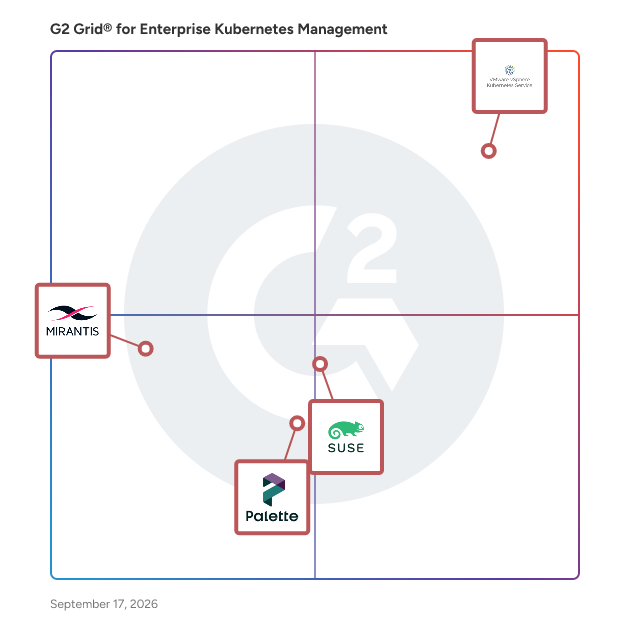
Highlighted products: VMware vSphere Kubernetes Services (VKS), SUSE Rancher, Spectro Cloud Palette, and Mirantis Kubernetes Engine (formerly Docker Enterprise).
Underlying data: [Grid® JSON](https://www.g2.com/categories/enterprise-kubernetes-management/grids.json?focus%5B%5D=vmware-vsphere-kubernetes-services-vks&focus%5B%5D=suse-rancher&focus%5B%5D=spectro-cloud-palette&focus%5B%5D=mirantis-kubernetes-engine-formerly-docker-enterprise)
kloudease: the sovereign Kubernetes platform for applications and AI. Cloud-native, managed, and ready for immediate use. kloudease is a product of the AOE Group, born from 26 years of software development experience in highly complex, regulated industries and over 10 years of hands-on Kubernetes experience, serving clients such as Deutsche Flugsicherung (German Air Traffic Control) and congstar.
Opslogix is a global leader in monitoring and observability solutions. With over 15 years of experience, we help organizations worldwide build stable, efficient, and cost-effective IT environments through our products and services. Bring Kubernetes monitoring into Microsoft System Center Operations Manager (SCOM) with the Opslogix Kubernetes Management Pack. The Kubernetes Management Pack monitors the health and performance of your containerized Kubernetes infrastructure. With our Management Pack, you can optimize its operation more seamlessly.
Kunobi is a native, lightweight Kubernetes desktop platform built for engineers who want speed, clarity, and control without the bloat of Electron-based tools. Modern Kubernetes dashboards have grown heavy, slow, and increasingly commercialized. Kunobi takes a different approach. It delivers a fast, low-footprint, native desktop experience designed for SREs, DevOps engineers, and platform teams managing multiple clusters daily. Unlike many Kubernetes GUIs built on Electron, Kunobi is powered by a Rust backend and Tauri 2.x. This architecture significantly reduces memory consumption and improves startup time compared to browser-wrapped applications. The result is faster cold starts, lower RAM usage, smoother navigation across large clusters, and reliable performance even on resource-constrained machines. Kunobi’s standout capability is its native Flux CD visualization engine. Instead of manually tracing YAML relationships across multiple resources, users can view visual flow graphs of GitOps components, including Kustomizations and HelmReleases, with clear dependency mapping and status propagation. This dramatically reduces troubleshooting time in GitOps-driven environments and improves operational visibility. The platform includes a VSCode-style integrated terminal system with multi-tab support, split panes, persistent sessions, and automatic cluster reconnection. Engineers can operate directly inside the application without switching contexts between tools. Kunobi also integrates built-in KIND support, allowing users to create and manage local Kubernetes clusters directly from the interface. This enables fast testing of manifests, local GitOps experimentation, and reproduction of production issues without requiring additional tooling. For multi-cluster environments, Kunobi provides fast switching between clusters, a favorites system, customizable keyboard shortcuts, and high-performance virtualized resource browsing. Large-scale environments remain responsive, even when navigating extensive resource lists. The integrated Monaco Editor delivers a full-featured YAML editing experience with syntax highlighting, inline editing, and direct apply workflows. Users can inspect, modify, and deploy resources without leaving the desktop application. Kunobi is designed for DevOps engineers, Site Reliability Engineers, and platform teams who rely on Kubernetes daily and need a tool that complements CLI workflows while adding visual clarity where it matters most. Key differentiators include native desktop performance without Electron overhead, Flux CD visual debugging capabilities, integrated local cluster testing, and a focus on high-efficiency Kubernetes operations. Kunobi delivers a modern Kubernetes desktop experience built around speed, GitOps visibility, and operational efficiency.
Radar is an open-source Kubernetes visibility tool that runs as a single binary on your laptop or in your cluster - no agents, no CRDs, and no account required. It connects to the Kubernetes API directly and opens a fast web UI in about 30 seconds, working against any conformant cluster (GKE, EKS, AKS, minikube, kind, k3s) and staying airgapped-ready with no external calls. Radar gives you real-time cluster topology and live service-traffic graphs, a resource browser with full CRD auto-discovery, log streaming and pod exec, container image filesystem inspection, a unified event-and-change timeline, and Helm release management (inspect, diff, upgrade, rollback). It includes first-class GitOps support for FluxCD and ArgoCD, OpenCost-powered cost insights, TLS certificate expiry monitoring, and a 31-check cluster audit across security, reliability, and efficiency with NSA/CISA and CIS framework labels and remediation guidance. A built-in MCP server lets AI assistants like Claude, Cursor, and Copilot query your cluster through Radar using token-efficient, read-only-by-default tools. Radar Cloud is the hosted tier for teams. It runs the same open-source engine as an agent in your clusters and adds a multi-tenant control plane: all clusters behind one URL, fleet-wide views (audit failures, package/version drift, expiring certs, cross-cluster resource search), SSO (Google and GitHub on all plans; SAML/OIDC on Team and Enterprise), organizations and roles, invitations, an audit log with CSV export, and Slack/webhook notifications. Because the engine is identical and Kubernetes stays the source of truth, there's no proprietary data format and no lock-in. Radar OSS is free forever under Apache 2.0; Radar Cloud offers a free tier up to 3 clusters plus Team and Enterprise plans.
Scalefield is a centralised platform for deploying and managing PostgreSQL services on private cloud infrastructure, built and operated by CYBERTEC's PostgreSQL. It is designed for organisations that need to keep their data on their own infrastructure due to regulatory, compliance, or policy reasons, offering an alternative to public cloud database services. The platform consolidates PostgreSQL environments into a single governed layer, providing automation for deployment, backups, monitoring, and scaling, along with multi-tenancy, encryption, and compliance reporting. Scalefield runs on Kubernetes or OpenShift and integrates with other CYBERTEC tools, including the CYBERTEC Migrator, CYPEX, PGEE, Babelfish for PostgreSQL, and Scalefield Secure.
Tight integration across your Kubernetes environments makes your infrastructure consistent, seamless, and scalable. Omni manages all your Talos Linux clusters in all locations for truly hybrid Kubernetes.
Open source LLM proxy. Single Go binary, embedded SQLite, zero external dependencies, 40+ provider integrations. Cost tracking, observability, caching, rate limiting, failover.
