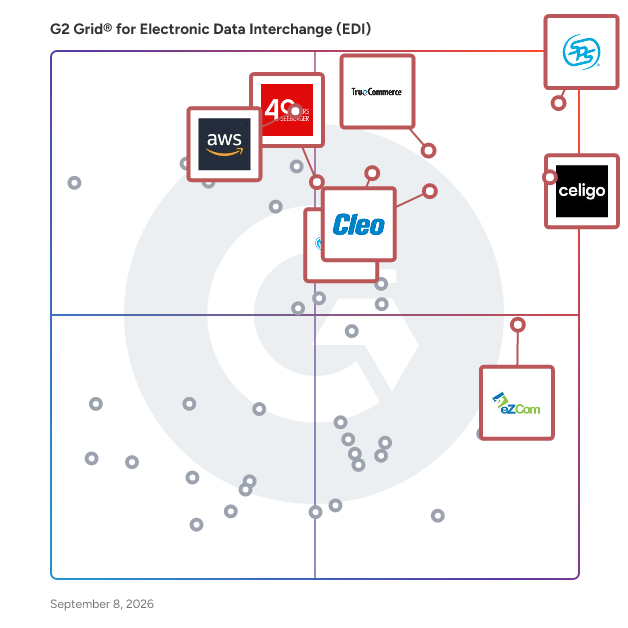
Electronic data interchange (EDI) software facilitates the structured exchange of business documents between organizations and systems. These solutions enable companies to transmit data, such as purchase orders, invoices, shipping notices, and other B2B documents, to trading partners in a standardized, automated manner.
EDI solutions are used across supply chain management, procurement, logistics, invoicing, and broader B2B integration workflows to improve operational efficiency and reduce manual data handling.
EDI products may range from fully managed EDI providers and network operators to integration platforms that enable and automate EDI workflows as part of broader data integration capabilities. These solutions typically support translating diverse file formats into standardized structures and orchestrating data flows across on-premise and cloud environments.
To qualify for inclusion in the Electronic Data Interchange (EDI) category, a product must:
- Provide secure data exchange between two or more systems, organizations, or trading partners
- Offer data transformation or document mapping capabilities to convert business documents into structured formats, like EDI, XML, and JSON
- Support automated workflows and business rules to facilitate and streamline data exchange processes
- Enable the transmission of data through one or more communication protocols, such as AS2, FTP, SFTP, APIs, VAN, or similar methods
- Include security measures such as encryption, authentication, or other mechanisms to protect data during transmission
- Facilitate the exchange of structured business documents commonly used in B2B transactions, like purchase orders, invoices, and shipping notices, either natively or through configurable integrations