DF Scanner
Who Is the Company Behind DF Scanner?
- Seller: DeepForest Technologies
- Year Founded: 2022
- HQ Location: Kyoto, JP
-
LinkedIn® Page: www.linkedin.com
12 employees on LinkedIn®
Total Products under this Category: 79
Last updated: September 05, 2026
Why You Can Trust G2's Software Rankings:
G2's software rankings are built on verified user reviews, rigorous moderation, and a consistent research methodology maintained by a team of analysts and data experts. Each product is measured using the same transparent criteria, with no paid placement or vendor influence. While reviews reflect real user experiences, which can be subjective, they offer valuable insight into how software performs in the hands of professionals. Together, these inputs power the G2 Score, a standardized way to compare tools within every category.
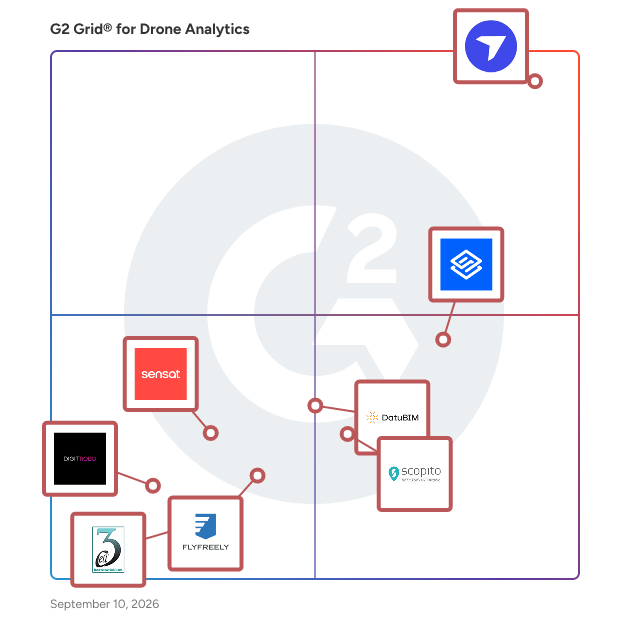
Highlighted products: DroneDeploy, Sitemark, DatuBIM, Scopito, Sensat, FlyFreely, DigitRobo, and MayaDrone.
Underlying data: [Grid® JSON](https://www.g2.com/categories/drone-analytics/grids.json?focus%5B%5D=dronedeploy&focus%5B%5D=sitemark&focus%5B%5D=datubim&focus%5B%5D=scopito&focus%5B%5D=sensat&focus%5B%5D=flyfreely&focus%5B%5D=digitrobo&focus%5B%5D=mayadrone)
Enterprise drone solutions for industrial inspection, surveillance, mapping, and data capture, supporting predictive maintenance, safety compliance, and operational efficiency across large-scale facilities.
eyerod is a spatial operations platform for industrial projects. By integrating drone imagery, field records and AI analysis into a map-based environment, it creates a live digital representation of industrial assets - from design through construction and across the entire operational lifecycle - enabling teams to understand, manage and verify what is happening on site from anywhere.
Global Mapper’s intuitive user interface and logical layout help smooth the learning curve and ensure that users will be up-and-running in no time. To add to the usability, nearly 400 file formats are supported for import and export. This all-in-one software allows users to complete their entire workflow within the same software with tools such as contour creation, watershed analysis, and multiband raster calculations. Top Tools Include: • Access to online data sources for streaming imagery, terrain and vector data • Immersive 3D visualization • Workflow automation with scripting • Site plan with cut and fill analysis • Generate terrain models (REM, DSM, and DEM) • Terrain analysis including contour generation and path profile Global Mapper Pro® expands upon the extensive functionality of the standard version of the application. Users can take advantage of the comprehensive collection of tools for advanced 3D analysis, lidar and photogrammetric point cloud processing, drone-collected image analysis, Python scripting methods, machine-learning integration and much more. Award-winning machine learning has been integrated with the beloved automatic point cloud classification. In addition to the built-in models for auto-classifying ground, building, vegetation and powerline points, custom classes can be created by users. Top Tools Include: • Pixels to Points: Photogrammetric toolset • Filtering and editing of lidar point clouds • Automatic classification of ground, vegetation, buildings, power lines, and poles • Terrain Painting • Solar analysis from loaded terrain and 3D features • Global Mapper Insight and Learning Engine: Deep-learning powered object detection and land cover classification Developed for both GIS professionals and map enthusiasts, Global Mapper® has all the functionality you need in a GIS software. Take GIS into the field with Global Mapper Mobile. This iOS and Android application makes viewing and collecting data on-the-go easy. • Display vector, raster, and elevation layers • Drawing, tracing and form-based collection • Connection to GNSS and GPS receivers • Terrain Analysis: contour creation, volume calculation and viewshed
Average Rating: 4.3/5.0
Total Reviews: 30
"Alittle complicated but provides useful results"
Rating: 4.0/5.0 stars
— Verified User in Animation
"Global Mapper is very good tool for quick Spatial Analysis"
Rating: 5.0/5.0 stars
— Jagrati J.
Measure Ground Control (MGC) is an end-to-end solution that lets you manage your drone operations and easily create quality data products using industry-leading tools like Pix4D. Mobile Flight Application – Fly and capture data with a user-friendly mobile app built for commercial use, then automatically upload your flight logs and screen shots for seamless activity tracking. Mapping & Data Analysis – Produce high-quality data products with an easy-to-use web portal and integrated, industry-leading data tools such as Pix4D. Drone Program Management – Streamline your operations with comprehensive mission planning, easy management of users and equipment, and robust reporting of program activity. Enterprise Solutions – Get a solution customized to your business needs with advanced inspection tools, system integrations, and priority customer support.
HIVE's silicon brain retrofits the industrial fleet you already run, and compounds in value with every hour it operates. Excavators, wheel loaders, forklifts, haulers - every asset runs with shared awareness and shared intelligence, coordinated as one system.
Lisual specializes in audiovisual monitoring and documentation of construction projects using drones and cameras in Argentina. Their services include long-duration timelapse videos, 24/7 site monitoring, and aerial filming, aimed at enhancing the visibility and progress tracking of construction works. They cater primarily to construction companies and real estate developments, providing innovative solutions to improve project management and client engagement. With over eight years of experience, Lisual combines cutting-edge technology with creative approaches to deliver high-quality visual documentation.
Site Explorer™ by Falcker is a cloud-based site intelligence platform built for tank storage terminals and complex industrial facilities. Powered by advanced mapping software and UAV/drone technology, it provides an intuitive digital user experience, delivering a high-resolution, bird's-eye view of storage facilities at various altitude levels and enabling seamless site navigation — so operators, inspectors, and contractors can explore a site remotely instead of relying solely on physical walk-downs. Within the platform, assets, equipment, and pipelines can be tagged, allowing users to quickly locate the relevant asset, and every asset can be accompanied by documents, comments, or links to other systems. Site Explorer links users directly to specific on-site locations or external systems such as Maintenance Management Systems, streamlining information access and sharing. The result is a single platform where visual and technical asset data live side by side. FalckerFalcker By centralizing site information online, Site Explorer improves safety and productivity through digital access to built-environment information, strengthening situational awareness and remote collaboration while reducing reliance on multiple contractors for inspections. For operators, that means optimized procurement, minimized risk, and improved operational efficiency — making work preparation safer, faster, and more cost-effective. Key features & benefits - Easy-to-navigate visual information with high-resolution 360° imagery Falcker - Bird's-eye site views at multiple altitude levels - Powerful navigation and search tools Falcker - Efficient and safe drone-based data acquisition Falcker - Asset, equipment, and pipeline tagging with attached documents, comments, and links - Direct links to on-site locations and external systems (e.g., MMS) - Role-based software access for external contractors Falcker - Complete operator insight and overview, remotely accessible Falcker Best suited for: tank terminal operators, storage facility owners, and asset integrity and inspection teams across oil, gas, chemical, and biofuel storage.
Sitemark is a field documentation platform for professional contractors using precision survey and grade equipment. Log grade shots, verify pile elevations, generate as-built reports, and get AI-powered troubleshooting for Topcon, Trimble, Leica, and Spectra equipment — all from your phone in the field. Free to start, built for the contractor who does it right.
SkySafe's drone detection system empowers organizations to take control of their airspace, ensuring safety, security, and peace of mind.
