  # Best Data-Centric Security Software - Page 3

  *By [Lauren Worth](https://research.g2.com/insights/author/lauren-worth)*


   Data-centric security software focuses on securing the data itself, rather than the infrastructure or application used to store or access that data. This approach differs from a traditional network (or perimeter-centric) security approach, which focuses on protecting the locations where data is accessed or stored, such as servers, networks, applications, and devices.

This software can be used to achieve a zero trust security model and safeguard data across complex IT environments, including cloud environments. Businesses use data-centric security solutions to protect data when it’s in transit, at rest, or in use.

Core capabilities of data-centric security software include the discovery of sensitive data, policy management, access control, encryption, data obfuscation processes such as data masking, and monitoring data access and usage for suspicious behaviors. Additionally, these tools facilitate the labeling, tagging, and tracking of sensitive data points as well as auditing for security and compliance assurance.

Certain functionalities of data-centric security tools may be similar to those of [data governance software](https://www.g2.com/categories/data-governance), mainly in terms of compliance and policy enforcement. While that is an important functionality, data-centric security tools are intended primarily for data lifecycle management rather than for data security. [Sensitive data discovery software](https://www.g2.com/categories/sensitive-data-discovery) is a subset of a broader functionality offered by data-centric security software and specializes in discovering sensitive data.

To qualify for inclusion in the Data-Centric Security category, a product must:

- Provide sensitive data discovery functionality
- Support data classification with the tagging and auditing of sensitive information
- Enforce access control policies for sensitive information
- Offer encryption for data at rest and in transit
- Monitor for abnormalities related to information access and user behavior


## How Many Data-Centric Security Software Products Does G2 Track?
**Total Products under this Category:** 66

### Category Stats (Jun 2026)
- **Average Rating**: 4.49/5 (↑0.01 vs May 2026) The average rating of products in this category, based on all submitted ratings
- **New Reviews This Quarter**: 59
- **Buyer Segments**: Mid-Market 41% │ Small-Business 30% │ Enterprise 30% Represents the distribution of reviewers across all products in this category.
- **Top Trending Product**: Thales CipherTrust Data Security Platform (+5.0%) - Among all products in this category, Thales CipherTrust Data Security Platform recorded the largest rating increase compared to last month
*Last updated: June 18, 2026*

  
## How Does G2 Rank Data-Centric Security Software Products?

**Why You Can Trust G2's Software Rankings:**

- 30 Analysts and Data Experts
- 2,500+ Authentic Reviews
- 66+ Products
- Unbiased Rankings

G2's software rankings are built on verified user reviews, rigorous moderation, and a consistent research methodology maintained by a team of analysts and data experts. Each product is measured using the same transparent criteria, with no paid placement or vendor influence. While reviews reflect real user experiences, which can be subjective, they offer valuable insight into how software performs in the hands of professionals. Together, these inputs power the G2 Score, a standardized way to compare tools within every category.

  
## Which Data-Centric Security Software Is Best for Your Use Case?

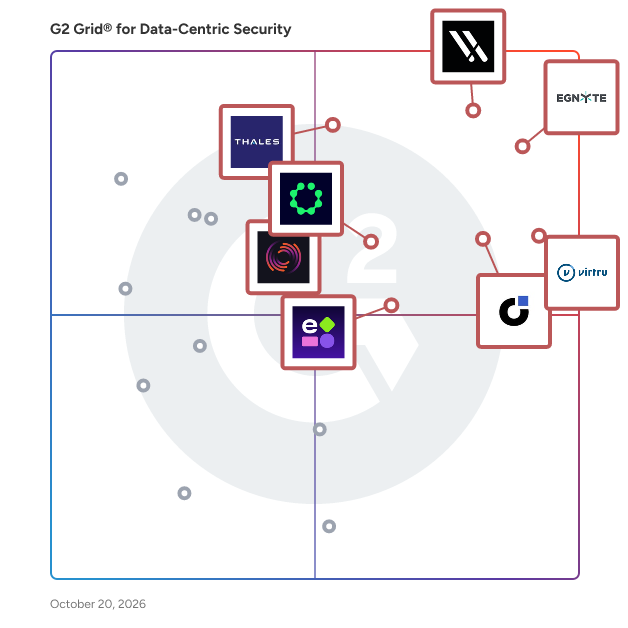
- **Leader:** [Egnyte](https://www.g2.com/products/egnyte/reviews)
- **Highest Performer:** [Entro Security](https://www.g2.com/products/entro-security/reviews)
- **Easiest to Use:** [Egnyte](https://www.g2.com/products/egnyte/reviews)
- **Top Trending:** [Kiteworks](https://www.g2.com/products/kiteworks/reviews)
- **Best Free Software:** [Egnyte](https://www.g2.com/products/egnyte/reviews)

  
---

**Sponsored**

### ManageEngine DataSecurity Plus

ManageEngine DataSecurity Plus is a unified data visibility and security platform that specializes in file auditing, file analysis, data risk assessment, data leak prevention, and cloud protection. File server auditing - Seamlessly monitor, alert, and report on all file accesses and modifications made across your Windows file server, failover cluster, and workgroup environments. File storage and security analysis - Perform metadata analysis, spot file security vulnerabilities, analyze and optimize file storage by clearing our old, duplicate, and stale files. Ransomware protection - Discern ransomware intrusions using threshold-based alerts, and execute instant responses to shut down infected machines. Data leak prevention - Avoid data leaks by blocking high-risk file copy activities to USB devices or within endpoints and prevent files containing highly sensitive data from being shared via email (Outlook) as attachments. Data risk assessment - Locate and classify sensitive data occurrences in your repositories to spot potential data exposure and to help comply with data regulations like GDPR, HIPAA, and more. Cloud protection - Track your organization&#39;s web traffic, and enforce policies to safeguard your employees against inappropriate or malicious web content.


[Visit website](https://www.g2.com/external_clickthroughs/record?secure%5Bad_program%5D=ppc&amp;secure%5Bad_slot%5D=category_product_list&amp;secure%5Bcategory_id%5D=1862&amp;secure%5Bdisplayable_resource_id%5D=1862&amp;secure%5Bdisplayable_resource_type%5D=Category&amp;secure%5Bmedium%5D=sponsored&amp;secure%5Bplacement_reason%5D=page_category&amp;secure%5Bplacement_resource_ids%5D%5B%5D=1862&amp;secure%5Bprioritized%5D=false&amp;secure%5Bproduct_id%5D=65999&amp;secure%5Bresource_id%5D=1862&amp;secure%5Bresource_type%5D=Category&amp;secure%5Bsource_type%5D=category_page&amp;secure%5Bsource_url%5D=https%3A%2F%2Fwww.g2.com%2Fcategories%2Fdata-centric-security%3Fpage%3D3&amp;secure%5Btoken%5D=d0a5c15f533dc3bea9bf99eab59b8edd0f0dbb4281291f846ed4a41224a1158b&amp;secure%5Burl%5D=https%3A%2F%2Fwww.manageengine.com%2Fdata-security%2Fsem%2F%3Futm_source%3DG2%26utm_medium%3Dtpac%26utm_campaign%3DDSP-datacentric-security&amp;secure%5Burl_type%5D=custom_url)

---

  ## What Are the Top-Rated Data-Centric Security Software Products in 2026?
### 1. [data security](https://www.g2.com/products/data-security/reviews)
  The privacy vault that doesn&#39;t ask you to trust a vendor with the data you don&#39;t trust anyone with. Most &quot;privacy vaults&quot; are SaaS products built by GRC teams for GRC teams. Your encryption keys and your encrypted data sit in the same blast radius. The audit log that&#39;s supposed to prove compliance is controlled by the same vendor you&#39;d need to audit. Developer experience is bolted on after the fact. And every one of them was built for GDPR first, then &quot;replicated&quot; for markets they don&#39;t understand. Securelytix is built the other way around. India&#39;s first indigenous privacy vault — engineered ground-up for DPDP, RBI localization, and the runtime enforcement realities of the Indian market. One SDK drops into your stack and makes PII exposure architecturally impossible: logs, analytics, LLM prompts, support tools — all tokenized by default. Keys you control. Audit logs you own. An API engineers actually want to use at 3 a.m. during an incident. Vault-first. Developer-first. India-first. No middleman.


**Who Is the Company Behind data security?**

- **Seller:** [Securelytix](https://www.g2.com/sellers/securelytix)
- **HQ Location:** San Francisco, US
- **LinkedIn® Page:** https://www.linkedin.com/company/securelytix/ (12 employees on LinkedIn®)


### 2. [DTEX inTERCEPT](https://www.g2.com/products/dtex-intercept/reviews)
  DTEX InTERCEPT™ consolidates Data Loss Prevention, User Activity Monitoring, and User Behavior Analytics in one lightweight platform to enable organizations to achieve a trusted and protected workforce. Backed by behavioral science, powered by AI, and used by governments and organizations around the world, DTEX is the trusted authority for protecting data and people at scale with privacy by design. As the trusted leader of insider risk management, DTEX transforms enterprise security by displacing reactive tools with a proactive solution that stops insider risks from becoming data breaches.


**Who Is the Company Behind DTEX inTERCEPT?**

- **Seller:** [Dtex Systems](https://www.g2.com/sellers/dtex-systems)
- **Year Founded:** 2002
- **HQ Location:** Saratoga, California, United States
- **LinkedIn® Page:** https://www.linkedin.com/company/dtex-systems (183 employees on LinkedIn®)


### 3. [e-Safe Compliance](https://www.g2.com/products/e-safe-compliance/reviews)
  e-Safe implements multi-level encryption to protect sensitive data from access by unauthorised users, both internal and external, while still allowing staff to work and collaborate productively.


  **Average Rating:** 4.0/5.0
  **Total Reviews:** 1
**How Do G2 Users Rate e-Safe Compliance?**

- **Ease of Use:** 8.3/10 (Category avg: 8.8/10)

**Who Is the Company Behind e-Safe Compliance?**

- **Seller:** [e-Safe Compliance](https://www.g2.com/sellers/e-safe-compliance)
- **Year Founded:** 2010
- **HQ Location:** Baslow, GB
- **LinkedIn® Page:** https://www.linkedin.com/company/e-safesystems/ (21 employees on LinkedIn®)

**Who Uses This Product?**
  - **Company Size:** 100% Enterprise


### 4. [Fasoo DSPM](https://www.g2.com/products/fasoo-dspm/reviews)
  Fasoo DSPM (Data Security Posture Management) is an enterprise-grade solution that provides full visibility and control over sensitive data across multi-cloud, on-premises, and hybrid environments. It helps organizations proactively identify data security risks, enforce protection policies, and maintain compliance with evolving regulations. The platform begins by automatically discovering and classifying sensitive data—such as personal information, intellectual property, and financial records—regardless of where it resides. Fasoo DSPM then evaluates the security posture of each data source, overexposed data and unused or orphaned data assets. This ongoing analysis helps organizations understand where their data is most vulnerable and take immediate action. With an intuitive dashboard and detailed risk assessments, Fasoo DSPM provides valuable insights into data access patterns, user behavior, and potential threats. It also maps data flow between users, systems, and storage locations to help uncover blind spots and enforce proper data governance. Designed to support compliance with frameworks such as GDPR, HIPAA, CCPA, and PCI DSS, Fasoo DSPM simplifies audit preparation by centralizing visibility and automating risk reports. It also integrates seamlessly with existing security tools and IT infrastructure, reducing operational overhead and improving response time to potential incidents. Key Features and Benefits: - Automated Data Discovery &amp; Classification: Detects sensitive information across structured and unstructured data repositories. - Continuous Risk Assessment: Identifies vulnerabilities, security statuses, and compliance risks in real time. - Data Flow Visualization: Tracks how data moves across environments to expose hidden risks and compliance gaps. - Compliance Readiness: Helps align data practices with global privacy and security regulations. Fasoo DSPM empowers organizations to transition from reactive security measures to a proactive, data-centric approach—ensuring that sensitive information remains protected throughout its lifecycle.


**Who Is the Company Behind Fasoo DSPM?**

- **Seller:** [Fasoo AI](https://www.g2.com/sellers/fasoo-ai)
- **Year Founded:** 2000
- **HQ Location:** Darien, US
- **Twitter:** @Fasoocom (235 Twitter followers)
- **LinkedIn® Page:** https://www.linkedin.com/company/fasoo/ (130 employees on LinkedIn®)
- **Ownership:** 150900 (KOSDAQ)


### 5. [Forcepoint DSPM](https://www.g2.com/products/forcepoint-dspm/reviews)
  Forcepoint Data Security Posture Management (DSPM) is designed for organizations that need consistent visibility and control of sensitive data across structured and unstructured data whether stored in on-premises systems or cloud environments. Forcepoint DSPM provides: • Automated discovery and classification of sensitive data • Mapping of access permissions • Risk prioritization • Remediation capabilities to adjust access permissions and move or delete files Forcepoint DSPM is an essential component of Forcepoint’s Data Security Cloud platform for reducing the risk of data breaches and regulatory non-compliance. Unlike other competing DSPM solutions, Forcepoint delivers full visibility and control across the data security lifecycle; providing data security everywhere by combining proactive discovery of data-at-rest (DSPM), active discovery of potential data breaches by focusing on data-in-use (DDR), with enforcement controls over data-in-motion (DLP) while continuously adapting to each user&#39;s actions (Risk-Adaptive Protection). Forcepoint gives both SaaS and on-prem delivery options. By using Forcepoint DSPM, you can: • Increase productivity by making data access and sharing more reliable for better innovation and collaboration. • Cut costs through automation to reduce time and resources spent on classification and investigations. • Reduce the risk of data breaches by uncovering and fixing risks to sensitive data. • Streamline compliance by gaining consistent visibility and control over regulated data everywhere.


**Who Is the Company Behind Forcepoint DSPM?**

- **Seller:** [Forcepoint](https://www.g2.com/sellers/forcepoint)
- **Company Website:** https://www.forcepoint.com/
- **Year Founded:** 1994
- **HQ Location:** Austin, TX
- **Twitter:** @Forcepointsec (65,368 Twitter followers)
- **LinkedIn® Page:** https://www.linkedin.com/company/forcepoint/ (1,652 employees on LinkedIn®)


### 6. [Fortra Cloud Data Protection](https://www.g2.com/products/fortra-cloud-data-protection/reviews)
  Data protection of the past typically worked by securing all sensitive data within the bounds of a perimeter—your corporate network. But organizations’ data now sprawls across various environments, including data centers, private clouds, and third-party SaaS applications, making the perimeter security model of the past impractical at best and ineffective at worst. This can leave organizations vulnerable to attacks, data breaches, compliance penalties, and more. Fortra Cloud Data Protection helps IT teams extend their organizations’ data protection capabilities from their endpoints to the cloud, enabling them to regain visibility and control over their sensitive data—no matter where it lives or travels. Fortra makes deployment and management easy with guided implementation, out-of-the-box policy templates, and centralized policy enforcement and management, all from a single admin console. But our solutions are also easily customizable, allowing IT teams to define, enforce, and administer security policies consistently across all users, apps, and data according to both compliance and business-specific needs. This zero-trust, data-centric approach to data protection enables comprehensive security for distributed IT assets and modern, hybrid workforces. The Forta Cloud Data Protection Includes: - Data Security Posture Management (DSPM) - Cloud Access Security Broker (CASB) - Zero Trust Network Access (ZTNA) - Secure Web Gateway (SWG)


**Who Is the Company Behind Fortra Cloud Data Protection?**

- **Seller:** [Fortra](https://www.g2.com/sellers/fortra)
- **Company Website:** https://www.fortra.com/
- **Year Founded:** 1982
- **HQ Location:** Eden Prairie, Minnesota
- **Twitter:** @fortraofficial (2,774 Twitter followers)
- **LinkedIn® Page:** https://www.linkedin.com/company/fortra (1,755 employees on LinkedIn®)


### 7. [IBM Guardium Data Security Center](https://www.g2.com/products/ibm-ibm-guardium-data-security-center/reviews)
  IBM Guardium Data Security Center is a comprehensive solution designed to protect sensitive data across its entire lifecycle, addressing both current and emerging threats, including those associated with artificial intelligence (AI and quantum computing. By offering a unified platform, it enables organizations to manage data security vulnerabilities and risks effectively, ensuring compliance with evolving regulations. The solution empowers security teams to collaborate seamlessly, providing integrated workflows and a centralized view of data assets, thereby enhancing the organization&#39;s overall security posture. Key Features and Functionality: - Unified Data Protection: Offers a holistic view of data assets, allowing security teams to monitor, detect, and respond to risks while managing data governance and AI security posture. - Generative AI Capabilities: Incorporates AI-driven tools to generate risk summaries, enhancing the productivity of security professionals in managing data security challenges. - AI Security: Includes IBM Guardium AI Security, which helps protect AI deployments from vulnerabilities and unauthorized models (&quot;shadow AI&quot; by ensuring robust governance for sensitive AI models and data. - Quantum-Safe Protection: Features IBM Guardium Quantum Safe, designed to safeguard encrypted data against potential future quantum-based cyber threats by leveraging post-quantum cryptography developed by IBM Research. - Comprehensive Compliance Management: Simplifies compliance needs by automating policy enforcement and monitoring data activity, facilitating adherence to industry standards like GDPR, HIPAA, and PCI DSS. Primary Value and Problem Solved: IBM Guardium Data Security Center addresses the critical need for organizations to protect their sensitive data amidst the complexities of hybrid cloud environments, AI integration, and the advent of quantum computing. By providing a unified platform that integrates data monitoring, governance, detection, response, and cryptographic management, it enables organizations to proactively manage and mitigate data security risks. This comprehensive approach not only enhances the organization&#39;s security posture but also ensures compliance with evolving regulatory requirements, thereby reducing potential liabilities and safeguarding the organization&#39;s reputation.


**Who Is the Company Behind IBM Guardium Data Security Center?**

- **Seller:** [IBM](https://www.g2.com/sellers/ibm)
- **Year Founded:** 1911
- **HQ Location:** Armonk, New York, United States
- **Twitter:** @IBMSecurity (74,679 Twitter followers)
- **LinkedIn® Page:** https://www.linkedin.com/company/1009/ (328,202 employees on LinkedIn®)
- **Ownership:** SWX:IBM


### 8. [NetApp Ransomware Resilience](https://www.g2.com/products/netapp-ransomware-resilience/reviews)
  NetApp Ransomware Resilience includes native capabilities for ransomware defense and manages relevant ONTAP features, including ARP/AI and other NetApp Data Services, to deliver a comprehensive ransomware defense for ONTAP (file and volume) - all from a single control plane. With Ransomware Resilience, organizations can avoid data loss, limit downtime, and minimize business disruptions.


**Who Is the Company Behind NetApp Ransomware Resilience?**

- **Seller:** [NetApp](https://www.g2.com/sellers/netapp)
- **Year Founded:** 1992
- **HQ Location:** Sunnyvale, California
- **Twitter:** @NetApp (118,051 Twitter followers)
- **LinkedIn® Page:** https://www.linkedin.com/company/2105/ (12,682 employees on LinkedIn®)
- **Ownership:** NASDAQ


### 9. [Nextlabs CloudAz](https://www.g2.com/products/nextlabs-cloudaz/reviews)
  At NextLabs, we empower intelligent enterprises by providing industry-leading zero trust security solutions to protect business-critical data and applications everywhere. While traditional methods focus primarily on securing the network perimeter, often critical data and applications are left exposed, vulnerable to both external breaches and internal misuse. By employing a zero trust, data-centric security strategy, we go beyond mere perimeter defense. We provide robust protection directly around your most vital data, ensuring its safety no matter where it resides or is shared. In doing so, we enable organizations to harness the power of advanced technology, drive decisions through data-centric analytics, and foster secure collaboration. At the core of NextLabs’ approach is our unified zero trust policy platform and dynamic authorization policy engine— areas in which we advance new innovations in data-centric security. We proudly hold over 90 patents along with 30 pending patents in both the United States and Europe that are designed to automate least privilege access and safeguard information sharing. In the policy platform, data governance, compliance, and security policies are digitized and stored as centrally managed, attribute-based policies. During access attempts, policy enforcer working with the policy engine employ the identity centric Attribute-Based Access Control (ABAC) method to protect data in real-time, evaluating and authorizing access based on user, device, resource and contextual attributes. With the centralized policy platform, organizations can easily manage security rules to control access and protect data anywhere, defining what data to protect, who can access what data, and what actions are permissible. Centralized policy management along with the enforcement of security policies, allowing organizations to safeguard data across diverse systems beyond network boundaries. Moving beyond manual and often siloed security controls, organizations will be able to unify the access control process and reduce the number of desperate policies to proactively prevent breaches before they happen. The policy platform includes a central activity log, making it easy to monitor, track, and report any risky access activities. This not only streamlines compliance reporting but also helps in strengthening security measures. NextLabs offers an extensive set of out-of-the-box policy enforcers to protect data in use, at rest, and in motion seamlessly for 100s of the leading enterprise applications and cloud services including ERP, PLM, CRM, ECM, DBMS, CAD, Big Data, BI, and many more. The comprehensive SDKs, REST APIs, and flexible application integration framework allow for rapid and no code integration with any applications, identity providers and attribute sources. As a result, companies can integrate their custom and third-party applications into NextLabs&#39; policy platform and policy engine easily in addition to the commercial off-the-shelf (COTS) applications and cloud services.


**Who Is the Company Behind Nextlabs CloudAz?**

- **Seller:** [NextLabs](https://www.g2.com/sellers/nextlabs)
- **Year Founded:** 2004
- **HQ Location:** San Mateo, US
- **Twitter:** @nextlabs (402 Twitter followers)
- **LinkedIn® Page:** https://www.linkedin.com/company/nextlabs (190 employees on LinkedIn®)


### 10. [OPAQUE Platform](https://www.g2.com/products/opaque-platform/reviews)
  A governed environment where your teams can design, test, and deploy AI workflows over sensitive data: Design confidential RAG pipelines and agentic workflows using a visual canvas Bring your own workloads as containers from other AI frameworks Attach policies and guardrails to each workflow View execution results, policy enforcement outcomes, and audit evidence in one place


**Who Is the Company Behind OPAQUE Platform?**

- **Seller:** [Opaque](https://www.g2.com/sellers/opaque)
- **Year Founded:** 2021
- **HQ Location:** San Francisco, US
- **LinkedIn® Page:** https://www.linkedin.com/company/opaquesystems/ (51 employees on LinkedIn®)


### 11. [OpenText Data Privacy &amp; Protection Foundation (Voltage)](https://www.g2.com/products/opentext-data-privacy-protection-foundation-voltage/reviews)
  OpenText™ Data Privacy &amp; Protection Foundation (Voltage) is a comprehensive data security solution designed to protect sensitive information across its entire lifecycle, whether at rest, in motion, or in use. By employing a data-centric approach, it de-identifies data, rendering it useless to unauthorized users while preserving its usability and referential integrity for legitimate business processes, applications, and services. This ensures that organizations can maintain data privacy without compromising operational efficiency. Key Features and Functionality: - Data Discovery and Classification: Automatically scans and identifies sensitive data across structured and unstructured sources, including rich media like images, audio, and video files. - Comprehensive Data Protection: Utilizes encryption, tokenization, and data masking techniques to safeguard sensitive information throughout its lifecycle, ensuring compliance with data privacy regulations. - Test Data Management: Generates realistic, anonymized test data that mirrors actual production data, facilitating accurate testing without exposing sensitive information. - Adaptive to Hybrid IT Environments: Supports both on-premises and cloud infrastructures, providing flexibility and scalability to meet diverse data protection requirements. Primary Value and Problem Solved: OpenText™ Data Privacy &amp; Protection Foundation (Voltage) addresses the critical challenge of protecting sensitive data in an era of increasing cyber threats and stringent regulatory requirements. By implementing robust data protection measures, it enables organizations to: - Ensure Regulatory Compliance: Meet global data privacy standards such as GDPR, CCPA, and HIPAA, reducing the risk of legal penalties and reputational damage. - Enhance Data Security: Safeguard sensitive information from unauthorized access and breaches, thereby maintaining customer trust and business integrity. - Facilitate Secure Data Analytics: Allow secure data sharing and analytics by protecting data in use, enabling organizations to derive valuable insights without compromising privacy. - Optimize Operational Efficiency: Reduce the total cost of ownership of application infrastructure by managing data effectively and securely, streamlining processes, and minimizing risks associated with data breaches. By integrating these capabilities, OpenText™ Data Privacy &amp; Protection Foundation (Voltage) empowers organizations to manage and protect their sensitive data proactively, ensuring both compliance and operational excellence.


**Who Is the Company Behind OpenText Data Privacy &amp; Protection Foundation (Voltage)?**

- **Seller:** [OpenText](https://www.g2.com/sellers/opentext)
- **Year Founded:** 1991
- **HQ Location:** Waterloo, ON
- **Twitter:** @OpenText (21,559 Twitter followers)
- **LinkedIn® Page:** https://www.linkedin.com/company/2709/ (23,048 employees on LinkedIn®)
- **Ownership:** NASDAQ:OTEX


### 12. [PHEMI Health DataLab](https://www.g2.com/products/phemi-health-datalab/reviews)
  The PHEMI Trustworthy Health DataLab is a unique, cloud-based, integrated big data management system that allows healthcare organizations to enhance innovation and generate value from healthcare data by simplifying the ingestion and de-identification of data with NSA/military-grade governance, privacy, and security built-in. Conventional products simply lock down data, PHEMI goes further, solving privacy and security challenges and addressing the urgent need to secure, govern, curate, and control access to privacy-sensitive personal healthcare information (PHI). This improves data sharing and collaboration inside and outside of an enterprise—without compromising the privacy of sensitive information or increasing administrative burden. Built on privacy-by-design principles, the software gives researchers, scientists, and clinicians faster access to more information while ensuring that they only see data on a need-to-know basis. Responsible data sharing and a governance framework facilitate compliance with privacy regulations. PHEMI Trustworthy Health DataLab can scale to any size of organization, is easy to deploy and manage, connects to hundreds of data sources, and integrates with popular data science and business analysis tools. For more information, visit https://www.phemi.com/ and follow us on Twitter @PHEMISystems, Linkedin, Youtube, and Facebook


  **Average Rating:** 3.9/5.0
  **Total Reviews:** 6
**How Do G2 Users Rate PHEMI Health DataLab?**

- **Ease of Use:** 9.6/10 (Category avg: 8.8/10)
- **Has the product been a good partner in doing business?:** 6.7/10 (Category avg: 9.2/10)
- **Ease of Admin:** 6.7/10 (Category avg: 8.7/10)

**Who Is the Company Behind PHEMI Health DataLab?**

- **Seller:** [PHEMI Systems](https://www.g2.com/sellers/phemi-systems)
- **Year Founded:** 2013
- **HQ Location:** Vancouver, CA
- **Twitter:** @PHEMIsystems (745 Twitter followers)
- **LinkedIn® Page:** https://www.linkedin.com/company/3561810 (6 employees on LinkedIn®)

**Who Uses This Product?**
  - **Company Size:** 67% Small-Business, 33% Enterprise


### 13. [PK Protect Endpoint Manager](https://www.g2.com/products/pkware-pk-protect-endpoint-manager/reviews)
  Your DLP tool monitors traffic and blocks external drives. That&#39;s fine, until a file gets copied to a SharePoint folder, emailed to a personal account, or saved to a laptop nobody flagged. The perimeter approach has a ceiling. PK Protect Endpoint Manager (PEM) works below it. PEM is an endpoint data security solution that automatically discovers sensitive data across desktops, laptops, servers, file shares, and Microsoft 365, then applies protection without waiting for a user to do the right thing. Policy-driven actions are enforced centrally and executed automatically. Users can&#39;t override them. What it does: PEM continuously scans endpoints for sensitive data including PII, PCI data, PHI, and custom data types. When it finds something, it acts based on your policy: encrypt, redact, classify, mask, move, quarantine, or delete. Protection travels with the data, so even if a file moves outside the organization, the security moves with it. Who it&#39;s built for: IT security teams, compliance officers, and data privacy leaders in regulated industries who need consistent, auditable protection across every endpoint in the enterprise without depending on employee behavior to enforce it. Where it&#39;s different from DLP: Traditional DLP solutions focus on egress. PEM secures the data itself. That means protection holds even when files are moved, copied, or shared, and even when credentials are compromised. Certificate-free, policy-based encryption keeps workflows intact without the overhead of traditional key management. Compliance support: PEM supports audit readiness for PCI DSS, HIPAA, GDPR, CCPA, GLBA, FISMA, and more, with centralized reporting and visibility into exactly which files are sensitive, who accessed them, and where. Trusted by 21 of the top 25 U.S. commercial banks and deployed across hundreds of thousands of endpoints worldwide.


**Who Is the Company Behind PK Protect Endpoint Manager?**

- **Seller:** [PKWARE](https://www.g2.com/sellers/pkware)
- **Year Founded:** 1986
- **HQ Location:** Milwaukee, WI
- **Twitter:** @PKWARE (1,122 Twitter followers)
- **LinkedIn® Page:** https://www.linkedin.com/company/23724 (158 employees on LinkedIn®)


### 14. [PK Protect For z/OS](https://www.g2.com/products/pk-protect-for-z-os/reviews)
  IBM Z is the most secure computing platform on the planet. The problem is not what happens to your data on the mainframe. The problem is what happens when it leaves. When z/OS production data gets copied to development, test, cloud, or analytics environments, IBM&#39;s Pervasive Encryption no longer applies. That data is exposed. In most organizations it has been accumulating that way for decades, with no clear picture of what sensitive data exists, where it moved, or whether it is protected. PK Protect for z/OS closes that gap. As an IBM Partner Plus with four decades of mainframe expertise, PKWARE delivers the only solution purpose-built to discover and protect sensitive data on IBM Z, in motion and at rest, whether or not it stays on the mainframe. What it does: PK Protect for z/OS automatically discovers sensitive data across VSAM clusters, sequential, partitioned, and tape data sets using your own application data definitions and copybooks for maximum accuracy. The entire discovery process runs on the mainframe, with no copies left behind and sensitive data staying 100% on-premises. Persistent encryption travels with data as it moves out of z/OS, so protection holds regardless of where the data lands SchemaLink Technology: PK Protect for z/OS includes SchemaLink, which provides discovery support for z/OS datasets with or without copybooks. It is the only solution in the industry that delivers this level of flexibility for mainframe data structures, eliminating manual mapping and dramatically reducing discovery time. Who it&#39;s built for: Mainframe security, compliance, and modernization teams at large enterprises in financial services, insurance, government, and healthcare who need accurate visibility into decades of accumulated z/OS data and persistent protection that follows data beyond the mainframe. Compliance and modernization: Supports PCI DSS, HIPAA, GDPR, GLBA, and FISMA with automated reporting and SBOM generation to accelerate audits. Protects sensitive data throughout modernization initiatives as workloads migrate to cloud and hybrid environments. In one risk assessment, PK Protect scanned 504 million VSAM records and found that 88% contained vulnerable sensitive data.


**Who Is the Company Behind PK Protect For z/OS?**

- **Seller:** [PKWARE](https://www.g2.com/sellers/pkware)
- **Year Founded:** 1986
- **HQ Location:** Milwaukee, WI
- **Twitter:** @PKWARE (1,122 Twitter followers)
- **LinkedIn® Page:** https://www.linkedin.com/company/23724 (158 employees on LinkedIn®)


### 15. [QuProtect](https://www.g2.com/products/quprotect/reviews)
  QuSecure offers QuProtect (Web App Security + Network Security), the worlds first post quantum cryptographic (PQC) security solution that enables government and enterprise businesses to address their post quantum cryptography business and technology challenges. This Post Quantum Cyber solution enables organizations to integrate, deploy, and evaluate post quantum cryptographic solutions that suit their unique infrastructure environments. With QuProtect Web App Security + Network Security, organizations can realize the rare opportunity for first mover market advantage and become cyber security leaders. Ready today, QuProtect provides valuable protection and differentiation across industries.


**Who Is the Company Behind QuProtect?**

- **Seller:** [QuSecure](https://www.g2.com/sellers/qusecure)
- **Year Founded:** 2019
- **HQ Location:** San Mateo, US
- **Twitter:** @qusecure (415 Twitter followers)
- **LinkedIn® Page:** https://www.linkedin.com/company/qusecure (71 employees on LinkedIn®)

**Who Uses This Product?**
  - **Company Size:** 100% Mid-Market


### 16. [Sertainty](https://www.g2.com/products/sertainty/reviews)
  Sertainty is a data privacy platform that embeds self-protection, governance, and tracking directly into data, enabling it to act as an active participant in its own security. By integrating intelligence within the data itself, Sertainty ensures that sensitive information remains secure, even when traditional security measures fail. This approach allows organizations to maintain control over their data, enforce access policies, and monitor data usage in real-time, thereby transforming passive data into self-reliant, self-governing entities. Key Features and Functionality: - Self-Protecting Data: Data files are equipped with embedded intelligence that enables them to defend against unauthorized access and mitigate risks autonomously. - Zero Trust Architecture: The platform operates on a zero-trust model at the data layer, ensuring that data continuously verifies access requests, granting permissions only to authenticated users. - End-to-End Self-Governance: Organizations can define and enforce policies governing data access, usage, and sharing, with the data itself ensuring compliance with these policies. - Real-Time Tracking and Auditing: Sertainty provides tamper-resistant event logs that track data ownership, access history, and movements, offering transparency and accountability. - Developer Tools: The Sertainty Software Development Kit (SDK allows developers to integrate these security features into their applications, supporting multiple operating systems and programming languages. Primary Value and Problem Solved: Sertainty addresses the critical challenge of data privacy by empowering data to protect, govern, and track itself, thereby reducing reliance on external security measures that can be bypassed. This self-reliant approach ensures that sensitive information remains secure across various environments, including in transit, at rest, and during processing. By embedding security directly into the data, organizations can confidently share and monetize their information without compromising privacy, comply with evolving data protection regulations, and build trust with customers and stakeholders.


**Who Is the Company Behind Sertainty?**

- **Seller:** [Sertainty](https://www.g2.com/sellers/sertainty)
- **Year Founded:** 2010
- **HQ Location:** Nashville, US
- **LinkedIn® Page:** https://www.linkedin.com/company/sertintyone/ (23 employees on LinkedIn®)


    ## What Is Data-Centric Security Software?
  [Data Security Software](https://www.g2.com/categories/data-security)
  ## What Software Categories Are Similar to Data-Centric Security Software?
    - [Encryption Software](https://www.g2.com/categories/encryption-software)
    - [Data Loss Prevention (DLP) Software](https://www.g2.com/categories/data-loss-prevention-dlp)
    - [Data Governance Tools](https://www.g2.com/categories/data-governance-tools)
    - [Cloud Data Security Software](https://www.g2.com/categories/cloud-data-security)
    - [Sensitive Data Discovery Software](https://www.g2.com/categories/sensitive-data-discovery)
    - [ Data Security Posture Management (DSPM)](https://www.g2.com/categories/data-security-posture-management-dspm)

  
---

## How Do You Choose the Right Data-Centric Security Software?

### Learn More About Data-Centric Security Software

In the modern digital realm, safeguarding sensitive data has become an essential task. With the ever-increasing amount and variety of data, along with the constant evolution of cybersecurity threats and strict privacy regulations, organizations face significant hurdles in maintaining the confidentiality and integrity of their information assets.

In response to these challenges, data-centric security software has become a key solution. Let&#39;s explore its importance and how it addresses the complexities organizations face today.

### What is data-centric security software?

Unlike traditional approaches that focus on fortifying network boundaries, data-centric security software prioritizes protecting data itself, regardless of its location or transmission mode.

It employs advanced techniques such as encryption, [access controls](https://www.g2.com/glossary/access-control-definition), data masking, and [tokenization](https://www.g2.com/glossary/data-tokenization-definition) to embed security directly into the data. By doing so, organizations mitigate the risks of data breaches, unauthorized access, and insider threats. [Data encryption](https://www.g2.com/categories/encryption), one key feature of this software, makes sure that data remains unreadable and unusable to unauthorized users by encrypting it both at rest and in transit.&amp;nbsp;

Access controls enable organizations to enforce granular permissions and restrictions with regard to who can use sensitive data and which actions they can perform. Moreover, data-centric security software helps businesses remain current with various regulations like the General Data Protection Regulation (GDPR) and the Health Insurance Portability and Accountability Act (HIPAA) by implementing robust [encryption](https://www.g2.com/articles/what-is-encryption).

### What are the common features of data-centric security software?

Data-centric security software has various functions that vary by tool and use case. Some valuable features of data-centric security software include the following.

- [Data discovery](https://www.g2.com/articles/data-discovery) refers to identifying and locating sensitive data across infrastructure. It teaches organizations how to understand the scope of their data assets and potential vulnerabilities.
- **Data classification** categorizes data based on sensitivity levels so organizations can prioritize their security efforts and apply appropriate protection measures.
- **Encryption** transforms data into an unreadable format. It prevents unauthorized parties from understanding the data, even if they somehow gain access.
- **Access controls** restrict unauthorized access to sensitive data. This includes using role-based access control (RBAC), permissions, and [multi-factor authentication (MFA)](https://www.g2.com/categories/multi-factor-authentication-mfa).
- **Tokenization** shields sensitive data while preserving format and integrity. It’s useful for testing, analytics, or outsourcing without the risk of exposing sensitive information.
- **Data loss prevention (DLP)** stops unauthorized access, transmission, or storage of sensitive data. This not only protects the organization&#39;s reputation and financial assets but also ensures compliance with regulatory requirements, such as GDPR or HIPAA.
- **Data monitoring** tracks data access, usage patterns, and security events. Real-time data monitoring helps Organizations rely on it to optimize resource allocation, improve operational efficiency, and enhance their overall security posture.
- **Audit trails and reporting** records data access, modifications, and system events for compliance and analysis. By analyzing audit trail data, organizations identify security gaps, interpret user behavior, and detect anomalies or potential threats.
- **Risk management** assesses and mitigates potential security risks. By using [risk assessment solutions](https://www.g2.com/categories/risk-assessment) organizations can find vulnerabilities, threats, and potential negative impacts to their data assets.&amp;nbsp;

### What types of data-centric security software exist?

Each of the various data-centric security software options presents both distinct advantages and disadvantages. Exploring them will allow an organization to tailor their choices based on specific preferences and requirements.

- [Firewall solutions](https://www.g2.com/categories/firewall-software) monitor and control incoming and outgoing network traffic based on predetermined security rules. It’s possible to set them up at network boundaries to prevent unauthorized access and protect against malicious activities.
- **Authentication and authorization systems** verify the identity of users who access data. They determine the level of access granted based on their credentials and permissions.
- **Encryption** secures data by converting it into a ciphertext format that can only be solved with the appropriate decryption key. This means that even if hackers intercept data, they won’t be able to understand it.&amp;nbsp;&amp;nbsp;
- **Data masking** hides sensitive information in non-production environments to protect privacy by replacing sensitive data with realistic but fake data or with a masked format.
- **Hardware-based security solutions** use specialized hardware components or devices to protect data. Examples include hardware security modules (HSMs) for managing encryption keys and secure enclaves for processing sensitive data in a protected environment.
- [Data backup](https://www.g2.com/articles/what-is-backup) automatically creates copies of important data to guarantee its availability in case of data loss or system failure. This process helps organizations recover quickly from disruptions by providing redundancy and failover mechanisms.
- **Data erasure** securely deletes data from storage devices so unauthorized parties can’t recover it. This is crucial when retiring or replacing storage devices.

### What are the benefits of data-centric security software?

The benefits of using a data-centric security software include:

- **Enhanced protection for sensitive data.** Data-centric security software employs encryption, tokenization, and other advanced techniques to protect sensitive data. By focusing on securing the data itself rather than just the perimeter, the data remains encrypted and unreadable, which provides enhanced protection against breaches.
- **Regulatory compliance.** Many industries are subject to strict regulations regarding protecting sensitive data, such as GDPR and HIPAA. Data-centric security software helps organizations achieve compliance by establishing robust data protection measures, including encryption, access controls, and [audit trails](https://www.g2.com/glossary/audit-trail) to shrink the risk of non-compliance penalties.
- **Persistent security.** Data-centric security protects data throughout the entire lifecycle, from creation and storage to transmission and disposal. By embedding security controls directly into the data, organizations maintain persistent protection regardless of where the data resides or how users access it, whether on-premises, in the cloud, or on mobile devices.
- **Access control.** Businesses use data-centric security to enable granular access control. This makes it easier to define and enforce policies regarding the terms of access. RBAC, attribute-based access control (ABAC), and other access control mechanisms prevent unauthorized access.
- **Reduced operational complexity.** Implementing data-centric security simplifies security management by centralizing control over [data protection](https://learn.g2.com/data-protection) policies. Rather than relying on a patchwork of disparate security solutions, organizations refine their security infrastructure, reducing complexity, lower administrative overhead, and greater operational efficiency.
- **Enhanced data governance.** Data-centric security facilitates better data governance by providing visibility into how users access and share sensitive data across their organizations. By monitoring data usage patterns and enforcing compliance with data policies, businesses maintain control over their data assets, reduce the risk of misuse or leakage, and demonstrate accountability to stakeholders.
- **Deterrence of insider threats.** Insider threats, whether intentional or unintentional, pose a significant risk. Data-centric security software deters insider threats by limiting access to sensitive data based on the principle of least privilege, monitoring user behavior for suspicious activity, and applying data loss prevention (DLP) to prevent unauthorized exfiltration.

### Data-Centric Security vs. Zero Trust

Data-centric security and Zero Trust both approach cybersecurity with a focus on enhancing protection in the digital landscape.&amp;nbsp;

Data-centric security places the utmost importance on safeguarding sensitive data, regardless of its location within the network or cloud. By employing techniques like encryption, access controls, and data classification, it protects data even if perimeter defenses are compromised.&amp;nbsp;

On the other hand, Zero Trust takes a proactive stance by assuming that threats exist inside and outside the network perimeter. It continuously verifies each user and device that wants access to resources by relying on strict access controls and least privilege principles to mitigate the risk of unauthorized access and lateral movement of threats.

Incorporating both data-centric security and Zero Trust principles work hand in hand rather than separately.&amp;nbsp;

### Who uses data-centric security software?

Data-centric security software finds use with a variety of professionals and roles. Here&#39;s how:

- **Chief information security officers (CISOs)** oversee the implementation and management of data-centric security measures meant to protect sensitive data.
- **Security analysts and engineers** analyze security threats and vulnerabilities, configure and maintain [security software](https://www.g2.com/categories/security), and investigate security incidents related to data breaches.
- **Data protection officers (DPOs)** ensure compliance with data protection regulations and implement data-centric security measures to safeguard personal data.
- **IT and security managers** handle the deployment and maintenance of data-centric security solutions to protect information assets.
- **Database administrators (DBAs)** implement security controls within databases, manage access permissions, and monitor [database](https://www.g2.com/articles/what-is-a-database)activity to prevent unauthorized access or data breaches.
- **Compliance officers** align data-centric security practices with relevant industry regulations and standards.
- **Risk management professionals** assess potential harm related to data security, develop mitigation strategies, and implement security measures to reduce the likelihood of [data breaches](https://www.g2.com/articles/data-breach).
- **Network administrators** set up network-level security controls to protect data in transit and configure firewalls or intrusion detection systems.
- **Chief data officers (CDOs)** develop data governance policies and strategies to ensure the confidentiality, integrity, and availability of data assets.
- [DevOps](https://www.g2.com/articles/what-is-devops) **engineers** integrate data-centric security measures into software development lifecycles to identify and remediate application security vulnerabilities.
- **Systems administrators** configure and maintain operating systems and server-level security controls to protect data stored on servers and endpoints within an organization&#39;s infrastructure.

### Data-centric security software pricing

Each pricing model has its advantages and suitable customer scenarios. The choice of pricing model depends on factors such as budget, usage patterns, scalability requirements, and preferences for payment structure.

- **Subscription-based models** have customers pay a recurring fee at regular intervals (monthly, annually) to access data-centric security solutions.
- **Perpetual licenses** ask for a one-time fee for the software license, allowing buyers to use the platform indefinitely.
- **Usage-based pricing** is based on the volume or usage of the tool.
- **Tiered pricing** lets customers choose from different tiers or packages according to their needs and budget.
- **Freemium models** are basic versions of data-centric security solutions offered for free, with advanced features or additional functionality available for a fee.
- **Volume licensing or enterprise agreements:** are best for large organizations with the means to negotiate customized pricing and licensing terms.
- **Feature-based pricing** is determined by the specific features or modules of the data-centric security solution that customers choose to use.
- **Pay-as-you-grow** allows customers to start with a basic package and pay for additional capacity or features as their needs grow.

####   

#### Return on investment (ROI) for data-centric security platforms&amp;nbsp;

- **Scalability and flexibility** determine how effectively organizations adapt to changing security needs and accommodate growth without significant additional investment.
- **Integration capabilities** with existing infrastructure and systems can boost ROI by paring down operations, reducing manual effort, and avoiding duplication of resources.
- **The total cost of ownership (TCO)** of the software, including initial implementation costs, ongoing maintenance fees, and any necessary training or support, directly influences ROI.
- **The speed and efficiency of incident detection and response** facilitated by the software minimize the impact of security breaches, reducing downtime and associated costs.
- **Automation and analytics** enhance operational efficiency, which allows security teams to focus on high-priority tasks and potentially reduces the need for additional personnel.
- **Actionable insights and intelligence** empower proactive security measures, mitigating risks.
- **User adoption and ease of use** prevent employee resistance.

### Software related to data-centric security platforms&amp;nbsp;

Related solutions and services include the following.

- [Encryption software](https://www.g2.com/categories/encryption) ensures that data is protected by converting it into a coded format that can only be processed by individuals or systems with the appropriate decryption key. It&#39;s a fundamental aspect of data-centric security because it secures data at rest and in transit.
- **Data loss prevention (DLP)** prevents unauthorized access, use, or transmission of sensitive data. It monitors usage and applies policies to stop breaches, leakage, or unauthorized transfers.
- [Database security management software](https://www.g2.com/categories/database-security) secures databases and [database management systems (DBMS)](https://www.g2.com/categories/database-management-systems-dbms) from internal and external threats. It includes access controls, encryption, and auditing functionalities to strengthen the confidentiality, integrity, and availability of database information.
- [Data masking tools](https://www.g2.com/categories/data-masking) obscure or anonymize sensitive data in non-production environments, such as development and testing. This helps protect confidential information while still allowing realistic data to be used for testing.
- **Data discovery and classification** identify and classify sensitive data across infrastructure. By understanding where sensitive data resides, organizations can apply appropriate security controls and policies to protect it effectively.
- [Security information and event management (SIEM) software](https://www.g2.com/categories/security-information-and-event-management-siem) collects and analyzes security event data from various sources throughout an organization&#39;s IT infrastructure. It detects and responds to security threats in real time by correlating events and providing actionable insights into potential incidents.
- [Data rights management (DRM) solutions](https://www.g2.com/categories/digital-rights-management-drm) control permissions and restrictions about how data can be accessed, used, and shared.&amp;nbsp;

### Challenges with data-centric security software

Some common challenges with data-centric security software are discussed here.

- **Complexity of data discovery and classification:** Identifying sensitive data within vast datasets and accurately classifying it overwhelms IT departments across industries. Automated tools may struggle to accurately detect all sensitive data types, leading to potential gaps in protection.
- **Integration with existing systems:** Integrating data-centric security solutions with existing IT infrastructure, including databases, file systems, and cloud services, complicates operations. Compatibility issues may arise, requiring careful planning and coordination to guarantee smooth integration without disrupting existing operations.
- **Performance overhead:** Implementing robust data-centric security measures can introduce performance overhead, especially in environments with high data throughput requirements. Balancing security needs with performance considerations helps avoid damaging system responsiveness or user experience.
- **Scalability:** Data-centric security solutions must scale effectively to accommodate growing demands. Scalability involves designing systems that can handle increasing volumes of data and user activity without sacrificing security or performance.
- **Changes to data structure:** Adapting data-centric security software to accommodate changes in data structure, such as schema updates or migrations to new platforms, presents significant burdens. It requires ongoing monitoring and adjustment to keep up with the protection of sensitive information.
- **Costs:** Implementing and sustaining data-centric security solutions cost a lot. They involve expenses related to software licensing, hardware infrastructure, training, and ongoing support. Organizations must carefully evaluate the cost-benefit ratio to justify investments.
- **Training and expertise:** Effective deployment and management of data-centric security software require specialized knowledge and expertise. Organizations need to invest in training programs to ensure that staff members know how to use and maintain these solutions.

### Which companies should buy data-centric security software?

Below are some examples of companies that should consider buying data-centric security software.

- **Financial institutions** deal with highly sensitive data, making them prime cyberattack targets. Data-centric security software can help protect customer information, transaction data, and other relevant records.
- **Healthcare organizations** handle personal health information (PHI) and medical records. Data-centric security software ensures compliance with regulations like HIPAA and protects against data breaches.
- **Government agencies** store a wealth of information that includes citizen data, national security information, and government operations data. It all stays safe thanks to data-centric security software.
- **Technology companies** often have access to valuable intellectual property, proprietary information, and customer data. Data-centric security software can protect against data theft, industrial espionage, and unauthorized access.
- **Retail and e-commerce** businesses collect and store customer payment information, personal details, and purchase history. The right security software can protect customer trust by preventing breaches.
- **Educational institutions** hold onto student records, research data, and proprietary information that require protection against cyber threats. Data-centric software provides this protection and also ensures compliance with student privacy regulations.
- **Corporate enterprises** deal with sensitive business data, employee records, and intellectual property. They need data-centric security software to protect against [insider threats](https://www.g2.com/articles/insider-threat), external attacks, and data leaks.

### How to choose data-centric security software

Choosing data-centric security software depends on specific needs, preferences, and work. Here&#39;s a concise guide to help find the right solution:

- Understand the organization&#39;s security requirements, including the types of sensitive data handled and relevant compliance regulations like GDPR or HIPAA.
- Evaluate data-centric security technologies and prioritize features based on what is needed,&amp;nbsp;such as encryption for PII or data discovery for compliance.
- Research each vendor&#39;s reputation, future product development plans, financial stability, and quality of customer support.
- Consider deployment options (on-premises, cloud, hybrid) and confirm that the vendor’s pricing structures align with the budget and operational needs.
- Create a shortlist of solutions, conduct trials, gather feedback, and consider factors like functionality, integration, and user experience to make an informed decision.

### Data-centric security software trends

- **Adoption of the Zero Trust Model:** Software solutions that use zero trust principles are rising. They feature micro-segmentation, MFA, least privilege access, and continuous monitoring for anomalies.
- **Enhanced privacy regulations and compliance:** In response to growing concerns over data privacy and protection, regulatory bodies have introduced stringent measures such as the GDPR and CCPA. Consequently, data-centric security software offers features like encryption, data masking, and pseudonymization.
- [Machine learning](https://www.g2.com/articles/machine-learning) **and** [artificial intelligence (AI)](https://www.g2.com/articles/what-is-artificial-intelligence) **integration:** ML and AI algorithms analyze large volumes of data to identify patterns indicative of potential security threats. These technologies help refine incident response procedures by prioritizing alerts, orchestrating response actions, and even autonomously mitigating security incidents.

_Researched and written by_ [_Lauren Worth_](https://research.g2.com/insights/author/lauren-worth)

_Reviewed and edited by_ [_Aisha West_](https://learn.g2.com/author/aisha-west?_gl=1*1ugnvz0*_ga*OTU5ODUxODYxLjE2NjUzODc5MzY.*_ga_MFZ5NDXZ5F*MTcxNDAzNTUxNy43NDYuMC4xNzE0MDM1NTE5LjU4LjAuMA..*_gcl_aw*R0NMLjE3MTA3NTI4NTQuQ2p3S0NBand6Ti12QmhBa0Vpd0FZaU83b05QZUZ1RjFJaU1tRUR6QlBBMDc2bnJ6VHhCcl84ZmlFUU5CbFVQRFF3MHlPbVBINzg1eThCb0N5RkFRQXZEX0J3RQ..*_gcl_au*MTQ3OTA5NDQzMi4xNzEzMTI2MjIy)


