# Best Chatbots Software - Page 44

  *By [Bijou Barry](https://research.g2.com/insights/author/bijou-barry)*

   Chatbots, also called virtual agents or virtual assistants, are used in place of humans to conduct specific tasks or provide information based on written or spoken requests, allowing users to interact with applications in a conversational manner to automate tasks that formerly required human intervention.

### Core Capabilities of Chatbot Software

To qualify for inclusion in the Chatbots category, a product must:

- Provide an output based on the initial request in written or speech form
- Allow for the automation of formerly human-necessary tasks
- Be sold as a standalone chatbot solution, and not simply contain NLP or speech recognition within a conversational interface

### Common Use Cases for Chatbot Software

Businesses use chatbots to automate customer-facing and internal interactions across a growing range of functions. Common use cases include:

- Serving as a first line of defense in customer support alongside [live chat](https://www.g2.com/categories/live-chat), [help desk](https://www.g2.com/categories/help-desk), and [contact center software](https://www.g2.com/categories/contact-center)
- Handling sales and marketing knowledge base queries with automated, scripted responses
- Enabling users to retrieve data points from [business intelligence software](https://www.g2.com/categories/business-intelligence) through natural language requests

### How Chatbot Software Differs from Other Tools

Although chatbots frequently use natural language processing (NLP) or speech recognition to understand requests, they primarily function through scripted conversations, distinguishing them from intelligent virtual assistants, which use natural language understanding (NLU) to conduct more dynamic, human-like conversations. Chatbots are rules-driven and best suited for predictable, structured interactions, while AI-powered alternatives offer greater flexibility and intent comprehension.

### Insights from G2 on Chatbot Software

Based on category trends on G2, ease of scripting and deployment speed stand out as key strengths. These platforms deliver reductions in routine inquiry volume and improved first-response times as primary outcomes of chatbot adoption.


## Category Overview

**Total Products under this Category:** 760


## Trust & Credibility Stats

**Why You Can Trust G2's Software Rankings:**

- 30 Analysts and Data Experts
- 65,800+ Authentic Reviews
- 760+ Products
- Unbiased Rankings

G2's software rankings are built on verified user reviews, rigorous moderation, and a consistent research methodology maintained by a team of analysts and data experts. Each product is measured using the same transparent criteria, with no paid placement or vendor influence. While reviews reflect real user experiences, which can be subjective, they offer valuable insight into how software performs in the hands of professionals. Together, these inputs power the G2 Score, a standardized way to compare tools within every category.


## Best Chatbots Software At A Glance

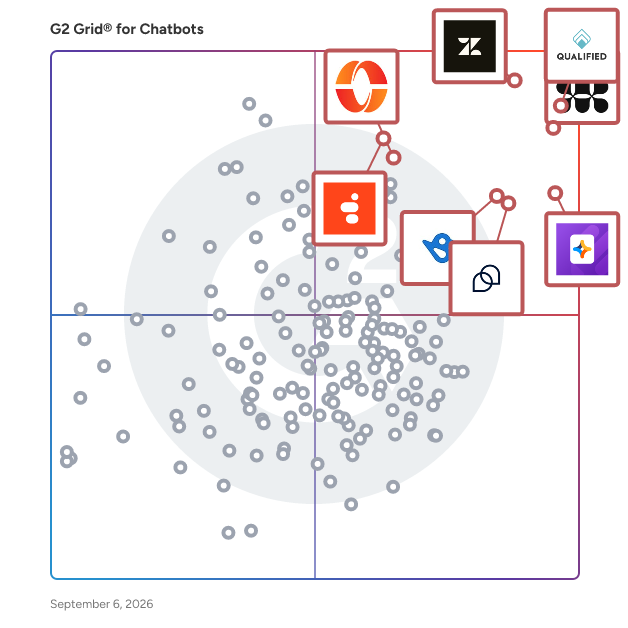
- **Leader:** [Zendesk for Customer Service](https://www.g2.com/products/zendesk-for-customer-service/reviews)
- **Highest Performer:** [Twixor](https://www.g2.com/products/twixor/reviews)
- **Easiest to Use:** [Podium](https://www.g2.com/products/podium/reviews)
- **Top Trending:** [HighLevel](https://www.g2.com/products/highlevel/reviews)
- **Best Free Software:** [Fin by Intercom](https://www.g2.com/products/fin-by-intercom/reviews)


---

**Sponsored**

### LiveChat

LiveChat is a comprehensive customer communication platform that enables businesses to connect with their website visitors and customers in real-time, driving sales, delivering support, and enhancing customer satisfaction. Designed for ecommerce teams, the platform boosts AOV, upsell, and overall ROI by engaging shoppers at the right moment and converting more traffic into revenue. AI and advanced analytics surface sales opportunities, automate routine conversations, and give clear visibility into performance. All essential tools - including AI automation, analytics, a customizable chat widget, and agent apps - come together in one easy-to-deploy, no-code platform that delivers value quickly. ✅ Benefits • Higher conversions by capturing visitor attention at key moments through proactive, real-time engagement. • Lower operational overhead and greater agent productivity thanks to managing all communication channels in one unified workspace. • Better business decisions and clearer performance insights driven by transparent reporting on conversions, lead quality, and sales opportunities. • Faster responses and more time for high-value conversations enabled by AI that automates routine work and supports agents with smart assistance. • Stronger customer engagement and higher average order value through chat experiences tailored to your brand and optimized for upsell. 💬 Key features • Chat tools and widget: Real-time, two-way conversations with visitors, supported by file sharing, chat archives, automated greetings (like sneak-peek and inactivity prompts), seamless chat transfer, and post-chat ratings. • Multi-channel messaging: Manage all conversations from a single workspace - one license covers unlimited websites and apps, plus Facebook Messenger, WhatsApp Business, and email. • AI and automation: Leverage built-in AI features, including Copilot, reply suggestions, chat summaries, and insights extracted from high-volume conversations to boost efficiency and speed. • Analytics and reporting: Access intuitive dashboards that track agent performance, conversions, customer behavior, and more, with robust filtering and easy data export. • Customization and integrations: Tailor the widget’s appearance, language, and brand voice, and extend capabilities with 200+ integrations across CRMs, ecommerce platforms, help desks, and automation tools. • Easy implementation: Add LiveChat to your site with a simple code snippet-no heavy development or complex setup required. • Security and support: Benefit from enterprise-grade security, reliable infrastructure, and 24/7/365 customer support to keep your communication running flawlessly. 🌎 Trusted by teams worldwide to drive growth Thousands of companies worldwide utilize LiveChat to deliver fast and personalized customer interactions. Over 40% of customers prefer brands that offer live chat, and businesses that consistently use it see higher conversion rates and stronger engagement. LiveChat helps teams work more efficiently, improve satisfaction, and drive measurable growth. Adding specific customer results - like increases in conversions or agent productivity - can further highlight its impact. About Us LiveChat was created by Text S.A., a global software company headquartered in Wrocław, Poland. For over two decades, we’ve been dedicated to building tools that help businesses communicate better with their customers. LiveChat serves companies in more than 150 countries - from growing ecommerce stores to established B2B SaaS organizations - empowering them to deliver fast, personal, and effective customer service.


[Visit website](https://www.g2.com/external_clickthroughs/record?secure%5Bad_program%5D=ppc&amp;secure%5Bad_slot%5D=category_product_list&amp;secure%5Bcategory_id%5D=1250&amp;secure%5Bdisplayable_resource_id%5D=191&amp;secure%5Bdisplayable_resource_type%5D=Category&amp;secure%5Bmedium%5D=sponsored&amp;secure%5Bplacement_reason%5D=neighbor_category&amp;secure%5Bplacement_resource_ids%5D%5B%5D=191&amp;secure%5Bplacement_resource_ids%5D%5B%5D=1346&amp;secure%5Bprioritized%5D=false&amp;secure%5Bproduct_id%5D=1856&amp;secure%5Bresource_id%5D=1250&amp;secure%5Bresource_type%5D=Category&amp;secure%5Bsource_type%5D=category_page&amp;secure%5Bsource_url%5D=https%3A%2F%2Fwww.g2.com%2Fcategories%2Fchatbots%3Fpage%3D44&amp;secure%5Btoken%5D=ed81b7e5bd8eaaa7c3c5ce0156e79dfd90c64c5360a8b44088067b782f2fbe0b&amp;secure%5Burl%5D=https%3A%2F%2Fwww.livechat.com%2F&amp;secure%5Burl_type%5D=free_trial)

---


## Parent Category

[Conversational Intelligence Software](https://www.g2.com/categories/conversational-intelligence)


## Related Categories

- [Customer Self-Service Software](https://www.g2.com/categories/customer-self-service)
- [Live Chat Software](https://www.g2.com/categories/live-chat)
- [Conversational Marketing Software](https://www.g2.com/categories/conversational-marketing)


---

## Buyer Guide

### What You Should Know About Chatbots Software

### What are Chatbots?

Chatbots are impacting every aspect of how businesses communicate with people. Although chatbots are still in the early days, they have grown and developed in leaps and bounds. Chatbots—also known as digital assistants, virtual assistants, virtual agents, interactive agents, and more—have gone from being a simple conversational interface where the user would input text and receive a canned response, to a robust tool where users can converse with a computer via text or voice and receive bespoke responses based on the given context. This advancement is due largely to the rise of artificial intelligence and [natural language processing (NLP) software](https://www.g2.com/categories/natural-language-processing-nlp), as well as improvements in computing power. However, the rise of chatbots should not be viewed in a vacuum. Messaging, in general, has arisen as a preeminent form of communication, and as such, it should come as no surprise that people want a faster and more accessible way to get information. Chatbots can get them that information quickly and can help companies fulfill this desire.

With the use of machine learning and deep learning, chatbots can grow intelligently and understand a wider vocabulary and colloquial language, as well as provide more precise and correct responses to requests. Through providing information and conducting specific tasks, whether external, customer-facing requests or internal, employee-facing requests, chatbots can augment humans’ abilities.

#### What Types of Chatbots Exist?

The manner in which a user might interact with a chatbot can differ, especially as it relates to the sophistication of the chatbot’s conversational abilities and the degree to which a human might need to step in when the chatbot is not able to respond to a particular query in a reasonable manner.

**Button-based bots**

Users interact with these chatbots through menus and buttons.

**Keyword recognition-based chatbots**

Users interact with these chatbots through text or speech and the bot responds based on certain pre-programmed keywords.

**Contextual chatbots**

Users interact with these chatbots in a natural, conversational manner and the bot responds appropriately, thanks to advanced NLP software techniques.

### What are the Common Features of Chatbots?

To fully evaluate a chatbot, it should fulfill the task that it has been programmed to do in an efficient and effective way. Here are some criteria through which it can be evaluated.

**Emotional intelligence:** In any conversational context, it is critical that each speaker responds to the other in an emotionally intelligent manner, paying careful attention to the emotional state of the other. This is no less true with a chatbot. The best chatbots on the market respond to the user in a way that is commensurate with their emotional state.

**Conversational ability:** As the name implies, chatbots should be able to chat in a way that is natural and fluent, understanding the intent of what was said and responding appropriately.

**Broad knowledge base:** Good chatbots are well integrated with a host of business systems or knowledge bases, giving them the ability to answer questions correctly and contextually.

**Personal:** Stellar chatbots connect to the user in a way that is bespoke and tailored to the individual. They take in personal information in a safe and secure manner and output a response which befits the question as well as the questioner.

**Personality:** Boring chatbots might work in some cases, but adding a bit of zest and personality can help unlock the full potential of these conversational agents. When a chatbot has a touch of sass, the conversation is enriched and enlightened, thus raising the level and sophistication of the conversation.

### What are the Benefits of Chatbots?

Chatbots affect any touchpoint where businesses communicate with people. Therefore, there are many key reasons a company might deploy a chatbot for a given use case. Chatbots aren’t just useful for website visitors, app users, and customers, but businesses as well. Below are a few reasons why businesses may decide to use chatbots.

**More people are ready to use chatbots:** At least in certain circumstances, consumers actually prefer using chatbots for quick communication with brands. People are in front of their computer and phone screens now more than ever, so it makes sense to provide them with a service they can access with their fingertips.

**They never take a day off:** Bots are not constrained to traditional work hours or time zones. So, if one approaches the bot with a basic issue at odd hours, it can be resolved within minutes.

**Knowledge acquisition:** Chatbots can be used to help visitors sign up for marketing newsletters, register for webinars, schedule appointments, and even guide customers to a landing page or e-commerce site to finalize transactions.

### Who Uses Chatbots?

Chatbots, as a multi-purpose, many-featured solution, can be utilized by various business users.&amp;nbsp;

**Marketers** : Marketers are always looking to connect and engage with customers and potential customers. Some channels which they utilize include SMS, email, and telephone. Through conversational solutions, like chatbots, marketers can connect in an automated manner, which would help increase their scale and scope.

**Customer support:** When one has issues with a product or service, they want to be able to engage with the business in whatever channel they desire. As such, businesses across industries are developing solutions, such as chatbots, to ensure that they are always available. With chatbots, they are able to provide 24/7 support and services to employees and customers.

**Human resources:** Employees frequently have questions for their human resources (HR) team, sometimes known as employee success. These questions range from benefits to paid time off (PTO) to salary-related queries. Although it is important to keep the human in human resources, chatbots can provide a channel in which employees can ask questions and receive answers immediately.

### What are the Alternatives to Chatbots?

As mentioned, chatbots are making an impact across industries as well as business functions. Therefore, it is only natural that they integrate with a host of different software. Here are some different types of software that are either directly related to or can be integrated with chatbots.

[Bot platforms](https://www.g2.com/categories/bot-platforms) **:** Chatbots are a great solution when users are looking for a chatbot that they can use off the shelf, with little to no development or coding experience necessary. However, companies looking to build their own chatbot can benefit from bot platforms, which are tools used to build and deploy interactive chatbots. These platforms provide development tools such as frameworks and API toolsets for customizable bot creation.

[Intelligent virtual assistant](https://www.g2.com/categories/intelligent-virtual-assistants)[s software](https://www.g2.com/categories/intelligent-virtual-assistants) **:** If a company has more time and energy, as well as fiscal resources, it is wise for them to explore intelligent virtual assistants (IVAs), which provide the same basic capabilities of chatbots and more. With IVAs, users are enabled to have natural conversations via a host of different channels to solve their business problems. In addition, this advanced software has the ability to use the conversations to update systems such as a CRM, an ERP, or human resource management systems.

#### Software Related to Chatbots

The following solutions can be used in conjunction with chatbots to automate business operations and further advance digital transformation:

[Help desk software](https://www.g2.com/categories/help-desk) **:** Customer service is a major use case for chatbots. Help desk software, which is designed to provide a customer with information and support regarding a company’s products or services, is extensively including chatbot functionality or the ability to integrate with chatbots.

[Productivity bots software](https://www.g2.com/categories/productivity-bots) **:** Users looking to increase the productivity of software they are using should look to productivity bots to help them achieve this goal. Productivity bots work as add-ons to software tools, providing additional features, organization, or automation on top of the foundational features of the product.

When a bot is connected to a software platform, it boosts the utility of the existing tool that the team already uses.

[Natural language processing (NLP) software](https://www.g2.com/categories/natural-language-processing-nlp): NLP software allows applications to interact with human language using a deep learning algorithm. NLP algorithms input language and can give a variety of outputs based on the learned task

NLP algorithms can provide voice recognition and natural language generation, which converts data into understandable human language. Some examples of NLP uses include chatbots, translation applications, and social media monitoring tools that scan social media networks for mentions.

### Challenges with Chatbots

A software can come with its own set of challenges. Chatbots, which are changing many industries and use cases (such as customer support and e-commerce), have some key issues which one should keep in mind.

**Preference for human agents:** Although chatbots are great at many tasks, some contexts, such as those which require a significant amount of empathy, may be better served by a human agent.

**Handoffs to humans:** There might come a time when a chatbot does not have an answer to a question from the user. It is critical that the system is designed in a way to successfully resolve this problem. Typically, the best way to solve this is to transition the user to a human agent.

### Which Companies Should Buy Chatbots?

Chatbots are positively affecting industries from travel to retail, as well as business functions such as HR. Within these industries, the roles can significantly vary as to who most commonly engages with chatbots.

**Hospitality:** The hospitality industry is being transformed by chatbots, with businesses using them to increase customer loyalty through on-demand support and personalized service. Other uses of chatbots in the hospitality sector include taking reservations, enabling personalized services like preferred room features or local restaurant recommendations supporting customer engagement and retention.

**Retail:** Retail and e-commerce stand to benefit greatly from the deployment of chatbots to enhance customer engagement and drive sales. Chatbots can also deliver a personalized e-commerce experience for customers.

**Travel:** The travel sector is adopting chatbots to assist customer bookings, provide customer support, resolve complaints, and act as a personal assistant to customize a traveler’s itinerary.

### How to Buy Chatbots

When looking to deploy a chatbot solution, businesses should start by investigating their various channels, such as messaging platforms, emails, and websites. Chatbots can be deployed across any and all of these platforms. Through analyzing these channels—e.g., discovering response rates, most popular channels, etc.—users can best understand their performance and how chatbot solutions can supercharge them.

#### Requirements Gathering (RFI/RFP) for Chatbots

Whether a company is purchasing chatbots for the first time or looking to replace their current system, G2.com can assist them with the selection process.

First, buyers should evaluate the need for chatbots and determine what functionality will be most useful for the business.&amp;nbsp;

Some initial questions which should be asked include:

- Which are the channels that are supported?
- How long does it take to set up?
- How easy is it to script the chatbots?
- How is the offering priced?

#### Compare Chatbots

**Create a long list**

Evaluating vendors should start with a long list, which will help to determine whether or not a given solution is a good fit. With a long list, one creates a broad list of tools that align with one’s business goals. So that there is a level playing field, it is important to ask the same set of questions to each seller.

**Create a short list**

Next, a whittling down should take place. Through pointed questions, demos, and trials, one can go from a long list to a short one. Although this will differ for each business and use case, three to five products are typically a good number. With this list in hand, businesses can produce a matrix to compare the features and pricing of the various solutions.

**Conduct demos**

To ensure the comparison is thoroughgoing, the user should demo each solution on the short list with the same use case and datasets. This will allow the business to evaluate like for like and see how each vendor stacks up against the competition.

#### Selection of Chatbots

**Choose a selection team**

Before getting started, it&#39;s crucial to create a winning team that will work together throughout the entire process, from identifying pain points to implementation. The software selection team should consist of members of the organization who have the right interest, skills, and time to participate in this process. A good starting point is to aim for three to five people who fill roles such as the main decision maker, project manager, process owner, system owner, or staffing subject matter expert, as well as a technical lead, IT administrator, or security administrator. In smaller companies, the vendor selection team may be smaller, with fewer participants multitasking and taking on more responsibilities.

**Negotiation**

Just because something is written on a company’s pricing page, does not mean it is fixed (although some companies will not budge). It is imperative to open up a conversation regarding pricing and licensing. For example, the vendor may be willing to give a discount for multi-year contracts or for recommending the product to others.

**Final decision**

After this stage, and before going all in, it is recommended to roll out a test run or pilot program to test adoption with a small sample size of users. If the tool is well used and well received, the buyer can be confident that the selection was correct. If not, it might be time to go back to the drawing board.

### Chatbots Trends

In addition, artificial intelligence techniques such as NLP software help make chatbot solutions easier to use and more powerful, providing more accurate results. Below are the trends relevant to this software.

**Conversational interfaces**

In general, users are looking to conversational interfaces to get answers to their burning questions. For example, they are looking to query their data in a more natural way. Since natural language understanding has improved, people can talk to their data, finding and exploring insights using natural, intuitive language. With this powerful technology, users can focus on discovering patterns and finding meaning hidden in the data as opposed to memorizing SQL queries.

Data-focused businesspeople, like data analysts, can benefit from conversational interfaces like chatbots. Users can uncover the material they are looking for using intuitive language. Intuitive methods of querying data mean a larger user base that can access and make sense of company data.

**Voice**

Voice is a primal method of interacting with others. It is only natural that we now converse with our machines using our voice and that the platforms for said voicebots have seen great success. Voice makes technology feel more human and allows people to trust it more. Voice will prove to be an important natural interface that mediates human communication and relationships with devices, and ultimately, within an AI-powered world.

**Artificial intelligence**

AI is quickly becoming a promising feature of many, if not most, types of software. With machine learning, end users can identify patterns in data, allowing them to make sense of content and help them understand what they are seeing. This pattern recognition is fueling the rise of more powerful, contextually-aware chatbots.


