Best Block Storage Software - Page 3

How Many Block Storage Software Products Does G2 Track?

Total Products under this Category: 47

Category Stats (Sep 2026)

  • Average Rating: 4.45/5 (↓0.01 vs Aug 2026) The average rating of products in this category, based on all submitted ratings
  • Top Trending Product: DigitalOcean (+0.02%) - Among all products in this category, DigitalOcean recorded the largest rating increase compared to last month

Last updated: September 16, 2026

How Does G2 Rank Block Storage Software Products?

Why You Can Trust G2's Software Rankings:

  • 30 Analysts and Data Experts
  • 2,100+ Authentic Reviews
  • 47+ Products
  • Unbiased Rankings

G2's software rankings are built on verified user reviews, rigorous moderation, and a consistent research methodology maintained by a team of analysts and data experts. Each product is measured using the same transparent criteria, with no paid placement or vendor influence. While reviews reflect real user experiences, which can be subjective, they offer valuable insight into how software performs in the hands of professionals. Together, these inputs power the G2 Score, a standardized way to compare tools within every category.

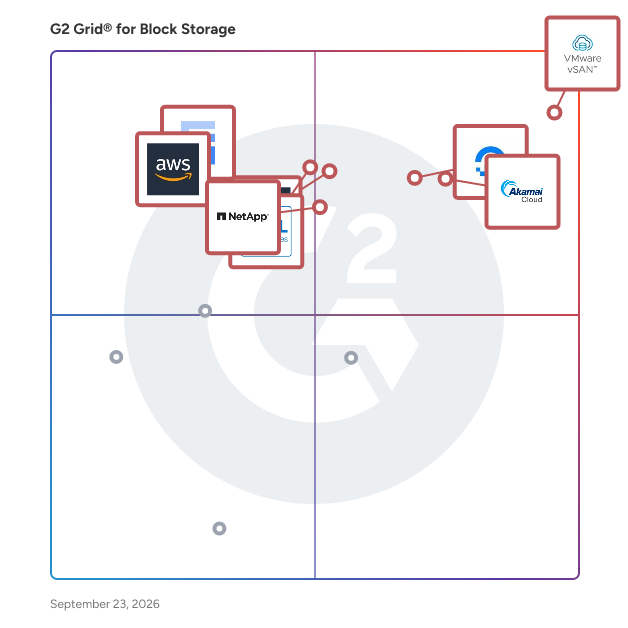
G2 Grid® for Block Storage Software

G2 Grid® for Block Storage Software plotting products by satisfaction and market presence

Highlighted products: VMware vSAN, Akamai Cloud Computing, DigitalOcean, Amazon Elastic Block Store (EBS), Dell PowerFlex, NetApp ONTAP Data Management Software, Google Cloud Persistent Disk, and Amazon Lightsail.

Underlying data: [Grid® JSON](https://www.g2.com/categories/block-storage/grids.json?focus%5B%5D=vmware-vsan&focus%5B%5D=akamai-cloud-computing&focus%5B%5D=digitalocean&focus%5B%5D=amazon-elastic-block-store-ebs&focus%5B%5D=dell-powerflex&focus%5B%5D=netapp-ontap-data-management-software&focus%5B%5D=google-cloud-persistent-disk&focus%5B%5D=amazon-lightsail)

Catalyst Cloud

Delivers robust and innovative cloud services in New Zealand with prices comparable to global cloud providers. Provides web services that are the building blocks of IT.

Who Is the Company Behind Catalyst Cloud?

croit unified storage platform

Being avid Ceph users ourselves for many years, we were keen to bring all our knowledge about Ceph, Linux and networks into a solution that we believe to be outstanding. We strongly believe that our software not only solves many recurring problems that we have experienced ourselves in any other form of Ceph deployment, but also reduces the total cost of scale-out of storage. Our solution will help you grow your business without worrying about the usual problems. Thanks to the openness of our solution, there are no lock-in effects. You can always use hardware from any manufacturer, as well as seamlessly deploy alternative Ceph solutions in the same storage. This puts you in the unique position to operate state-of-the-art scale-out storage at best conditions with perfect support.

Who Is the Company Behind croit unified storage platform?

  • Seller: croit
  • Year Founded: 2017
  • HQ Location: München, DE
  • LinkedIn® Page: www.linkedin.com
    23 employees on LinkedIn®

Dell PowerStore

Dell PowerStore is a unified, all-flash end-to-end NVMe storage platform engineered for performance, efficiency, and resilience. It supports block, file, and container workloads across modern IT environments. With an autonomous architecture, built-in intelligence, and seamless migration tools, PowerStore delivers up to 2x better efficiency*, 52x lower latency*, and 30% faster performance* — making it the #1 choice in ease of use* and future-ready infrastructure.

Who Is the Company Behind Dell PowerStore?

  • Seller: Dell Technologies
  • Year Founded: 1984
  • HQ Location: Round Rock, TX
  • Twitter: @Dell
    799,086 Twitter followers
  • LinkedIn® Page: www.linkedin.com
    124,254 employees on LinkedIn®
  • Ownership: NYSE: DELL

Exoscale

Exoscale is a European sovereign cloud service provider offering a full range of infrastructure solutions, including virtual machines, S3-compatible object storage, scalable Kubernetes clusters, block storage, managed databases, GPUs, AI services and many more. The platform is designed for simplicity and flexibility, allowing users to deploy resources quickly and manage their cloud environments efficiently, whether through self-service tools or ready-made solutions for operational ease. Exoscale supports a wide range of users, from developers and system administrators seeking automation to IT managers needing reliable hosting or powerful compute capacity. With data centers located in Europe and strong data protection commitments, your data and services are safeguarded against technical issues and external legal risks. Exoscale combines quality with competitive, pay-per-use pricing, so you can scale resources and costs in step with your business growth.

Who Is the Company Behind Exoscale?

  • Seller: Exoscale
  • Year Founded: 2011
  • HQ Location: Lausanne, CH
  • Twitter: @exoscale
    3,529 Twitter followers
  • LinkedIn® Page: www.linkedin.com
    86 employees on LinkedIn®

Who Uses This Product?

  • Company Size: 100% Large

What Are Recent G2 Reviews of Exoscale?

What Are G2 Users Discussing About Exoscale?

gBlock Storage

gBlock Storage is designed to meet specific IOPS performance levels. All block storage types are RAID configured and accessed via fiber channel. Block storage is fast no matter what IOPS level you choose, with speeds that are four to eight times faster than a mechanical hard disk.

Who Is the Company Behind gBlock Storage?

  • Seller: Lunavi
  • Year Founded: 2007
  • HQ Location: Cheyenne, US
  • Twitter: @WeAreLunavi
    3,133 Twitter followers
  • LinkedIn® Page: www.linkedin.com
    125 employees on LinkedIn®

Google Local SSD

Local SSD Local solid-state drive storage for virtual machine instances.

Who Is the Company Behind Google Local SSD?

  • Seller: Google
  • Year Founded: 1998
  • HQ Location: Mountain View, CA
  • Twitter: @google
    31,899,995 Twitter followers
  • LinkedIn® Page: www.linkedin.com
    301,144 employees on LinkedIn®
  • Ownership: NASDAQ:GOOG

Lightbits Labs

Lightbits SDS offers high bandwidth, low latency storage over a standard NVMe/TCP network. Storage solution for Kubernetes, MySQL, Cassandra, Mongodb, Kafka.

Who Is the Company Behind Lightbits Labs?

  • Seller: LIGHTBITS LABS
  • Year Founded: 2016
  • HQ Location: San Jose, California, United States
  • LinkedIn® Page: www.linkedin.com
    99 employees on LinkedIn®

Lunavi Cloud Storage

Highly scalable, cost-effective cloud storage for large sets of unstructured data including images, video, documents, and other media-rich environments.

Average Rating: 3.1/5.0

Total Reviews: 4

How Do G2 Users Rate Lunavi Cloud Storage?

  • Ease of Use: 5.0/10 (Category avg: 8.7/10)
  • Quality of Support: 6.7/10 (Category avg: 8.5/10)

Who Is the Company Behind Lunavi Cloud Storage?

  • Seller: Lunavi
  • Year Founded: 2007
  • HQ Location: Cheyenne, US
  • Twitter: @WeAreLunavi
    3,133 Twitter followers
  • LinkedIn® Page: www.linkedin.com
    125 employees on LinkedIn®

Who Uses This Product?

  • Company Size: 50% Medium, 50% Small

What Are Recent G2 Reviews of Lunavi Cloud Storage?

What Are G2 Users Discussing About Lunavi Cloud Storage?

MayaScale Cloud Data Platform

MayaScale Cloud Data Platform by ZettaLane Systems is a high-performance, software-defined storage solution that leverages NVMe over Fabrics technology to consolidate direct-attached NVMe resources into a shared storage pool. This platform enables on-demand provisioning of NVMe namespaces, allowing clients to access high-speed storage without the constraints of over-provisioning or stranded resources. Designed to be network-agnostic, MayaScale supports RDMA for on-premises deployments and standard TCP for cloud environments, ensuring seamless integration across diverse infrastructures. Key Features and Functionality: - Flexible Storage Provisioning: Dynamically allocate and deallocate NVMe storage, optimizing resource utilization and eliminating the inefficiencies associated with direct-attached storage. - High Availability: Implement Active-Active configurations with synchronous mirroring, providing persistent storage solutions that deliver up to 10 times the performance of traditional Elastic Block Store systems. - Network Versatility: Utilize RDMA for low-latency, high-throughput on-premises setups, and standard TCP for cloud-based deployments, facilitating adaptable and efficient storage solutions. - Advanced Data Services: Enhance storage efficiency with features such as compression, deduplication, and synchronous mirroring, ensuring data integrity and optimal performance. - Seamless Integration: Present true NVMe devices to clients using standard NVMe driver stacks, eliminating the need for proprietary drivers and simplifying deployment. Primary Value and User Solutions: MayaScale Cloud Data Platform addresses the challenges of modern enterprises by providing a scalable, high-performance storage solution that separates storage from compute instances. This separation removes deployment restrictions associated with locally attached ephemeral NVMe SSDs, offering persistent storage with superior performance. By consolidating NVMe resources into a shared pool, organizations can achieve significant cost savings, reduce data center footprints, and enhance business productivity through efficient storage management.

Who Is the Company Behind MayaScale Cloud Data Platform?

NetApp Keystone StaaS

NetApp Keystone STaaS is an on-premises, cloud-like storage subscription service that delivers NetApp’s enterprise storage as an operational expense rather than a capital investment. Customers get guaranteed performance tiers, built-in data protection, and ONTAP’s full set of capabilities without needing to own, refresh, or manage the hardware lifecycle. Keystone provides elastic capacity, predictable billing, and a single subscription model that can span on-prem, hybrid cloud, and public cloud environments. Keystone STaaS is ideal for organizations that want to simplify storage operations, avoid large upfront purchases, or align storage spending with actual usage. It’s a strong fit for IT teams modernizing aging infrastructure, supporting unpredictable workloads, or building hybrid cloud architectures that require consistent data services across environments. Keystone also helps public sector and enterprise customers accelerate digital transformation by reducing complexity and providing guaranteed SLAs for availability and performance.

Who Is the Company Behind NetApp Keystone StaaS?

  • Seller: NetApp
  • Year Founded: 1992
  • HQ Location: Sunnyvale, California
  • Twitter: @NetApp
    118,015 Twitter followers
  • LinkedIn® Page: www.linkedin.com
    12,706 employees on LinkedIn®
  • Ownership: NASDAQ

Powerstore

Who Is the Company Behind Powerstore?

  • Seller: Dell Technologies
  • Year Founded: 1984
  • HQ Location: Round Rock, TX
  • Twitter: @Dell
    799,086 Twitter followers
  • LinkedIn® Page: www.linkedin.com
    124,254 employees on LinkedIn®
  • Ownership: NYSE: DELL

Serverspace Block Storage

Elastic You can easily manage the capacity by increasing it even after creating a volume. The single volume size is from 10 GB up to 1 TB, and a single VM can mount up to 4 add volumes. Stable Storage volumes data replication is higher than the industry’s average level, which ensures rapid data recovery, and the data availability is as high as 99.9% to protect your volumes from failure. Simple Cloud storage volumes can be managed with simple automated operations such as creating, mounting, and deleting, without wasting time on manual control and deployment costs.

Who Is the Company Behind Serverspace Block Storage?

  • Seller: Serverspace
  • Year Founded: 2006
  • HQ Location: New Jersey, USA
  • Twitter: @ServerspaceTeam
    146 Twitter followers
  • LinkedIn® Page: www.linkedin.com
    1 employees on LinkedIn®

simplyblock

Simplyblock delivers enterprise-grade storage orchestration for Kubernetes environments through its innovative NVMe-first architecture. By leveraging NVMe over TCP, simplyblock provides ultra-low latency access while unifying disparate storage tiers into a seamless pool. The platform's sophisticated multi-tier architecture automatically optimizes data placement across high-performance NVMe storage, QLC or HDD pools, and cost-effective object storage tiers. Rather than relying on full replication, simplyblock employs erasure coding to deliver enterprise-grade data protection with significantly lower storage overhead and fewer data copies. For Kubernetes operators, this means gaining the performance benefits of local NVMe storage while maintaining the durability of distributed systems - all through a single storage plane that dynamically adapts to your workload requirements. Whether running cloud-native databases, streaming platforms, or observability solutions, simplyblock's intelligent storage optimization ensures maximum performance and cost-efficiency at scale.

Who Is the Company Behind simplyblock?

SkyAtlas

SkyAtlas API allows you to manage your cloud infrastructure in a simple and programmatic way. You can automate routine tasks with RESTful SkyAtlas API that you are familiar with in the SkyAtlas administrator interface.

Who Is the Company Behind SkyAtlas?

  • Seller: SkyAtlas
  • HQ Location: Istanbul, TR
  • Twitter: @skyatlascom
    88 Twitter followers
  • LinkedIn® Page: www.linkedin.com
    14 employees on LinkedIn®

Tencent Cloud Block Storage

Tencent Cloud offers a powerful and robust cloud solution that is specifically designed to address unique challenges faced by enterprises as they expand into China. Tencent Cloud is part of a rich digital ecosystem that includes some of China’s top social, messaging, mobile payment, gaming, digital literature, music streaming, and video platforms.

Who Is the Company Behind Tencent Cloud Block Storage?

  • Seller: Tencent
  • Year Founded: 1998
  • HQ Location: Shenzhen, Guangdong
  • Twitter: @TencentGlobal
    56,308 Twitter followers
  • LinkedIn® Page: www.linkedin.com
    89,584 employees on LinkedIn®
  • Ownership: OTC: TCEHY
Rachana Hasyagar
RH
Researched and written by Rachana Hasyagar
Updated October 3, 2024