# Best Asset Performance Management Software - Page 7

  *By [Nathan Calabrese](https://research.g2.com/insights/author/nathan-calabrese)*

   Asset performance management (APM) encompasses software tools designed to optimize essential operational assets, such as plants, equipment, and infrastructure, which are critical to a business’ success. Asset performance management helps companies track the performance of their fixed assets to optimize their use. Companies use asset performance management solutions to extend the life of their fixed assets and to reduce the costs of maintenance. Asset performance management is mainly used by maintenance managers, but can also be used by finance professionals to monitor fixed asset costs. Additionally, APM tools help businesses comply with regulatory requirements for asset inspection and maintenance.

APM solutions use data capture, integration, visualization, and analytics to refine operations and schedule maintenance more effectively. By analyzing data, APM systems help determine the most impactful maintenance and inspection activities, improving the reliability of mission-critical assets.

Asset performance management software can be delivered as part of an [enterprise asset management (EAM) software](https://www.g2.com/categories/enterprise-asset-management-eam) package, or as a separate solution. Some [business intelligence software](https://www.g2.com/categories/business-intelligence) providers also offer solutions customized for asset performance.

To qualify for inclusion in the Asset Performance Management category, a product must:

- Consolidate fixed assets data from multiple sources
- Provide standard KPIs to track asset performance
- Identify trends and potential risks that may impact assets
- Deliver suggestions on how to improve asset utilization
- Track the financial performance of fixed assets


## How Many Asset Performance Management Software Products Does G2 Track?
**Total Products under this Category:** 103

### Category Stats (May 2026)
- **Average Rating**: 4.36/5
- **New Reviews This Quarter**: 136
- **Buyer Segments**: Mid-Market 48% │ Small-Business 31% │ Enterprise 21%
- **Top Trending Product**: Octave Attune EAM (HxGN EAM) (+0.071)
*Last updated: May 18, 2026*

  
## How Does G2 Rank Asset Performance Management Software Products?

**Why You Can Trust G2's Software Rankings:**

- 30 Analysts and Data Experts
- 6,200+ Authentic Reviews
- 103+ Products
- Unbiased Rankings

G2's software rankings are built on verified user reviews, rigorous moderation, and a consistent research methodology maintained by a team of analysts and data experts. Each product is measured using the same transparent criteria, with no paid placement or vendor influence. While reviews reflect real user experiences, which can be subjective, they offer valuable insight into how software performs in the hands of professionals. Together, these inputs power the G2 Score, a standardized way to compare tools within every category.

  
## Which Asset Performance Management Software Is Best for Your Use Case?

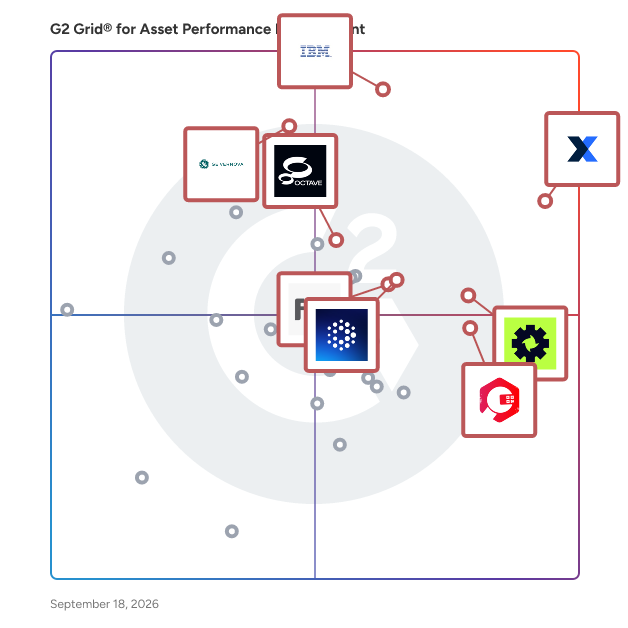
- **Leader:** [MaintainX](https://www.g2.com/products/maintainx/reviews)
- **Highest Performer:** [Tenna](https://www.g2.com/products/tenna/reviews)
- **Easiest to Use:** [MaintainX](https://www.g2.com/products/maintainx/reviews)
- **Top Trending:** [MaintainX](https://www.g2.com/products/maintainx/reviews)
- **Best Free Software:** [IBM Maximo Application Suite](https://www.g2.com/products/ibm-maximo-application-suite/reviews)

  
---

**Sponsored**

### eWorkOrders CMMS

eWorkOrders CMMS is a powerful, affordable, and web-based Computerized Maintenance Management System (CMMS) that helps organizations streamline work orders, preventive maintenance, and asset management. Designed for maintenance teams of all sizes, eWorkOrders makes it simple to track assets, manage inventory, schedule maintenance, and generate detailed reports—all from any device, anywhere. Key features include: • Work Order Management – create, assign, and track tasks efficiently. • Preventive Maintenance (PMs) – plan and automate maintenance schedules. • Asset &amp; Inventory Management – keep assets and spare parts organized. • Employee &amp; Service Management – manage staff, contractors, and service requests. • Documentation &amp; Meter Tracking – record vital maintenance data and readings. • GIS Tracking &amp; Scheduling – optimize operations across multiple locations. • AI Assistant with Automatic Assignments, PM Recommendations, Work Orders Assist, Reporting &amp; Help Assistant. No software installation or hardware purchase required. Upgrades and technical support are included, so you can be up and running in a single day. Discover why eWorkOrders is consistently one of the highest-rated CMMS solutions. Request a live demo today by calling us at 888-333-4617 and learn how it can reduce downtime, improve compliance, and enhance asset reliability


[Visit website](https://www.g2.com/external_clickthroughs/record?secure%5Bad_program%5D=ppc&amp;secure%5Bad_slot%5D=category_product_list&amp;secure%5Bcategory_id%5D=1734&amp;secure%5Bdisplayable_resource_id%5D=431&amp;secure%5Bdisplayable_resource_type%5D=Category&amp;secure%5Bmedium%5D=sponsored&amp;secure%5Bplacement_reason%5D=neighbor_category&amp;secure%5Bplacement_resource_ids%5D%5B%5D=663&amp;secure%5Bplacement_resource_ids%5D%5B%5D=431&amp;secure%5Bprioritized%5D=false&amp;secure%5Bproduct_id%5D=11966&amp;secure%5Bresource_id%5D=1734&amp;secure%5Bresource_type%5D=Category&amp;secure%5Bsource_type%5D=category_page&amp;secure%5Bsource_url%5D=https%3A%2F%2Fwww.g2.com%2Fcategories%2Fasset-performance-management%3Fpage%3D7&amp;secure%5Btoken%5D=55f2e7feaef299a65649b4323039a29d3ebc90959b67ad0eeb668a0359cd16f8&amp;secure%5Burl%5D=https%3A%2F%2Feworkorders.com%2FLandingPages.asp&amp;secure%5Burl_type%5D=product_website)

---

  
    ## What Is Asset Performance Management Software?
  [Asset Management  Software](https://www.g2.com/categories/asset-management)
  ## What Software Categories Are Similar to Asset Performance Management Software?
    - [CMMS Software](https://www.g2.com/categories/cmms)
    - [Enterprise Asset Management (EAM) Software](https://www.g2.com/categories/enterprise-asset-management-eam)
    - [Asset Tracking Software](https://www.g2.com/categories/asset-tracking)

  
---

## How Do You Choose the Right Asset Performance Management Software?

### What You Should Know About Asset Performance Management Software

### What is asset performance management (APM) software?

Asset performance management solutions help companies track the performance of fixed assets to optimize their use by providing a detailed view of asset performance, asset health, quality of product, and production. Companies use this type of software to extend the life of their fixed assets and to reduce the costs of maintenance. Asset performance management tools are mainly used by maintenance managers but can also be used by finance professionals to monitor fixed asset costs and ROI. This software is used to improve the availability and asset reliability while minimizing cost and risk.

APM can be delivered as part of an[enterprise asset management (EAM) software](https://www.g2.com/categories/enterprise-asset-management-eam) package or as a separate solution. Some business intelligence software providers also offer solutions customized for asset performance.

### Types of asset performance management solutions

APM solutions vary depending on how the product is sold and implemented, its features, and the software&#39;s delivery model.

#### **Standalone or part of EAM**

Asset performance management software can be implemented on its own or as part of EAM software, which enables businesses across multiple industries to acquire, manage, and analyze physical assets. Asset performance management software is sometimes integrated into EAM for asset-intensive industries such as manufacturing, construction, energy, and utilities. The primary users of EAM software are maintenance teams who leverage the software to identify issues and perform inspections or repairs.

#### **Cloud or on-premises**

Cloud-based asset performance management software doesn’t require additional hardware, is accessible from anywhere with an internet connection, and does not require an onsite support team. All of this information and support is hosted by a 3rd party which allows companies to pay on an as-needed basis and effectively scale up or down depending on overall usage, user requirements, and the growth of a company.

On-premises software, on the other hand, resides within an organization’s premises and sometimes requires a license to operate. There are also additional costs associated with managing and maintaining on-premises software, such as server hardware, integration capabilities, and IT employees on hand to support and manage potential issues that may arise.

#### **Agnostic or industry-specific**

Agnostic APM software can receive data in multiple formats or from multiple sources and effectively process the data. This software does not need to be hardcoded to deal with all different kinds of data and also allows users to change the fields and format quickly and easily without having to compile or hardcode programs.

Industry-specific asset performance management software is designed exclusively for asset-heavy industries and offers unique features that directly apply to the company using the software. Organizations use industry-specific software to avoid investing large amounts of money in developing or customizing a software solution that fits their specific needs.&amp;nbsp;

### What are the common features of APM tools?

The following are some core features within the best asset performance management software that can help users track and manage the asset lifecycle:

**Tracks the financial performance of fixed assets:** Accountants and financial analysts use APM software solutions to track the financial performance of fixed assets to achieve the fastest ROI possible. This is done by minimizing maintenance expenses, replacing non-performing assets, allocating assets to proper locations, and writing off assets that are at the end of their life.

**Provides standard KPIs to track asset performance:** Key performance indicators provide an analytical basis for companies using asset performance management software by assisting in decision-making and helping implement an effective asset strategy. Oftentimes, these KPIs can be broken up by production and maintenance and include metrics such as on-time delivery, production costs, uptime, reliability, and asset maintenance costs.

**Consolidates fixed**  **asset data from multiple sources** : Tracking performance relies on accurate and timely data&amp;nbsp;gathered from all sources containing asset information. APM platforms consolidate asset data from CMMS, EAM, ERP, databases, and spreadsheets, as well as usage and condition monitoring information captured by intelligent sensors and [Supervisory Control and Data Acquisition (SCADA)](https://www.g2.com/categories/supervisory-control-and-data-acquisition-scada) systems.

**Optimizes asset performance** : Asset performance management software helps to optimize asset performance across departments such as operations, quality management, and maintenance and can improve waste, inefficiencies, and any other dysfunctional areas. Optimization in these areas can help improve customer satisfaction, revenue, margins, and inventory issues.

**Integrates with enterprise software** : Asset performance management systems integrate mostly with ERP and EAM solutions because ERP software helps align assets with the core functions of production and accounting, while EAM software helps companies further acquire, manage, and analyze physical assets.

### Benefits of asset performance management software

The main benefits of asset performance management software are:

**Reduce maintenance costs:** Asset performance management software can help reduce asset maintenance costs by generating maintenance reports for advanced analytics to identify non-performing assets (assets that are constantly down or underperforming) that need to be replaced by new ones. These reports can also assist in planning preventive maintenance of assets to reduce the chance of sudden and costly asset failures in the future.

**Decrease downtime:** Asset downtime, either planned or unplanned, interrupts daily operations, causes backups in production and ultimately costs the company money. Asset performance management software tracks asset usage and can help managers schedule routine maintenance so equipment failure and unplanned downtime can be minimized.

**Improve asset ROI and profitability:** When assets are managed correctly, they result in increased productivity and better return on investment (ROI) because maintenance expenses are decreased, and performance is optimized. **&amp;nbsp;** Asset performance management software assists in managing these assets so the organization can fully benefit from the investments it made in them.

### Who uses APM software?

**Asset managers:** Asset managers use asset performance management software to optimize and streamline maintenance activities, such as preventive maintenance, inspections, and planned downtime, and to identify opportunities to optimize the performance of the critical assets used by the company.

**Operations:** Operations teams and managers use asset performance management software to optimize asset allocation based on department performance, such as production and logistics. With this software, they can move assets to where the company will get the greatest productivity out of each asset and achieve ROI faster.&amp;nbsp;

**Accountants:** Accountants use asset performance management software to track and analyze each asset&#39;s financial performance. This data is used to properly record depreciation, write off assets that are at the end of their life, minimize maintenance expenses, replace non-performing assets, allocate assets to proper locations, and achieve the fastest ROI possible.

### What are the alternatives to APM software?

Alternatives to asset performance management software can replace this type of software, either partially or completely:

[EAM software](https://www.g2.com/categories/enterprise-asset-management-eam): EAM software enables businesses across multiple industries to acquire, manage, and analyze physical assets. Using a holistic approach helps optimize management strategies by tracking the lifecycle of all company-owned assets. EAM software aims to control and measure asset performance, maintenance costs, and usage across the company. This software type is most beneficial to companies from asset-intensive industries such as manufacturing, construction, energy, and utilities. The primary users of EAM software are maintenance teams who leverage the software to identify issues and perform inspections or repairs.

[ERP systems](https://www.g2.com/categories/erp-systems): ERP systems are complete, integrated systems that manage all aspects of a production-based or distribution business. They align financial management, human resources, supply chain management, and manufacturing or distribution with the core function of accounting. ERP systems provide transparency into the entire business process by tracking all aspects of production or distribution, financials, and the back office.

### Software related to APM tools

Related solutions that can be used together with asset performance management solutions include:

[Predictive maintenance](https://www.g2.com/categories/predictive-maintenance) **:** Predictive maintenance software uses machine learning to help companies proactively identify issues that may harm their fixed assets. This type of software uses statistical process control principles and predictive analytics to determine the best time to perform maintenance. It’s also able to improve safety and lower the number of accidents caused by faulty equipment. Predictive maintenance is mostly beneficial to companies from asset-intensive industries such as manufacturing, utilities, oil and gas, and mining. Maintenance managers use this type of software to reduce downtime and optimize condition-based maintenance.

[Industrial IoT](https://www.g2.com/categories/industrial-iot) **:&amp;nbsp;** Industrial IoT software, or IIoT software, assists with configuring, managing, and monitoring the Internet of Things (IoT) devices used in manufacturing operations. Smart technology allows factory operators and workers to optimize resource usage, improve product quality, and automate certain routine tasks while generating valuable data across the operation. Industrial IoT solutions may include unique hardware or assets that are specially designed for use in these areas. In some cases, these IoT solutions sync with other connected devices that are preconfigured for IoT or that are connected using third-party sensors. IoT can also be used to create digital twins or virtual simulations of fixed assets that help companies estimate asset performance in multiple scenarios.

[Manufacturing execution system](https://www.g2.com/categories/manufacturing-execution-system) **:** Manufacturing execution system (MES) software is used by manufacturers to monitor the production process. Manufacturing companies benefit from MES by tracking real-time production data, which they can use to optimize the production output. An MES is used mostly by production managers, shop floor supervisors, and the employees involved in the production process. Managers and supervisors utilize MES to implement production plans, monitor efficiency, detect potential issues and implement corrective actions.

### Challenges with APM solutions

Asset performance management tools can come with its own set of challenges, the most important being:

**Complexity:** Asset performance management is not always easy to implement and maintain, mostly because it relies on data from other systems to provide optimal results. This means that any change to or replacement of ERP or EAM software can disrupt the data flow between asset performance management and these solutions. Replacing fixed assets may also require a reconfiguration of the asset performance management software, especially when it comes to intelligent equipment or robots.

**Market consolidation:** Asset performance management software tends to be acquired by ERP and EAM vendors, which aim to provide a complete solution for asset lifecycle management. Since these vendors usually incorporate asset performance management into their ERP and EAM offerings, it will be difficult for buyers to find standalone products.&amp;nbsp;

### Which companies should buy APM software?

**Asset-intensive companies:** Any company that requires heavy investments in assets to operate can benefit from asset performance management software. Some examples of industries that should use this technology are manufacturing, construction, retail, energy, or other utility companies.&amp;nbsp;

**Maintenance services providers:** Maintenance service providers can benefit from asset performance management software because they are responsible for services such as preventive maintenance, emergency repairs, scheduled servicing, component testing, and parts replacement. These services require extensive planning, coordination, and communication between the service provider and the company receiving the service, and asset performance management software can assist in handling these responsibilities.

### How to choose the best asset performance management software

#### Requirements Gathering (RFI/RFP) for Asset Performance Management Software

APM requirements can include standard features like consolidating fixed asset data, providing standard KPIs to track asset performance, and identifying trends and potential risks that may impact assets. Technical requirements include the delivery model (cloud or on-premises), mobile versions of the software, or integration with other systems such as ERP and EAM.

#### Compare Asset Performance Management Software Products

##### **Create a long list**

A long list should include all asset performance management products that have the core features for asset-heavy companies of all sizes, such as tracking the financial performance of fixed assets and delivering suggestions on how to improve asset utilization.

##### **Create a short list**

Next, buyers should research the long list of solutions further to create a short list. There is lots of research (articles and videos) and documentation that explains and reviews different products from different perspectives. Buyers should find research that caters to their industry. G2.com’s ‘Compare’ feature will help stack software side by side to compare specific features and learn how real users rate them.

##### **Conduct demos**

A demo should focus on the buyer&#39;s critical functionality, not on generic features provided by most asset performance solutions. Ideally, buyers should see how the system manages operations similar to theirs. Other factors to consider are the system&#39;s ease of use, its compatibility with existing hardware, or the ability to generate custom reports with advanced analytics.&amp;nbsp;

#### Selection of Asset Performance Management Software

##### **Choose a selection team**

The selection team includes asset managers and members of the operations and accounting teams that will use the software. Depending on the buyer&#39;s industry, other managers may be involved, such as production managers in manufacturing or project managers in professional services.

##### **Negotiation**

While price and incentives like discounts can be essential in negotiation, functionality should take precedence over cost. Software that doesn&#39;t cover the buyer&#39;s main requirements may be affordable, but the company may need to invest in additional technology. For example, if the solution does not provide EAM functionality, the buyer will have to buy separate software for EAM.

##### **Final decision**

Now that buyers know which software solution they want to purchase, they should ask for a trial run of the product to test how it will be implemented and adopted by their teams. If it is well integrated with existing technology and the teams receive it well, the buyer can be confident that they are purchasing the best asset performance management software for their needs. If not, they must go back to the drawing board.