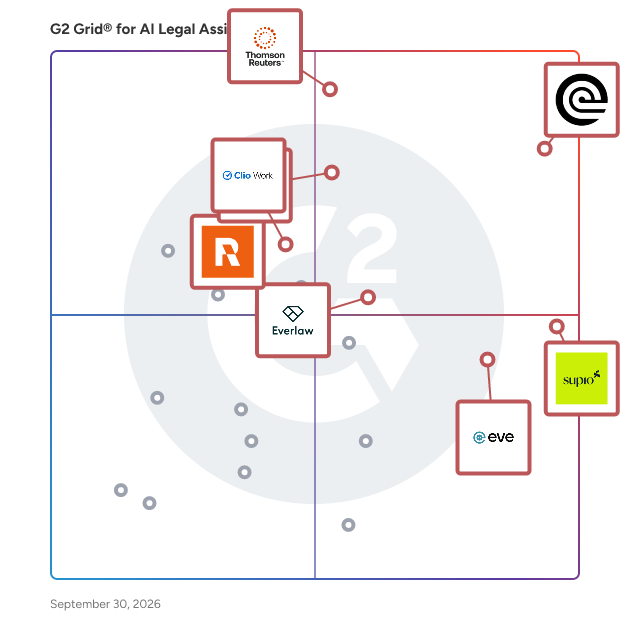
AI legal assistant software leverages generative AI and natural language processing to help attorneys and legal teams automate routine tasks, conduct legal research, review and produce documents, draft contracts, manage deadlines, and generate actionable legal insights, delivering speed, accuracy, and efficiency across litigation and legal practice workflows.
Core Capabilities of AI Legal Assistant Software
To qualify for inclusion in the AI Legal Assistant category, a product must:
- Leverage NLP and generative AI for knowledge management to extract meaningful insights from legal texts and provide analytics for better decision-making
- Automate routine legal tasks and manage workflows effectively
- Be tailored for law firms, legal departments, and legal practitioners
- Deliver highly accurate and legally compliant solutions that integrate with legal databases internally and externally
Common Use Cases for AI Legal Assistant Software
Attorneys, legal departments, and law firms use AI legal assistants to reduce manual effort on high-volume, repetitive legal tasks. Common use cases include:
- Automating contract drafting, document review, and due diligence for M&A and litigation workflows
- Conducting legal research by identifying relevant information and precedents from large document repositories
- Managing case timelines, billing, client communications, and compliance monitoring through AI-powered automation
How AI Legal Assistant Software Differs from Other Tools
AI legal assistants are purpose-built for law firms, legal departments, and practitioners, distinguishing them from general AI productivity tools or chatbots. Unlike broad AI platforms, AI legal assistants understand complex legal language, integrate with legal databases, and automate tasks specific to litigation, compliance, and legal practice such as e-discovery, case preparation, and evidence analysis. Some solutions also provide governance and visibility tools for tracking firm productivity and regulatory compliance.
Insights from G2 on AI Legal Assistant Software
Based on category trends on G2, document review automation and legal research speed stand out as standout capabilities. These platforms deliver reductions in billable hours spent on routine tasks and improved accuracy in compliance monitoring as primary outcomes of adoption.