# Best Print Fulfillment Software - Page 7

*By [Yukta Rustagi](https://research.g2.com/insights/author/yukta-rustagi)*


Print fulfillment services, also called web-to-print services, is a comprehensive solution encompassing software and services to streamline managing and warehousing online print items. It involves receiving orders, gathering the specified items, packing, shipping, and verifying complete orders. This solution aids businesses in efficiently producing large quantities of diverse printed materials, such as marketing collateral, business cards, and unique items that may not be feasible to produce in-house.

Web to print services cater to various business needs. They can serve as an all-encompassing solution or focus on handling significant or specialized projects. By leveraging these tools, companies can allocate their resources more effectively to other critical business aspects, relieving concerns about printing logistics.

Key distinctions among print fulfillment tools include the range of printing projects supported, order sizes accommodated, integration of photo editing tools, marketing features, and scalability. Web to print services sometimes offer integration with shipping partners or in-house shipping services. This integration facilitates real-time calculation of shipping costs, the generation of shipping labels, and the ability to track orders. This seamless shipping functionality contributes to an optimized end-to-end fulfillment process.

This software category complements related areas such as [procurement](https://www.g2.com/categories/procurement), [print management](https://www.g2.com/categories/print-management), and [print on demand](https://www.g2.com/categories/print-on-demand), allowing for comprehensive management of a company’s print-related needs.

To qualify for inclusion in the Print Fulfillment Services category, a product must:

- Offer specific printing facilities based on the nature of the order 
- Incorporate file upload and design tools for customers to upload their print-ready design files


## G2 Grid® for Print Fulfillment Software
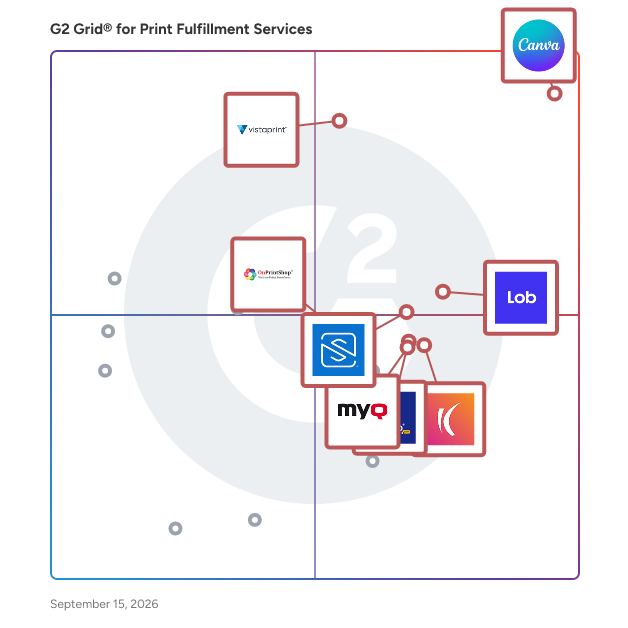
![G2 Grid® for Print Fulfillment Software plotting products by satisfaction and market presence](https://www.g2.com/categories/print-fulfillment-services/grids.png?focus%5B%5D=4400&focus%5B%5D=917&focus%5B%5D=10483&focus%5B%5D=1442190&focus%5B%5D=54984&focus%5B%5D=49115&focus%5B%5D=4262&focus%5B%5D=49450)
Highlighted products: Canva, Vistaprint, Lob, Smartpress&#39; Marketing on Demand, MyQ, Kotis Design, Swag Pro (by Swag.com), and Stannp.com.
Underlying data: [Grid® JSON](https://www.g2.com/categories/print-fulfillment-services/grids.json?focus%5B%5D=canva&amp;focus%5B%5D=vistaprint&amp;focus%5B%5D=lob&amp;focus%5B%5D=smartpress-marketing-on-demand&amp;focus%5B%5D=myq&amp;focus%5B%5D=kotis-design&amp;focus%5B%5D=swag-pro-by-swag-com&amp;focus%5B%5D=stannp-com)


## How Many Print Fulfillment Software Products Does G2 Track?
**Total Products under this Category:** 118

### Category Stats (Jul 2026)
- **Average Rating**: 4.28/5 (↑0.01 vs Jun 2026) The average rating of products in this category, based on all submitted ratings
- **Top Trending Product**: Infigo (+1.75%) - Among all products in this category, Infigo recorded the largest rating increase compared to last month
*Last updated: July 20, 2026*


## How Does G2 Rank Print Fulfillment Software Products?

**Why You Can Trust G2's Software Rankings:**

- 30 Analysts and Data Experts
- 9,800+ Authentic Reviews
- 118+ Products
- Unbiased Rankings

G2's software rankings are built on verified user reviews, rigorous moderation, and a consistent research methodology maintained by a team of analysts and data experts. Each product is measured using the same transparent criteria, with no paid placement or vendor influence. While reviews reflect real user experiences, which can be subjective, they offer valuable insight into how software performs in the hands of professionals. Together, these inputs power the G2 Score, a standardized way to compare tools within every category.

## Which Print Fulfillment Software Is Best for Your Use Case?

- **Leader:** [Canva](https://www.g2.com/products/canva/reviews)
- **Highest Performer:** [MyQ](https://www.g2.com/products/myq/reviews)
- **Easiest to Use:** [Canva](https://www.g2.com/products/canva/reviews)
- **Top Trending:** [Canva](https://www.g2.com/products/canva/reviews)
- **Best Free Software:** [Canva](https://www.g2.com/products/canva/reviews)


---

**Sponsored**

### Truffle

Truffle is a candidate screening platform that combines resume screening, one-way video interviews, and talent assessments in one workflow. It is built for the owners and operators who run hiring themselves — the people who hire without a recruiter — at small and growing companies hiring year-round for high-volume, low-resume-signal roles. Truffle replaces the first-round phone screen with structured async screening. AI transcribes every response, scores candidates against criteria you define, and surfaces match scores, AI summaries, and 30-second Candidate Shorts so you review a candidate in seconds instead of scheduling a 15-minute call. The principle behind every feature: AI surfaces information. Humans make hiring decisions. WHY CANDIDATE SCREENING BROKE Easy-apply and AI-generated resumes mean every job posting gets hundreds of candidates who all look the same on paper. The person doing the hiring cannot muscle through that volume the way they used to. Phone screens do not scale to hundreds of applications per role. The signals people relied on for decades, like resumes, cover letters, and even assessment answers, are now compromised by AI tools any candidate can use. The industry&#39;s answer has been to hand more decisions to AI. Let algorithms score, rank, and decide who moves forward. But the people who own the outcome of a hire do not trust AI to pick for them, and they should not. Their value is judgment. Truffle&#39;s approach is different. The way out is not better AI decisions. It is giving the person doing the hiring the evidence to make faster human ones. WHAT TRUFFLE DOES Truffle gives you three layers of evidence to separate real candidates from noise. Each layer captures a signal the others cannot, and each is harder to fake than the last. Resume screening: Upload your role criteria once. AI parses every resume and ranks applicants against your requirements. Qualification gaps surface clearly. No keyword filtering. One-way video interviews: Candidates record on their own time, on any device, no app download required. AI transcribes every answer, scores responses against the criteria you set, and surfaces 30-second Candidate Shorts of the most relevant moments. Talent assessments: Three types out of the box. Personality (validated Big Five / IPIP based), Situational Judgment Tests built around your team&#39;s real scenarios, or Environment Fit. Lightweight enough that someone juggling 26 open roles will actually use them. Use one capability on its own, stack two, or use all three. Truffle does not force a sequence. The screening process is yours to design. When you stack the layers, the evidence compounds. Resumes show credentials. Interviews reveal communication and presence on camera, something no chatbot can replicate. Assessments prove capability and temperament under real conditions. Each is harder to game than the last. AI FEATURES INCLUDED ON EVERY PLAN AI Match: Match scores against your role criteria with reasoning shown for every score. You see exactly why each candidate scored the way they did, criterion by criterion. The AI applies your standard. The standard is yours to set. AI summaries: Executive-style overviews of every candidate. Strengths, gaps, and alignment with role criteria highlighted. Designed to orient a reviewer in 30 seconds. Candidate Shorts: AI identifies the three most relevant moments from each interview and compiles them into a 30-second highlight reel with context on why each moment was selected. Full interview transcripts: Every video response is transcribed, searchable, and exportable. AI Check (Beta): Flags response patterns that suggest AI assistance, surfacing as a context signal you can use to ask better follow-up questions. Never an automatic disqualification. AI-suggested interview questions: Tailored to the role and seniority level. You review, edit, and approve every question before launch. AI assists configuration, not evaluation. SPECS - Credit-based screening: 200 credits/month on Starter, up to 48,000 credits/year on Scale - Roughly 1–3 roles a month on Starter, up to 25–50 roles a month on Scale; custom volume on Enterprise - Unlimited open positions on every plan - Unlimited team members and reviewers on every plan - Multi-reviewer scoring and threaded comments - Side-by-side candidate comparison view - Custom branding on the candidate-facing portal - Custom evaluation criteria per role with weighting - Bulk candidate review and bulk actions - Position Link: one shareable link per role - Mobile-first candidate experience tested on iOS and Android - Browser-based, no candidate downloads - Email candidate communications with custom templates - Candidate experience analytics: completion rate, time to complete, drop-off INTEGRATIONS - ATS: Greenhouse, Lever, Ashby, Workable, BambooHR - API access on the Enterprise plan - Zapier (5,000+ apps) - CSV export of candidate data - Webhook events on candidate progress SECURITY AND COMPLIANCE - GDPR-aware data handling for global hiring teams - Encrypted data in transit - Role-based access controls - Audit trail of reviewer actions and scoring - Extended data retention to 24+ months on the Enterprise plan - SSO / SAML on the Enterprise plan (coming soon) - Customer data segregated per workspace - Standard data export and deletion controls PRICING Every plan includes every AI feature, unlimited open positions, and unlimited team members. Plans differ by screening volume (credits), not by features or seats. - Starter: $49/month, billed monthly. 200 credits per month. Roughly 1–3 roles a month. - Core: $99/month, billed annually. 7,200 credits per year. Built for individuals hiring roughly 4–8 roles a month. - Team: $199/month, billed annually. 18,000 credits per year. For small teams hiring roughly 10–20 roles a month. - Scale: $499/month, billed annually. 48,000 credits per year. For larger teams hiring roughly 25–50 roles a month. - Enterprise: Custom pricing for teams hiring 50+ roles a month. Adds API access, priority support, dedicated onboarding, extended data retention, and SSO/SAML. Free trial: 7 days. 30 credits. Full feature access. No credit card required. No contracts. Cancel anytime. What you do not pay extra for: per-seat charges, per-position charges, AI add-ons, standard branding, or live chat support. Truffle is flat-rate. Every plan includes every AI feature. Setup takes 10 minutes. No implementation team. No IT ticket. No mandatory training. BEST FOR - Owners, founders, and operators who run hiring themselves, without a recruiter - Small and growing companies hiring year-round, not one or two hires a year - High-volume, low-resume-signal roles where every posting gets hundreds of applications - Anyone replacing the first-round phone screen with structured async screening - Teams consolidating a video tool, an assessment tool, and the phone-screen process into one workflow Common use cases: customer service and support hiring at volume, sales and BDR/SDR pipelines, operations and warehouse roles, engineering first-round screens, and seasonal high-volume retail or hospitality hiring. HOW TRUFFLE COMPARES Truffle vs HireVue: HireVue requires enterprise contact-sales pricing and long implementation. Truffle is transparent from $49/mo, self-serve, with 10-minute setup. HireVue alternative for teams that want enterprise-grade screening without the enterprise contract. Truffle vs Spark Hire: Spark Hire starts at $299/mo with AI features on higher tiers. Truffle starts at $49/mo — a fraction of the cost — with AI Match, summaries, and Candidate Shorts on every plan. Spark Hire alternative for teams that want AI-driven screening, not just video collection. Truffle vs Willo: Willo&#39;s pricing ranges $279-409/mo with AI features on higher tiers. Truffle starts at $49/mo and includes AI Match and Candidate Shorts on every plan. Willo alternative for teams that need intelligence in their screening, not just recording. Truffle vs Hireflix: Hireflix starts at $150/mo for video interviews only. Truffle starts at $49/mo and adds resume screening and talent assessments, not just recording. Hireflix alternative for teams that want video plus assessments plus resume screening together. Truffle vs VidCruiter: VidCruiter is custom-priced and contact-sales only. Truffle is self-serve with transparent pricing. VidCruiter alternative for teams that want to evaluate the product before talking to anyone. Truffle vs Jobma: Jobma is custom pricing and feature-gated. Truffle is flat-rate with every feature included. Jobma alternative for teams that want predictable pricing. Truffle vs TestGorilla: TestGorilla focuses on assessments and charges per position on lower tiers. Truffle includes assessments alongside video and resume screening at one flat rate with unlimited positions. TestGorilla alternative for teams that want assessments combined with video screening. Truffle vs phone screens: A 15-minute phone screen does not scale to hundreds of applicants. Truffle delivers what the phone screen was meant to (does this person seem real, qualified, and worth a real conversation) without the calendar coordination. Truffle vs ATS-built-in screening: ATS screening filters on keywords. Truffle scores candidates against the criteria you actually define and shows you how each candidate communicates and thinks.


[Visit website](https://www.g2.com/external_clickthroughs/record?secure%5Bad_program%5D=ppc&amp;secure%5Bad_slot%5D=category_product_list&amp;secure%5Bcategory_id%5D=6&amp;secure%5Bchosen_at%5D=2026-07-21T09%3A52%3A38Z&amp;secure%5Bdisplayable_resource_id%5D=261&amp;secure%5Bdisplayable_resource_type%5D=Category&amp;secure%5Bmedium%5D=sponsored&amp;secure%5Bplacement_reason%5D=retargeted_product&amp;secure%5Bplacement_resource_ids%5D%5B%5D=1409959&amp;secure%5Bprioritized%5D=false&amp;secure%5Bproduct_id%5D=1409959&amp;secure%5Bresource_id%5D=6&amp;secure%5Bresource_type%5D=Category&amp;secure%5Bsource_type%5D=category_page&amp;secure%5Bsource_url%5D=https%3A%2F%2Fwww.g2.com%2Fcategories%2Fprint-fulfillment-services%3Fpage%3D6&amp;secure%5Btoken%5D=2e25a52a3fff0d2b8c23e00d17f9893b9c0f4dbd694723ee31976766ef1ee6c5&amp;secure%5Burl%5D=https%3A%2F%2Fwww.hiretruffle.com%2F&amp;secure%5Burl_type%5D=company_website)

---


## What Is Print Fulfillment Software?

[Marketing Software](https://www.g2.com/categories/marketing)

## What Software Categories Are Similar to Print Fulfillment Software?

- [Print On Demand Software](https://www.g2.com/categories/print-on-demand)


---

## How Do You Choose the Right Print Fulfillment Software?

### What You Should Know About Print Fulfillment Software

### What is Print Fulfillment Software?

Print fulfillment software, also known as web-to-print software, helps manage warehousing, printing, and delivering print-on-demand orders. Print fulfillment service providers enable businesses to manage end-to-end print orders for marketing materials, sales collateral, product labels, promotional items, signage, accessories, personalized items, and branded products.&amp;nbsp;

Beyond simplifying print fulfillment, print fulfillment software lets businesses track inventory, monitor the progress of print orders, make real-time adjustments, communicate with print vendors, and automate shipping processes. Through these tools, organizations experience fewer order processing errors, greater [print management](https://www.g2.com/categories/print-management) efficiency, enhanced customer satisfaction, and timely order fulfillment.

### What types of Print Fulfillment Processes exist?

Print fulfillment services encompass a variety of services tailored to meet different business needs. These include:&amp;nbsp;

- **On-demand printing** or print-on-demand (POD) services enable businesses to print products individually or in small batches after receiving client orders. Print fulfillment service providers either collect digital files when receiving orders or retain them for recurring orders. Businesses using on-demand printing benefit from automated order processing and easy product customization. Since they don’t have to stock [inventory](https://learn.g2.com/inventory) of finished goods, they can reduce upfront costs and minimize waste.&amp;nbsp;
- **Kitting** combines multiple items and packages them as a single stock keeping unit (SKU). This method is ideal for selling subscription boxes, product bundles, and promotional packages.&amp;nbsp;
- **Assembly** is another value-added service that service providers use to assemble various components and create a finished product. Assembly service fulfillment centers configure all parts before packaging. Their error-free supply chain processes allow businesses to ensure seamless distribution and deliver a cohesive brand experience to customers.&amp;nbsp;
- **Direct-to-film (DTF) printing** is a textile printing process that uses heat and pressure to transfer designs from a specialized film onto different fabric materials, including cotton, polyester, and blends. DTF printing is cost-effective since it doesn’t need pre-treated fabrics to print personalized items.
- [White labeling](https://www.g2.com/glossary/white-labeling-definition) allows businesses to rebrand and sell products created by a third-party service provider. This service helps scale product offerings without investing in inventory or manufacturing infrastructure.&amp;nbsp;
- [3D printing](https://www.g2.com/articles/3d-printing) **,** or additive manufacturing, is the process of layering materials to create a three-dimensional object based on a digital design. Print fulfillment software solutions may offer 3D printing capabilities with [rapid prototyping](https://www.g2.com/glossary/rapid-prototyping-definition) features. Businesses use 3D printing software to iterate designs and quickly bring new products to market while minimizing inventory costs.&amp;nbsp;
- **Direct mail fulfillment** is the end-to-end process of printing and distributing physical marketing materials to recipients’ mailboxes. Print fulfillment services offering [direct mail campaigns](https://learn.g2.com/direct-mail-marketing) handle design, printing, and mailing list management. Companies rely on these providers for their efficient campaign management and targeted distribution.&amp;nbsp;
- **Automatic fulfillment** uses print fulfillment software to automate the receipt, processing, packing, and shipping of print orders. After receiving an order, it checks inventory levels and generates a print job. The automatic fulfillment system then packs and labels the order based on order specifications. Finally, it uses [supply chain and logistics tools](https://www.g2.com/categories/supply-chain-logistics) to automatically generate shipping labels, schedule pickups, and share tracking information with customers.&amp;nbsp;

### What are the common features of Print Fulfillment Software?

Print fulfillment software is equipped with a range of features designed to optimize operations, enhance efficiency, and improve customer experience. These include:

- **Centralized order processing:** Print fulfillment systems’ centralized platform makes it easy for businesses to manage orders from multiple channels, including marketplaces, direct sales, and [e-commerce](https://www.g2.com/glossary/e-commerce-definition) platforms. Some solutions also allow users to create custom workflows for routing orders and refilling supplies. Businesses rely on print fulfillment software to give customers real-time order updates, like printing start, completion, and shipping.&amp;nbsp;
- **Real-time inventory updates:** Print fulfillment software simplifies inventory management by automatically tracking raw material levels and finished goods. As a result, businesses can reduce stockouts and overstocks more effectively. Companies can also integrate print fulfillment systems with [inventory forecasting](https://www.g2.com/glossary/inventory-forecasting-definition) tools to predict future demand and plan inventory accordingly.&amp;nbsp;
- **Print job management:** Businesses rely on print fulfillment software to prioritize jobs based on predefined criteria. These tools help with all print preparation tasks, including file checking, color management, imposition, and proofing.&amp;nbsp;
- **Integrations:** Print fulfillment software allows businesses to create a seamless workflow, thanks to its ability to integrate with [CRM platforms](https://www.g2.com/categories/crm), e-commerce marketplaces, and shipping solutions. These integrations allow businesses to upload design files, schedule order pickups, send shipping details to customers, store customer data, and receive orders from different sales channels.&amp;nbsp;

### What are the benefits of Print Fulfillment Software?

Unlike traditional print production, print fulfillment helps businesses reduce inventory costs, adapt to fluctuating demand, and simplify end-to-end order fulfillment.&amp;nbsp;

- **Cost efficiency:** Traditional print production companies have large minimum order quantities (MOQ), but print fulfillment service providers print products only after receiving orders. The flexibility of having no MOQ allows businesses to avoid warehousing and inventory carrying costs, which together can lead to a hefty upfront investment.&amp;nbsp;
- [**Scalability**](https://www.g2.com/glossary/scalability) **:** Businesses don’t need to manage inventory for print fulfillment, meaning they can easily adjust the scale of their operations. For example, companies can increase production during peak seasons and vice versa. Print fulfillment platforms also make it easy for business owners to tap into new product segments without investing in raw materials.&amp;nbsp;
- **Automated order fulfillment:** Print fulfillment software can automatically capture and process orders from online stores. This automation reduces errors and allows humans to focus on value-added tasks.&amp;nbsp;
- **Easy to maintain inventory levels:** Businesses using print fulfillment solutions also benefit from real-time inventory tracking, which allows them to reorder supplies on time and maintain optimal inventory levels.&amp;nbsp;
- **Improved customer service:** Print fulfillment platforms, with their strategic network of print facilities, ensure faster shipping and fulfillment. Minimizing transit time by sending products from facilities near customer locations also helps businesses improve customer service.&amp;nbsp;

### Who uses Print Fulfillment Solutions?

Print fulfillment solutions cater to a wide range of users. Such as:

- **E-commerce retailers and online merchants** use print fulfillment software to handle the printing, packaging, and shipping of customized products.&amp;nbsp;
- **Marketing agencies** rely on print fulfillment service providers to conduct large-scale print runs of marketing collaterals like brochures, flyers, and promotional materials.
- **Self-publishing authors and independent writers** use print fulfillment to print books on demand.&amp;nbsp;
- **Large businesses** turn to print fulfillment services for printing internal and external communication materials like branded merchandises, stationery, training manuals, and business cards.&amp;nbsp;
- **Educational institutions** also use print fulfillment software to print course packs, textbooks, and promotional materials.&amp;nbsp;

### Software related to Print Fulfillment Solutions

Some of the closely related software to print fulfillment solutions are:

- [**Print on demand software**](https://www.g2.com/categories/print-on-demand) helps e-commerce companies automate the manufacturing of customized products. B2B companies use these tools to fulfill and ship orders without worrying about storing inventory.&amp;nbsp;
- **&amp;nbsp;** [**Print management software**](https://www.g2.com/categories/print-management) eases coordination between printer hardware and devices requesting print jobs. These solutions allow large printer networks to manage incoming printing tasks from different employee devices.&amp;nbsp;

### Challenges with Print Fulfillment Platforms

Businesses using print fulfillment solutions may experience challenges from dependency on vendors, large order volumes, integration complexities, and print errors.&amp;nbsp;

- **Handling large orders:** When print fulfillment providers need more processing time to handle large order volumes, businesses may experience fulfillment delays. Print services must invest in hardware, software, and personnel resources to avoid these challenges.
- **Integration challenges:** Print fulfillment solutions must integrate with CRM systems, [e-commerce platforms](https://www.g2.com/categories/e-commerce-platforms), and logistics networks for timely order processing and delivery. Lack of integration among these solutions may result in operational inefficiencies and workflow disruption.&amp;nbsp;
- **Error management:** Print fulfillment services must also set up processes to spot and fix print errors, like incorrect layouts and color mismatches. Lack of quality checks may harm a business&#39;s reputation and cause customer dissatisfaction.&amp;nbsp;

### How to choose the best Print Fulfillment Software?

When choosing print fulfillment software, companies must assess business needs and evaluate print fulfillment features, integration capabilities, and cost structure.

#### Assess business needs

Businesses must start by understanding the different types of products they’d like to sell. Understanding the range of product categories is essential for choosing the right service provider.&amp;nbsp;

They should compare current and projected order volumes against the print fulfillment partner’s turnaround times. Completing these two steps helps businesses create a short list of print fulfillment software solutions. The company must also consider these vendors&#39; ability to deliver customization options and user-friendly design tools.

#### Evaluate print and fulfillment features

Next, the business must examine print fulfillment partners’ printing techniques and quality check processes. It must also consider the print fulfillment service provider’s ability to meet shipping and production timelines.&amp;nbsp;

Finally, the business should look at whether the software has domestic and global fulfillment centers, which will be important for reducing shipping costs and delivery times. These criteria will help filter the list of solutions.

#### Check integration capabilities

This stage involves understanding the software’s ability to integrate with APIs from e-commerce platforms, CRM systems, and [shipping solutions](https://www.g2.com/categories/shipping). These integrations are critical for seamless order processing, customer data management, and smooth order fulfillment.&amp;nbsp;

#### Compare pricing and calculate ROI

Most print fulfillment solutions follow a subscription model or per-order cost structure. Consider checking if they also charge additional costs for premium features. Ideally, the print fulfillment provider should explain the hidden costs, integration charges, and transaction fees at this stage. Considering all these factors will help the business calculate the ROI of each print fulfillment software. Businesses can also sign up for a free trial or request a demo to understand the product better.&amp;nbsp;

Some other factors to consider include:

- **Scalability:** Can the software handle increasing product volumes efficiently?
- **Security:** Does the print fulfillment tool follow data protection regulations to secure sensitive customer data?
- **Online reviews:** Look for user testimonials and reviews on G2.com to determine whether the product efficiently meets user needs. Users can also use G2’s [Monty](https://ai.g2.com/bots/default) chatbot to get recommendations based on their business needs.&amp;nbsp;

### How much does Print Fulfillment Software cost?

Print fulfillment software costs up to $30 per month, depending on product features, dedicated account management, transaction fees, etc.

- **Subscription-based pricing:** Most print fulfillment solutions offer tiered pricing models with varying ranges of features, order capacities, and additional services.&amp;nbsp;
- **Pay-per-order model:** Print fulfillment services opting for this model charge fees per order, which include fulfillment costs and additional charges for labeling, packaging, and shipping.
- **One-time licensing fee:** Some print fulfillment tools also offer perpetual access for a one-time fee.&amp;nbsp;
- **Custom pricing:** Print fulfillment providers may also offer custom pricing plans based on order volume, integration needs, and product complexity.&amp;nbsp;

Also, consider checking if the vendor will charge additionally for software updates, technical support, training, and maintenance.&amp;nbsp;

### Print Fulfillment Software trends

- **Variable data printing (VDP):** The demand for personalized marketing materials has significantly grown over the past few years. VDP allows print fulfillment providers to individualize high-quality printing materials with dynamic text, images, and graphics. VDP is becoming popular for marketing materials, packaging materials, t-shirts, and event tickets.&amp;nbsp;
- **Eco-friendly printing:** Players in the print fulfillment space are adopting eco-friendly practices to avoid paper waste and reduce the carbon footprint of print jobs. They are also raising customer awareness about printing on uncoated or carbon-balanced paper and sustainable options like digital printing and LED UV printing solutions.
- **Design automation:** Print fulfillment companies also use [AI-powered design tools](https://learn.g2.com/free-ai-image-generators) to create stunning graphics. These tools can create templates for print materials, arrange text and images, and suggest design elements. These AI design tools help designers free up their time and focus on understanding design trends and creating better products.

Researched and written by [Yukta Rustagi](https://research.g2.com/insights/author/yukta-rustagi)

﻿Reviewed and edited by [Monishka Agrawal](https://learn.g2.com/author/monishka-agrawal)


