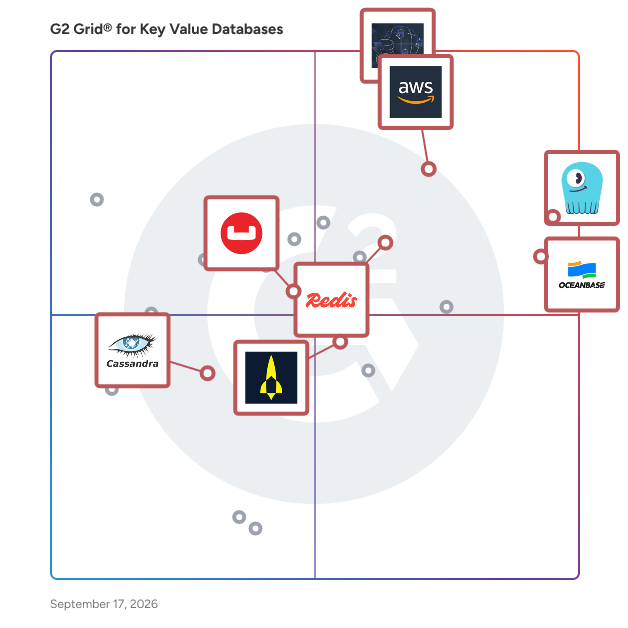
  # Best Enterprise Key Value Databases

  *By [Shalaka Joshi](https://research.g2.com/insights/author/shalaka-joshi)*

   Products classified in the overall Key Value Databases category are similar in many regards and help companies of all sizes solve their business problems. However, enterprise business features, pricing, setup, and installation differ from businesses of other sizes, which is why we match buyers to the right Enterprise Business Key Value Databases to fit their needs. Compare product ratings based on reviews from enterprise users or connect with one of G2&#39;s buying advisors to find the right solutions within the Enterprise Business Key Value Databases category.

In addition to qualifying for inclusion in the Key Value Databases category, to qualify for inclusion in the Enterprise Business Key Value Databases category, a product must have at least 10 reviews left by a reviewer from an enterprise business.


## How Many Key Value Databases Products Does G2 Track?
**Total Products under this Category:** 66

### Category Stats (May 2026)
- **Average Rating**: 4.42/5 (↑0.01 vs Apr 2026)
- **New Reviews This Quarter**: 18
- **Buyer Segments**: Mid-Market 51% │ Small-Business 29% │ Enterprise 20%
- **Top Trending Product**: Cloudera Data Platform (+0.155)
*Last updated: May 18, 2026*

  
## How Does G2 Rank Key Value Databases Products?

**Why You Can Trust G2's Software Rankings:**

- 30 Analysts and Data Experts
- 2,300+ Authentic Reviews
- 66+ Products
- Unbiased Rankings

G2's software rankings are built on verified user reviews, rigorous moderation, and a consistent research methodology maintained by a team of analysts and data experts. Each product is measured using the same transparent criteria, with no paid placement or vendor influence. While reviews reflect real user experiences, which can be subjective, they offer valuable insight into how software performs in the hands of professionals. Together, these inputs power the G2 Score, a standardized way to compare tools within every category.


---

**Sponsored**

### Dragonfly

Dragonfly is a drop-in Redis replacement, designed to meet the performance and efficiency requirements of modern cloud-based applications. Organizations that switch to Dragonfly require less hardware and achieve dramatically improved data performance.


[Visit website](https://www.g2.com/external_clickthroughs/record?secure%5Bad_program%5D=ppc&amp;secure%5Bad_slot%5D=category_product_list&amp;secure%5Bcategory_id%5D=307&amp;secure%5Bdisplayable_resource_id%5D=307&amp;secure%5Bdisplayable_resource_type%5D=Category&amp;secure%5Bmedium%5D=sponsored&amp;secure%5Bplacement_reason%5D=page_category&amp;secure%5Bplacement_resource_ids%5D%5B%5D=307&amp;secure%5Bprioritized%5D=false&amp;secure%5Bproduct_id%5D=1333307&amp;secure%5Bresource_id%5D=307&amp;secure%5Bresource_type%5D=Category&amp;secure%5Bsource_type%5D=category_page&amp;secure%5Bsource_url%5D=https%3A%2F%2Fwww.g2.com%2Fcategories%2Fkey-value-databases%2Fenterprise&amp;secure%5Btoken%5D=aa428a736561768de072d326b90e0282f814fbee67e672eabdb12de8e1dcdd97&amp;secure%5Burl%5D=https%3A%2F%2Fwww.dragonflydb.io%2Fpricing&amp;secure%5Burl_type%5D=custom_url)

---

  ## What Are the Top-Rated Key Value Databases Products in 2026?
### 1. [Amazon DynamoDB](https://www.g2.com/products/amazon-web-services-aws-amazon-dynamodb/reviews)
  Amazon DynamoDB is a pioneering NoSQL, fully managed, serverless database with limitless scalability and single-digit millisecond latency performance enabling customers to develop modern, microservice-based applications through a simple API. Customers enjoy the benefits of DynamoDB’s fully-managed service including broad compliance standards, security integration with AWS Identity and Access Management and numerous disaster recovery services. With DynamoDB Global Tables, customers have a 99.999% highly available, multi-Region, multi-active database supporting local reads and writes for globally distributed users. DynamoDB provides cost management features such as scale-to-zero, Time to Live (TTL) for aging data out, and multiple pricing models including a free tier.


  **Average Rating:** 4.4/5.0
  **Total Reviews:** 499
**How Do G2 Users Rate Amazon DynamoDB?**

- **Has the product been a good partner in doing business?:** 8.9/10 (Category avg: 8.7/10)
- **Auto Recovery:** 8.9/10 (Category avg: 8.6/10)
- **Data Model:** 8.4/10 (Category avg: 8.8/10)
- **Integrated Cache:** 8.5/10 (Category avg: 8.6/10)

**Who Is the Company Behind Amazon DynamoDB?**

- **Seller:** [Amazon Web Services (AWS)](https://www.g2.com/sellers/amazon-web-services-aws-3e93cc28-2e9b-4961-b258-c6ce0feec7dd)
- **Year Founded:** 2006
- **HQ Location:** Seattle, WA
- **Twitter:** @awscloud (2,228,514 Twitter followers)
- **LinkedIn® Page:** https://www.linkedin.com/company/amazon-web-services/ (156,424 employees on LinkedIn®)
- **Ownership:** NASDAQ: AMZN

**Who Uses This Product?**
  - **Who Uses This:** Software Engineer, Senior Software Engineer
  - **Top Industries:** Computer Software, Information Technology and Services
  - **Company Size:** 35% Enterprise, 34% Mid-Market


#### What Are Amazon DynamoDB's Pros and Cons?

**Pros:**

- Scalability (10 reviews)
- Ease of Use (8 reviews)
- Cost Efficiency (5 reviews)
- Low Latency (5 reviews)
- Managed Services (5 reviews)

**Cons:**

- Expensive (8 reviews)
- Query Complexity (7 reviews)
- Complexity (5 reviews)
- Learning Curve (5 reviews)
- Cost Issues (3 reviews)

### 2. [ScyllaDB](https://www.g2.com/products/scylladb/reviews)
  ScyllaDB is a specialty database for workloads that require predictable performance at scale. It’s adopted by organizations that require ultra-low latency, even at millions of features or operations per second, billions of embeddings, or petabytes of storage. ScyllaDB’s shard-per-core architecture taps the full power of modern infrastructure, translating to fewer nodes, less admin, and lower costs. Over 400 companies such as Disney+, Discord, Tripadvisor, Expedia, Zillow, Starbucks, and Comcast use ScyllaDB for their toughest database challenges.


  **Average Rating:** 4.5/5.0
  **Total Reviews:** 423
**How Do G2 Users Rate ScyllaDB?**

- **Has the product been a good partner in doing business?:** 8.7/10 (Category avg: 8.7/10)
- **Auto Recovery:** 8.6/10 (Category avg: 8.6/10)
- **Data Model:** 8.7/10 (Category avg: 8.8/10)
- **Integrated Cache:** 8.8/10 (Category avg: 8.6/10)

**Who Is the Company Behind ScyllaDB?**

- **Seller:** [ScyllaDB](https://www.g2.com/sellers/scylladb)
- **Company Website:** https://www.scylladb.com/
- **Year Founded:** 2013
- **HQ Location:** Palo Alto, US
- **Twitter:** @ScyllaDB (29,619 Twitter followers)
- **LinkedIn® Page:** https://www.linkedin.com/company/10201068 (222 employees on LinkedIn®)

**Who Uses This Product?**
  - **Who Uses This:** Software Engineer, Senior Software Engineer
  - **Top Industries:** Computer Software, Information Technology and Services
  - **Company Size:** 41% Small-Business, 29% Mid-Market


#### What Are ScyllaDB's Pros and Cons?

**Pros:**

- Performance (53 reviews)
- Speed (44 reviews)
- Scalability (41 reviews)
- Low Latency (35 reviews)
- Ease of Use (12 reviews)

**Cons:**

- Learning Curve (20 reviews)
- Limited Features (13 reviews)
- Difficult Learning (9 reviews)
- Difficult Setup (8 reviews)
- Complexity (7 reviews)

### 3. [Amazon ElastiCache](https://www.g2.com/products/amazon-elasticache/reviews)
  Amazon ElastiCache is a fully managed service that makes it easy to deploy, operate, and scale an in-memory data store and cache in the cloud. Often working in conjunction with other AWS database and storage services, ElastiCache ensures modern applications meet real-time requirements for high data throughput and sub-milli second response times, while serving millions of simultaneous requests. Amazon ElastiCache supports two open-source in-memory engines: o Redis - a fast, open source, in-memory data store and cache. Amazon ElastiCache for Redis is a Redis-compatible in-memory service that delivers the ease-of-use and power of Redis along with the availability, reliability and performance suitable for the most demanding applications. ElastiCache for Redis is fully managed, scalable, and secure - making it an ideal candidate to power high-performance use cases such as Web, Mobile Apps, Gaming, Ad-Tech, and IoT. o Memcached - a widely adopted memory object caching system. Amazon ElastiCache for Memcached is protocol compliant with Memcached, so popular tools that you use today with existing Memcached environments will work seamlessly with the service. ElastiCache for Memcached is suitable for caching use cases where performance and concurrency is important.


  **Average Rating:** 4.5/5.0
  **Total Reviews:** 83
**How Do G2 Users Rate Amazon ElastiCache?**

- **Has the product been a good partner in doing business?:** 8.7/10 (Category avg: 8.7/10)
- **Auto Recovery:** 8.2/10 (Category avg: 8.6/10)
- **Data Model:** 8.7/10 (Category avg: 8.8/10)
- **Integrated Cache:** 9.2/10 (Category avg: 8.6/10)

**Who Is the Company Behind Amazon ElastiCache?**

- **Seller:** [Amazon Web Services (AWS)](https://www.g2.com/sellers/amazon-web-services-aws-3e93cc28-2e9b-4961-b258-c6ce0feec7dd)
- **Year Founded:** 2006
- **HQ Location:** Seattle, WA
- **Twitter:** @awscloud (2,228,514 Twitter followers)
- **LinkedIn® Page:** https://www.linkedin.com/company/amazon-web-services/ (156,424 employees on LinkedIn®)
- **Ownership:** NASDAQ: AMZN

**Who Uses This Product?**
  - **Who Uses This:** DevOps Engineer, Software Engineer
  - **Top Industries:** Computer Software, Information Technology and Services
  - **Company Size:** 36% Small-Business, 33% Mid-Market


#### What Are Amazon ElastiCache's Pros and Cons?

**Pros:**

- Cost Efficiency (1 reviews)
- Customer Support (1 reviews)
- Low Latency (1 reviews)
- Performance (1 reviews)
- Performance Efficiency (1 reviews)

**Cons:**

- Cost Issues (1 reviews)
- Downtime Issues (1 reviews)
- Expensive (1 reviews)
- Poor Customer Support (1 reviews)
- Scaling Issues (1 reviews)

### 4. [Couchbase](https://www.g2.com/products/couchbase/reviews)
  Couchbase’s operational data platform for AI is a scalable foundation for enterprise operational, analytical, mobile and AI workloads that replaces legacy infrastructure and data services.


  **Average Rating:** 4.3/5.0
  **Total Reviews:** 142
**How Do G2 Users Rate Couchbase?**

- **Has the product been a good partner in doing business?:** 8.3/10 (Category avg: 8.7/10)
- **Auto Recovery:** 8.0/10 (Category avg: 8.6/10)
- **Data Model:** 8.4/10 (Category avg: 8.8/10)
- **Integrated Cache:** 8.0/10 (Category avg: 8.6/10)

**Who Is the Company Behind Couchbase?**

- **Seller:** [Couchbase](https://www.g2.com/sellers/couchbase)
- **Company Website:** https://www.couchbase.com/
- **Year Founded:** 2009
- **HQ Location:** San Jose, CA
- **Twitter:** @couchbase (136,277 Twitter followers)
- **LinkedIn® Page:** https://www.linkedin.com/company/1866670/ (859 employees on LinkedIn®)

**Who Uses This Product?**
  - **Who Uses This:** Senior Software Engineer, Software Engineer
  - **Top Industries:** Computer Software, Information Technology and Services
  - **Company Size:** 39% Small-Business, 34% Enterprise


#### What Are Couchbase's Pros and Cons?

**Pros:**

- Ease of Use (15 reviews)
- Scalability (11 reviews)
- Speed (7 reviews)
- Flexibility (6 reviews)
- MongoDB Compatibility (6 reviews)

**Cons:**

- Complex Configuration (8 reviews)
- Difficult Learning (7 reviews)
- Complexity (5 reviews)
- Limited Community Growth (3 reviews)
- Poor UI (3 reviews)

### 5. [Aerospike](https://www.g2.com/products/aerospike/reviews)
  The Aerospike Real-time Data Platform enables organizations to act instantly across billions of transactions while reducing server footprint by up to 80 percent. The Aerospike multi-cloud platform powers real-time applications with predictable sub-millisecond performance up to petabyte-scale with five-nines uptime with globally distributed, strongly consistent data. Applications built on the Aerospike Real-time Data Platform fight fraud, provide recommendations that dramatically increase shopping cart size, enable global digital payments, and deliver hyper-personalized user experiences to tens of millions of customers. Customers such as Airtel, Experian, Nielsen, PayPal, Snap, Wayfair, and Yahoo rely on Aerospike as their data foundation for the future.


  **Average Rating:** 4.4/5.0
  **Total Reviews:** 80
**How Do G2 Users Rate Aerospike?**

- **Has the product been a good partner in doing business?:** 9.2/10 (Category avg: 8.7/10)
- **Auto Recovery:** 9.0/10 (Category avg: 8.6/10)
- **Data Model:** 9.1/10 (Category avg: 8.8/10)
- **Integrated Cache:** 9.0/10 (Category avg: 8.6/10)

**Who Is the Company Behind Aerospike?**

- **Seller:** [Aerospike](https://www.g2.com/sellers/aerospike)
- **Year Founded:** 2009
- **HQ Location:** Mountain View, CA
- **Twitter:** @aerospikedb (7,833 Twitter followers)
- **LinkedIn® Page:** https://www.linkedin.com/company/2696852/ (306 employees on LinkedIn®)

**Who Uses This Product?**
  - **Who Uses This:** Software Engineer
  - **Top Industries:** Marketing and Advertising, Information Technology and Services
  - **Company Size:** 45% Mid-Market, 34% Enterprise


### 6. [Redis Software](https://www.g2.com/products/redis-software/reviews)
  Redis Software is our advanced solution delivering unmatched speed and reliability for on-prem and private cloud environments. It gives you full control over your deployment, ensuring high performance and scalability to meet your specific needs. Redis Software builds on the speed and reliability of Redis Community Edition with advanced features like active-active geo-distribution, advanced query and search capabilities, automated data synchronization, and superior security features. These enhancements provide enterprise-grade performance, reliability, and security, making Redis Software the ideal choice for production-grade applications.


  **Average Rating:** 4.5/5.0
  **Total Reviews:** 130
**How Do G2 Users Rate Redis Software?**

- **Has the product been a good partner in doing business?:** 8.6/10 (Category avg: 8.7/10)
- **Auto Recovery:** 8.1/10 (Category avg: 8.6/10)
- **Data Model:** 8.6/10 (Category avg: 8.8/10)
- **Integrated Cache:** 8.8/10 (Category avg: 8.6/10)

**Who Is the Company Behind Redis Software?**

- **Seller:** [Redis](https://www.g2.com/sellers/redis)
- **Year Founded:** 2011
- **HQ Location:** San Francisco, CA
- **Twitter:** @Redisinc (43,979 Twitter followers)
- **LinkedIn® Page:** https://www.linkedin.com/company/2014725/ (1,510 employees on LinkedIn®)

**Who Uses This Product?**
  - **Who Uses This:** Software Engineer, Senior Software Engineer
  - **Top Industries:** Computer Software, Information Technology and Services
  - **Company Size:** 54% Small-Business, 26% Mid-Market


#### What Are Redis Software's Pros and Cons?

**Pros:**

- Useful (2 reviews)
- Cost Efficiency (1 reviews)
- Customization (1 reviews)
- Data Storage (1 reviews)
- Ease of Setup (1 reviews)

**Cons:**

- Data Size Limitations (1 reviews)
- Expensive (1 reviews)
- Limited Chart Features (1 reviews)
- Poor UI (1 reviews)
- Slow Performance (1 reviews)

### 7. [Cassandra](https://www.g2.com/products/cassandra/reviews)
  Cassandra&#39;s data model offers the convenience of column indexes with the performance of log-structured updates, strong support for denormalization and materialized views, and powerful built-in caching.


  **Average Rating:** 4.1/5.0
  **Total Reviews:** 33
**How Do G2 Users Rate Cassandra?**

- **Has the product been a good partner in doing business?:** 7.4/10 (Category avg: 8.7/10)
- **Auto Recovery:** 6.7/10 (Category avg: 8.6/10)
- **Data Model:** 6.7/10 (Category avg: 8.8/10)
- **Integrated Cache:** 6.7/10 (Category avg: 8.6/10)

**Who Is the Company Behind Cassandra?**

- **Seller:** [The Apache Software Foundation](https://www.g2.com/sellers/the-apache-software-foundation)
- **Year Founded:** 1999
- **HQ Location:** Wakefield, MA
- **Twitter:** @TheASF (66,161 Twitter followers)
- **LinkedIn® Page:** https://www.linkedin.com/company/215982/ (2,408 employees on LinkedIn®)

**Who Uses This Product?**
  - **Top Industries:** Information Technology and Services, Internet
  - **Company Size:** 49% Enterprise, 34% Mid-Market


    ## What Is Key Value Databases?
  [NoSQL Databases](https://www.g2.com/categories/nosql-databases)
  ## What Software Categories Are Similar to Key Value Databases?
    - [Graph Databases](https://www.g2.com/categories/graph-databases)
    - [Document Databases](https://www.g2.com/categories/document-databases)
    - [Database as a Service (DBaaS) Providers](https://www.g2.com/categories/database-as-a-service-dbaas)

  
---

## How Do You Choose the Right Key Value Databases?

### What You Should Know About Key Value Databases

### What are Key Value Databases?

Key value databases are arguably the simplest of NoSQL databases. Unlike relational databases, which rely on primary and foreign keys to be able to find and connect data, key value databases utilize a single main identifier—the _key_—and associate that with a data point, array of data, or blob—a _value_. Key value databases can only be queried by the key itself. Key names can be _uniform resource identifiers_ or _URI_, hashes, filenames, or anything else that is entirely unique from other keys. In the same way, values can be just about any data.

Key Benefits of Key Value Databases

- Simple and lightweight
- Built for speed
- Data type-agnostic

### Why Use Key Value Databases?

Key value databases are designed for speed. Because they require minimal input for querying compared to other databases, and because they store so simply, key value databases can return query results near instantly.

Key value databases are optimal for situations with constant read/write operations or situations requiring low latency and lower operational demand than a relational database. Some example use cases follow.

**E-commerce shopping carts —** Key value databases work fantastically for temporary, lightweight listings, which makes them perfect for storing customer shopping carts while they order products online.

**Online session information —** Need to be able to keep a log of user session data over the course of being logged onto a device, utilizing your website, etc.? Key value databases make it simple to track and store activity information, including which pages were accessed, on-page actions a user took, and more. This information can fuel customer product recommendations, inform trends, and create more data-driven insights for businesses.

**Cache —** Key value databases are a great option for storing information that gets accessed often but rarely, if ever, gets modified. So, key value databases can serve as effective cache in these situations.

### Who Uses Key Value Databases?

Like most other databases, database administrators and teams are the ones who will most often interact with key-value store solutions. That being said, developers and support teams will also use these solutions frequently – developers, for integrating databases with their code, and support teams, for root cause investigation, troubleshooting, etc. Key value databases in particular might not have as wide a usage range outside these groups because of, oddly enough, their simplicity. They’re not as applicable as some kinds of databases—like relational or graph—in more general business settings that lean into more tabular or relationship-oriented data grouping, or that might need often and significant editing.

### Key Value Databases Features

**In-memory residence —** Most value databases are built in such a way that they can be run in-memory as opposed to off a storage drive. This improves transaction speeds and also is a testament to the lightweight nature of these databases.

**Speed —** Whether a user is writing to the database or querying from it, key-value databases offer greater speed and responsiveness compared to other kinds of databases.

**Scalability —** No matter how much data may need to go into the database, value databases will be able to keep up.

**Integration —** Key value databases should be able to integrate easily with other systems and tools. Should there be specific integrations you’d need your key-value store to have, check with both the key-value store vendor and community, as well as those of any solutions with which you might be integrating.

Other Features of Key Value Databases: [Audit logs](https://www.g2.com/categories/key-value-databases/f/audit-logs), [Authentication](https://www.g2.com/categories/key-value-databases/f/authentication), [Integrated cache](https://www.g2.com/categories/key-value-databases/f/integrated-cache), [Multi-model](https://www.g2.com/categories/key-value-databases/f/multi-model), [Role-based authorization](https://www.g2.com/categories/key-value-databases/f/role-based-authorization)

### Trends Related to Key Value Databases

**Moving away from SQL —** Businesses are actively exploring NoSQL (non-relational) databases more now than ever before. NoSQL databases as a whole provide greater flexibility than SQL databases because of less rigid schema, and thus, more adaptability and opportunities for specialization.

### Potential Issues with Key Value Databases

**Value returns —** Most value databases, when queried, return the entire value associated with a key. While generally this is beneficial, if you’ve stored multiple pieces of information within a single value, querying for its key may return more information than you wanted. If planning to use a key-value database to store multiple items of information within a value, be sure that the database you choose has the ability to sift information out of an array value, or you have an alternate way to compensate for an array of information being returned.

**Value updates —** Key value databases, by nature of their design, require that the **entire** value be updated when a value is modified. If you anticipate your values consistently having multiple pieces of information within them, consider a key-value database that will let you have more fine-tuned control over modification, or perhaps consider a different type of database altogether. If you anticipate constant modifications and numerous pieces of information being associated to a single identifying data point (key), perhaps consider a relational, graph, or document database instead.

### Software and Services Related to Key Value Databases

[**Graph databases**](https://www.g2.com/categories/graph-databases) **—** Another type of NoSQL database, graph databases specialize in showing the relationships (_edges_) between different data (_nodes_). Graph and key-value databases can have some overlap in use cases, in which case businesses should investigate further on the two types of databases to discern which more properly fits their constraints.

[**Document databases**](https://www.g2.com/categories/document-databases) **—** Document databases, another NoSQL database type, store and retrieve data in document format, e.g. JSON, XML, and YAML. This database specializes in storing related groups of data together in a single document for retrieval and querying.

[**Relational databases**](https://www.g2.com/categories/relational-databases) **—** The most familiar of any database, relational databases take on strict structures and schema to manage and store data. Key value databases and relational databases can work well together for businesses, with each covering situations where the other might not be as well-suited.


