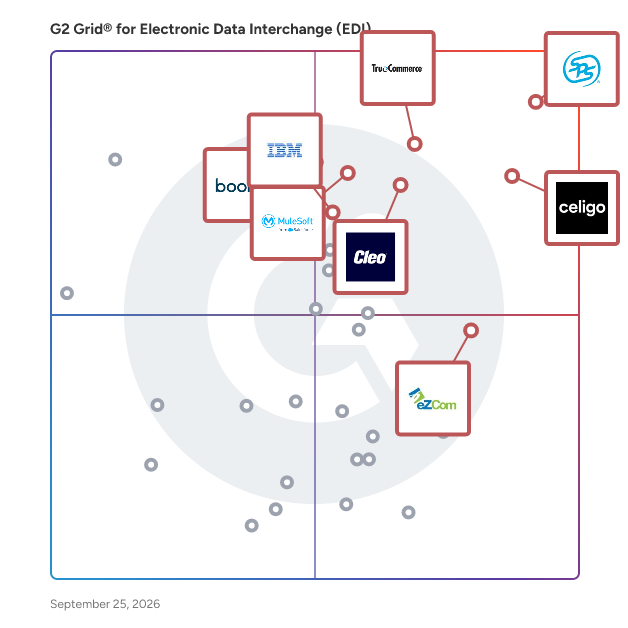
# Best Enterprise Electronic Data Interchange (EDI) Software

  *By [Shalaka Joshi](https://research.g2.com/insights/author/shalaka-joshi)*

   Products classified in the overall Electronic Data Interchange (EDI) category are similar in many regards and help companies of all sizes solve their business problems. However, enterprise business features, pricing, setup, and installation differ from businesses of other sizes, which is why we match buyers to the right Enterprise Business Electronic Data Interchange (EDI) to fit their needs. Compare product ratings based on reviews from enterprise users or connect with one of G2&#39;s buying advisors to find the right solutions within the Enterprise Business Electronic Data Interchange (EDI) category.

In addition to qualifying for inclusion in the Electronic Data Interchange (EDI) Software category, to qualify for inclusion in the Enterprise Business Electronic Data Interchange (EDI) Software category, a product must have at least 10 reviews left by a reviewer from an enterprise business.


## Category Overview

**Total Products under this Category:** 124


## Trust & Credibility Stats

**Why You Can Trust G2's Software Rankings:**

- 30 Analysts and Data Experts
- 7,200+ Authentic Reviews
- 124+ Products
- Unbiased Rankings

G2's software rankings are built on verified user reviews, rigorous moderation, and a consistent research methodology maintained by a team of analysts and data experts. Each product is measured using the same transparent criteria, with no paid placement or vendor influence. While reviews reflect real user experiences, which can be subjective, they offer valuable insight into how software performs in the hands of professionals. Together, these inputs power the G2 Score, a standardized way to compare tools within every category.


## Top-Rated Products (Ranked by G2 Score)
  ### 1. [SEEBURGER Business Integration Suite](https://www.g2.com/products/seeburger-business-integration-suite/reviews)
  For 40 years, SEEBURGER has helped companies move data securely, reliably, and with confidence. Today, we help them move smarter – with a platform designed for agility, scale, and the future of integration. With SEEBURGER Business Integration Suite (BIS), you can integrate faster, govern better, and empower more users across your organization: from strategy to execution. SEEBURGER BIS is our unified platform for all integration needs, from B2B/EDI and MFT to APIs, SaaS connectivity and ERP process automation. Built for a fast-moving, hybrid world, BIS brings business and IT together – with the flexibility to adapt, the power to scale, and the clarity to act. Our offering includes: BIS Hub provides a cloud-native, low-code environment that allows business and IT teams to build and manage integrations independently, on one shared platform. It includes AI-assisted mapping, configuration assistance and code generation, reusable integration assets, and role-based access for better alignment and faster outcomes. BIS Server offers a self-managed, enterprise-grade deployment for enterprises that require full control over infrastructure, governance, and compliance. It is suited for complex, regulated environments and supports containerized and hybrid models. As an optional add-on, BIS Accelerator Services support companies with expert guidance, managed operations, application management services and best practices – helping reduce time-to-value and ensure operational excellence across BIS deployments Whether you prefer full control on-premises or want to explore cloud-based scaling options, BIS adapts to your environment and your strategy – not the other way around. SEEBURGER BIS is more than an integration platform: it’s a strategic foundation for secure, scalable, and intelligent digital transformation.


  **Average Rating:** 4.6/5.0
  **Total Reviews:** 53

**User Satisfaction Scores:**

- **EDI Testing:** 9.4/10 (Category avg: 8.9/10)
- **Data Exchange:** 9.6/10 (Category avg: 9.2/10)
- **Has the product been a good partner in doing business?:** 9.2/10 (Category avg: 8.7/10)
- **Data Mapping:** 9.4/10 (Category avg: 9.0/10)


**Seller Details:**

- **Seller:** [SEEBURGER ](https://www.g2.com/sellers/seeburger)
- **Company Website:** https://www.seeburger.com
- **Year Founded:** 1986
- **HQ Location:** Bretten, Baden-Wurttemberg
- **LinkedIn® Page:** https://www.linkedin.com/company/seeburger/ (983 employees on LinkedIn®)

**Reviewer Demographics:**
  - **Top Industries:** Automotive, Logistics and Supply Chain
  - **Company Size:** 57% Enterprise, 28% Mid-Market


#### Pros & Cons

**Pros:**

- Integration Capabilities (18 reviews)
- Features (17 reviews)
- Connectivity (16 reviews)
- Ease of Use (13 reviews)
- Versatility (13 reviews)

**Cons:**

- Difficult Learning (13 reviews)
- Complexity (8 reviews)
- Poor UI (5 reviews)
- Not User-Friendly (4 reviews)
- Poor Documentation (4 reviews)

  ### 2. [MuleSoft Anypoint Platform](https://www.g2.com/products/mulesoft-anypoint-platform/reviews)
  MuleSoft Anypoint Platform is the industry-leading integration and governance solution designed to connect any application, API, and AI agent across hybrid and multi-cloud environments. For nearly two decades, we have served as the integration backbone for the world’s most complex enterprises. Today, we are extending to the AI era. We allow organizations to move beyond AI sprawl into a unified architecture where legacy systems, modern APIs, and autonomous agents interact securely on a single, trusted foundation. Key capabilities and components include: Hybrid integration and connectivity, utilizing a library of hundreds of pre-built connectors and support for new AI protocols like MCP and A2A to provide AI agents with the tools they need to access and act within legacy ERPs, CRMs, and on-premise databases. MuleSoft Agent Fabric: Unified API and agent governance, applying the same rigorous security policies, cost controls, and traffic enforcement to AI models and agents that organizations already trust for their global API ecosystems through a single, federated control plane. Fabric also includes agent visibility and registry, offering a single source of truth to discover and observe any cross-ecosystem agent, ensuring complete transparency and the elimination of shadow AI. MuleSoft Vibes: Natural language design and management, providing a revamped experience where teams can use native natural language prompts to scaffold integrations, manage lifecycles, and stay ahead of technical sprawl using the AI tools they already prefer. Trusted runtime and compliance, delivering a fully managed, hybrid, or on-prem foundation that has been proven at scale for years, ensuring that every interaction is backed by enterprise-grade monitoring and human-in-the-loop security. Overall, MuleSoft Anypoint Platform is the enterprise platform for organizations seeking to bring visibility, trust, and orchestration to their APIs and AI agents.


  **Average Rating:** 4.5/5.0
  **Total Reviews:** 613

**User Satisfaction Scores:**

- **EDI Testing:** 8.3/10 (Category avg: 8.9/10)
- **Data Exchange:** 9.4/10 (Category avg: 9.2/10)
- **Has the product been a good partner in doing business?:** 8.8/10 (Category avg: 8.7/10)
- **Data Mapping:** 9.1/10 (Category avg: 9.0/10)


**Seller Details:**

- **Seller:** [Salesforce](https://www.g2.com/sellers/salesforce)
- **Company Website:** https://www.salesforce.com/
- **Year Founded:** 1999
- **HQ Location:** San Francisco, CA
- **Twitter:** @salesforce (581,281 Twitter followers)
- **LinkedIn® Page:** https://www.linkedin.com/company/3185/ (88,363 employees on LinkedIn®)

**Reviewer Demographics:**
  - **Who Uses This:** Software Engineer, Senior Consultant
  - **Top Industries:** Information Technology and Services, Computer Software
  - **Company Size:** 57% Enterprise, 31% Mid-Market


#### Pros & Cons

**Pros:**

- Ease of Use (23 reviews)
- Integration Capabilities (23 reviews)
- Easy Integrations (20 reviews)
- Features (20 reviews)
- API Management (18 reviews)

**Cons:**

- Learning Curve (13 reviews)
- Expensive (12 reviews)
- Learning Difficulty (10 reviews)
- Steep Learning Curve (10 reviews)
- Difficult Learning (9 reviews)

  ### 3. [Axway B2B Integration](https://www.g2.com/products/axway-b2b-integration/reviews)
  Axway B2B Integration is the lifeblood behind the global B2B ecosystem. We simplify complex partner networks by automating with APIs and AI, unifying API and EDI partner flows, removing EDI complexity, and connecting to iPaaS and other backend systems — so your most critical transactions keep flowing, no matter the volume or integration pattern. Connect and grow without limits with Axway B2B Integration: - Any need, anytime, B2B integration: Customer-proven solutions support most integration patterns and use cases such as EDI, API, e-invoicing, and VAN with a consistent, scalable B2B platform. - B2B integration that adapts to your strategy: Deploy as software, private SaaS or managed service in the Axway cloud, or hybrid. Choose classic installation or container deployment. Reversible if preferences change. - Tailored B2B integration experience: UI and API-first tools boost efficiency with REST APIs for configuration, partner onboarding, operations, and API governance. Key features and functionalities of Axway B2B Integration include: - Partner management: Self-service onboarding and enrollment, partner SLA tracking and testing - Mapping and orchestration: Quickly and easily onboard new trading partners using powerful map designer and wizards - Real-time visibility: Meet SLAs and optimize thanks to real-time EDI visibility - EDI + API: Leverage all major EDI and API protocols and standards - Managed services: Taking full care of your B2B operations and eliminating risks - Connectors: Rely on connectors with cloud ERPs, Amazon S3, MS SharePoint, Splunk, and other systems - Value-added services: In addition to the core B2B offering, you can take advantage of Axway Business Network (VAN), B2B API Service, WebEDI Supplier Portal, eInvoicing, Track &amp; Trace, and CSOS options


  **Average Rating:** 4.5/5.0
  **Total Reviews:** 99

**User Satisfaction Scores:**

- **EDI Testing:** 8.9/10 (Category avg: 8.9/10)
- **Data Exchange:** 9.1/10 (Category avg: 9.2/10)
- **Has the product been a good partner in doing business?:** 8.9/10 (Category avg: 8.7/10)
- **Data Mapping:** 8.4/10 (Category avg: 9.0/10)


**Seller Details:**

- **Seller:** [Axway](https://www.g2.com/sellers/axway)
- **Company Website:** https://www.axway.com
- **Year Founded:** 2001
- **HQ Location:** Scottsdale, AZ
- **LinkedIn® Page:** https://www.linkedin.com/company/162610/ (1,657 employees on LinkedIn®)
- **Ownership:** 74SW.PA

**Reviewer Demographics:**
  - **Who Uses This:** Software Engineer
  - **Top Industries:** Pharmaceuticals, Hospital &amp; Health Care
  - **Company Size:** 55% Enterprise, 21% Mid-Market


#### Pros & Cons

**Pros:**

- Ease of Use (16 reviews)
- Visibility (11 reviews)
- EDI Integration (8 reviews)
- Efficiency (7 reviews)
- Automation (6 reviews)

**Cons:**

- Learning Curve (16 reviews)
- Complexity (14 reviews)
- Poor Interface Design (8 reviews)
- Not Intuitive (5 reviews)
- Not User-Friendly (5 reviews)

  ### 4. [Boomi](https://www.g2.com/products/boomi/reviews)
  Boomi is the intelligent integration and automation company that drives transformation. The Boomi Platform enables businesses to connect applications, people, and data faster to eliminate digital fragmentation caused by the exponential growth of applications and data. Through a combination of Generative AI, prebuilt connectors to applications, low-code automation, recipes for common business processes, full API lifecycle management, and event-driven architecture for cloud and hybrid on-premises integration, the Boomi Platform provides the breadth and depth of support required for modern digital transformation in an easy-to-use platform with enterprise-grade security, scalability, and reliability.


  **Average Rating:** 4.4/5.0
  **Total Reviews:** 419

**User Satisfaction Scores:**

- **EDI Testing:** 8.6/10 (Category avg: 8.9/10)
- **Data Exchange:** 8.9/10 (Category avg: 9.2/10)
- **Has the product been a good partner in doing business?:** 8.8/10 (Category avg: 8.7/10)
- **Data Mapping:** 8.9/10 (Category avg: 9.0/10)


**Seller Details:**

- **Seller:** [Boomi](https://www.g2.com/sellers/boomi)
- **Company Website:** https://boomi.com/
- **Year Founded:** 2000
- **HQ Location:** Chesterbrook, PA
- **Twitter:** @boomi (101,219 Twitter followers)
- **LinkedIn® Page:** https://www.linkedin.com/company/boomi-inc/ (2,874 employees on LinkedIn®)

**Reviewer Demographics:**
  - **Who Uses This:** Software Engineer, Senior Software Engineer
  - **Top Industries:** Information Technology and Services, Computer Software
  - **Company Size:** 46% Enterprise, 38% Mid-Market


#### Pros & Cons

**Pros:**

- Ease of Use (37 reviews)
- Integrations (37 reviews)
- Easy Integrations (34 reviews)
- Features (33 reviews)
- Integration Capabilities (32 reviews)

**Cons:**

- Complexity (13 reviews)
- Integration Issues (11 reviews)
- Learning Curve (11 reviews)
- Difficult Learning (10 reviews)
- Missing Features (10 reviews)

  ### 5. [Lobster Data Platform](https://www.g2.com/products/lobster-data-platform/reviews)
  Lobster is a next-generation data integration ecosystem designed for both business and IT teams to simplify system integration, process automation, and data collaboration across internal and external partners. At the heart of Lobster’s ecosystem are three key offerings: the all-in-one Lobster Data Platform, the Lobster Data Network for seamless connectivity, and a growing suite of plug-and-play Data Products. Each tool delivers standalone value, but together they enable fast, scalable digital transformation. With an intuitive interface, fast onboarding, and expert support, Lobster attracts 300+ new companies each year and maintains a 99.5% retention rate. It’s particularly strong in industries with complex supply chains and regulatory environments like retail, logistics, automotive, and manufacturing – helping teams automate workflows, reduce manual effort, ensure compliance, and gain real-time insights. Whether tackling data silos, legacy systems, or new regulations like Germany’s 2025 e-invoicing mandate, Lobster delivers the agility and tools needed to thrive. Our mission is simple: connect people and data for a better future. And we’re building the community to make it happen.


  **Average Rating:** 4.6/5.0
  **Total Reviews:** 104

**User Satisfaction Scores:**

- **EDI Testing:** 8.7/10 (Category avg: 8.9/10)
- **Data Exchange:** 9.2/10 (Category avg: 9.2/10)
- **Has the product been a good partner in doing business?:** 8.9/10 (Category avg: 8.7/10)
- **Data Mapping:** 9.2/10 (Category avg: 9.0/10)


**Seller Details:**

- **Seller:** [Lobster Data GmbH](https://www.g2.com/sellers/lobster-data-gmbh)
- **Company Website:** https://www.lobster-world.com/
- **Year Founded:** 2002
- **HQ Location:** Tutzing, Germany
- **LinkedIn® Page:** https://www.linkedin.com/company/lobster-data-gmbh/ (328 employees on LinkedIn®)

**Reviewer Demographics:**
  - **Top Industries:** Logistics and Supply Chain, Transportation/Trucking/Railroad
  - **Company Size:** 63% Mid-Market, 27% Enterprise


#### Pros & Cons

**Pros:**

- Ease of Use (19 reviews)
- Customer Support (17 reviews)
- Features (11 reviews)
- Integrations (8 reviews)
- User Interface (8 reviews)

**Cons:**

- Complexity (11 reviews)
- UX Improvement (6 reviews)
- Missing Features (5 reviews)
- Poor Documentation (5 reviews)
- Complex Usability (4 reviews)

  ### 6. [AWS Transfer Family](https://www.g2.com/products/aws-transfer-family/reviews)
  AWS Transfer Family offers fully managed support for the transfer of files over SFTP, AS2, FTPS, FTP, and web browsers directly into and out of Amazon S3 or Amazon EFS. You can seamlessly migrate, automate, and monitor your file transfer workflows by maintaining existing client-side configurations for authentication, access, and firewalls — so nothing changes for your customers, partners, and internal teams, or their applications.


  **Average Rating:** 4.3/5.0
  **Total Reviews:** 206

**User Satisfaction Scores:**

- **EDI Testing:** 8.5/10 (Category avg: 8.9/10)
- **Data Exchange:** 8.8/10 (Category avg: 9.2/10)
- **Has the product been a good partner in doing business?:** 8.7/10 (Category avg: 8.7/10)
- **Data Mapping:** 8.8/10 (Category avg: 9.0/10)


**Seller Details:**

- **Seller:** [Amazon Web Services (AWS)](https://www.g2.com/sellers/amazon-web-services-aws-3e93cc28-2e9b-4961-b258-c6ce0feec7dd)
- **Year Founded:** 2006
- **HQ Location:** Seattle, WA
- **Twitter:** @awscloud (2,223,984 Twitter followers)
- **LinkedIn® Page:** https://www.linkedin.com/company/amazon-web-services/ (156,424 employees on LinkedIn®)
- **Ownership:** NASDAQ: AMZN

**Reviewer Demographics:**
  - **Who Uses This:** Software Engineer, DevOps Engineer
  - **Top Industries:** Information Technology and Services, Computer Software
  - **Company Size:** 47% Small-Business, 30% Mid-Market


#### Pros & Cons

**Pros:**

- Ease of Use (73 reviews)
- Secure Transfer (58 reviews)
- Integration Capabilities (55 reviews)
- Easy Integrations (43 reviews)
- Features (43 reviews)

**Cons:**

- Expensive (58 reviews)
- Pricing Issues (45 reviews)
- Complexity (42 reviews)
- Difficult Setup (26 reviews)
- Difficult Learning (22 reviews)

  ### 7. [Jitterbit](https://www.g2.com/products/jitterbit/reviews)
  For organizations ready to modernize and innovate, Jitterbit provides a unified AI-infused low-code platform for integration, orchestration, automation, and app development that accelerates business transformation, boosts productivity, and unlocks value. The Jitterbit Harmony platform, including iPaaS, API Manager, App Builder, and EDI, future-proofs operations, simplifies complexity, and drives innovation for organizations globally.


  **Average Rating:** 4.5/5.0
  **Total Reviews:** 571

**User Satisfaction Scores:**

- **EDI Testing:** 8.5/10 (Category avg: 8.9/10)
- **Data Exchange:** 8.9/10 (Category avg: 9.2/10)
- **Has the product been a good partner in doing business?:** 9.2/10 (Category avg: 8.7/10)
- **Data Mapping:** 8.8/10 (Category avg: 9.0/10)


**Seller Details:**

- **Seller:** [Jitterbit](https://www.g2.com/sellers/jitterbit)
- **Company Website:** https://www.jitterbit.com
- **Year Founded:** 2003
- **HQ Location:** Alameda, CA
- **Twitter:** @jitterbit (3,658 Twitter followers)
- **LinkedIn® Page:** https://www.linkedin.com/company/695546/ (420 employees on LinkedIn®)

**Reviewer Demographics:**
  - **Who Uses This:** IT Manager, CEO
  - **Top Industries:** Information Technology and Services, Computer Software
  - **Company Size:** 51% Mid-Market, 26% Enterprise


#### Pros & Cons

**Pros:**

- Ease of Use (60 reviews)
- Customer Support (28 reviews)
- Integrations (27 reviews)
- Speed (26 reviews)
- Easy Integrations (23 reviews)

**Cons:**

- Learning Curve (23 reviews)
- Missing Features (22 reviews)
- Integration Issues (11 reviews)
- Complexity (10 reviews)
- Debugging Issues (9 reviews)

  ### 8. [SPS Commerce Fulfillment EDI](https://www.g2.com/products/sps-commerce-fulfillment-edi/reviews)
  SPS Commerce Fulfillment EDI is your gateway to retail growth. With access to the world’s largest network of pre-mapped connections via the only EDI solution on the market with full-service support, you’ll remove the heavy lift associated with manual supply chain management. Enjoy a fully compliant solution proactively monitored 24/7 by our team of experts that tackles all your EDI needs, including system integration and document automation. Ready to see how your EDI solution can work for you? Discover SPS Commerce Fulfillment EDI.


  **Average Rating:** 4.2/5.0
  **Total Reviews:** 558

**User Satisfaction Scores:**

- **EDI Testing:** 8.5/10 (Category avg: 8.9/10)
- **Data Exchange:** 9.0/10 (Category avg: 9.2/10)
- **Has the product been a good partner in doing business?:** 8.5/10 (Category avg: 8.7/10)
- **Data Mapping:** 8.5/10 (Category avg: 9.0/10)


**Seller Details:**

- **Seller:** [SPS Commerce](https://www.g2.com/sellers/sps-commerce)
- **Company Website:** https://www.spscommerce.com
- **Year Founded:** 1987
- **HQ Location:** Minneapolis, MN
- **LinkedIn® Page:** https://www.linkedin.com/company/15345/ (3,352 employees on LinkedIn®)
- **Ownership:** NASDAQ:SPSC

**Reviewer Demographics:**
  - **Who Uses This:** Operations Manager, Owner
  - **Top Industries:** Consumer Goods, Retail
  - **Company Size:** 66% Small-Business, 31% Mid-Market


#### Pros & Cons

**Pros:**

- Ease of Use (34 reviews)
- Customer Support (26 reviews)
- EDI Integration (10 reviews)
- Efficiency (8 reviews)
- Implementation Ease (8 reviews)

**Cons:**

- Poor Customer Support (10 reviews)
- Integration Issues (6 reviews)
- Technical Issues (6 reviews)
- Difficult Setup (5 reviews)
- Inefficient Process (4 reviews)

  ### 9. [IBM Sterling B2B Integration SaaS](https://www.g2.com/products/ibm-sterling-b2b-integration-saas/reviews)
  IBM Sterling B2B Integration SaaS is a trusted and scalable business-to-business network that augments the power of EDI integration with API capabilities. It helps automate and orchestrate your supply chain processes and partner collaboration on a single cloud-based platform. Support peak volumes of any transaction type with global availability and AI-powered data insights to help you detect anomalies and take corrective action to avoid disruptions. Unify supply chain data, insights and actions across your customers, partners and suppliers on a single business network. Simplify business collaboration with access to more than 800,000 pre-connected trading partners exchanging billions of EDI documents globally. As your business grows or requirements change, get the flexibility to onboard new partners quickly. IBM can help simplify B2B integration, reduce supply chain risk and accelerate innovation for your business, partners and people. Key Highlights:&amp;nbsp; - Anomaly detection, alerts and natural language search - Multi-party, security-rich shared ledger of digital transactions - Real-time visibility; trend analysis and dashboards - Any-to-any connectivity - Premium managed services - Expanding self-service capabilities&amp;nbsp; - IBM data security best practices - Seamless PEPPOL support for B2G and B2B trade - e-Invoicing signature, validation and archiving - Automation of small partner interactions - Catalog management for product ordering


  **Average Rating:** 4.5/5.0
  **Total Reviews:** 51

**User Satisfaction Scores:**

- **EDI Testing:** 8.3/10 (Category avg: 8.9/10)
- **Data Exchange:** 8.6/10 (Category avg: 9.2/10)
- **Has the product been a good partner in doing business?:** 9.1/10 (Category avg: 8.7/10)
- **Data Mapping:** 8.4/10 (Category avg: 9.0/10)


**Seller Details:**

- **Seller:** [IBM](https://www.g2.com/sellers/ibm)
- **Year Founded:** 1911
- **HQ Location:** Armonk, NY
- **Twitter:** @IBM (709,023 Twitter followers)
- **LinkedIn® Page:** https://www.linkedin.com/company/1009/ (324,553 employees on LinkedIn®)
- **Ownership:** SWX:IBM

**Reviewer Demographics:**
  - **Top Industries:** Logistics and Supply Chain
  - **Company Size:** 40% Small-Business, 37% Enterprise


#### Pros & Cons

**Pros:**

- Ease of Use (3 reviews)
- Easy Integrations (2 reviews)
- EDI Integration (2 reviews)
- Features (2 reviews)
- API Management (1 reviews)

**Cons:**

- Poor Interface Design (1 reviews)

  ### 10. [IBM Sterling B2B Integrator](https://www.g2.com/products/ibm-sterling-b2b-integrator/reviews)
  IBM Sterling B2B Integrator supports up to 10 million transactions per day by automating and consolidating B2B processes on a single, always-on B2B platform. IBM Sterling B2B Integrator helps companies integrate all their complex B2B/EDI processes across their partner communities in a single gateway. It provides a highly flexible platform, available on premise or via hybrid cloud, that supports data transformation and most communication protocols; secures your B2B network and data; provides Docker container support; and achieves high-availability for operations with Global Mailbox. B2B Integrator enables companies to reduce costs by consolidating on a single platform and automates B2B processes across enterprises while providing governance, adherence to standards and visibility for those processes.


  **Average Rating:** 4.2/5.0
  **Total Reviews:** 33

**User Satisfaction Scores:**

- **EDI Testing:** 8.3/10 (Category avg: 8.9/10)
- **Data Exchange:** 10.0/10 (Category avg: 9.2/10)
- **Has the product been a good partner in doing business?:** 8.7/10 (Category avg: 8.7/10)
- **Data Mapping:** 10.0/10 (Category avg: 9.0/10)


**Seller Details:**

- **Seller:** [IBM](https://www.g2.com/sellers/ibm)
- **Year Founded:** 1911
- **HQ Location:** Armonk, NY
- **Twitter:** @IBM (709,023 Twitter followers)
- **LinkedIn® Page:** https://www.linkedin.com/company/1009/ (324,553 employees on LinkedIn®)
- **Ownership:** SWX:IBM

**Reviewer Demographics:**
  - **Top Industries:** Information Technology and Services, Logistics and Supply Chain
  - **Company Size:** 68% Enterprise, 20% Mid-Market


#### Pros & Cons

**Pros:**

- Features (2 reviews)
- Data Management (1 reviews)
- Ease of Use (1 reviews)
- Easy Integrations (1 reviews)
- File Transfer (1 reviews)

**Cons:**

- Complexity (3 reviews)
- Integration Issues (3 reviews)
- Cost Management (1 reviews)
- Difficult Implementation (1 reviews)
- Difficult Learning (1 reviews)

  ### 11. [Orderful EDI](https://www.g2.com/products/orderful-edi/reviews)
  Orderful is a modern Electronic Data Interchange (EDI) platform designed to help logistics providers, retailers, manufacturers, and technology companies efficiently manage their EDI trading partnerships and transactions in real-time. By leveraging advanced technology, Orderful simplifies the complexities often associated with traditional EDI systems, allowing organizations to seamlessly integrate and communicate with their trading partners. The platform primarily targets businesses that require a reliable and streamlined method for exchanging electronic documents, such as purchase orders, invoices, and shipping notices. With the shift towards digital transformation, many companies are seeking to replace outdated EDI infrastructures with more agile solutions. Orderful serves as a bridge for these organizations, enabling them to adopt modern API principles while maintaining essential EDI functionalities. This is particularly beneficial for companies looking to enhance their operational efficiency and responsiveness in a fast-paced market. One of the key features of Orderful is its ability to facilitate rapid onboarding of new trading partners. Organizations can connect with partners in just a matter of days, significantly reducing the time and resources typically required for integration. This is made possible through Orderful&#39;s pre-connected network, which provides access to a wide range of trading partners and eliminates the need for extensive manual setup. The platform also offers a self-service experience, empowering users to proactively address issues and manage their EDI transactions without relying heavily on IT support. In addition to its onboarding capabilities, Orderful enhances the overall EDI experience by providing real-time visibility into transactions. Users can track the status of their documents and receive immediate notifications about any discrepancies or issues that may arise. This transparency not only helps in maintaining compliance with trading partner requirements but also fosters stronger relationships by ensuring timely and accurate communication. Orderful stands out in the EDI landscape by combining the robustness of traditional EDI with the flexibility of modern technology. Its user-friendly interface and comprehensive support for various document types make it an attractive solution for businesses aiming to streamline their supply chain operations. By adopting Orderful, companies can not only improve their EDI processes but also position themselves for future growth in an increasingly interconnected digital economy.


  **Average Rating:** 4.7/5.0
  **Total Reviews:** 114

**User Satisfaction Scores:**

- **EDI Testing:** 9.1/10 (Category avg: 8.9/10)
- **Data Exchange:** 9.3/10 (Category avg: 9.2/10)
- **Has the product been a good partner in doing business?:** 9.4/10 (Category avg: 8.7/10)
- **Data Mapping:** 8.9/10 (Category avg: 9.0/10)


**Seller Details:**

- **Seller:** [Orderful](https://www.g2.com/sellers/orderful)
- **Company Website:** https://www.orderful.com
- **Year Founded:** 2016
- **HQ Location:** San Francisco, California
- **Twitter:** @orderful (195 Twitter followers)
- **LinkedIn® Page:** https://www.linkedin.com/company/orderful/ (103 employees on LinkedIn®)

**Reviewer Demographics:**
  - **Top Industries:** Consumer Goods, Logistics and Supply Chain
  - **Company Size:** 63% Mid-Market, 27% Small-Business


#### Pros & Cons

**Pros:**

- EDI Integration (14 reviews)
- Ease of Use (11 reviews)
- Customer Support (10 reviews)
- Easy Integrations (5 reviews)
- Flexibility (5 reviews)

**Cons:**

- Difficult Setup (4 reviews)
- EDI Complexity (4 reviews)
- Time Management (3 reviews)
- Poor Customer Support (2 reviews)
- Slow Deployment (2 reviews)

  ### 12. [TrueCommerce EDI](https://www.g2.com/products/truecommerce-edi/reviews)
  Across industries, TrueCommerce is viewed as one of the best names in global supply chain integration and automation. Leveraging our TrueCommerce Trading Partner Platform, we offer seamless integration options, including EDI integration with your business or ERP system, an automated connection to hundreds of leading online marketplaces like Amazon and Walmart, and integration with leading eCommerce platforms including Shopify, Magento and WooCommerce.


  **Average Rating:** 4.4/5.0
  **Total Reviews:** 403

**User Satisfaction Scores:**

- **EDI Testing:** 8.5/10 (Category avg: 8.9/10)
- **Data Exchange:** 9.1/10 (Category avg: 9.2/10)
- **Has the product been a good partner in doing business?:** 9.0/10 (Category avg: 8.7/10)
- **Data Mapping:** 8.7/10 (Category avg: 9.0/10)


**Seller Details:**

- **Seller:** [TrueCommerce](https://www.g2.com/sellers/truecommerce)
- **Company Website:** https://www.truecommerce.com
- **Year Founded:** 1995
- **HQ Location:** Cranberry Township, PA
- **Twitter:** @TrueCommerce (1,288 Twitter followers)
- **LinkedIn® Page:** https://www.linkedin.com/company/38248/ (1,063 employees on LinkedIn®)

**Reviewer Demographics:**
  - **Who Uses This:** IT Manager, Office Manager
  - **Top Industries:** Wholesale, Consumer Goods
  - **Company Size:** 61% Small-Business, 35% Mid-Market


#### Pros & Cons

**Pros:**

- Ease of Use (38 reviews)
- Customer Support (26 reviews)
- EDI Integration (17 reviews)
- Efficiency (9 reviews)
- Features (9 reviews)

**Cons:**

- Poor Customer Support (14 reviews)
- Lacking Features (6 reviews)
- Slow Performance (6 reviews)
- Slow Processing (6 reviews)
- Difficult Setup (5 reviews)

  ### 13. [Cleo Integration Cloud](https://www.g2.com/products/cleo-integration-cloud/reviews)
  Cleo Integration Cloud (CIC) is a powerful cloud-based integration platform created to design, build, operate, and optimize critical supply chain processes. Leading logistics, manufacturing, wholesale, and technology organizations trust CIC as their modern EDI and B2B integration platform to handle any mandate or complexity. CIC delivers end-to-end visibility across EDI, non-EDI, MFT, and API integrations, giving both technical and business users confidence to onboard partners faster, integrate applications seamlessly, and accelerate revenue-generating processes. With real-time control and transparency into every transaction, companies can manage exceptions quickly and maintain smooth operations . Cleo provides businesses with an AI-powered supply chain orchestration solution that offers end-to-end visibility and control to digitalize, automate, and orchestrate every supply workflow – from buying and selling to shipping and billing. Cleo offers complete flexibility and control over your B2B integration strategy with options for self-service, managed services, or a blended approach. Its no-code onboarding tools and pre-connected trading partner library enable new business connections in days instead of weeks or months. As supply chains evolve, complexity grows. Cleo Integration Cloud simplifies it all with an all-in-one supply chain orchestration platform for both EDI and API integrations, automating any process across ERP, TMS, WMS, and more.


  **Average Rating:** 4.4/5.0
  **Total Reviews:** 534

**User Satisfaction Scores:**

- **EDI Testing:** 9.1/10 (Category avg: 8.9/10)
- **Data Exchange:** 9.3/10 (Category avg: 9.2/10)
- **Has the product been a good partner in doing business?:** 8.9/10 (Category avg: 8.7/10)
- **Data Mapping:** 9.1/10 (Category avg: 9.0/10)


**Seller Details:**

- **Seller:** [Cleo](https://www.g2.com/sellers/cleo)
- **Company Website:** https://www.cleo.com/
- **Year Founded:** 1976
- **HQ Location:** Rockford, IL
- **Twitter:** @CleoNeverStops (959 Twitter followers)
- **LinkedIn® Page:** https://www.linkedin.com/company/80901/ (557 employees on LinkedIn®)

**Reviewer Demographics:**
  - **Who Uses This:** EDI Analyst, IT Director
  - **Top Industries:** Transportation/Trucking/Railroad, Logistics and Supply Chain
  - **Company Size:** 52% Mid-Market, 30% Enterprise


#### Pros & Cons

**Pros:**

- Integration Capabilities (10 reviews)
- Customer Support (9 reviews)
- Easy Integrations (9 reviews)
- Connectivity (8 reviews)
- Efficiency (7 reviews)

**Cons:**

- Difficult Learning (7 reviews)
- Integration Issues (5 reviews)
- Complexity (4 reviews)
- Expensive (4 reviews)
- Lacking Features (4 reviews)

  ### 14. [OpenText Business Network Cloud EDI](https://www.g2.com/products/opentext-business-network-cloud-edi/reviews)
  The global nature of business is pressuring organizations to automate supply chain operations and improve collaboration with customers and partners. Mid-sized companies are now investing in digitization at a higher rate than their enterprise counterparts. Yet, many require external EDI support to supplement their internal resources and assist with the overwhelming complexity of their digital B2B networks. ​ Business Network Cloud EDI integration solutions by OpenText allows businesses to quickly and easily modernize internal and external integrations to enable collaboration with partners while controlling cost and complexity of their growing B2B networks. OpenText EDI solutions can help businesses meet specific partner EDI requirements for smooth integration, while turnkey ERP adapters and trading partner kits speed the flow of transaction data for boosted customer satisfaction. Even non-technical staff can easily manage tasks with OpenText’s self-service tools, easing bottlenecks and time-consuming manual effort. ​ OpenText acts as a strategic partner for organizations seeking to upgrade their EDI/B2B environments. Companies can leverage market-leading technologies and services that scale and customize to fit any business’ current and future needs. Organizations can tap into decades of EDI/B2B experience to augment their internal IT resources’ expertise to accelerate their digitalization projects without increasing costs and disruption to customers. ​


  **Average Rating:** 4.1/5.0
  **Total Reviews:** 39

**User Satisfaction Scores:**

- **EDI Testing:** 8.6/10 (Category avg: 8.9/10)
- **Data Exchange:** 8.9/10 (Category avg: 9.2/10)
- **Has the product been a good partner in doing business?:** 8.2/10 (Category avg: 8.7/10)
- **Data Mapping:** 9.1/10 (Category avg: 9.0/10)


**Seller Details:**

- **Seller:** [OpenText](https://www.g2.com/sellers/opentext)
- **Year Founded:** 1991
- **HQ Location:** Waterloo, ON
- **Twitter:** @OpenText (21,588 Twitter followers)
- **LinkedIn® Page:** https://www.linkedin.com/company/2709/ (23,339 employees on LinkedIn®)
- **Ownership:** NASDAQ:OTEX

**Reviewer Demographics:**
  - **Company Size:** 44% Mid-Market, 37% Enterprise


  ### 15. [BizTalk360](https://www.g2.com/products/biztalk360/reviews)
  BizTalk360 - One place for administration, monitoring, and getting analytics of your BizTalk Server environment. We are trusted by 650+ enterprises worldwide to enhance their BizTalk Server Operations. More information can be found at http://www.biztalk360.com


  **Average Rating:** 4.5/5.0
  **Total Reviews:** 134

**User Satisfaction Scores:**

- **EDI Testing:** 8.3/10 (Category avg: 8.9/10)
- **Data Exchange:** 8.3/10 (Category avg: 9.2/10)
- **Has the product been a good partner in doing business?:** 9.2/10 (Category avg: 8.7/10)
- **Data Mapping:** 8.7/10 (Category avg: 9.0/10)


**Seller Details:**

- **Seller:** [Kovai Limited](https://www.g2.com/sellers/kovai-limited)
- **Year Founded:** 2009
- **HQ Location:** London
- **Twitter:** @BizTalk360 (1,922 Twitter followers)
- **LinkedIn® Page:** https://www.linkedin.com/company/kovaico/ (333 employees on LinkedIn®)

**Reviewer Demographics:**
  - **Top Industries:** Information Technology and Services, Government Administration
  - **Company Size:** 58% Enterprise, 25% Mid-Market


  ### 16. [Frends](https://www.g2.com/products/frends/reviews)
  Frends is a European low-code integration platform as a service (iPaaS) that enables organizations to connect applications, automate workflows, and manage APIs across cloud and on-premises environments. Designed for both developers and business technologists, Frends helps streamline system communication, reduce integration complexity, and support real-time operations. The platform supports a wide range of use cases including ERP modernization, cloud migration, business process automation, and data synchronization between legacy and modern systems. With a graphical interface based on BPMN 2.0 and built-in AI capabilities, Frends makes it easier to build, monitor, and manage integration processes without heavy reliance on custom code. Frends is built on Microsoft .NET and integrates natively with a wide range of systems including Microsoft Dynamics, Salesforce, SAP, and various industry-specific tools. Frends is used across industries such as public sector, utilities, manufacturing, finance, and retail. It is particularly suited for IT teams seeking to unify integration, automation, and API management into a single tool while maintaining compliance and security in distributed environments. Key capabilities include: - Building and managing integrations visually with BPMN 2.0 to accelerate development and collaboration - Automating business processes and system tasks with reusable, scalable workflows - Monitoring integrations in real-time to reduce downtime and improve operational visibility - Managing APIs and connections securely with full version control and access management - Leveraging AI assistance to configure integrations, generate documentation, and streamline onboarding --- Frends has been recognized in the Gartner® Magic Quadrant™ for Enterprise iPaaS and ranks consistently as a G2 High Performer across usability, setup, and implementation. The platform enables faster time-to-value, reduces reliance on custom development, and gives teams the tools to adapt quickly to change, making it a preferred integration solution for organizations in Europe and beyond.


  **Average Rating:** 4.5/5.0
  **Total Reviews:** 135

**User Satisfaction Scores:**

- **EDI Testing:** 6.1/10 (Category avg: 8.9/10)
- **Data Exchange:** 8.1/10 (Category avg: 9.2/10)
- **Has the product been a good partner in doing business?:** 9.1/10 (Category avg: 8.7/10)
- **Data Mapping:** 7.0/10 (Category avg: 9.0/10)


**Seller Details:**

- **Seller:** [FRENDS](https://www.g2.com/sellers/frends)
- **Company Website:** https://frends.com
- **Year Founded:** 1988
- **HQ Location:** Espoo, Uusimaa, Finland
- **Twitter:** @FRENDSplatform (213 Twitter followers)
- **LinkedIn® Page:** https://www.linkedin.com/company/frends-app/ (288 employees on LinkedIn®)

**Reviewer Demographics:**
  - **Top Industries:** Information Technology and Services, Oil &amp; Energy
  - **Company Size:** 55% Mid-Market, 26% Enterprise


#### Pros & Cons

**Pros:**

- Ease of Use (27 reviews)
- Features (17 reviews)
- Easy Integrations (16 reviews)
- Integrations (16 reviews)
- Integration Capabilities (13 reviews)

**Cons:**

- Missing Features (9 reviews)
- UX Improvement (8 reviews)
- Limited Features (7 reviews)
- Difficult Learning (6 reviews)
- Integration Issues (5 reviews)

  ### 17. [PartnerLinQ](https://www.g2.com/products/partnerlinq/reviews)
  PartnerLinQ is a cloud-native supply chain visibility platform that delivers resilience through simplifying visibility and connectivity. PartnerLinQ’s Platform with Native Applications adds business context to traditional integrations, minimizing the impact of disruption. With capabilities for intelligent hyper-automation, multi-channel integration, and real-time analytics, PartnerLinQ seamlessly connects multi-tier supply chain networks, channels, marketplaces, and core systems worldwide to deliver unified connectivity for the future. PartnerLinQ’s Platform with Native Applications enables EDI, Non-EDI, and API-led enterprise wide integration capabilities, while enhancing visibility across the partner network through in-depth, analytics-based insights. The PartnerLinQ platform provides businesses a highly configurable and flexible approach with an easy to use interface, that eases partner onboarding, provides built-in alerts with a control center view of the enterprise network transactions, in a cost-efficient and scalable manner.


  **Average Rating:** 4.6/5.0
  **Total Reviews:** 79

**User Satisfaction Scores:**

- **EDI Testing:** 9.4/10 (Category avg: 8.9/10)
- **Data Exchange:** 9.2/10 (Category avg: 9.2/10)
- **Has the product been a good partner in doing business?:** 8.6/10 (Category avg: 8.7/10)
- **Data Mapping:** 9.3/10 (Category avg: 9.0/10)


**Seller Details:**

- **Seller:** [PartnerLInQ](https://www.g2.com/sellers/partnerlinq)
- **Year Founded:** 1998
- **HQ Location:** Cranbury, New Jersey
- **Twitter:** @PartnerlinQ (43 Twitter followers)
- **LinkedIn® Page:** https://www.linkedin.com/company/partnerlinq-digital-supply-chain-solution/mycompany/ (70 employees on LinkedIn®)

**Reviewer Demographics:**
  - **Top Industries:** Information Technology and Services, Automotive
  - **Company Size:** 41% Mid-Market, 34% Small-Business


#### Pros & Cons

**Pros:**

- Innovation (4 reviews)
- Real-time Access (3 reviews)
- Communication (2 reviews)
- EDI Integration (2 reviews)
- Real-time Data (2 reviews)

**Cons:**

- Expensive (1 reviews)
- Lack of Mobile Support (1 reviews)
- Missing Features (1 reviews)
- Mobile Compatibility (1 reviews)
- Mobile Responsiveness (1 reviews)

  ### 18. [Syncrofy](https://www.g2.com/products/syncrofy/reviews)
  Syncrofy for EDI &amp; IT professionals is the premier way to simplify your data. It enables you to visualize data, discover problems before they occur, and collaborate seamlessly with internal teams and partners. Syncrofy is everything you need to make your data actionable and elevate your business, without the need to rely on your IT team or third party provider to get you the answers to your questions. You have full control and access to the raw EDI data. Syncrofy for Supply Chain provides you with real-time visibility to break down barriers across your supply chain. You’ll have complete visibility across your network. SSC’s advanced real-time analytics and insights help you identify challenges and prioritize and solve them before problems occur—empowering you to eliminate costly fines and fees, prevent late payments and late shipments, and realize revenue faster.


  **Average Rating:** 4.4/5.0
  **Total Reviews:** 30

**User Satisfaction Scores:**

- **EDI Testing:** 8.8/10 (Category avg: 8.9/10)
- **Data Exchange:** 9.0/10 (Category avg: 9.2/10)
- **Has the product been a good partner in doing business?:** 10.0/10 (Category avg: 8.7/10)
- **Data Mapping:** 8.5/10 (Category avg: 9.0/10)


**Seller Details:**

- **Seller:** [Coenterprise](https://www.g2.com/sellers/coenterprise)
- **Year Founded:** 2010
- **HQ Location:** New York, New York
- **Twitter:** @CoEnterprise (842 Twitter followers)
- **LinkedIn® Page:** https://www.linkedin.com/company/1724464/ (92 employees on LinkedIn®)

**Reviewer Demographics:**
  - **Top Industries:** Automotive, Retail
  - **Company Size:** 53% Enterprise, 33% Mid-Market


## Parent Category

[Data Integration Tools](https://www.g2.com/categories/data-integration-tools)


## Related Categories

- [API Management Tools](https://www.g2.com/categories/api-management)
- [iPaaS Software](https://www.g2.com/categories/ipaas)
- [Integration Brokerage  Software](https://www.g2.com/categories/integration-brokerage)


---

## Buyer Guide

### What You Should Know About Electronic Data Interchange (EDI) Software

### What is Electronic Data Interchange (EDI) Software?

Electronic data interchange (EDI) software was created to lessen the procedural demand around industry trading processes such as shipping and mass product purchasing, purchase order (PO) generation, etc. Initially, invoices, POs, supply chain shipping information, and the like were manually generated and was time consuming to share between trading partners.&amp;nbsp;

EDI software is a simple and secure solution that significantly shortens the time taken in the purchasing process, as well as reduce the costs associated with manual entry using automation. It facilitates the exchange of such business documents in an electronic real-time format between trading partners and across a variety of platforms and programs. It allows automation for generating electronic documents like POs, invoices, advance ship notices (ASN), and inventory levels.&amp;nbsp;

Presently, EDI has expanded beyond trade. Documents and data exchanged using EDI can still be trade transactions, but now they also can involve health care data (e.g., patient electronic health records), transportation information (e.g., mass shipping data), construction workflows, and more.

When selecting EDI software, it is critical to understand the format of the information that is being sent, and the format the target receiver can accept. For example, UN/EDIFACT is an international standard format and predominantly used within the U.K., but transmissions in the U.S. typically follow the ANSI ASC X12 standard. If the sender and receptor data EDI formats do not match, the information will not be received.

EDI software also integrates well with other software solutions. Many EDI buyers are looking to integrate with a warehouse management system (WMS), an enterprise resource planning (ERP) system, SAP services, or other data processing systems.&amp;nbsp;

**What Does EDI Stand For?**

EDI stands for electronic data interchange. However, electronic file transfer is only one of many things that this software can do. It also offers features that can help businesses by lowering costs and improving speed, accuracy, and business efficiency.&amp;nbsp;

EDI is used to electronically transfer business documents such as POs, supply chain invoices, shipping bills, and communicate with one another. A specified format which is known as EDI standards is set by both parties to facilitate the transmission of information. Traders use EDI to exchange financial information in electronic form.&amp;nbsp;

#### What Types of Electronic Data Interchange (EDI) Software Exist?

**On-premises**  **vs. cloud-based EDI software**

A cloud-based solution will make important data readily available to any permitted users with an internet connection, enabling remote business partners to access data regardless of their location. Conversely, an on-premises solution will be accessible from one location or server but tends to allow more overall control and security. Some EDIs offer both cloud and on-premises options, allowing the buyer to choose their deployment preference. However, some EDIs only exist as either a cloud-based or on-premises system. An important determining factor would be to verify whether existing software easily integrates with an on-premise or cloud-based solution.

Additionally, it is helpful to consider the preferences of business partners and clients. How do they prefer to access files and media? Some corporations prefer data that can be accessed through real-time, web-based services. This question also requires an organization to consider their security preferences. Although cloud solutions do have defensive security features, some companies might prefer controlled access to files, which on-premises solutions readily offer.

**Integration capabilities&amp;nbsp;**

EDI software is able to integrate quickly with other tools, such as those that help manage back-end processes. After integration, processes that were once manual become automated tasks, allowing companies to shift their focus toward other important efforts. Potential buyers should consider their integration requirements and ensure the product they choose will work well with the processes they already have in place.

### What are the Common Features of Electronic Data Interchange (EDI) Software?

To maximize the strategic value and return on investment (ROI) of an EDI software investment, buyers should opt for solutions that enable robust business document transfer automation, minimize manual intervention, and can smoothly and seamlessly scale as the needs grow. The following are some core features within EDI software:

1. **Data exchange:** Data exchange capabilities of EDI software enable electronic document transfer between businesses and trading partners.
2. **Data mapping:** EDI software can translate the data back and forth, converting internal data format into the EDI standard format.&amp;nbsp;
3. [**Workflow management**](https://www.g2.com/categories/electronic-data-interchange-edi/f/workflow-management) **:** The workflow scheduler feature enables end-to-end automation of key EDI processes without any user intervention.
4. [**Exception handling**](https://www.g2.com/categories/electronic-data-interchange-edi/f/exception-handling) **:** EDI solutions detect the errors and instantly notifies and alerts the transmission issue.
5. **Communication protocols:** The software supports encrypted file transfer protocols like VAN, AS2, FTP/sFTP, and HTTPS.
6. [**Real-time reporting**](https://www.g2.com/categories/electronic-data-interchange-edi/f/real-time-reporting) **:** Real-time reporting features within an EDI software provides a real-time customizable dashboard that allows users to track, monitor, and manage transactions.
7. **EDI standards:** This software provides built-in support for agreed-upon EDI standards to send and receive business documents.
8. **Transfer methods:** This software allows the company to exchange data directly, through a value-added network (VAN), or sometimes both. VAN is a hosted data-sharing service.
9. **Secure exchange**** :** EDI software facilitates the safe exchange of data between endpoints since EDI transmission data should stay secure in the sharing network.
10. [**Integration**](https://www.g2.com/categories/electronic-data-interchange-edi/f/bi-tools-integration) **:** The software easily integrates with different systems or software to create a smoother workflow experience.
11. **Data tracking:** Data tracking feature aggregates and generates details surrounding data transmissions. Solutions will typically offer dashboards or reporting features to evaluate transactions. EDI software allows users to use this data to plan projects, map documents, and optimize transfers.
12. [**EDI testing**](https://www.g2.com/categories/electronic-data-interchange-edi/f/edi-testing) **:** The software creates a test environment for EDI transactions to verify them and ensure they adhere to industry compliance requirements.

### What are the Benefits of Electronic Data Interchange (EDI) Software?

EDI solutions are highly efficient in business process automation, is entirely paperless, and require little to no human intervention. Deploying an EDI system not only saves time and money, but it also enables close collaboration between trading partners and helps build customer satisfaction and loyalty.

- **Time savings:** EDI changes transmission time from days to minutes so users can get more done, quicker. Additionally, improved accuracy of EDIs let teams spend less time making corrections to invoices and other pieces of data.
- **Cost savings:** Order processing can be costly. By cutting the costs associated with sending physical documentation, EDI software reduces the spending related to generating and distributing data.
- **Efficiency and accuracy:** EDI software improves the accuracy of data transmissions. Between slimmed-down processes and increased accuracy, teams will have more time for other tasks. In addition, EDI increases transparency in B2B interactions, offering greater insight into entire transactions for auditing purposes.
- **Improved timelines:** EDI solutions reduce the time taken in manually sending and receiving documents in real time. It also reduces the time taken to manually create invoices and process POs.

### Who Uses Electronic Data Interchange (EDI) Software?

Any team that deals with B2B data interactions daily would potentially benefit from an EDI software. Since EDI solutions improve business data transmissions with efficiency, cost, and time savings, any teams or companies doing regular B2B data transmission would also benefit. Health care is a prime example as critical patient data can be transmitted accurately in minutes instead of hours or days.&amp;nbsp;

**Purchase and invoice teams:** EDI software also automates transactions that occur between organizations on a frequent basis, such as exchanging POs, invoices, and supply chain shipping notices. Purchase and invoice generation teams utilize EDI to automate supply chain processes and exchange business documents.&amp;nbsp;

EDI helps many organizations that produce, ship, purchase, and sell goods or provide care, from retailers and manufacturers to logistics firms, airlines, healthcare providers, insurers, and more.

**Supply chain companies (retail, manufacturing, and automotive industries):** EDI streamlines the process of transferring business documents and is hence an essential part of manufacturing processes. Automating data exchange across supply chains ensures time-critical data delivery and real-time tracking. EDI software allows shorter order processing and delivery times which in turn helps in reducing inventory.

**Companies in the financial sector:** These businesses manage a lot of confidential data and complicated transactions. EDI helps financial firms reduce manual paper processes in payables and receivables. It also prevents errors by process automation in document transfers and generations.

**Retail industry:** EDI in the retail industry allows companies to cut costs without compromising on customer service. It helps reduce the time taken in manual transactions and increases efficiency through the supply chain.&amp;nbsp;

**Healthcare organizations:** EDI software enables exchanging patient health information and processing health insurance documents.

### What’s the best EDI software for small businesses?

For small businesses aiming to streamline order processing, ensure compliance, and integrate with trading partners efficiently, [leading SMB EDI software](https://www.g2.com/categories/electronic-data-interchange-edi/small-business) options include:

- [SPS Commerce Fulfillment EDI](https://www.g2.com/products/sps-commerce-fulfillment-edi/reviews) offers a comprehensive solution with full-service support, providing access to a vast network of pre-mapped connections. It&#39;s designed to help vendors meet retailer requirements, including EDI compliance and batch processing, making it a strong choice for small businesses seeking scalability and ease of use.
- [TrueCommerce EDI](https://www.g2.com/products/truecommerce-edi/reviews) provides seamless integration across the supply chain, simplifying the process of transmitting invoices, orders, and other documents. Its user-friendly interface and robust customer support suit small businesses looking to automate their EDI processes.
- [eZCom Software EDI](https://www.g2.com/products/ezcom-software-edi/reviews) is recognized for its user-friendly interface and robust customer support. It streamlines order processing and ensures compliance with trading partners. Its intuitive design makes it accessible for businesses seeking efficient EDI solutions.

### What’s the best value EDI software for manufacturing?

For manufacturing companies seeking cost-effective EDI solutions that streamline supply chain operations and integrate seamlessly with existing systems, leading options include:

- [TrueCommerce EDI](https://www.g2.com/products/truecommerce-edi/reviews) offers comprehensive integration across the supply chain, facilitating seamless connections with ERP systems and leading eCommerce platforms like Shopify and Magento. Its user-friendly interface and robust customer support suit manufacturers aiming to automate their EDI processes.
- [Cleo Integration Cloud](https://www.g2.com/products/cleo-integration-cloud/reviews) provides a cloud-based platform that unifies EDI and API integrations, offering end-to-end visibility across B2B transactions. Its customizable interface simplifies partner onboarding and enhances exception management, catering to the complex needs of manufacturing operations.
- [MuleSoft Anypoint Platform](https://www.g2.com/products/mulesoft-anypoint-platform/reviews) enables manufacturers to integrate EDI with other applications and data sources through robust API-led connectivity. Its real-time reporting features and scalability support complex manufacturing ecosystems requiring agile data exchange.

#### Software Related to Electronic Data Interchange (EDI) Software

Related solutions that can be used together with EDI software include:

**Blockchain software:** As blockchain software becomes more prevalent, there’s significant discussion about how blockchain might augment EDI or even make EDI obsolete. Blockchain’s natural transparency can improve accountability and accuracy in EDI transmissions, and its reliability can further improve EDI accuracy and dependability.

### Challenges with Electronic data interchange (EDI) Software

On-premises EDI solutions are becoming a challenge for companies. Here are some of the most common issues enterprises face from their EDI technologies deployed on premises.

**Increased costs:** EDI is an expensive investment, but maintaining outdated and legacy EDI solutions can further magnify costs. When an enterprise owns EDI software and hardware, it also needs to invest in manpower to manage and maintain the on-premises software. Additionally, when something crashes, the hours and costs for maintenance also add up quickly.

**Scaling:** Homegrown on-premises EDI software is not capable of scaling up to support data needs as the business grows. This becomes challenging for businesses in the long run as they plan to grow operations. EDI standards also vary from industry to industry, supporting each of the standardized data format to enable EDI transactions is difficult with on-premises EDI systems.

**Lack of automation:** EDI based on the cloud can integrate with other business systems and applications to automate processes. Traditional EDI solutions are quite rigid and can only perform specific EDI tasks because they cannot integrate with an ERP or CRM for end-to-end processing. Using on-premises EDI solutions become time consuming, inefficient, and unscalable.

### How to Buy Electronic Data Interchange (EDI) Software

#### Requirements Gathering (RFI/RFP) for Electronic Data Interchange (EDI) Software

If a company is just starting out and looking to purchase the first EDI software, or maybe an organization needs to update a legacy system--wherever a business is in its buying process, g2.com can help select the best EDI software for the business.

The particular business pain points might be related to all of the manual processes involved in ordering and distribution and business document exchange in large volumes on day to day basis between trading partners.&amp;nbsp;

If the company has a lot of data transfers daily, the need is to look for a solution that can grow with the organization. Users should think about the pain points and jot them down; these should be used to help create a checklist of criteria. Additionally, the buyer must determine the number of employees who will need to use this software, as this drives the number of licenses they are likely to buy.

Taking a holistic overview of the business and identifying pain points can help the team springboard into creating a checklist of criteria. Buyers should identify the features they want in an EDI solution and have an idea of what the organization needs in terms of deployment, industry, and cybersecurity. Buyers must create a checklist of requirements that can be easily referred to when evaluating different EDI solutions.

#### Compare Electronic Data Interchange (EDI) Software Products

**Create a long list**

From meeting the business functionality needs to implementation, vendor evaluations are an essential part of the software buying process. For ease of comparison after all demos are complete, it helps to prepare a consistent list of questions regarding specific needs and concerns to ask each vendor.

**Create a short list**

From the long list of vendors, it is helpful to narrow down the list of vendors and come up with a shorter list of contenders, preferably no more than three to five. With this list in hand, businesses can produce a matrix to compare the features and pricing of the various solutions.

**Conduct demos**

To ensure the comparison is thorough, the user should demo each solution on the short list with the same use case and datasets. This will allow the business to evaluate like for like and see how each vendor stacks up against the competition.

#### Selection of Electronic Data Interchange (EDI) Software

**Choose a selection team**

Before getting started, it&#39;s crucial to create a winning team that will work together throughout the entire process, from identifying pain points to implementation. The software selection team should consist of members of the organization who have the right interest, skills, and time to participate in this process.

**Negotiation**

Many companies are willing to negotiate pricing that is listed on their website. It is imperative to open up a conversation regarding pricing and licensing. For example, the vendor may be willing to give a discount for multi-year contracts or for recommending the product to others.

**Final decision**

After this stage, and before going all in, it is recommended to roll out a test run or pilot program to test adoption with a small sample size of users. If the tool is well used and well received, the buyer can be confident that the selection was correct. If not, it might be time to go back to the drawing board.&amp;nbsp;&amp;nbsp;

### What Does Electronic Data Interchange (EDI) Software Cost?

An EDI solution can be deployed by organizations in one of two ways: on premises or in the cloud.

In addition to transaction volume, costs are always a consideration. As cloud-based EDI is a subscription model, the company only pays for what it uses. As the volume increasesthe cost does too. In contrast, on-premises EDI requires an upfront expenditure for hardware. It is a good practice to map the current and future requirements and it’s impact on the budget. Organizations that require control over their data opt for an on-premises EDI solution. EDI software may be a big investment, but in terms of improved efficiencies, increased productivity, and accelerated growth potential, the return on investment (ROI) is worth it.

Some of the key factors to measure the ROI of an EDI software include determining the cost of and time taken in manual data entry in POs and invoices, error detection percentage in manual data entry, and the number of data transmission requests per day.

### Implementation of Electronic Data Interchange (EDI) Software

**How is Electronic Data Interchange (EDI) Software Implemented?**

Deployment options include on-premises or on the cloud. In an on-premises deployment, the software is loaded on servers at a company’s location. One advantage to on-premises deployment of EDI is the ability for in-house management. However, this option does require a skilled IT team with the bandwidth to manage updates and monitoring.

In contrast, a cloud EDI deployment is hosted and managed at an off-site third-party location. The company has access to their EDI data through their office computers.

**Who is Responsible for Electronic Data Interchange (EDI) Software Implementation?**

Some key people involved in the implementation of an EDI software includes:&amp;nbsp;

**EDI coordinator:** These are&amp;nbsp;IT professionals with extensive experience in delivering EDI solutions. The coordinator can be an in-house team member or an external consultant, depending on the EDI requirements and experience of the organizations.&amp;nbsp;

**Executive committee:** This committee consists of a group of department heads of the business units which are going to be affected by the EDI deployment. This committee is typically led by the EDI coordinator.

**Dedicated EDI team:** This is a&amp;nbsp;team formed to primarily focus on the actual implementation of the EDI system.

**What Does the Implementation Process Look Like for Electronic Data Interchange (EDI) Software?**

EDI implementation can be complicated at both technical and organizational levels, so following a systematic and structured approach to the implementation process can be helpful. Some of the processes in EDI implementation are listed as follows:

**Requirements analysis:** The implementation process starts with addressing key questions such as what business processes (orders, invoices) should the software support, data or information that needs to be exchanged, whether data exchange should be a one-way or a two-way process, etc.

**Building organization structure:** For EDI implementation, it is important to make strategic decisions with regard to equipping the project team with the necessary resources and expertise required in driving the implementation within the organization.

**Selection of the ideal EDI solution (in-house or EDI service provider):** To ensure automated data processing, companies need special EDI software that supports the message standards and interface requirements. Businesses must conduct research around the solutions available in the market and weigh the pros and cons of an EDI outsourcing solution.&amp;nbsp;

**Information compilation:** A variety of information is required for implementation and rollout such as EDI translation, EDI formats or EDI standards, transliteration (EBCDIC, ASCII, UTF), EDI data file transfer, or managed communication, etc.

**System and data integration:** The necessary infrastructure must be set up (in-house model) or the communication connection to the EDI provider (outsourcing model) needs to be established according to the company’s operational model. Then, the interfaces to the internal ERP system must be supplied or adapted.&amp;nbsp;

**EDI testing:** Once the EDI system has been implemented or all of the requirements have been fulfilled by the EDI provider, pilot project testing is conducted with the buyer.&amp;nbsp;

### Electronic Data Interchange (EDI) Software Trends

**Shift from on-premises to cloud EDI software**

With the cloud growing in popularity, EDI vendors are working hard to make sure organizations have the flexibility they need to meet their business requirements. This includes the ability to work in multiple environments, from on premises to the cloud. Purchasing hardware, setting it up, maintaining it, and buying software licenses is an expensive expenditure for organizations. Paying for a monthly cloud EDI service may be easier to initiate and scale, which is why many companies are moving towards adopting cloud EDI solutions.