Artificial Intelligence Software Resources - Page 36
Articles, Glossary Terms, and Discussions to expand your knowledge on Artificial Intelligence Software
Resource pages are designed to give you a cross-section of information we have on specific categories. You'll find articles from our experts, feature definitions, and discussions from users like you.
Artificial Intelligence Software Articles
I Compared the 7 Best Machine Translation Software (2027)
What Is Machine Learning? How It Works and What It Is For
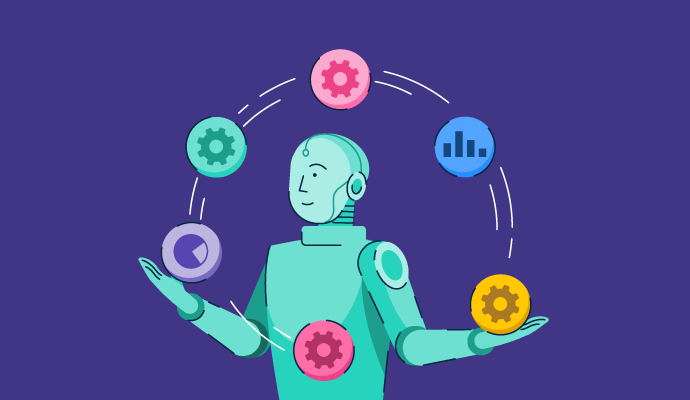
20 Revolutionary AI Applications in 2025: Real-World Examples

What Is Image Annotation? Types, Use Cases and More
10 Best Data Labeling Software With G2 User Reviews
AI In Music: Benefits, Challenges, and Tools for Musicians
Brief History of Artificial Intelligence - From 1900 till Now
What Is Artificial Intelligence (AI)? Types, Definition And Examples
What Is TinyML? A Brief Introduction And Benefits
History Of Computers: Timeline, I/O Devices and Networking
AI Image Generation: The Science Behind How It Works
The Rise of AI-Generated Art: From Algorithms to Aesthetics
What Is Artificial General Intelligence (AGI)? The Future Is Here
Mastering ChatGPT: Behrang Asadi on the Growing Effect of Generative AI
Top Digital Transformation Trends in 2021
Innovation in Artificial Intelligence [INFOGRAPHIC]
When Platforms Collide, Analytics Evolves
Tech Companies Bridging the Gap Between AI and Automation
The Industry Impact of AI Regulations in the EU
The Things Have Eyes: An Introduction to IoT
The Data Toolbox: The Expanding Domain of AI & Analytics
CX Tech: Artificial and Intelligent
G2 on Enterprise AI & Analytics: What is It Really & Why Does It Matter?
AI in Retail: How It’s Being Used (+ 4 Brand Examples)
Embedded AI: Embedded Systems Trends for 2019
Artificial Intelligence Software Glossary Terms

Artificial Intelligence Software Discussions
Hi! I am looking for the best data labeling software for preventing annotation inconsistencies across multiple annotators and reducing labeling errors. Inconsistency between annotators is a different failure from individual errors. One person mislabelling an image is noise the model can absorb. Two annotators applying different class boundaries produces systematic bias that survives training.
The top tools are:
- Taskmonk: The most complete on paper: gold sets, consensus, and adjudication as named multi-stage QA, plus affinity-based routing that assigns tasks by annotator performance rather than role.
- V7 Darwin: Multi-stage review workflows with conditional logic and consensus, plus nested annotation classes, which reduces the ambiguity that causes disagreement in the first place.
- CVAT: Pre-annotation is itself a consistency mechanism: when everyone starts from the same model output, the variance between annotators narrows.
- FiftyOne: Its visualization layer is built for spotting labeling discrepancies and edge cases across a dataset rather than reviewing item by item, which is a different and complementary approach to catching inconsistency.
Where did your annotators actually disagree, and did you fix it with tooling or by rewriting the guidelines?
I'm researching the best data labeling platform for ML engineers scaling annotation without hiring a dedicated labeling team, and there are really two ways to solve this: Buy the workforce, or automate enough that you don't need one.
Both are viable, and they suit different situations. Managed workforce works when the labels need domain judgment and the volume is steady. Model-assisted labeling works when the task is repetitive enough that a model can pre-label and a human verifies. Several products offer both.
Buy the workforce:
- SuperAnnotate: A global network of vetted experts with managed operations and talent matching, plus project visibility so you're not managing annotators directly.
- Taskmonk: An SLA-backed annotation workforce on the same platform as the tooling, so there's one contract and one escalation path rather than sourcing labeling talent separately. That single-vendor structure is the specific answer to this question.
- Keymakr: In-house annotation team paired with proprietary tooling. Reviewers praise responsiveness.
- SUPA: Machine-led labeling platform combined with a workforce, positioned on cost efficiency.
Automate instead:
- CVAT: YOLO and SAM2 pre-annotation running in-platform turns most of the work into verification. Open source, so the cost of scaling is compute rather than headcount. Best fit if you have engineering time but no labeling budget.
- Roboflow: Auto-labeling and augmentation, with a free entry tier.
Did you buy the workforce or automate, and what would you do differently? For pre-labeling: what accuracy did the model need to hit before verification was genuinely faster than labeling fresh? Did a managed workforce actually stay consistent across annotator turnover?
Annotation is repetitive work measured in seconds per object, so interface efficiency compounds in a way it doesn't for most software.
The top choices from the Data Labeling category:
- SuperAnnotate: Keyboard shortcuts are the single most-praised feature, specifically for working through large batches. The intuitive interface is the most frequently cited strength overall.
- Encord: Reviewers consistently pair the interface with workflow smoothness rather than describing it in isolation, which usually indicates the tool isn't interrupting the task.
- V7 Darwin: Auto-Annotate and SAM handle masks, segmentation, keypoints, and polygons, with auto-tracking across video frames cutting repeat work.
- Roboflow: Widely described as friendly and quick to learn, with frequent updates.
Which shortcut or interface behaviour actually saved you the most time and which one do you still wish existed?
For image annotation, I’d measure clicks and keystrokes per completed object rather than asking annotators which UI they prefer. SuperAnnotate’s shortcuts could shave seconds off repetitive work, while V7 Darwin may remove the repetitive step entirely with Auto-Annotate. At scale, that distinction adds up quickly.


![Innovation in Artificial Intelligence [INFOGRAPHIC] Innovation in Artificial Intelligence [INFOGRAPHIC]](https://learn.g2.com/hubfs/Marketing%20Automation-1.png)