AI-Generated Results
Finding matches…
"Our experienced team of specialized software engineers, architects and developers solve intractable business problems in creative, unexpected and pragmatic ways. We also provide you with premier access to emerging technologies through our vast network of industry partners.
Developing software is more than engineering an end product. It's about helping your internal teams have a customer-centric view when thinking through the future of the business. It is redefining the market by having a true pulse of the market's needs. Orion employs software architects, product managers and global developers who are experts across software platforms - Java, Microsoft (.NET), Open-Source (Python & Golang) & frontend stacks (React/React Native) - making Orion an ideal development partner for those who are serious about building a software-driven business. We're there, incubating at the cutting edge to bring you simple, seamless software at its best."
Not seeing what you're looking for?
Dive deeper into "OpenTofu" on G2 AI

DoliOnDemand is a Cloud-based ERP-CRM solution built on Dolibarr, the leading open-source ERP-CRM platform created in France and supported by an international community.
DoliOnDemand provides Dolibarr as a SaaS solution, accessible directly from any web browser, without complex installation or infrastructure management.
It enables SMEs to centralize their business operations in one platform, including CRM, sales, purchasing, invoicing, inventory, accounting, projects, HR, manufacturing and e-commerce.
Thanks to Dolibarr’s modular and open-source architecture, companies can start with the features they need and expand their system as their business grows. DoliOnDemand also offers additional modules and industry-specific solutions developed by ATM Consulting.
DoliOnDemand combines the flexibility of Dolibarr with the simplicity of a Cloud SaaS solution.
DoliOnDemand: Dolibarr in the Cloud — a flexible, modular and scalable ERP-CRM solution for growing businesses.

Morphy is a desktop workspace for developers and builders who work with several AI coding agents. Claude Code, Codex, Grok, GitHub Copilot, Gemini (Antigravity), OpenRouter and local Ollama models each run as a chat card on an infinite canvas, signed in with the plans the user already pays for. Every chat shows the agent's steps, any turn can be undone, and a conversation can continue with another AI when one hits its usage limit. Each project gets its own frame, and focus mode tiles the chats you need on one screen. Agents build cards on request (live trackers, dashboards, small internal tools), and flows chain chats with arrows so one agent's answer goes to the next, on a schedule if wanted. A built-in browser, terminal and file viewer sit beside the chats. Windows, Mac and Linux. Free; Pro is $9 a month.

Pulse by Ciphera is privacy-first web analytics — traffic, uptime, performance and search data in one dashboard, cookie-free by design. It sets no cookies and stores nothing about individual visitors, so no consent banner is needed for the analytics. In one dashboard: traffic (visitors, referrers, UTM campaigns, custom events, funnels, scroll depth, realtime), uptime monitoring with incident history, Lighthouse-based performance checks, Google Search Console and Bing data, and CDN analytics. Open-source client (AGPL dashboard + tracking script, Apache-2.0 CLI); managed EU cloud backend. Built by Ciphera BV in Belgium; analytics data hosted on Swiss infrastructure. Free to 5,000 pageviews/month; paid from €7/month; every feature on every plan. Public read API, open-source CLI and CSV export included. Live demo with our own real data: https://pulse.ciphera.net/demo

DSPy is an open-source framework designed to streamline the development and optimization of AI systems by allowing developers to define AI behaviors through structured, declarative modules instead of traditional prompt strings. This approach enhances the reliability and maintainability of AI applications by decoupling system design from specific language models or prompting strategies.
Key Features and Functionality:
- Modular Design: Enables the creation of AI components with clear input/output behaviors, facilitating rapid iteration and integration.
- Optimizers: Provides tools to fine-tune prompts and model weights, improving performance across various tasks.
- Ecosystem Support: Offers a comprehensive suite of tools and resources to advance open-source AI research and development.
Primary Value and Problem Solved:
DSPy addresses the challenges of maintaining and scaling AI systems by offering a structured programming approach that abstracts away the complexities of prompt engineering. This results in more robust, adaptable, and efficient AI applications, empowering developers to focus on high-level design and functionality.

open-source machine learning-based WAF for Kubernetes Ingress, NGINX, Envoy, and API Gateways.
open-appsec (openappsec.io) is an open-source initiative that builds on machine learning to provide pre-emptive web app & API threat protection against OWASP-Top-10 and zero-day attacks.
It can be deployed as an add-on to Kubernetes Ingress, NGINX, Envoy and API Gateways.
The open-appsec engine learns how users normally interact with your web application. It then uses this information to automatically detect requests that fall outside of normal operations and sends those requests for further analysis to decide whether the request is malicious or not.
open-appsec uses two machine learning models:
1. A supervised model that was trained offline based on millions of requests, both malicious and benign.
2. An unsupervised model that is being built in real time in the protected environment. This model uses traffic patterns specific to the environment.
open-oppsec simplifies maintenance as there is no threat signature upkeep and exception handling, as common in many WAF solutions.

ColossalChat is an advanced AI-powered chatbot designed to facilitate seamless and intelligent conversations. Leveraging cutting-edge language models, it offers users a responsive and interactive experience, making it suitable for various applications, from customer support to personal assistance.
Key Features and Functionality:
- Advanced Language Understanding: Utilizes state-of-the-art language models to comprehend and generate human-like responses.
- User-Friendly Interface: Provides an intuitive platform for users to engage in conversations effortlessly.
- Safety Filters: Incorporates simple safety mechanisms to filter out offensive content, ensuring a respectful interaction environment.
- Open Source Integration: Built upon open-source frameworks, allowing for transparency and community-driven improvements.
Primary Value and User Solutions:
ColossalChat addresses the need for efficient and intelligent conversational agents by offering a platform that understands and responds to user queries effectively. Its integration of safety filters ensures that interactions remain appropriate, while its open-source foundation allows for continuous enhancement and customization to meet diverse user requirements.

Gato AI Translations for Polylang is a WordPress plugin that translates your site with AI. It works on top of Polylang, free or PRO. It translates posts, pages, custom post types, categories, tags, media, menus and SEO metadata. It translates the text and keeps the structure, so layouts built with Gutenberg, the Classic Editor, Elementor, Bricks or Etch stay intact. You bring your own API key for ChatGPT, Claude, Gemini, DeepSeek, Mistral, DeepL, Google Translate or OpenRouter, or point it to a self-hosted LLM, and you pay the provider directly. The plugin sets no word quota and no limit on languages. Translations run automatically when you publish, in bulk from the posts list, or from WP-CLI and PHP. Extensions add WooCommerce products, translating the whole site from one dashboard, and translating from Claude Code, Codex or Gemini CLI with an AI subscription you already pay for.

Roo Code is an AI-powered coding assistant seamlessly integrated into Visual Studio Code (VS Code), designed to enhance software development by acting as a virtual development team within your editor. It goes beyond simple autocompletion by understanding your entire codebase, enabling efficient writing, refactoring, and debugging across multiple files.
Key Features and Functionality:
- AI Dev Team in VS Code: Roo Code introduces agentic AI assistants capable of planning, writing, and fixing code across multiple files, effectively serving as a virtual development team within your editor.
- Multiple Specialized Modes: It offers various modes tailored for different development scenarios, including coding, debugging, and architecture, allowing users to switch seamlessly as needed.
- Deep Project-wide Context: Roo Code reads and understands your entire codebase, preserving valid code through diff-based edits, which is particularly beneficial for seamless multi-file refactoring.
- Open-Source and Model-Agnostic: Being open-source, Roo Code supports various AI models, including OpenAI and local large language models (LLMs), ensuring flexibility without vendor lock-in.
- Guarded Command Execution: Users have the ability to approve or deny commands, ensuring that automation occurs with oversight, thereby maintaining control over the development workflow.
- Fully Customizable: Roo Code allows for the creation and modification of modes, definition of usage rules, and precise shaping of its behavior to align with specific development needs.
- Automated Browser Actions: It enables seamless testing and verification of web applications directly from VS Code by automating browser actions, enhancing testing capabilities.
Primary Value and User Solutions:
Roo Code addresses the challenges of modern software development by integrating intelligent AI assistance directly into the development environment. It streamlines coding tasks, reduces the time spent on debugging and refactoring, and enhances overall productivity. By understanding the entire codebase and offering specialized modes, it provides context-aware support, making it an invaluable tool for developers seeking to optimize their workflow and maintain high code quality.

Eventual is a data platform that empowers data scientists and engineers to build resilient data applications across various domains, including ETL, analytics, and machine learning. Its flagship product, Daft, is an open-source distributed data engine capable of running on an extensive scale, utilizing over 800,000 CPU cores daily. Eventual addresses the evolving needs of modern data workloads by bridging traditional data analytics with advanced ML/AI capabilities, allowing seamless execution of complex, multimodal data tasks. The company is well-funded by prominent investors and comprised of a team with robust backgrounds in high-performance computing and cloud infrastructure, all committed to developing cutting-edge data technologies. Eventual fosters a culture of intellectual curiosity and collaborative problem-solving, making it an engaging workplace for those passionate about the future of data.
Key Features and Functionality:
- Daft Data Engine: An open-source distributed data engine designed for large-scale data processing, capable of utilizing over 800,000 CPU cores daily.
- Multimodal Data Processing: Supports complex, multimodal data tasks, bridging traditional data analytics with advanced ML/AI capabilities.
- Python-Native Platform: Provides a Python-native environment that integrates seamlessly with existing tools, enhancing user experience for data scientists and engineers.
- Cloud Integration: Integrates with popular cloud data storage services such as S3, PostgreSQL, and Snowflake, eliminating the need for complex data I/O or serialization code.
- Scalability: Offers a scalable and open-source solution suitable for organizations of all sizes, from startups to large enterprises.
Primary Value and Problem Solved:
Eventual simplifies modern data workloads by providing a robust platform that integrates data engineering, machine learning, and analytics. By offering a Python-native environment and seamless cloud integration, it reduces the complexity of managing infrastructure, allowing data professionals to focus on developing and deploying data applications efficiently. This approach addresses the challenges of processing complex, unstructured data at scale, unlocking the potential of the remaining 80% of the world's data that is largely unstructured and made up of images and video.

Faculty.ai offers a comprehensive AI platform designed to empower organizations in developing, deploying, and managing artificial intelligence solutions efficiently. The platform provides a robust environment for data scientists, featuring scalable computing resources, secure collaboration tools, and seamless integration with various data sources. By streamlining the AI development lifecycle, Faculty.ai enables teams to focus on building impactful models without the complexities of infrastructure management.
Key Features and Functionality:
- Scalable Compute Resources: Dynamically adjust data storage and computational power to meet project demands, ensuring optimal performance and cost management.
- Secure Collaboration: Facilitate safe sharing of data and code among team members, enhancing collaborative efforts while maintaining data integrity.
- Integrated Development Environment: Access pre-configured Jupyter environments with essential Python libraries, including proprietary tools like Lens and Customer Intelligence, to accelerate data analysis and model development.
- Model Management: Track, version, and deploy machine learning models systematically, connecting experiments with applications and APIs for streamlined workflows.
- Application Deployment: Build and deploy interactive web applications using frameworks like Plotly Dash and R Shiny, with Faculty handling authentication and secure access.
- Open-Source Integration: Leverage and contribute to open-source tools developed by Faculty, such as Lens for data exploration and Dash Bootstrap Components for responsive app design.
Primary Value and Problem Solved:
Faculty.ai addresses the challenges organizations face in implementing AI by providing a unified platform that simplifies the development and deployment process. It eliminates the need for extensive infrastructure management, allowing data scientists to concentrate on creating effective models. The platform's emphasis on secure collaboration and integration with existing tools ensures that teams can work together efficiently, leading to faster innovation and more reliable AI solutions. By offering scalable resources and comprehensive model management, Faculty.ai helps organizations harness the full potential of artificial intelligence to drive business success.

Dia TTS is an advanced open-source text-to-speech (TTS) solution designed to generate ultra-lifelike multi-speaker conversations with natural timing and tone. Unlike traditional TTS systems, Dia TTS captures the nuances of human dialogue, including pauses, interruptions, and variations in speaking speed, resulting in more engaging and authentic audio content. Its unique capabilities include producing non-verbal sounds directly from text cues—such as laughter, coughing, and throat clearing—adding a layer of realism to generated speech. Additionally, Dia TTS offers advanced voice cloning technology, allowing users to mimic any voice with just a short audio sample, and provides precise control over speech emotion and tone for expressive and context-appropriate output. Fully open-source under the Apache 2.0 license, Dia TTS is free to use and customize, fostering innovation and collaboration within the developer community.
Key Features and Functionality:
- Realistic Dialogue Generation: Creates lifelike multi-speaker conversations with natural timing and tone.
- Non-Verbal Sound Support: Generates non-verbal sounds like laughter and coughing directly from text cues.
- Voice Cloning: Mimics any voice using a short audio sample.
- Emotion and Tone Control: Provides precise control over speech emotion and tone.
- Open Source and Free: Available under the Apache 2.0 license for free use and customization.
Primary Value and User Solutions:
Dia TTS addresses the need for natural-sounding, multi-speaker dialogue generation in various applications. Content creators can produce engaging audio for podcasts, audiobooks, and videos without the need for separate sound effects or professional voice actors. Language learners benefit from realistic conversations for listening and speaking practice. Customer support systems can enhance user experience with human-like virtual assistants. Game developers can add lifelike character voices and interactions, while advertisers can create expressive voiceovers with controlled emotional tones. By offering an open-source, customizable solution, Dia TTS empowers users to create high-quality, natural-sounding speech tailored to their specific needs.

Agent Zero (A0) is an open-source, autonomous AI assistant designed to operate within its own virtual Linux environment via Docker. Unlike traditional AI chatbots, A0 has full access to a Linux system, enabling it to write and execute code, install and use software, browse the web, and more. Its capabilities are not predefined; instead, it can create and adapt new tools on the fly, allowing for limitless customization and growth. This makes A0 a unique, self-improving AI companion.
Key Features and Functionality:
- Virtual Computer: Operates within a secure, isolated Docker environment, ensuring maximum security and continuous operation.
- Code Execution: Dynamically installs and runs necessary tools without predefined limitations, executing scripts in various languages like Python, Node.js, and Bash.
- Web Browser Integration: Includes an integrated open-source browser, enabling it to extract information, interact with dynamic websites, and automate web tasks independently.
- Multi-Agent Cooperation: Can spawn subordinate agents to distribute complex tasks across multiple specialized AI units, enhancing efficiency and performance.
- Memory Management: Employs advanced context window management and a hybrid memory system to retain and organize information, ensuring coherent and efficient interactions.
- Integrated Search Engine: Incorporates SearXNG, a fully private, self-hosted search engine, providing real-time web data without tracking or reliance on corporate-controlled AI search tools.
Primary Value and User Solutions:
Agent Zero empowers users by providing a fully autonomous, customizable AI assistant free from restrictions, centralized control, or corporate oversight. Its open-source nature and extensibility allow users to tailor its behavior, integrate various language models, and develop new tools as needed. By operating within a secure, isolated environment, A0 ensures user data privacy and system security. Whether for developers, researchers, or AI enthusiasts, Agent Zero offers a robust foundation for exploring and implementing autonomous AI solutions.

Mellowtel is an innovative open-source library designed to help developers monetize their browser extensions and Flutter applications ethically. It allows users to opt-in to share a portion of their unused internet bandwidth, which is then utilized by AI labs and startups to access public websites for training their models. This process is entirely consensual, with users having full control to opt-out at any time. Mellowtel emphasizes transparency, user privacy, and minimal impact on user experience. Developers can integrate Mellowtel into their browser plugins or Flutter apps to start earning revenue based on factors like the number of active users and their geographical location. Key features include:
- Open-source and transparent code
- User-controlled participation
- Privacy-focused design with no collection of personal data
- Support for both browser extensions and Flutter applications
- Sustainable monetization for developers without compromising user trust
The library aims to create a sustainable ecosystem for digital products, offering an alternative revenue stream for developers while maintaining respect for user privacy and experience.
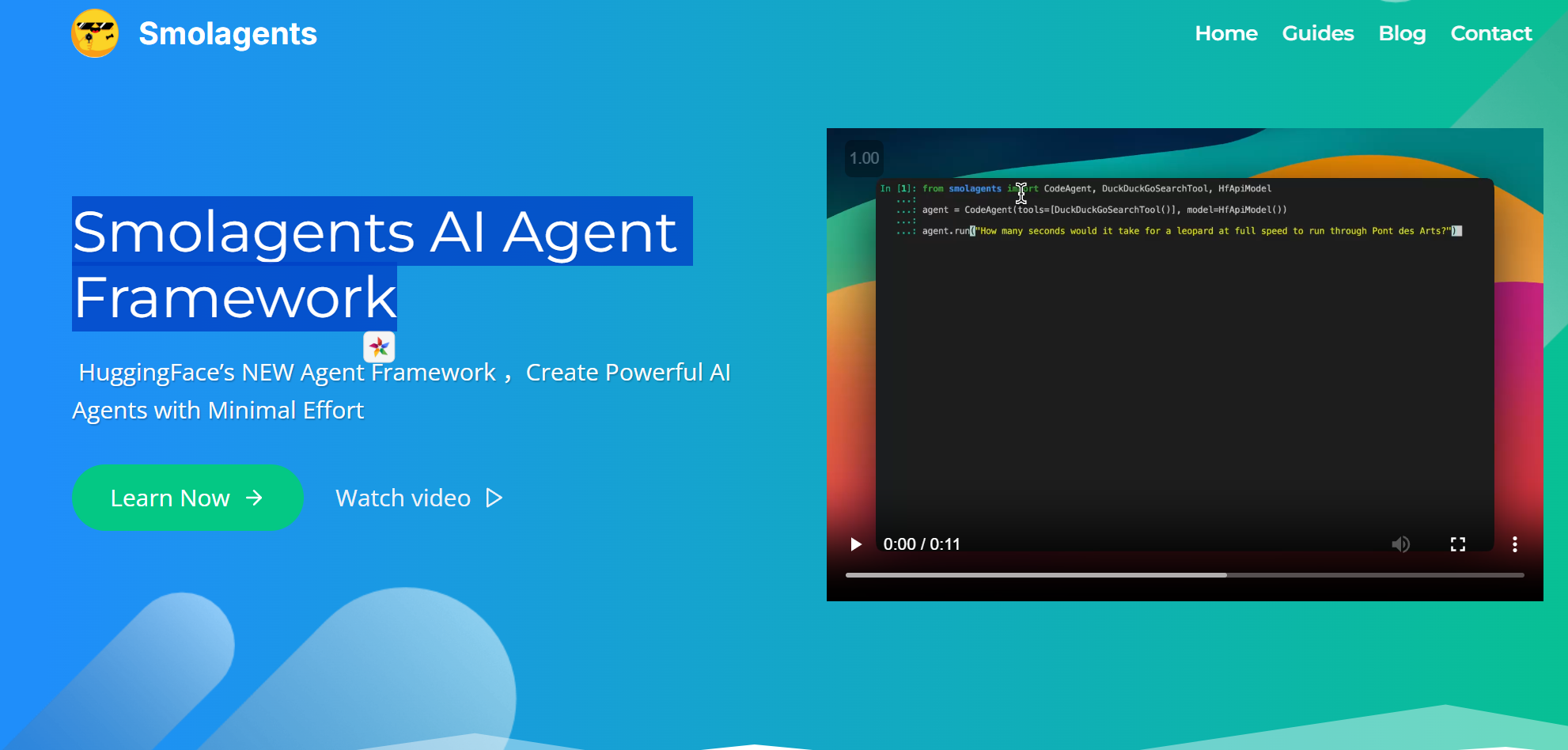
Smolagents - The minimalist AI agent framework by Hugging Face
Tagline: Create powerful AI agents with minimal code using Hugging Face's lightweight framework.
molagents is a revolutionary open-source AI agent framework that allows developers to build and deploy robust AI agents with just a few lines of code. Built by the Hugging Face team, it focuses on simplicity and efficiency while enabling Large Language Models (LLMs) to interact seamlessly with the real world.
Key Features:
🎯 Minimalist codebase (~1,000 lines of core code)
💻 Code-first approach for better efficiency
🔒 Secure sandboxed code execution
🤝 Deep integration with Hugging Face Hub
🔄 Support for multiple LLM providers
🛠️ Easy tool sharing and importing
Who is it for?
AI developers looking for a lightweight agent framework
Teams wanting to build efficient AI solutions
Researchers exploring agent-based AI systems
Developers who prefer code-first approaches over JSON configurations
Pricing:
Free and open-source

Auctus Software Pvt. Ltd. is a Mumbai-based IT firm specializing in web-based application development. Established in 2007, the company leverages technology partnerships with industry leaders such as SUN Microsystems and Microsoft, as well as open-source platforms, to deliver comprehensive website design and development services.
Key Features and Functionality:
- Web-Based Application Development: Auctus Software focuses on creating dynamic and scalable web applications tailored to client needs.
- Technology Partnerships: Collaborations with SUN Microsystems, Microsoft, and open-source communities ensure access to cutting-edge technologies and best practices.
- Comprehensive Services: The company offers end-to-end solutions, encompassing website design, development, and maintenance.
Primary Value and User Solutions:
Auctus Software addresses the growing demand for robust and user-friendly web applications by providing customized solutions that enhance online presence and operational efficiency. By integrating advanced technologies and adhering to industry standards, Auctus ensures that clients receive high-quality, scalable, and secure web solutions, thereby facilitating business growth and digital transformation.

BlitzBrain provides software development services that cover all phases of project implementation, from idea development to implementation and technical support. And if you've already started a development process, we are ready to get involved and provide assistance at any stage of a project. Although we provide a wide range of IT services, the main focus of our expertise lies in data engineering, with solutions for Data Warehousing and BI & Analytics. Our years of experience led to the creation of our own product - Blitz DMS - an ecosystem based on open-source technologies and in-house development for data storing, processing, and visualizing with additional services and functional possibilities. Our customers come from all industries, specifically from the banking, telecommunications, retail, and manufacturing sectors. Having dozens of projects under our belt with enterprises and startups, we pride ourselves in the individual approach and professionalism of our specialists. If you are considering a cost-effective data management tool on an open-source basis or want to develop a custom IT solution, contact us via sales@blitz-brain.com

Swift Outbox is AI cold email software for agencies, freelancers and B2B sales teams. Its built-in AI, Swift Pilot, reads up to 10 pages of each lead's website and writes a one-to-one email around something real it found, not a template with a first name dropped in. You can also connect your own OpenAI, Anthropic Claude, Google Gemini or OpenRouter key. Approve, edit or rewrite each email yourself, or let a campaign send automatically. Emails go out from your own Gmail, Google Workspace, Microsoft 365, Zoho or SMTP mailboxes, with mailbox rotation, daily limits and sending windows, and every reply lands in one inbox. Also included: an email verifier that checks real mailboxes (paid plans), a do-not-email list, open and click tracking, team roles and one workspace per client. Free plan available, no card required. Not included: follow-up sequences, a lead database and mailbox warm-up.

Culprit SQL Studio helps developers identify and optimize slow SQL queries across SQL Server, PostgreSQL, MySQL, and MariaDB databases. Simply analyze your queries and receive one-sentence fixes to improve performance.
Available as a free, open-source desktop application, command-line interface (CLI), and Model Context Protocol (MCP) server, it integrates seamlessly into your development workflow.
FEATURES
Performance Optimizer: Identifies slow queries and provides simple one-sentence fixes to speed them up.
Multi Database Support: Works across SQL Server, PostgreSQL, MySQL, and MariaDB databases.
Desktop Application: Offers a free, open-source graphical interface for easy desktop use.
CLI Tool: Includes a command-line interface for quick access directly from your terminal.
MCP Server: Acts as an MCP server to integrate performance insights into your existing development tools.
Workflow Integration: Designed to fit easily into your daily coding routine without extra hassle.

DeepFilter Email Security is an AI-assisted secure email gateway (SEG) that runs entirely on your own servers. It sits in front of your existing mail infrastructure — Microsoft 365, Exchange, Google Workspace, Zimbra or Postfix — and scans inbound and outbound mail before delivery, quarantining phishing, business email compromise, ransomware and malicious attachments.
Its defining property is data sovereignty: routine email traffic and message content never leave your organization's boundary, and there are no third-party cloud API calls. The AI model runs on your server, not in a vendor cloud. This makes DeepFilter a fit for regulated sectors, public institutions and any organization whose compliance program (GDPR, KVKK and similar) makes third-party cloud inspection of email content difficult.
How it works: every message passes four stages — pre-analysis, deep inspection, evaluation and decision — across seven detection layers: SPF/DKIM authentication, blocklists (RBL/URIBL), statistical classification, an on-premise AI model, similarity analysis for near-duplicate and image-based campaigns, antivirus, and phishing/impersonation detection. The layers combine into a single trust score, and for every rule that fires the console shows what it is, why it triggered and how much it contributed — 400+ documented rules with explainable, per-rule scoring.
Key capabilities:
• Fully on-premise deployment on Rocky Linux 9 via signed RPM packages
• Regional threat-intelligence packs (the Türkiye pack is live: national cyber-security authority feed, signed and integrity-verified)
• Collective intelligence — a signature learned on one deployment propagates encrypted across the network without sharing email data
• Optional DLP module detecting region-specific data patterns (IBAN, national ID, card numbers) in outbound mail
• Quarantine management, allow/block lists, reporting and an end-user portal
• Management console and end-user portal in English and Turkish
Measured performance (vendor's own measurement, not a third-party benchmark): the AI model is trained on 200,000+ emails and reaches 99.44% precision and 94.65% recall, with a false-positive rate below 0.1%.
Licensing is based on scanned messages per day — not per mailbox or per seat — starting from 50 EUR + VAT per month for 1,000 messages/day. Public sector, education and non-profit organizations have separate pricing. Evaluation is a free proof of concept, installed and run end-to-end by the DeepFilter team on your own infrastructure.
DeepFilter is developed by FZM Bilgi Teknolojileri A.Ş., which holds an ISO/IEC 27001:2022 information security management system certificate (no. IFC-I-08-26-2987, accredited by TÜRKAK under the IAF MLA). The certified scope covers the development, delivery and support of email security software. The certificate applies to the management system, not to the product.
Note: unrelated to DeepFilterNet, an open-source speech noise-suppression project.