Top 10 Alternatives to Amazon Rekognition Recently Reviewed By G2 Community
AI can help you find the answers. G2 helps you trust them.
Connect G2 to Claude or ChatGPT for answers grounded in G2's trusted reviews, comparisons, and pricing from real user insights.
How it works

Google Cloud Vision API enables developers to understand the content of an image by encapsulating powerful machine learning models in an easy to use REST API. Leveraging our API, developers can quickly build applications able to classify images into thousands of categories (e.g., "sailboat", "lion", "Eiffel Tower"), detect individual objects and faces within images, build metadata on image catalog, moderate offensive content, enable new marketing scenarios through image sentiment analysis, and more.

The Microsoft Computer Vision API is a cloud-based service that provides advanced algorithms to process and analyze visual data from images and videos. It enables developers to extract rich information, facilitating the development of applications that can interpret and understand visual content. Key Features and Functionality: - Image Analysis: Detects and classifies objects, scenes, and activities within images, offering detailed content understanding. - Optical Character Recognition (OCR): Accurately extracts printed and handwritten text from images and documents in multiple languages. - Intelligent Tagging and Captioning: Generates descriptive tags and captions to enhance content searchability and accessibility. - Facial Detection: Identifies faces, estimates age, gender, and emotions, enabling secure authentication workflows. - Spatial Analysis: Understands how people move through a physical space in near-real time. Primary Value and Solutions Provided: The Microsoft Computer Vision API automates the extraction of meaningful information from visual content, reducing the need for manual image review and data entry. It enhances customer experiences by enabling applications to adapt to visual inputs in real time. Additionally, it improves compliance and security through features like sensitive content detection and facial recognition for authentication. By integrating this API, businesses can streamline operations, develop intelligent applications, and gain deeper insights from their visual data.

OpenCV is a tool that has has C++, C, Python and Java interfaces and supports Windows, Linux, Mac OS, iOS and Android for computational efficiency and with a strong focus on real-time applications, written in optimized C/C++, the library can take advantage of multi-core processing and enabled to take advantage of the hardware acceleration of the underlying heterogeneous compute platform

Azure Face API uses state-of-the-art cloud-based face algorithms to detect and recognize human faces in images.Its capabilities include features like face detection, face verification, and face grouping to organize faces into groups based on their visual similarity.

Azure Custom Vision Service is a tool for building custom image classifiers, and for making them better over time. This service enables you to identify your own objects and things in images.
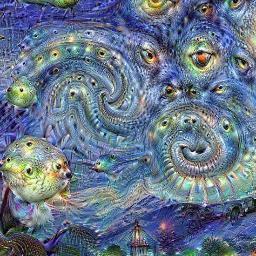
And this is where Google's deep dream ideas originate. With simple words you give to an AI program a couple of images and let it know what those images contain ( what objects - dogs, cats, mountains, bicycles, ... ) and give it a random image and ask it what objects it can find in this image.
Claude is an AI assistant from Anthropic that helps people and teams get work done through conversation, coding, delegated tasks, and collaboration. Available on desktop, web, and mobile, Claude is built on a family of frontier models (Claude Mythos, Opus, Sonnet, and Haiku) that range from the most capable to the most cost-effective, so teams can match intelligence to the task. Key Features and Functionality: - Chat: Collaborate with Claude on writing, analysis, research, and problem solving, with file uploads, projects that keep context across conversations, memory, web search, and artifacts for real-time documents and code. - Code: Build software with Claude Code, a coding agent that plans, writes, edits, tests, and debugs across large codebases, available in the terminal, desktop app, web, and mobile, with native GitHub and IDE integrations. - Cowork: Delegate multi-step tasks to Claude in plain language. Claude works across local files, connected apps, and the desktop, and returns finished documents, spreadsheets, presentations, and organized folders. An open plugin system bundles skills, data connectors, and workflows. - Tag: Bring Claude into Slack and other team tools. Tag Claude into any channel or thread and it drafts, analyzes, and answers in context, using shared documents and channel memory. - Specialized products: Claude Security (vulnerability detection and patch suggestions for security teams), Claude Design (designs, prototypes, and presentations from natural language), and Claude Science (an AI workbench for scientific research). - Connectors and extended context: Connect Claude to the tools and data teams already use, including the Model Context Protocol, and analyze large documents and codebases with long context and extended thinking. - Enterprise-grade security: Claude Enterprise includes Single Sign-On (SSO), role-based permissions, audit logs, and custom data retention controls. Primary Value and User Solutions: Claude gives individuals and organizations one assistant for everyday knowledge work, software development, and delegated tasks. Employees get faster research, writing, analysis, and coding. Teams collaborate with Claude where they already work. Enterprises get the administrative controls and security needed to deploy AI across the business.

SimpleCV is an open source framework for building computer vision applications, user can get access to several high-powered computer vision libraries such as OpenCV without having to learn about bit depths, file formats, color spaces, buffer management, eigenvalues, or matrix versus bitmap storage.

Derive insights from your images in the cloud or at the edge with AutoML Vision or use pre-trained Vision API models to detect emotion, understand text, and more.

scikit-image is a collection of algorithms for image processing.