Best Software Intelligence Platforms Software - Page 2

How Many Software Intelligence Platforms Software Products Does G2 Track?

Total Products under this Category: 33

Category Stats (Sep 2026)

  • Average Rating: 4.64/5 The average rating of products in this category, based on all submitted ratings

Last updated: September 12, 2026

How Does G2 Rank Software Intelligence Platforms Software Products?

Why You Can Trust G2's Software Rankings:

  • 30 Analysts and Data Experts
  • 200+ Authentic Reviews
  • 33+ Products
  • Unbiased Rankings

G2's software rankings are built on verified user reviews, rigorous moderation, and a consistent research methodology maintained by a team of analysts and data experts. Each product is measured using the same transparent criteria, with no paid placement or vendor influence. While reviews reflect real user experiences, which can be subjective, they offer valuable insight into how software performs in the hands of professionals. Together, these inputs power the G2 Score, a standardized way to compare tools within every category.

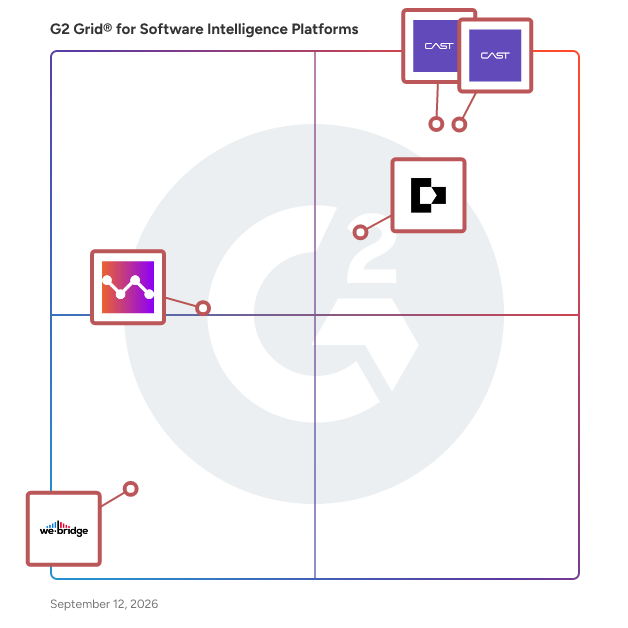
G2 Grid® for Software Intelligence Platforms Software

G2 Grid® for Software Intelligence Platforms Software plotting products by satisfaction and market presence

Highlighted products: CAST Imaging, CAST Highlight, Crowdbotics Platform, CodeLogic, Inc., and We-Bridge DeltaForce.

Underlying data: [Grid® JSON](https://www.g2.com/categories/software-intelligence-platforms/grids.json?focus%5B%5D=cast-imaging&focus%5B%5D=cast-highlight&focus%5B%5D=crowdbotics-platform&focus%5B%5D=codelogic-inc-codelogic-inc&focus%5B%5D=we-bridge-deltaforce)

DISCOVER

DISCOVER is an Artificial Intelligence (AI)-powered application analysis and understanding solution designed to help IT teams quickly make sense of complex application landscapes—especially legacy environments—and reduce risk during modernization, governance, and maintenance initiatives. With an AI conversational interface, DISCOVER enables users to ask questions in natural language and receive clear, contextual answers about how an application works: key components, dependencies, and the relationships between programs, modules, files, and data structures. This accelerates onboarding, improves collaboration across teams, and helps stakeholders make faster, better-informed decisions. DISCOVER automatically builds an application knowledge base and offers multiple ways to explore it, including visual diagrams, structured documentation, and functional trees. It reveals hidden complexity by highlighting cross-references, coupling points, and critical paths. Teams can use DISCOVER to perform impact analysis, identify obsolete or redundant components, and detect inconsistencies—so changes can be planned and delivered more safely. Built-in indicators (for example complexity metrics, code volume, and comment rate) help prioritize refactoring and modernization work based on effort and risk. For governance and compliance, DISCOVER supports data lineage and end-to-end traceability, helping organizations understand how data flows through the application, where sensitive data may be processed, and what parts of the system are impacted by security or regulatory requirements. This improves audit readiness, strengthens documentation quality, and supports reliable decision-making across the software lifecycle.

Who Is the Company Behind DISCOVER?

  • Seller: ARCAD Software
  • Year Founded: 1992
  • HQ Location: Chavanod, FR
  • Twitter: @arcad_software
    793 Twitter followers
  • LinkedIn® Page: www.linkedin.com
    121 employees on LinkedIn®

Docet/EV

Who Is the Company Behind Docet/EV?

  • Seller: Renewable Energy Systems
  • Year Founded: 1981
  • HQ Location: Kings Langley, England, United Kingdom
  • Twitter: @RES_Americas
    1,799 Twitter followers
  • LinkedIn® Page: www.linkedin.com
    4,041 employees on LinkedIn®

Doxygen

Doxygen is a free, open-source documentation generator that automates the creation of comprehensive documentation directly from annotated source code. Supporting multiple programming languages—including C, C++, Python, Java, and PHP—Doxygen parses code comments to produce well-structured documentation in various formats such as HTML, PDF , RTF, and XML. This tool simplifies the documentation process, enhancing collaboration and maintenance across diverse projects. Key Features and Functionality: - Multi-Language Support: Doxygen supports a wide range of programming languages, including C, C++, Python, PHP, Java, C#, Objective-C, Fortran, VHDL, Splice, IDL, and Lex. - Multiple Output Formats: It can generate documentation in various formats, such as HTML, PDF , Word , and XML, allowing developers to choose the format that best suits their needs. - Markdown Support: Doxygen allows the use of Markdown for documentation, enabling developers to write documentation using simple and readable syntax. - Cross-Referencing: The tool provides cross-referencing capabilities, generating hyperlinks to related elements, making it easy to explore the codebase and understand the relationships between different components. - Diagram Generation: Doxygen can generate graphical representations of class hierarchies and collaboration diagrams, providing a visual overview of the relationships between classes and functions. - Configuration Flexibility: It offers a configuration file that allows users to customize the documentation generation process, controlling various settings such as output format and file inclusion/exclusion. Primary Value and Problem Solved: Doxygen addresses the challenge of maintaining up-to-date and comprehensive documentation in software development. By automating the extraction of documentation from source code comments, it ensures consistency and accuracy, reducing the manual effort required to produce and update documentation. This automation enhances collaboration among developers, facilitates easier code maintenance, and improves the onboarding process for new team members by providing clear and accessible documentation.

Who Is the Company Behind Doxygen?

  • Seller: Doxygen
  • HQ Location: N/A
  • Twitter: @doxygen
    492 Twitter followers
  • LinkedIn® Page: www.linkedin.com
    1 employees on LinkedIn®

EasyCode

EasyCode is an AI-powered coding tool designed to make product and engineering teams productive. With deep codebase awareness and native integration with 3rd party APIs. EasyCode makes it easy to turn ideas into production apps.

Who Is the Company Behind EasyCode?

  • Seller: EasyCode
  • Year Founded: 2021
  • HQ Location: Mississauga, CA
  • LinkedIn® Page: www.linkedin.com
    5 employees on LinkedIn®

eXplain

eXplain is a market-leading code analysis tool designed to transform legacy software systems, particularly those running on IBM Z (mainframe and IBM Power i (AS400 platforms. It facilitates the replacement, redevelopment, or modernization of legacy applications by providing comprehensive insights into existing codebases. By uploading program sources to the eXplain server—without the need for host installation—organizations can centralize their code analysis, leading to accelerated project success and a reduction in onboarding time for new developers by up to 50%. Key Features and Functionality: - Comprehensive Code Parsing: eXplain supports a wide range of programming languages, including Cobol, PL/I, Assembler, Natural, RPG (IBM i, JCL, CL (IBM i, and REXX. It also accommodates various databases like Db2, Adabas, and IMS-DB, as well as schedulers such as AJM, TWS, and Control-M. Transaction monitors like CICS and IMS-DC are also supported. - Customizable Parsers: The tool offers 100% coverage of technological peculiarities through its customizable parsers, ensuring adaptability to specific organizational needs. - Intelligent Dead Code Detection: eXplain can reduce legacy source code by up to 40% through intelligent dead code detection, streamlining the codebase and improving maintainability. - Quality Analysis Dashboard: The QA dashboard presents code quality metrics in a compressed and visually appealing format, aiding in measuring complexity, maturity, and progress of modernization efforts. - Performance Optimization: For IBM Z/mainframe applications, eXplain integrates with common schedulers to visualize job networks, enabling proactive optimization of time-critical processes and cost savings identification. Primary Value and Problem Solved: eXplain addresses the challenges associated with legacy applications, which often have a reputation for being outdated and difficult to manage. By providing a systematic analysis of IBM legacy code, eXplain helps organizations uncover the true value within their existing systems. It enables developers to recognize connections, data flows, redundancies, and inconsistencies, thereby accelerating project work by approximately 30% and facilitating the training of new employees twice as quickly. Additionally, eXplain's ability to identify non-relevant areas allows teams to focus on key challenges, ensuring efficient, error-free communication and holistic decision-making in legacy modernization projects.

Who Is the Company Behind eXplain?

glue.tools

Glue is the pre-code intelligence platform that eliminates the Understanding Tax — the 20-35% of engineering time developers lose to context acquisition before writing a single line of code. Glue connects to your GitHub repos, indexes your entire codebase using 6 parallel AI agents, and builds a deep context layer — every function, every dependency, every call path, every feature boundary, every piece of tribal knowledge buried in git history. Then it makes that intelligence accessible through natural language. Paste a ticket, get a battle plan: affected files with line numbers, feature boundaries, tribal knowledge from git history, blast radius analysis, and suggested approach. Key capabilities include: Codebase Indexing and Symbol Extraction (Java, TypeScript, Python, JavaScript, Go), Feature Discovery using Louvain clustering on dependency graphs, Tribal Knowledge extraction from git history, Ticket Triage with duplicate detection and complexity estimation, Competitive Gap Analysis, Auto-generated Documentation, Team Insights with code ownership mapping, and a Conversational Workspace powered by Claude AI. Built for engineering teams of 10-500+ developers at mid-market companies in regulated industries. Glue reduces context-gathering time by 60-80% per ticket and accelerates new developer onboarding from 6 months to 2 weeks.

Who Is the Company Behind glue.tools?

IBM Bob Premium Package for Z

IBM Bob Premium Package for Z is application modernization software designed to help development teams analyze, maintain, and modernize IBM Z applications. It adds Z-specific tools, skills, and workflows to IBM Bob for understanding application structure, dependencies, metadata, data, and business logic. Teams can use it to assess change impact, document applications, generate and modify code, refactor selected components, and validate changes. It supports IBM Z technologies and artifacts including COBOL, PL/I, JCL, CICS, IMS, Db2, z/OS, HLASM, and related applications. Structured workflows provide human review, traceability, and governance throughout modernization activities.

Who Is the Company Behind IBM Bob Premium Package for Z?

  • Seller: IBM
  • Year Founded: 1911
  • HQ Location: Armonk, New York, United States
  • Twitter: @IBMSecurity
    74,660 Twitter followers
  • LinkedIn® Page: www.linkedin.com
    344,328 employees on LinkedIn®
  • Ownership: SWX:IBM

InitusDecoder

InitusDecoder prepares a visual map of all scripts deployed in an instance including their impact on the various system records. InitusDecoder prepares a visual map of all scripts and their impact on system records. This reduces the time required to analyze a system before architecting new changes and eliminates the potential of missing impacts on records.

Who Is the Company Behind InitusDecoder?

  • Seller: Initus
  • Year Founded: 2005
  • HQ Location: Dallas, US
  • LinkedIn® Page: www.linkedin.com
    10 employees on LinkedIn®

InteliG

InteliG is the intelligence and operating layer for engineering organizations. Connect GitHub and ask Cognis — InteliG's AI reasoning engine — anything about your engineering org. Get defensible answers backed by code, strategy, knowledge, and finance. No tickets. No dashboards. Just intelligence. Built by a CTO who inherited 20 engineers and had zero visibility.

Who Is the Company Behind InteliG?

Who Uses This Product?

  • Company Size: 100% Small

Kuscos

Kuscos is a comprehensive software intelligence platform designed to provide in-depth analysis and documentation of existing software systems. By offering detailed insights into code structures, dependencies, and team activities, Kuscos empowers organizations to make informed decisions, enhance development efficiency, and mitigate risks associated with software projects. Key Features and Functionality: - Multi-Language Support: Kuscos is capable of analyzing a wide range of programming languages, including Java, JavaScript, C#, VB.Net, VB, Cobol, PL/SQL, PowerBuilder, Delphi, Informix 4GL, and SAP/ABAP. - Comprehensive Code Analysis: The platform identifies duplicate and redundant code, improving system efficiency and reducing maintenance costs. - Dependency Mapping: Kuscos provides a clear understanding of internal and external system dependencies, aiding in risk identification and change management. - Predictive Insights: The platform predicts integration needs, facilitating smoother transitions and changes within software systems. - Performance Monitoring: With customized dashboards, Kuscos allows organizations to monitor software changes and developer performance effectively. - Quality Assurance: The platform ensures that development processes and code meet corporate and international quality and certification standards. Primary Value and Problem Solving: Kuscos addresses the critical need for organizations to have a clear and comprehensive understanding of their software systems. By providing detailed documentation and analysis, it enables informed decision-making, reduces project risks, and enhances overall development efficiency. The platform's ability to identify code inefficiencies, map dependencies, and monitor team performance ensures that organizations can proactively manage and optimize their software development processes.

Who Is the Company Behind Kuscos?

  • Seller: Morphis Tech
  • HQ Location: Lisboa, PT
  • Twitter: @morphis_tech
    177 Twitter followers
  • LinkedIn® Page: www.linkedin.com
    36 employees on LinkedIn®

Moderne

Moderne is a developer collaboration platform for automated code refactoring and analysis at mass scale. The platform enables development teams to migrate, maintain, and secure source code with speed and accuracy across thousands of repositories at once. Why just scan for issues when you can find and fix all at once? Code remediations and upgrades that can take many months of manual work can be done in minutes. Why undergo manual, expensive impact analysis projects on your codebase? Automate data collection and visualization to understand your code like never before. Why be stuck with older, unsupported software components? Automate your migrations to give your business the agility and innovation it's been missing! The Moderne refactoring system also works with AI large language models (LLMs) to support mass-scale code transformation and analysis tasks—enabling greater efficiency and accuracy for using AI across large codebases. Moderne is the creator of the OpenRewrite automated code refactoring open source project, and scales OpenRewrite recipes across thousands of repositories and millions of lines of code.

Who Is the Company Behind Moderne?

  • Seller: Moderne
  • Year Founded: 2020
  • HQ Location: Miami, US
  • LinkedIn® Page: www.linkedin.com
    53 employees on LinkedIn®

OpenAna Technology Intelligence

OpenAna Tech Intelligence is an AI-powered software intelligence and technology analysis platform that helps organizations understand the real health, risk, and maturity of their technology environments. Traditional technology assessments often rely on documentation, architecture diagrams, or isolated scans. OpenAna goes deeper by analyzing codebases, application architecture, cloud infrastructure, DevOps pipelines, and system dependencies to uncover the technology signals that truly impact performance, scalability, and operational resilience. The platform enables CIOs, CTOs, engineering leaders, and technology advisors to quickly identify technical debt, architecture risks, DevOps maturity gaps, and cloud infrastructure issues across complex software systems. OpenAna Tech Intelligence is commonly used during technology modernization initiatives, engineering transformation programs, and technology due diligence assessments to provide deep visibility into how systems are actually built and operated. Key Capabilities Software Intelligence & Architecture Analysis Analyze application architecture, service dependencies, and system interactions to understand how software systems are structured and how they behave in production environments. Technical Debt Detection Identify hidden technical debt, outdated components, fragile code structures, and maintainability risks across large codebases. DevOps & Engineering Maturity Insights Evaluate CI/CD pipelines, release processes, and engineering practices to identify operational inefficiencies and improvement opportunities. Cloud & Infrastructure Visibility Assess cloud environments and infrastructure configurations to surface scalability risks, security gaps, and cost optimization opportunities. Technology Due Diligence & System Discovery Quickly understand the real state of a technology stack during mergers, acquisitions, or major transformation initiatives. Unlike traditional software intelligence tools that only surface issues, OpenAna also enables organizations to move from insight to action by supporting modernization and remediation through its autonomous engineering platform. OpenAna Tech Intelligence helps organizations make data-driven technology decisions, reduce technical debt, and accelerate modernization efforts across complex software environments.

Who Is the Company Behind OpenAna Technology Intelligence?

Repowise

Repowise is codebase intelligence for AI coding agents and the teams that ship with them. It builds one index over your repository and uses it for two jobs: giving coding agents the context they need to make correct edits, and giving engineering teams reliable signals about code quality and risk. The index has five layers. Graph maps how code connects. Git surfaces change patterns and co-change risk. Docs makes documentation searchable. Decisions captures the reasoning behind past choices. Code Health scores every file using deterministic biomarkers with no LLM calls, so scores stay consistent and cheap to run. Agents connect through Repowise's MCP tools and stop searching blindly. They go straight to the code that matters, which cuts token cost, tool calls, and file reads on real tasks. On the team side, Code Health gives reviewers a defensible way to spot the files most likely to carry defects, so review effort lands where it pays off. Repowise is open source and available as an MCP server, a VS Code extension, and a PR review bot. AGPL-3.0 with a commercial license for teams.

Who Is the Company Behind Repowise?

  • Seller: repowise
  • Year Founded: 2026
  • HQ Location: Bengaluru, IN
  • LinkedIn® Page: www.linkedin.com
    1 employees on LinkedIn®

Sita

Sita cuts AI spend by 30% and saves 25 hours per developer each month by automating search and documentation. It turns code, messages, and docs into a knowledge graph and feeds only relevant context to your coding tools, cutting input tokens by 32%. Sita also keeps your docs up to date and helps ship features 37% faster with 68% fewer bugs. We onboard you with white-glove support in one hour. Sita works with or without your current tools and can power them through MCP or our own agent.

Who Is the Company Behind Sita?

Adam Crivello
AC
Researched and written by Adam Crivello
Updated October 3, 2024