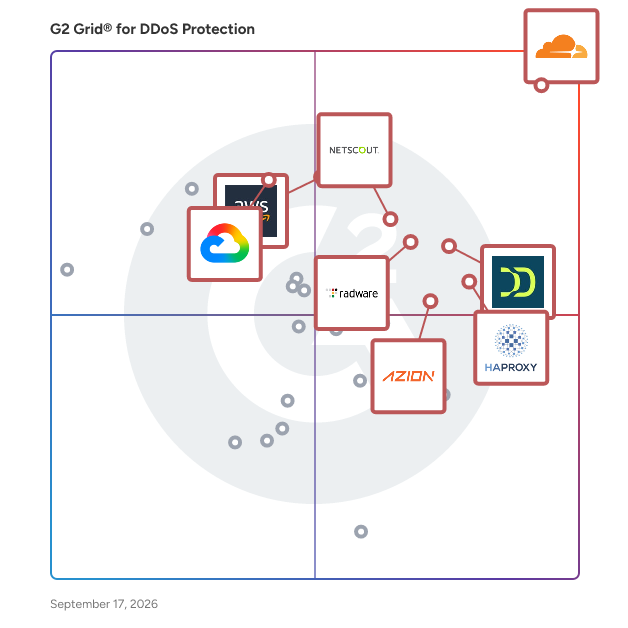
Total Products under this Category: 89
Last updated: July 12, 2026
Why You Can Trust G2's Software Rankings:
G2's software rankings are built on verified user reviews, rigorous moderation, and a consistent research methodology maintained by a team of analysts and data experts. Each product is measured using the same transparent criteria, with no paid placement or vendor influence. While reviews reflect real user experiences, which can be subjective, they offer valuable insight into how software performs in the hands of professionals. Together, these inputs power the G2 Score, a standardized way to compare tools within every category.
What do users say?
Users consistently praise the product for its ease of administration and effective protection against DDoS attacks, highlighting its ability to safeguard cloud workloads without requiring extensive se
What do users say?
Users consistently praise the product for its user-friendly interface and effective protection against DDoS attacks, making it easy to manage and integrate into existing systems. Many appreciate the c
What do users say?
Users consistently praise the product for its strong security features and ease of use, noting that it effectively protects against DDoS attacks while being user-friendly. Many appreciate the clear do
What do users say?
Users consistently praise the product for its high-level service and effective protection against DDoS attacks, noting that it is easy to use and backed by responsive support. Many appreciate the stra
What do users say?
Users consistently praise strong protection against hacking and DDoS attacks, highlighting how it provides peace of mind and enhances website security. The tool's ease of use and comprehensive feature
What do users say?
Users consistently praise the product for its ease of use and quick response to DDoS attacks, highlighting its straightforward setup and effective protection capabilities. Many appreciate the user-fri
What do users say?
Users consistently praise the product for its reliable protection against DDoS attacks and its customization options, which allow for tailored security measures. Many appreciate the ease of integratio
What do users say?
Users consistently praise the software for its real-time defense and ability to block malicious traffic, making it a reliable choice for protecting websites and APIs from threats like DDoS attacks and
What do users say?
Users consistently praise the ease of use and fast provisioning of Console Connect, highlighting its intuitive interface and quick setup for network services. The platform's ability to provide seamles
Product Description
Founded in 2008, Nexusguard is a leading cloud-based distributed denial of service (DDoS) security solution provider and the only managed security service provider (MSSP) specialized in combating DDoS
A distributed denial of service (DDoS) attack is a cyberattack where multiple compromised computers or devices flood a target server, network, or website with an overwhelming volume of traffic. The aim is to disrupt the normal functioning of the target, making it slow, unresponsive, or entirely inaccessible to legitimate users.
In a DDoS attack, hackers often use a network of infected devices, known as a botnet, to generate massive amounts of traffic, such as connection requests, data packets, or queries, to overwhelm the target. The goal is typically to cause downtime, damage reputation, or financial loss for the targeted organization.
DDoS protection solutions help prevent and mitigate DDoS attacks before and as they happen, ensuring no service interruptions.
DDoS protection and mitigation solutions work by identifying and filtering out malicious traffic before it overwhelms the target server, network, or application.
These solutions continuously monitor incoming traffic, comparing it against normal patterns and historical baselines. When abnormal spikes are detected, they activate automated measures like rate limiting, traffic filtering, and rerouting to maintain service availability. They often use machine learning (ML) algorithms to improve detection accuracy, quickly distinguishing between legitimate traffic and potential threats.
These measures are orchestrated to ensure consistent availability of online services, even in the face of volumetric, application-layer, or protocol-based DDoS attacks.
Because of the scale and sophistication of modern DDoS attacks, many organizations use a comprehensive DDoS service that includes appliance-based and cloud-based components. These services are often backed by a 24/7 response team that helps mitigate an attack as it happens.
The following are the common techniques employed by DDoS protection solutions to prevent and mitigate DDoS attacks:
For IT managers and security teams, selecting the right DDoS mitigation software is critical to maintaining network performance and protecting digital assets. Below are the essential features to consider:
DDoS security solutions protect financial assets, maintain brand reputation, enable attack reporting for future analysis, and ensure compliance with regulatory standards. Here are more benefits of the software.
DDoS protection solutions vary based on deployment—on-premises, cloud, or hybrid—each tailored to different infrastructure needs. Choosing the right type ensures effective detection, mitigation, and management of DDoS attacks.
A broad range of entities use DDoS protection software. Here's a breakdown of some of the most common users.
DDoS service providers typically offer tiered plans, ranging from free or low-cost options for small websites to enterprise DDoS defense solutions costing thousands per month based on several factors.
Key factors influencing DDoS solution pricing include:
For accurate pricing, request quotes tailored to your needs from multiple providers.
There are several challenges associated with increasingly savvy DDoS attacks. The general challenges with DDoS protection services are detailed here.
Nearly any company with an online presence could benefit from anti-DDoS software, especially as attacks continue to grow in frequency and sophistication. Some companies, like those listed here, may find it particularly critical to invest in these services.
Choosing the best DDoS protection service ensures your online services' uninterrupted availability and security.
Understand your industry, website traffic, and potential vulnerabilities to determine the scale and type of DDoS attacks you might face. Certain industries, like e-commerce, finance, and gaming, are more prone to frequent and complex attacks, which may require advanced, multi-layered defenses.
Define your requirements based on the criticality of online services, traffic volume, and compliance regulations. Look for a solution that can scale with your business, offering global coverage to protect against region-specific threats.
Create a shortlist of solutions of the best DDoS protection tools that match your criteria. Consider potential attack size (measured in Gbps/Mpps), the types of DDoS attacks you aim to manage, and deployment options—whether on-premises, cloud, or hybrid—based on your infrastructure.
In evaluating vendors, consider:
Once you have a shortlist, research the reputation and track record of potential DDoS protection vendors. Consider customer reviews, industry recognition, and the vendor’s history in cybersecurity. Evaluate the vendor's commitment to innovation, regular updates, and ability to handle new cyber threats.
Ask critical questions like:
Utilize trial periods to evaluate the DDoS solution’s performance in your environment. Seek feedback from peers and industry experts to gauge how well it aligns with your business’s needs, both current and future.
By aligning these factors with your organization’s requirements, you can choose the best DDoS protection solution tailored to your business size and needs.
Follow these steps to implement DDoS protection solutions.
A company is susceptible to cyber attacks if it doesn’t protect its vulnerable assets with the help of DDoS mitigation software. Begin by listing all external-facing assets, both virtual and physical. These may include servers, IP addresses, applications, data centers, and domains and subdomains. Knowing which assets to protect and which ones are most vulnerable helps you create a plan to safeguard what’s important.
After identifying the list of vulnerable assets, evaluate the risk involved with each of them. Examine the vulnerabilities individually since the damage depends on the severity and type of attack. An attack on an e-commerce site is different from an attack on a financial company. Prioritize the assets and implement protection accordingly.
The potential damages from a DDoS attack are direct loss of revenue, productivity, and customers, SLA obligations, and hits to brand and reputation. Customers may choose to stop working with a company after learning about a cyberattack.
It’s important to assign appropriate responsibility for establishing a DDoS mitigation. Knowing who needs to take up the responsibility depends on which assets the company is trying to protect. For example, a business manager would be responsible if the organization wants to protect revenue, the application owner would be responsible in case of protecting application availability, and so forth.
The next step in the implementation process is setting up detection techniques that send out alerts when there’s any sign of an attack or vulnerability. Detection methods can be deployed at different stages – either application level or network level. They can help send required alerts.
The final step in the implementation process is to deploy the DDoS defense services. After assessing the vulnerable assets and risk involved, assigning responsibilities, and setting up detection methods, you understand your organization’s requirements and have the means to set up the best DDoS protection solution.
Adopting a cloud-first approach is cost-effective and requires little maintenance investment. It offers scalability and suits businesses of any size due to its ability to absorb mass volumetric DDoS attacks, distributing the load across a global network.
With DDoS attacks growing rapidly, there’s an increased demand for cloud-based solutions where companies can take advantage of cloud flexibility while scaling as needed.
ML is becoming increasingly central to DDoS protection strategies. By using ML algorithms, DDoS protection software continuously analyzes traffic patterns to develop a dynamic understanding of what constitutes normal or harmful traffic. It can then identify anomalies that may indicate a DDoS attack quickly and effectively.
This type of automated intelligence can also predict and prepare for never-before-seen attack vectors, improving the adaptiveness of protective measures.
Threat intelligence sharing platforms collect and disseminate information about current and historical cyber threats from around the world. With real-time integration, DDoS protection software can access up-to-the-minute information on the latest attack signatures and tactics. This allows the protection systems to be updated immediately with new rules and definitions for rapid, accurate threat detection and response. Collective intelligence from various sources creates a global defense network against emerging DDoS attacks.
Researched and written by Lauren Worth