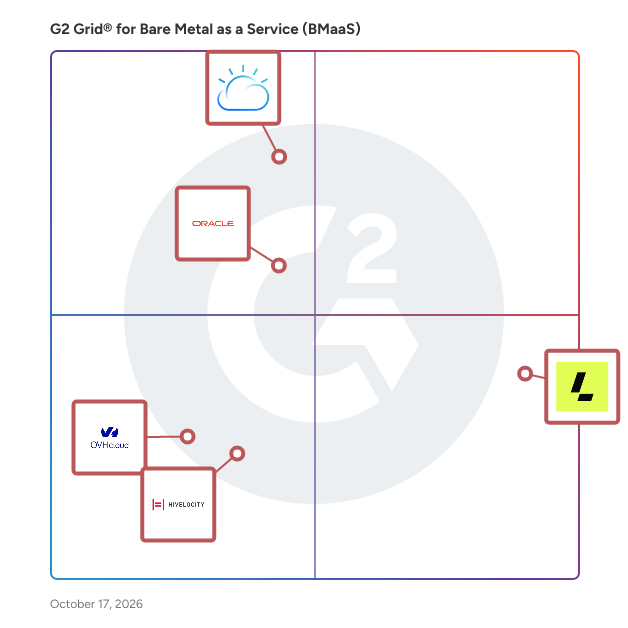
Bare metal as a service (BMaaS) platforms, also marketed as bare metal cloud, rent out dedicated physical servers with the automation and economics of public cloud. Customers pick a server configuration, deploy it via a web portal or API in minutes, and pay only for what they use at published hourly or monthly rates. Because the provider places no hypervisor or virtualization layer between the workload and the machine, a single customer receives the full, unshared performance of the hardware along with root-level control over the operating system and software stack.
These platforms are used by IT operations, DevOps, platform engineering, and site reliability teams that need consistent performance without the noisy neighbor effects of shared cloud infrastructure. Common buyers run performance-intensive databases and analytics engines, latency-sensitive trading, gaming, telecommunications, and streaming systems, regulated workloads that require physically isolated single-tenant infrastructure for compliance, and AI training or inference clusters built on dedicated GPU servers. Because capacity is consumed as an operating expense and can be added or released as demand changes, BMaaS supports short-lived projects as well as steady production estates without hardware ownership.
BMaaS occupies a distinct position among adjacent categories. Infrastructure as a service (IaaS) providers deliver virtualized, multi-tenant compute instances that run on a provider-managed hypervisor, while BMaaS delivers whole single-tenant physical machines. Dedicated hosting platforms also lease provider-owned physical servers, but those are typically configured by provider staff and sold as fixed monthly or annual plans, whereas BMaaS requires automated self-service provisioning and consumption-based billing that customers can start and stop on demand. VPS hosting platforms partition one physical server into isolated virtual machines for many customers, while a BMaaS server is never shared.
In colocation hosting, the customer owns the hardware and rents data center space, while the BMaaS provider owns and maintains the servers. Unlike managed hosting platforms, where the provider administers the operating system and software, BMaaS customers administer their own environments. GPU-based BMaaS offerings can complement generative AI infrastructure software, which is defined by model training and inference capabilities rather than by how the underlying servers are delivered.
To qualify for inclusion in the Bare Metal as a Service (BMaaS) category, a product must:
- Provide on-demand, single-tenant physical servers whose full hardware resources are dedicated to one customer at a time
- Deliver servers with no provider-imposed hypervisor or virtualization layer, giving the customer root or administrator access to the physical machine and control over the choice and installation of the operating system
- Offer automated self-service provisioning through both a web portal and a documented public API, with standard server configurations deployed and ready for use within minutes of ordering rather than through sales quotes or ticket-based setup
- Bill servers on a consumption basis at published hourly or monthly on-demand rates that customers can start and stop at any time without a mandatory long-term contract
- Offer block or object storage services that customers can provision in addition to the local drives of their servers
- Provide private networking between a customer's servers, such as VLANs or private network segments, that is isolated from public internet traffic