Best Bare Metal as a Service (BMaaS) Software - Page 2

How Many Bare Metal as a Service (BMaaS) Software Products Does G2 Track?

Total Products under this Category: 31

Category Stats (Oct 2026)

  • Average Rating: 4.44/5 (↓0.01 vs Sep 2026) The average rating of products in this category, based on all submitted ratings

Last updated: October 15, 2026

How Does G2 Rank Bare Metal as a Service (BMaaS) Software Products?

Why You Can Trust G2's Software Rankings:

  • 30 Analysts and Data Experts
  • 700+ Authentic Reviews
  • 31+ Products
  • Unbiased Rankings

G2's software rankings are built on verified user reviews, rigorous moderation, and a consistent research methodology maintained by a team of analysts and data experts. Each product is measured using the same transparent criteria, with no paid placement or vendor influence. While reviews reflect real user experiences, which can be subjective, they offer valuable insight into how software performs in the hands of professionals. Together, these inputs power the G2 Score, a standardized way to compare tools within every category.

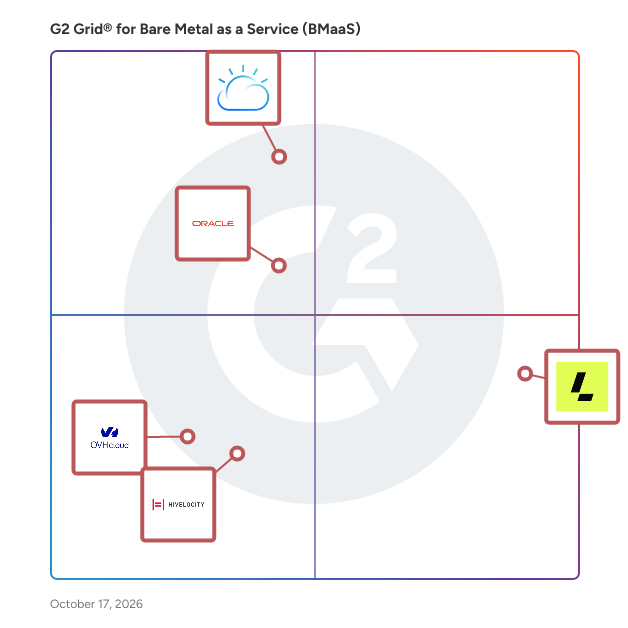
G2 Grid® for Bare Metal as a Service (BMaaS) Software

G2 Grid® for Bare Metal as a Service (BMaaS) Software plotting products by satisfaction and market presence

Highlighted products: Latitude.sh, IBM Cloud Bare Metal Servers, Oracle Bare Metal Cloud Services, Hivelocity, and OVHcloud.

Underlying data: [Grid® JSON](https://www.g2.com/categories/bare-metal-as-a-service-bmaas/grids.json?focus%5B%5D=latitude-sh&focus%5B%5D=ibm-cloud-bare-metal-servers&focus%5B%5D=oracle-bare-metal-cloud-services&focus%5B%5D=hivelocity&focus%5B%5D=ovhcloud)

Halfpenny Mac

Dedicated, managed Apple silicon Mac minis and Mac Studios rented by the month and hosted in the Cotswolds, UK. Every machine is a real physical Mac, never virtualised or shared: full GPU and Metal access, root admin, install anything. Built for iOS and macOS CI, local LLM inference, and browser automation. Access over Tailscale via SSH and remote desktop, nightly encrypted backups, UPS-backed racks with a public status page. Tiers from an M1 8 GB mini at £39/month up to M4 Pro and M5 Pro minis, with Mac Studios by quote. No contract, monthly or annual billing.

Who Is the Company Behind Halfpenny Mac?

Hostnot Gpu

Hostnot GPU is a cloud-based platform that provides on-demand GPU compute resources tailored for artificial intelligence (AI), machine learning (ML), and high-performance computing (HPC) workloads. The platform offers a diverse selection of GPU instances, enabling users to select configurations that best align with their specific computational requirements. This flexibility ensures that tasks ranging from model training and inference to rendering and data analysis can be executed efficiently. A key feature of Hostnot GPU is its live GPU Marketplace, which displays real-time availability and pricing for various GPU models across multiple regions. This transparency allows users to make informed decisions based on current capacity and cost considerations. The platform supports a wide array of GPU types, including NVIDIA's A100, H100, L40, and V100, among others, each suited for different workloads such as training, inference, rendering, and development. To streamline the deployment process, Hostnot GPU employs a wallet-first authorization system. Users fund their accounts in advance, and the platform reserves the necessary funds before initiating a compute resource. This approach ensures that there are no unexpected charges, as billing begins only after the instance reaches its billable running state. Usage is recorded in proportional time windows, and terminating an instance halts future usage charges immediately. For users requiring serverless inference capabilities, Hostnot GPU offers a Serverless AI API. This feature allows developers to deploy inference tasks without managing the underlying infrastructure. The API supports various inference workflows, including chat completions and image or video processing, with each request reserving an estimated wallet amount before execution. Delivered requests settle against reported usage, and unsuccessful requests release the reserved funds, maintaining cost efficiency. Security and control are integral to Hostnot GPU's design. The platform utilizes public SSH key authentication for instance access, ensuring that private keys remain secure on the user's local machine. Additionally, deploy templates enable the creation of repeatable and consistent environments, reducing setup time and minimizing configuration errors. Hostnot GPU's infrastructure spans multiple regions, providing users with the flexibility to deploy resources closer to their data sources or end-users, thereby reducing latency and improving performance. The platform's commitment to transparency, control, and efficiency makes it a valuable resource for teams and individuals seeking reliable and scalable GPU computing solutions for their AI and compute-intensive workloads.

Who Is the Company Behind Hostnot Gpu?

Hostsy

Guests find the information they need in seconds—from Wi-Fi and appliances to bins and check-out—while your team manages every property from one place

Who Is the Company Behind Hostsy?

AI can help you find the answers. G2 helps you trust them.

Connect G2 to Claude or ChatGPT for answers grounded in G2's trusted reviews, comparisons, and pricing from real user insights.

How it works

Hydromancer API

Hydromancer is data infrastructure for Hyperliquid. We provide real-time APIs, WebSocket streams, and analytics — so you can ship unique features faster with better data. Hydromancer data infrastructure delivers data faster than Hyperliquid native API, with much broader endpoint coverage accounting for frequently encountered builder usecases. 100+ teams on Hyperliquid use our tech stack.

Who Is the Company Behind Hydromancer API?

kMetal

kMetal is a bare metal Kubernetes platform from Clastix. It installs directly on physical servers and brings bare metal provisioning, virtualization, networking, and node operating system lifecycle together under a single cloud native control plane. kMetal is built for organizations that run Kubernetes on hardware they own and want a self-service experience without a separate virtualization suite underneath it. Every layer of the platform is expressed as a Kubernetes resource, so the infrastructure itself can be defined in Git, versioned, and reconciled through the same GitOps workflow used for applications. Provisioning servers, defining a tenant network, pinning a kernel version, and rolling out a cluster upgrade are all API operations against one control plane. Virtualization is provided natively through kernel-based KVM, with no separate hypervisor layer. Workloads that need full hardware performance run on dedicated bare metal worker nodes, and workloads that need virtual machine isolation run on lightweight KVM nodes provisioned by the same platform. One team operates Kubernetes and virtualization together, through one API and one set of tools. Multi-tenancy is enforced at the infrastructure boundary rather than by namespace convention. Each tenant receives a dedicated Kubernetes control plane, a software-defined network with no shared broadcast domain, and quotas and policies applied at the tenant boundary. Control planes run as pods rather than on servers dedicated to each cluster, removing the per-cluster overhead that makes large fleets costly to operate. Teams request clusters through a self-service interface, not a provisioning ticket. Node operating systems are managed declaratively. An operator describes the required node image, for example a kernel version or accelerator driver set, as a Kubernetes object, and kMetal builds it, signs it, and rolls it out across the fleet through the same reconciliation loop used for workloads. Cluster profiles and add-ons are templated the same way, keeping configuration consistent across teams and sites and making fleets of hundreds of clusters manageable as one set of resources. kMetal is assembled from established open source cloud native projects rather than proprietary forks, and the clusters it delivers are CNCF-conformant upstream Kubernetes. Existing ecosystem tooling, including ingress controllers, service meshes, container registries, and CI/CD runners, runs on them without modification. Typical deployments include private cloud platforms in enterprises, Kubernetes as a service from cloud and managed service providers, and GPU platforms for AI workloads that require tenant isolation and driver-specific node images. kMetal is designed for Kubernetes infrastructure specifically, so general-purpose virtual machine workloads remain outside its scope. It can also run alongside an existing virtualization platform, taking on the Kubernetes estate while other workloads stay where they are.

Who Is the Company Behind kMetal?

  • Seller: Clastix
  • Year Founded: 2020
  • HQ Location: Naples, IT
  • LinkedIn® Page: www.linkedin.com
    14 employees on LinkedIn®

Luganodes RPC

Luganodes RPC gives developers direct access to major blockchain networks through RPC endpoints served from bare-metal infrastructure owned and operated by Luganodes, an institutional staking provider securing $2B+ in assets across 40+ networks. Each app comes with one API key covering every supported chain and the platform includes usage analytics, alerts and security controls such as key rotation and IP and domain restrictions. Pricing is usage based with a published cost for every method. The free tier includes a monthly compute allowance with no card required and paid plans scale for production workloads. For teams with custom requirements, dedicated RPC deployments are available on request for any supported blockchain network.

Who Is the Company Behind Luganodes RPC?

Macyou

Macyou is a Mac cloud hosting provider for AI workloads. Customers rent a dedicated Apple Silicon Mac by the month, from an M4 Mac mini with 16 GB of unified memory up to an M3 Ultra Mac Studio with 256 GB, and get it running in about five minutes with a preconfigured stack: Ollama with open models such as Llama, Qwen, Mistral and DeepSeek, MLX and Jupyter, or agent frameworks like CrewAI and LangGraph. Every machine exposes an OpenAI compatible API, so applications built on the OpenAI SDK can switch to a private model by changing the base URL and key. SSH and a browser based remote desktop are included. Each Mac is used by a single customer and is billed at a fixed monthly or yearly price with no per token fees. Macyou also publishes measured inference benchmarks from its own machines as open data.

Who Is the Company Behind Macyou?

  • Seller: Macyou
  • Year Founded: 2026
  • HQ Location: Tbilisi, GE
  • LinkedIn® Page: www.linkedin.com
    1 employees on LinkedIn®

Oxid VM

Native Apple Silicon VM & container engine for Linux,Windows, & Docker with zero RAM bloat, isolated AI sandboxes, & pay-once ownership

Who Is the Company Behind Oxid VM?

PBN.LTD

PBN.LTD is hosting built specifically for SEOs who run private blog networks and money sites. Every domain gets its own unique IP and nameserver setup, spread across major hosting and CDN providers, so your network leaves no shared hosting footprint for search engines to find. Footprints are the number one reason PBNs get deindexed. Our placement algorithm is built on years of tracking data from a network of 20,000+ sites, and it decides where each domain lives so your sites look like independent, unrelated websites. What's included on every plan: - Unique IPs and diverse nameservers across multiple hosting and CDN providers (Cloudflare, BunnyCDN and more) - Free SSL, free daily backups and a 99.99% uptime guarantee - One-click installs for WordPress, static HTML, PHP, Joomla, Drupal and more - Automatic WordPress updates with rollback protection - Built-in Majestic metrics and automatic Google indexing checks - Malware protection, firewall and flood guard at no extra cost - Unlimited email accounts per domain, plus a mobile app to manage everything on the go Plans start at $6/month for 5 domains and scale to 1,000+ domains for agencies. Every account comes with a 7-day free trial (no card required), a 30-day money-back guarantee, live chat support and free SEO consulting. Whether you manage 5 sites or 500, PBN.LTD gives you safer rankings, less admin and more features than generic shared hosting, at a fraction of the price. FEATURES Unique Footprint: Gives every site a unique IP and nameserver so search engines think they are unrelated. Automated Management: Handles WordPress updates automatically with rollback protection if anything breaks. Security Suite: Protects your sites from malware and attacks with built-in firewalls and backups. SEO Tools: Includes built-in metrics and indexing checks to keep track of your site performance. Easy Setup: Provides one-click installs for various platforms like WordPress, Joomla, and Drupal. Global Hosting: Spreads your sites across major providers and CDNs to keep your network hidden. Mobile Control: Offers a mobile app so you can manage all your sites while you are on the move.

Who Is the Company Behind PBN.LTD?

proxygateway.si

Reliable dedicated mobile proxy provider offering on demand infrastructure in Slovenia.

Who Is the Company Behind proxygateway.si?

RouteOS

RouteOS is a driving school management platform for lesson scheduling, student records, instructor availability, online booking, packages and payments. Schools can coordinate staff and locations, track purchases and balances, and manage booking reminders. Students can review appointments, see purchased lesson packages and book remaining lessons. Scheduling takes travel time and pickup locations into account when organizing instructor availability.

Who Is the Company Behind RouteOS?

SpeedHub Hosting

SPEEDHUB.eu is a European hosting provider serving businesses, developers and individuals since 2013. It offers cPanel and DirectAdmin web hosting on NVMe storage, Linux and Windows VPS, domain registration and transfers, SSL certificates and a secure VPN service. Servers are located in Romania and Lithuania, with automatic backups and 24/7 human support. Web hosting plans start at 0.99 EUR per month.

Who Is the Company Behind SpeedHub Hosting?

Stat Proxies

Stat Proxies sells dedicated static ISP proxies in the US. We lease IP space directly or own it outright. Nothing is resold from other proxy providers, so you know where each IP comes from and it stays assigned to you for as long as you keep it. Products: Static ISP proxies, CAPTCHA proxies tuned for reCAPTCHA v2/v3 trust scores, Events proxies, and private /24 to /22 subnets. Every IP supports HTTP, HTTPS and SOCKS5, with UDP and HTTP/3 over SOCKS5. Bandwidth is unlimited, latency runs 10-50 ms, and the network has 99.994% uptime. Used for web scraping, AI data collection, browser and computer-use agents, multi-account management, price monitoring, ad verification and e-commerce.

Who Is the Company Behind Stat Proxies?

Takeprofit Bridge

Dynamic Leverage is a risk management plugin that automatically adjusts leverage based on: • a trader’s open position volume or equity • scheduled rules for high-risk periods High leverage is a strong marketing tool for attracting clients, but it needs a dynamic leverage setup to protect the broker from exposure during volatility, aggressive trading, or rapid volume growth. The plugin also protects against toxic flow: traders exploit maximum leverage to open oversized opposite positions across multiple brokers, hedging their own risk while leaving each broker exposed on one side.

Who Is the Company Behind Takeprofit Bridge?

Vpster

Linux and Windows VPS paid only in crypto. Dedicated IPv4 and a 1 Gbps DDoS-protected port. Fund a Bitcoin or USDT wallet from $20. Also ETH, USDC, SOL, LTC, and XMR. Instant SSH or RDP after the wallet debit. Locations in Frankfurt, Amsterdam, London, New York, Singapore, Dallas, Las Vegas, Los Angeles, Miami, Salt Lake City, Bern, Sydney, and Dubai.

Who Is the Company Behind Vpster?

Tian Lin
TL
Researched and written by Tian Lin
Updated September 2, 2026