AI-Generated Results
Finding matches…
AI-powered TMS for small and mid-sized road carriers and freight forwarders in Serbia and the Western Balkans. From €35/month, 14-day trial.
Not seeing what you're looking for?
Dive deeper into "syften" on G2 AI


Schneider Electric's EcoStruxure ADMS, a unified DMS, SCADA, OMS, and EMS solution, provides utilities with a modular and flexible platform within a common user experience, data model, integration framework and secure infrastructure.

Increase reach and revenue with a PRM integrated Channel Partner Training and Certification program with NetExam.
For growing product businesses: manage customers, sales, stock and finance with Corvexa, or let Corvexity handle receiving, warehousing and order fulfilment through Corvexa 3PL.
You run your relationships. PassQ runs your desk. PassQ is the CRM for UK temporary recruitment agencies. Education and social care agencies use it to clear workers, fill bookings and shifts, keep timesheets and work out pay, all on one record per worker. Clearing a worker means references, DBS, right to work and qualifications. PassQ chases each one, checks what comes back, and keeps every attempt on the worker's record, ready to hand to a school, a care home or an inspector. Its voice agent rings referees on a real phone, calls back when nobody picks up, and texts or tries WhatsApp when a phone goes unanswered. If a referee's first language isn't English, it speaks to them in their own. When a booking or a shift comes in, PassQ ranks who is cleared, free and close enough, and you place them. Timesheets come from the same bookings, and PassQ works out the pay. It watches the expiry date on every check, so a worker whose clearance has lapsed isn't put forward. Nobody has to log into a portal. PassQ reaches workers and referees by text, WhatsApp, email and phone. We built PassQ inside a working agency. Mike, Raina and Dan ran an education recruitment agency for seven years, and PassQ is the system we wanted then. Pricing is £249 a month for the whole CRM with unlimited users, plus £35 per worker you clear, charged only when they're cleared. There's no per-reference meter and no credits.

Hiring is a classic problem and we at Vidmagin remodelled it.
Every company has faced the same challenge for as long as there have been jobs. Too many applications and too little time. Recruiters and hiring managers download resumes, read them line by line and still miss strong candidates. Many systems try to help with automated scoring. But most of it rests on keywords and surface matches, so a well-formatted resume can rank high while a genuinely capable candidate slips through. Teams end up second-guessing the scores and reading every resume anyway. Vidmagin changes that.
Vidmagin is a candidate qualification platform. It isn’t an ATS and it doesn’t replace one. It sits in front of the system you already use and passes on only the strongest candidates, fully evaluated and ready for a conversation.
What sets it apart
It isn’t AI alone that makes the difference. It is the careful, detailed work underneath. Every application is broken down and organized at several levels, from skills and experience to expectations and how a candidate presents themselves. That depth powers everything Vidmagin does.
Three layers of filtering
Decoding the fit: Analyzes the resume against the job description to understand real expertise, strengths and gaps. It shows not just whether a candidate matches but why.
Decoding the details: A proprietary rule engine measures candidate responses on compensation, availability, location and preferences against what matters to you.
Decoding the person: A one-minute video response at application reveals communication, presence and motivation. It is your earliest handshake with the candidate.
Scoring you can trust
Every candidate is scored against what the role needs, with the reasoning laid out plainly. Your team decides with confidence instead of guessing.
Search the way you think
Hiring managers simply ask in plain words, such as “someone who has managed a regional sales team, can start within a month and is open to relocating.” No filters to configure and no technical know-how needed. The right profiles come forward on their own.
Async video interviews
Candidates receive a unique link and answer structured, role-specific questions in their own time. There’s no interview scheduling at all. Your team watches, shares and compares responses side by side, supported by AI-powered scores and summaries.
Built for
Mid to high-volume hiring
First-round screening that reduces live interview load
Remote hiring across time zones
Teams that want a sharper shortlist from the ATS they already have
Who benefits
Recruiters spend far less time on sourcing and screening.
Hiring managers see only the best, fully evaluated candidates.
Candidates get a fast, flexible and fair experience.
Businesses make better hires at a lower cost per hire.

Runnel is crew-staffing and production-paperwork software for film, video, and photo teams, built for producers and production coordinators who staff shoots, and the production companies and studios behind them. It runs pre-production end to end in four steps. Assemble: source the roles you need and book crew from your contacts. Onboard: booking sends the deal memo and NDA to e-sign, then Runnel collects W-9s and payment details over one secure link. Call sheet: booked crew, call times, location and hospital populate a per-day call sheet to export as a PDF or push to Google Drive. Wrap: track outstanding paperwork, send reminders, and issue a Certificate of Completion. Crew and clients never need an account. E-signatures land in a tamper-evident audit trail; SSN/TIN, bank details and W-9s are encrypted at rest, admin-only, and purged after delivery. Not a budgeting or payroll tool; it exports a crew cost report (CSV). A SOUN product. Free to start, no credit card, invite-only.

BAM ERP is a business-first ERP and management application for small and growing businesses. It helps teams manage sales, purchases, inventory, warehouse transfers, production, expenses, customer and supplier activity, and financial reporting through clear day-to-day workflows.
Rather than requiring users to understand accounting processes before they can work, BAM guides them to the action they need—such as recording a sale, receiving a purchase, transferring goods, running production, or recording an expense—while keeping business records and reporting connected in the background.
BAM ERP also supports granular team permissions, so each team member can access only the information and actions appropriate to their role. It is designed to help businesses run operations with less complexity and more visibility.

Noria HR is an AI-powered Applicant Tracking System (ATS) that helps companies streamline and accelerate their recruitment processes. It centralizes candidate management, AI-powered resume screening and ranking, interview scheduling, and interview analysis in one platform. With seamless ATS, calendar, and video conferencing integrations, Noria automates repetitive hiring tasks, improves candidate evaluation, and helps recruitment teams make faster, more informed hiring decisions.


An electronic source data, lab routing and CTMS system built for clinical research sites.
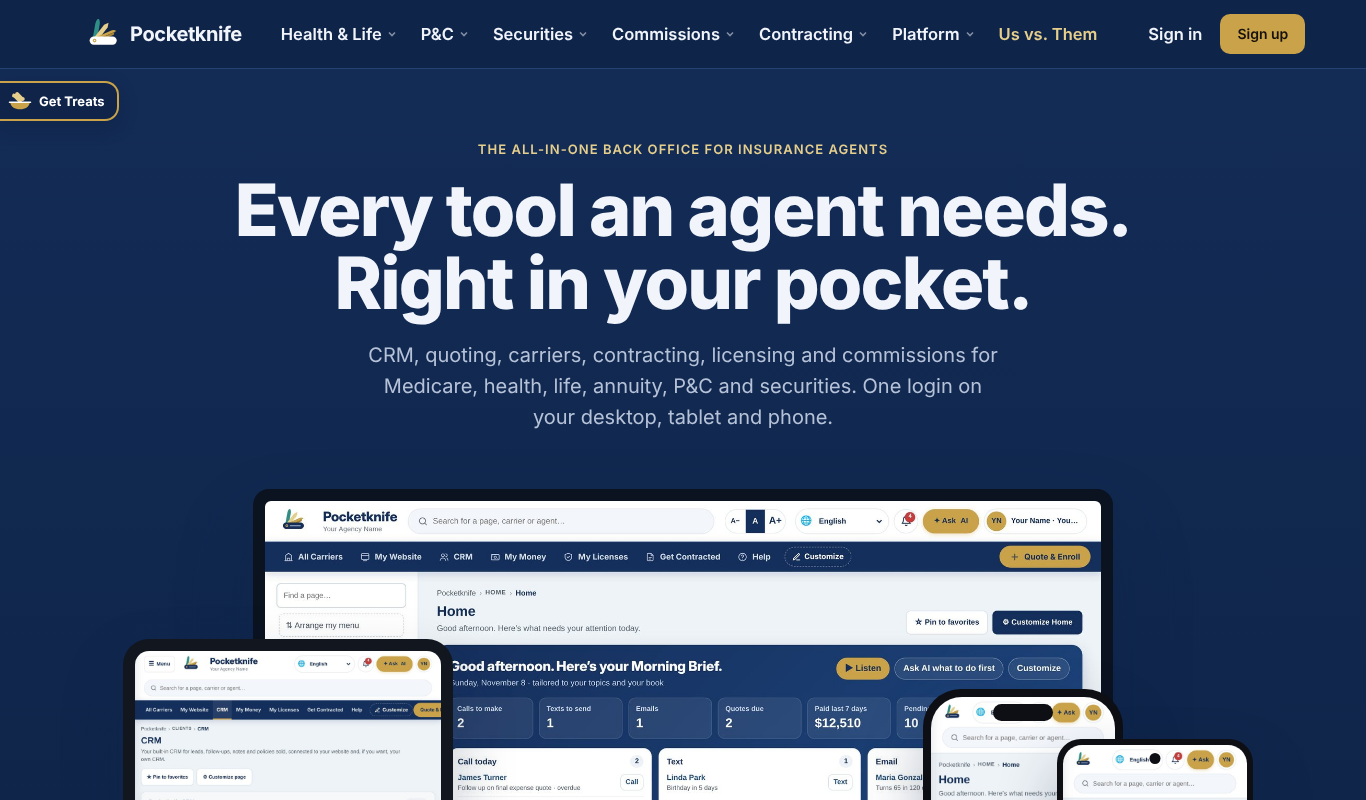
Pocketknife is the all-in-one back office for independent insurance agents and agencies. It brings your CRM, quoting, commission tracking, contracting with 211 carriers, license and CE tracking, and your own agent website together behind one login, on desktop, iPhone and Android. Medicare, ACA, life, annuities, P&C and securities are all built in. Client links let clients fill in their information on their phone and land in your CRM as a new lead. Agency owners and FMOs can run their whole downline from the same place. Clients, CPAs and estate attorneys get free access to see what clients choose to share.

Aspire Agency Management is a revolutionary agency management system brought to you by Impowersoft.

PK 7 (formerly known as Rapid Response Manufacturing or RRM) is our leading business solution for small to mid-sized manufacturers. It integrates all of your business operations allowing you to improve productivity and enhance profitability.

A fully featured HR platform built with seasonal businesses in mind. Applicant Tracking, Onboarding, Scheduling, Time Tracking, and a mobile app to keep all your employees connected.

easystory360 is a French no-code SaaS platform for building and distributing immersive 360° and virtual reality experiences. Upload your own 360° photos and videos, assemble scenes, add interactive events and quizzes, then publish to the web, to VR headsets or to self-service kiosks. A story can be translated into any language, texts as well as audio tracks and videos, and each visitor picks their own at launch. The authoring interface itself ships in six languages. Exports SCORM 1.2 and 2004 packages for any compatible LMS. Built and hosted in France.
Nextrain is an AI-native learning platform for enterprises. Its AI engine, Akira, generates a wide range of learning content, including interactive video courses, assessments and learning games, from an organization's own documents. Content can be produced in minutes from a single prompt or a catalog selection. Akira is built on andragogy (adult-learning) principles: before generating content, it selects an instructional model based on the target behavior, and applies that design across the output, rather than producing plain text.
The platform runs the learning operation automatically from rules the administrator sets once: assigning training, sending reminders, escalating overdue items and generating reports. Configuration is parametric, driven by parameters rather than manual spreadsheets, so programs scale without per-employee manual work.
Beyond tracking completion, Nextrain measures comprehension through a multi-turn AI dialogue (Socratic Chat), where learners explain concepts in their own words and pass/fail is determined by a server-side formula rather than the model. A RAG-based assistant answers learner questions using only the organization's own content, and managers can query training data in plain language and receive sourced answers.
Nextrain is fully white-label and can run as a standalone LMS or as an AI layer on top of an existing LMS. It supports SCORM for content portability and integrates with HR systems. Personnel data is not sent to language models; anonymized identifiers and selected context are used instead, and data is stored in the EU (Frankfurt).
MongoQUI is a MongoDB workspace, not another basic query browser. Most teams running MongoDB in production end up stitching together MongoDB Compass for basic queries, Studio 3T when Compass runs out of room, and Metabase or Looker whenever someone outside engineering needs a report. MongoQUI replaces that stack with one tool.
The core workflow: build a query or aggregation — with a 16-stage pipeline builder in Monaco, a compiled mongosh shell (IntelliShell), or an 8-language SQL-to-MongoDB translator — analyse the results, then turn any aggregation into a shareable report backed by DuckDB and Parquet, complete with charts, KPIs, and pivot tables. Reports go out as password-protected, expiring, watermarked links that need no install on the other end.
An AI Query Assistant (OpenAI, Anthropic Claude, or Google Gemini — bring your own key) reads your schema before writing a query, runs a dry-run safety gate before any write, and explains slow queries via $explain. Team access runs on shared connections and RBAC (Admin / Editor / Viewer) instead of shared passwords, with 2FA and a full streaming audit log. Everything at rest is AES-256 encrypted, saved credentials sit behind an Argon2id master password, and the access model is built to SOC 2-ready controls.