Best Artificial Neural Network Software - Page 5

How Many Artificial Neural Network Software Products Does G2 Track?

Total Products under this Category: 122

Category Stats (Oct 2026)

  • Average Rating: 4.28/5 The average rating of products in this category, based on all submitted ratings
  • Top Trending Product: PyTorch (+0.42%) - Among all products in this category, PyTorch recorded the largest rating increase compared to last month

Last updated: October 26, 2026

How Does G2 Rank Artificial Neural Network Software Products?

Why You Can Trust G2's Software Rankings:

  • 30 Analysts and Data Experts
  • 600+ Authentic Reviews
  • 122+ Products
  • Unbiased Rankings

G2's software rankings are built on verified user reviews, rigorous moderation, and a consistent research methodology maintained by a team of analysts and data experts. Each product is measured using the same transparent criteria, with no paid placement or vendor influence. While reviews reflect real user experiences, which can be subjective, they offer valuable insight into how software performs in the hands of professionals. Together, these inputs power the G2 Score, a standardized way to compare tools within every category.

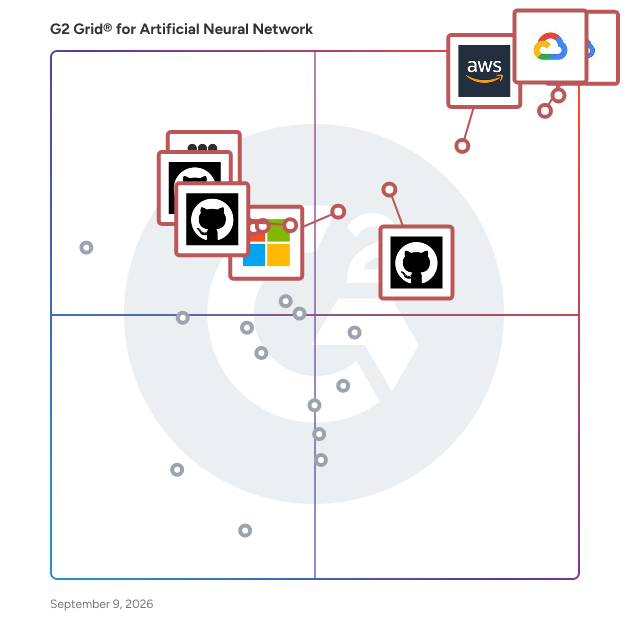
G2 Grid® for Artificial Neural Network Software

G2 Grid® for Artificial Neural Network Software plotting products by satisfaction and market presence

Highlighted products: Google Cloud Deep Learning VM Image, Google Cloud Deep Learning Containers, AWS Deep Learning AMIs, AIToolbox, Microsoft Cognitive Toolkit (Formerly CNTK), Knet, Merlin, and ConvNetJS.

Underlying data: [Grid® JSON](https://www.g2.com/categories/artificial-neural-network/grids.json?focus%5B%5D=google-cloud-deep-learning-vm-image&focus%5B%5D=google-cloud-deep-learning-containers&focus%5B%5D=aws-deep-learning-amis&focus%5B%5D=aitoolbox&focus%5B%5D=microsoft-cognitive-toolkit-formerly-cntk&focus%5B%5D=knet&focus%5B%5D=merlin&focus%5B%5D=convnetjs)

BigDL

BigDL makes it easier for data scientists and data engineers to build end-to-end, distributed AI applications.

Who Is the Company Behind BigDL?

  • Seller: Intel Corporation
  • Year Founded: 1968
  • HQ Location: Santa Clara, CA
  • Twitter: @intel
    4,467,591 Twitter followers
  • LinkedIn® Page: www.linkedin.com
    111,509 employees on LinkedIn®
  • Ownership: NASDAQ:INTC

BIOS Health

BIOS Health is a pioneering neurotechnology company that leverages artificial intelligence (AI) and advanced neural interfaces to decode and modulate the body's neural signals. By translating the complex 'code' of the nervous system, BIOS Health aims to develop precise, data-driven therapies for a range of chronic conditions, including cardiovascular diseases, diabetes, and neurodegenerative disorders. Key Features and Functionality: - Real-Time Neural Insights: Utilizing proprietary neural interfaces combined with AI, BIOS Health can measure and analyze neural data in real-time across both acute and chronic settings. - Neural Biomarkers Discovery: The company has developed a programming language for the nervous system, enabling the identification of novel neural biomarkers that can lead to groundbreaking disease insights and innovative treatments. - Precision Health Solutions: By harnessing real-time feedback from the nervous system, BIOS Health facilitates the creation of more targeted pharmaceuticals and software-delivered therapies, enhancing treatment efficacy and patient outcomes. Primary Value and User Solutions: BIOS Health addresses the critical need for personalized and effective treatments for chronic diseases by providing a platform that interprets and interacts with neural data. This approach allows for the development of therapies that are tailored to individual neural profiles, potentially improving the quality of life for millions of patients worldwide. By bridging the gap between neural data and therapeutic interventions, BIOS Health is at the forefront of a new era in precision medicine.

Who Is the Company Behind BIOS Health?

BrainKey

BrainKey is an innovative platform that leverages artificial intelligence to analyze brain MRI scans, providing personalized insights into brain health. By transforming complex medical imaging data into clear, intuitive visualizations, BrainKey empowers individuals and healthcare professionals to better understand and monitor neurological well-being. Key Features and Functionality: - AI-Powered Analysis: Utilizes advanced AI algorithms to examine MRI scans, identifying key biomarkers and assessing brain health at a biological level. - Personalized Visualizations: Converts intricate brain imaging data into user-friendly, interactive visual representations of individual brain anatomy. - 3D Brain Printing: Offers a unique service to create a 3D-printed model of a user's brain, based on their MRI scan, providing a tangible representation of their brain structure. Primary Value and User Solutions: BrainKey addresses the challenge of interpreting complex neurological data by making brain health information more accessible and understandable. This empowers users to take proactive steps in managing their cognitive health, facilitates early detection of potential issues, and supports healthcare providers in delivering personalized care. By demystifying brain imaging, BrainKey aims to prevent cognitive decline and contribute to a future where conditions like dementia are no longer prevalent.

Who Is the Company Behind BrainKey?

  • Seller: BrainKey
  • Year Founded: 2018
  • HQ Location: San Francisco, US
  • LinkedIn® Page: www.linkedin.com
    2,079 employees on LinkedIn®

AI can help you find the answers. G2 helps you trust them.

Connect G2 to Claude or ChatGPT for answers grounded in G2's trusted reviews, comparisons, and pricing from real user insights.

How it works

BrainScan

BrainScan CT is an advanced AI-powered system designed to revolutionize the analysis of human brain CT scans. By leveraging artificial intelligence, it automatically detects and highlights potential pathological changes, providing rapid and accurate diagnostic support to healthcare professionals. The system integrates seamlessly with existing medical infrastructure, enhancing diagnostic efficiency and patient care. Key Features and Functionality: - Comprehensive Pathology Detection: Identifies and classifies 30 critical brain pathologies, covering over 90% of findings in non-contrast CT imaging, with an average accuracy of 95% and up to 99% for hemorrhages. - Rapid Analysis: Processes scans in seconds, delivering results promptly to support timely clinical decisions. - Intuitive Results Presentation: Provides analysis outcomes in the form of infographics and structured text, which are returned to the PACS server from which they were sent. - Seamless Integration: Compatible with any PACS or DICOM viewer, ensuring smooth incorporation into existing radiology workflows. - Flexible Deployment Options: Offers both cloud-based and on-premise installations, catering to diverse institutional needs. - Regulatory Compliance: Holds CE MDR 2017/745 certification, affirming adherence to European medical device regulations. Primary Value and User Solutions: BrainScan CT addresses the critical need for swift and precise interpretation of brain CT scans, particularly in emergency settings. By automating the detection of significant brain pathologies, it reduces the workload on radiologists, minimizes diagnostic errors, and accelerates patient management. This leads to improved patient outcomes, optimized resource utilization, and enhanced overall efficiency in healthcare delivery.

Who Is the Company Behind BrainScan?

captum.ai

Captum is an open-source library developed by Facebook AI that provides interpretability and understanding of PyTorch models. It offers a suite of algorithms to help researchers and developers gain insights into the predictions made by neural networks, facilitating the identification of model behavior and potential biases. Key Features and Functionality: - Attribution Methods: Captum includes various algorithms such as Integrated Gradients, Saliency Maps, and DeepLIFT to attribute model predictions to input features. - Layer and Neuron Attribution: It allows for detailed analysis at the layer and neuron level, enabling users to understand the contribution of specific components within the network. - Feature Visualization: The library provides tools to visualize feature importance, aiding in the interpretation of complex models. - Model-Agnostic: Captum is designed to work seamlessly with any PyTorch model, ensuring flexibility across different architectures. Primary Value and User Solutions: Captum addresses the challenge of model interpretability in deep learning by offering tools that elucidate how models arrive at their predictions. This transparency is crucial for building trust in AI systems, debugging models, and ensuring compliance with regulatory standards. By providing detailed insights into model behavior, Captum empowers users to develop more reliable and accountable AI applications.

Who Is the Company Behind captum.ai?

Cebra

Cebra is a learnable latent embedding for joint behavioral and neural analysis, providing valuable insights for research.

Who Is the Company Behind Cebra?

  • Seller: Cebra
  • Year Founded: 2014
  • HQ Location: Las Condes, CL
  • LinkedIn® Page: www.linkedin.com
    129 employees on LinkedIn®

ClariPi

Who Is the Company Behind ClariPi?

  • Seller: ClariPi
  • Year Founded: 2015
  • HQ Location: Seoul, KR
  • LinkedIn® Page: www.linkedin.com
    10 employees on LinkedIn®

Cortica

Cortica is a pioneering company in the field of Autonomous Artificial Intelligence (AI), dedicated to developing technologies that enable machines to process information and learn in a manner akin to the human brain. Over the past 15 years, Cortica has invested over $250 million to build a comprehensive portfolio of Autonomous AI technologies, safeguarded by more than 300 patents. The company collaborates with global market leaders to establish Autonomous AI enterprises that possess a significant technological and business edge, addressing substantial market opportunities. Key Features and Functionality: - Signatures: Cortica's technology simulates human brain function by transitioning from traditional AI labels to generic representations. This approach indexes and compresses information into neural responses, facilitating efficient data processing. - Adaptive Architecture: The AI exhibits brain-like, scenario-focused contextual adaptability. It applies a sparse set of resources during processing, resulting in superior performance and enhanced efficiency. - Self-Learning: Cortica's neural network algorithms are capable of self-learning in dynamic environments, operating independently of manually labeled data and remaining unaffected by data biases. - Speed and Scalability: The technology is designed to process and index large volumes of data on low-compute platforms, ensuring rapid and scalable performance. - Versatility: Mirroring the human cortex, Cortica's systems can handle various types of signals, including visual, audio, radar, time series, and more. Primary Value and Solutions: Cortica's Autonomous AI technology offers transformative solutions across multiple industries by enabling machines to think and learn autonomously. This capability leads to significant advancements in sectors such as autonomous vehicles, security, and healthcare. By replicating human-like perception and learning, Cortica's AI enhances efficiency, reduces costs, and improves performance in complex tasks, thereby providing substantial value to its users.

Who Is the Company Behind Cortica?

Dadabots

Dadabots is an innovative project at the intersection of music and artificial intelligence, dedicated to creating neural networks that autonomously generate music across various genres. By leveraging advanced machine learning techniques, Dadabots produces continuous streams of AI-composed music, including 24/7 live streams of technical death metal. Their work encompasses writing code, publishing scientific research, collaborating with artists, and performing live shows, all aimed at exploring the creative potential of AI in music. Key Features and Functionality: - AI-Generated Music Streams: Continuous live streams of AI-composed music, such as technical death metal, available 24/7. - Collaborative Projects: Partnerships with artists and bands to create unique AI-assisted compositions. - Scientific Research: Publication of research papers on neural synthesis and music generation, contributing to the academic field. - Live Performances: Live shows featuring AI-generated music, showcasing the capabilities of neural networks in real-time. Primary Value and User Solutions: Dadabots offers a groundbreaking approach to music creation by harnessing AI to generate original compositions, pushing the boundaries of traditional music production. This innovation provides musicians, researchers, and enthusiasts with new tools and perspectives for exploring music, fostering creativity, and expanding the possibilities of sound. By automating aspects of music generation, Dadabots enables artists to experiment with novel ideas and collaborate with AI, leading to unique and diverse musical experiences.

Who Is the Company Behind Dadabots?

  • Seller: DadaBots
  • Year Founded: 2012
  • HQ Location: Boston, US
  • LinkedIn® Page: www.linkedin.com
    2 employees on LinkedIn®

Darmiyan

Darmiyan is a pioneering medical technology company specializing in brain health diagnostics. Their flagship product, BrainSee, is an FDA-approved, AI-powered software platform designed to predict the progression from amnestic mild cognitive impairment (aMCI) to Alzheimer's dementia within a five-year timeframe. By integrating standard clinical MRI scans with cognitive assessments, BrainSee generates an objective score that assists physicians in evaluating a patient's risk of developing Alzheimer's disease. Key Features and Functionality: - Advanced Image Analysis: Utilizes proprietary algorithms to analyze whole-brain MRI scans, detecting subtle cellular-level changes indicative of neurodegeneration. - AI Integration: Employs artificial intelligence to enhance diagnostic accuracy and provide predictive insights. - Non-Invasive Testing: Offers a non-invasive method for assessing brain health, eliminating the need for more invasive procedures. - Rapid Results: Delivers same-day test results, facilitating timely clinical decision-making. - Clinical Workflow Integration: Designed to seamlessly integrate into existing clinical workflows, enhancing efficiency for healthcare providers. Primary Value and User Benefits: BrainSee addresses the critical need for early detection and risk stratification in Alzheimer's disease. By identifying individuals at higher risk of progression from aMCI to Alzheimer's dementia, it enables proactive management strategies, potentially delaying the onset of dementia symptoms. For patients at lower risk, BrainSee provides reassurance, reducing the necessity for costly and invasive tests. This approach transforms the patient experience from prolonged uncertainty to proactive health management, ultimately aiming to improve quality of life and reduce the emotional and financial burdens associated with Alzheimer's disease.

Who Is the Company Behind Darmiyan?

  • Seller: Darmiyan
  • Year Founded: 2016
  • HQ Location: San Francisco, US
  • LinkedIn® Page: www.linkedin.com
    2,829 employees on LinkedIn®

Dde

Data Design Engineering (DDE) is a pioneering company specializing in the development of data-driven AI solutions and services. Established in 2014 in Seoul, Korea, DDE has expanded its presence to countries including Singapore and Luxembourg. The company focuses on creating AI technologies that are highly accurate, efficient, and fully automatable without necessitating changes to existing systems. DDE's AI solutions are designed to be ecological, evolutionary, and human-centric, capable of replicating expert human behaviors and conducting precise causal analyses. Key Features and Functionality: - Convergence AI Technologies: DDE integrates various AI technologies such as Image Processing, Natural Language Processing (NLP), Internet of Things (IoT), and Predictive Analysis to develop sophisticated models for critical missions. - Space and Earth Observation Solutions: The company designs AI models deployable on ground stations, aircraft, and spacecraft, facilitating immediate use in space and earth observation missions. These models automatically capture and validate anomalies with high accuracy. - On-Device AI Customization: DDE offers customized on-device AI solutions, including predictive analysis algorithms that calculate patterns and influences of various variables to precisely tune systems, such as automatic parking systems. Primary Value and User Solutions: DDE's AI solutions provide organizations with the ability to implement advanced, data-driven technologies that enhance operational efficiency and decision-making processes. By offering fully automatable and accurate AI models, DDE addresses the need for seamless integration of AI into existing systems without significant overhauls. Their technologies are particularly valuable in critical applications such as space and earth observation, where precision and reliability are paramount. Additionally, DDE's on-device AI customization allows for real-time predictive analysis, enabling precise control and optimization of various systems, thereby reducing operational costs and improving performance.

Who Is the Company Behind Dde?

Deargen

Who Is the Company Behind Deargen?

  • Seller: Deargen
  • Year Founded: 2016
  • HQ Location: Daejeon, KR
  • LinkedIn® Page: www.linkedin.com
    11 employees on LinkedIn®

Deep Genomics

Deep Genomics is a pioneering biopharmaceutical company that leverages artificial intelligence (AI) to decode RNA biology, facilitating the development of life-changing genetic medicines. By integrating AI with molecular biology, Deep Genomics aims to revolutionize drug discovery and development, offering innovative solutions for genetic diseases. Key Features and Functionality: - AI Foundation Model Platform: Deep Genomics has developed a cohesive AI foundation model platform, including BigRNA, the first transformer neural network for RNA biology and therapeutics. This platform accelerates therapeutic discovery across various RNA modalities. - BigRNA: A flagship AI foundation model comprising nearly two billion tunable parameters, trained on thousands of datasets with over a trillion genomic signals. BigRNA predicts tissue-specific regulatory mechanisms of RNA expression, protein and microRNA binding sites, and the effects of variants and candidate therapeutics. - REPRESS Model: An advanced deep learning model that accurately predicts microRNA (miRNA) binding and mRNA degradation directly from RNA sequences, enhancing the understanding of post-transcriptional biology and therapeutic design. - Project Saturn: An initiative utilizing the AI platform to evaluate over 69 billion oligonucleotide molecules against one million targets in silico, generating a library of 1,000 compounds experimentally verified to manipulate cell biology as intended. Primary Value and Problem Solved: Deep Genomics addresses the complexity of RNA biology by integrating AI to decode vast amounts of data, identifying novel targets, mechanisms, and molecules inaccessible through traditional methods. This approach accelerates the development of steric-blocking oligonucleotides (SBOs) that increase gene expression for treating genetic diseases. By combining AI with molecular biology, Deep Genomics enhances the predictability, reduces risks, and expedites the time to market for new therapies, ultimately aiming to deliver life-saving therapeutics to patients worldwide.

Who Is the Company Behind Deep Genomics?

Deeplearning4j

Deeplearning4j is a suite of tools for running deep learning on the JVM. It's the only framework that allows you to train models from java while interoperating with the python ecosystem through a mix of python execution via our cpython bindings, model import support, and interop of other runtimes such as tensorflow-java and onnxruntime.

Who Is the Company Behind Deeplearning4j?

Tian Lin
TL
Researched and written by Tian Lin
Updated April 9, 2026