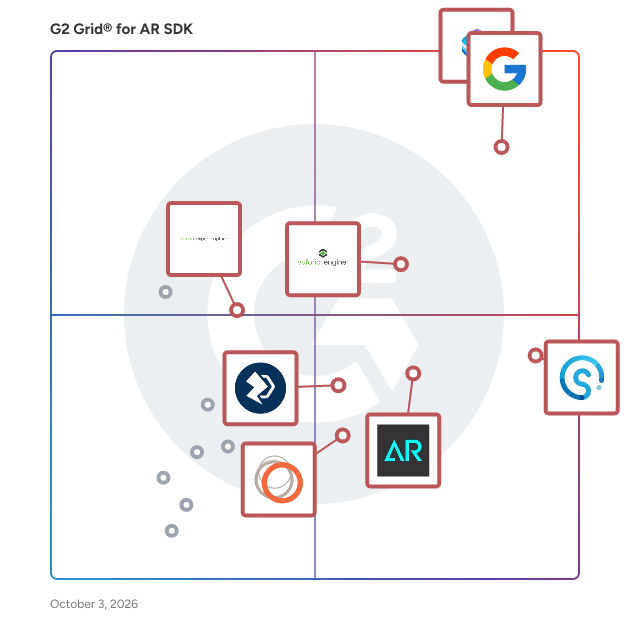
Total Products under this Category: 56
Last updated: July 02, 2026
Why You Can Trust G2's Software Rankings:
G2's software rankings are built on verified user reviews, rigorous moderation, and a consistent research methodology maintained by a team of analysts and data experts. Each product is measured using the same transparent criteria, with no paid placement or vendor influence. While reviews reflect real user experiences, which can be subjective, they offer valuable insight into how software performs in the hands of professionals. Together, these inputs power the G2 Score, a standardized way to compare tools within every category.
Product Description
Build your Augmented Reality apps with a light, easy to use, fast, stable, computationally inexpensive on-device detection and tracking SDK. No image dataset limits with the Cloud Recognition Service
Product Description
WebAR on iOS and Android - without an app Launch your AR experience in-browser from any link or QR code with our simple Javascript SDK. Native-quality tracking with no cost per-view. After creating
Product Description
ViewAR SDK will let you utilize all available tracking systems like Wikitude, visionLib, Vuforia, Placenote, 6d.ai, and many more. You can either build apps with an app builder just by styling and fi
Product Description
A ready-made platform for deploying and expanding Virtual Reality, Digital Twin, and Augmented Reality solutions for industrial operations and beyond.
Product Description
ARX Robotics specializes in developing autonomous and versatile robotic systems designed to enhance productivity, ensure safety, and adapt to critical tasks across defense, commercial, and humanitaria
Product Description
With Augwir, deploy augmented reality environment. Localize, track, and let your brand tell its story in its best way!
Product Description
EasyAR is a cross-platform augmented reality and spatial computing platform for building AR, WebAR, XR, and VPS applications. The EasyAR product suite includes: • EasyAR Sense — AR SDK for Unity, An
Product Description
Motion Gestures offers an advanced AI-driven software platform specializing in hand tracking and gesture recognition. Utilizing cutting-edge artificial intelligence and machine learning algorithms, th
An AR SDK, or an augmented reality software development kit, arms developers with all the necessary tools to create their own augmented reality apps or platforms. Some AR SDK platforms do not require any expertise in programming or 3D graphics, while others offer numerous advanced features. In this sense, AR SDK can be well-suited for beginners who have limited to no expertise—while still catering to experienced developers who are looking for a detailed software development tool. By the same token, some AR SDKs are free with limited features, while others are paid offerings that offer a more robust set of functionalities.
AR SDKs are responsible for all the features and components that make up a typical AR application. This includes AR tracking, which represents the visual effects of the program; content rendering, which relates to how effectively 3D objects can be overlaid in the real world; and scene recognition, which makes it possible to recognize, track, and augment feature-rich rooms, scenes, and larger objects.
The main audience for AR SDK software is software developers. AR SDKs provide developers with the necessary framework to customize code, essentially supplying the skeleton for developers to fill the application with their ideas. While augmented reality was once primarily used to develop games, the technology is now finding its way into a variety of industries.
For example, developers can use AR SDK software to aid architects with building design. Through technology, architects can experience entire building designs before they are actually built. Manufacturers, warehouse workers, and retail workers are now being trained with augmented reality software for faster onboarding. The health care industry is utilizing AR-enabled devices to train doctors on surgical techniques and observe a patient’s vitals.
In this sense, AR SDK software is not truly limited to just developers. Any industry with a use case for AR should be familiar with the various kinds of AR SDK software and how it can help users fulfill their vision.
Before selecting an AR SDK, clearly outline your project’s objectives, target audience, and specific features you need. Consider factors such as the type of AR experience you want to create (marker-based, location-based, etc.), the devices you plan to support, and the integration requirements with other tools or platforms.
Ensure that the AR SDK is compatible with the devices and operating systems you intend to target. Check if it supports major platforms like Android and iOS, as well as any specific hardware, such as smart glasses or AR headsets. Compatibility is crucial for reaching a broader audience and ensuring a seamless user experience.
Analyze the performance capabilities of the AR SDK, especially in terms of rendering graphics, tracking accuracy, and response time. Look for an SDK that can handle high-quality visuals and real-time interactions without significant lag. Additionally, consider whether the SDK can scale with your project as it grows, accommodating more complex features and a larger user base.
Examine the quality of the SDK’s documentation, tutorials, and community support. Comprehensive and well-organized documentation can greatly ease the development process, especially for beginners. A strong developer community can provide valuable resources, troubleshooting tips, and best practices, enhancing your learning experience and project development.
Evaluate the pricing structure and licensing terms of the AR SDK. Some SDKs offer free versions with limited features, while others may require a subscription or a one-time fee. Consider your budget and whether the SDK provides good value for the features it offers. Be sure to check for any hidden costs associated with scaling, support, or additional services that may arise as your project develops.
Of the trends included below, some are occurring in the AR SDK market while others are seen across the AR market as a whole. It’s important to note both, since changes in the AR market may influence the core features and functionality of AR SDK software in the coming years.