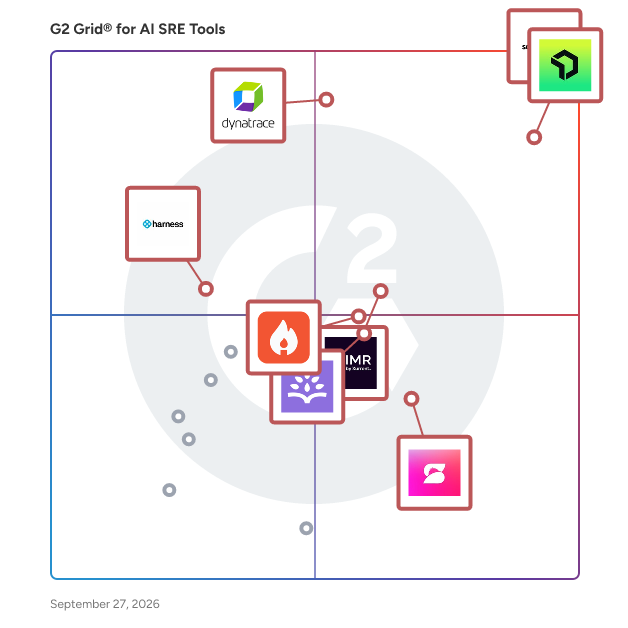
AI site reliability engineering (AI SRE) tools leverage artificial intelligence (AI) and machine learning (ML) to automate and augment the detection, investigation, and resolution of incidents across modern software systems. These tools reduce mean time to detect (MTTD) and mean time to resolve (MTTR) by correlating signals across observability data, logs, traces, and alerts, enabling engineering teams to manage reliability at scale.
AI SRE platforms go beyond traditional incident management by applying AI-driven root cause analysis, automated runbook execution, and intelligent on-call workflows. They integrate deeply with existing observability stacks, CI/CD pipelines, and communication tools to provide a unified reliability operations layer. These tools are primarily used by site reliability engineers, platform engineering teams, DevOps practitioners, and IT operations leaders who need to maintain service availability and performance across increasingly complex distributed architectures.
To qualify for inclusion in the AI Site Reliability Engineering (AI SRE) category, a product must:
- Enable teams to define, measure, and manage reliability through SLOs and SLIs
- Use AI to improve signal quality and detection by analyzing context, adjusting thresholds, and correlating events for intelligent alerting
- Accelerate investigation and root cause analysis by analyzing telemetry, incident data, and runtime behavior to identify likely causes, including emergent or non-deterministic failures, and, where possible, verify root causes through live execution rather than inference alone
- Operationalize reliability policy by managing or supporting error budgets, and providing service health insights and reporting for stakeholders
- Support automated remediation or guided actions, and may include human-in-the-loop decisioning for semi-autonomous operations at scale
- Support hybrid and heterogeneous environments, including legacy and enterprise codebases, and provide integrations or APIs so reliability work can be embedded into existing engineering and operations workflows
- Enable proactive, real-time, and end-to-end remediation from alert to code fix, including live debugging that produces and validates fixes in execution