Best Cloud Access Security Broker (CASB) Software

Lauren Worth
LW
Researched and written by Lauren Worth

Cloud access security broker (CASB) software is used to provide a layer of protection and policy enforcement for employees accessing cloud-based software. CASB serves as a gateway through which companies can enforce their security requirements beyond on-premise and secure connections between employees and cloud service providers. Companies use CASB software to reduce risks related to cloud applications and network connections while simultaneously monitoring actions and behaviors.

CASB solutions are also used to identify abnormal behaviors from internal actors and then alert administrators of potential shadow IT and noncompliant behaviors. These tools typically monitor and record the actions taken by an individual using the CASB, who can leverage the data collected for behavioral analysis and reporting.

To qualify for inclusion in the Cloud Access Security Broker (CASB) category, a product must:

Secure connections between end users and cloud service providers
Enforce security policies beyond local networks and infrastructure
Protect data and connected devices from cloud-based threats and malware
Show More
Show Less

Best Cloud Access Security Broker (CASB) Software At A Glance

Easiest to Use:
Top Trending:
Best Free Software:
Show LessShow More
Top Trending:
Best Free Software:

G2 takes pride in showing unbiased reviews on user satisfaction in our ratings and reports. We do not allow paid placements in any of our ratings, rankings, or reports. Learn about our scoring methodologies.

No filters applied
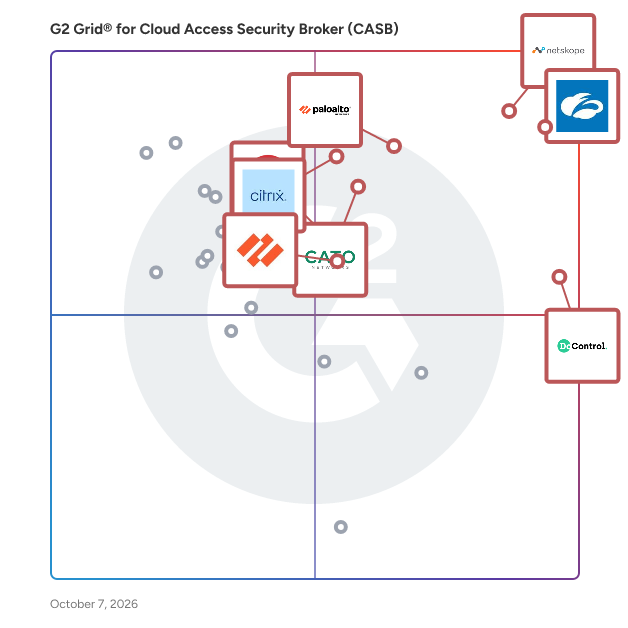
55 Listings in Cloud Access Security Broker (CASB) Available
(69)4.4 out of 5
3rd Easiest To Use in Cloud Access Security Broker (CASB) software
View top Consulting Services for Netskope One Platform
(73)4.3 out of 5
13th Easiest To Use in Cloud Access Security Broker (CASB) software
G2 Advertising
Sponsored
G2 Advertising
Get 2x conversion than Google Ads with G2 Advertising!
G2 Advertising places your product in premium positions on high-traffic pages and on targeted competitor pages to reach buyers at key comparison moments.
(103)4.2 out of 5
10th Easiest To Use in Cloud Access Security Broker (CASB) software
(82)4.5 out of 5
Optimized for quick response
2nd Easiest To Use in Cloud Access Security Broker (CASB) software
View top Consulting Services for Cato SASE Cloud
Entry Level Price:Contact Us
(103)4.6 out of 5
6th Easiest To Use in Cloud Access Security Broker (CASB) software
View top Consulting Services for Cloudflare One (SASE)
Entry Level Price:Contact Us
(42)4.6 out of 5
8th Easiest To Use in Cloud Access Security Broker (CASB) software
View top Consulting Services for Zscaler Zero Trust Cloud
(53)4.4 out of 5
12th Easiest To Use in Cloud Access Security Broker (CASB) software
(120)4.4 out of 5
11th Easiest To Use in Cloud Access Security Broker (CASB) software

Learn More About Cloud Access Security Broker (CASB) Software

What is Cloud Access Security Broker (CASB) Software?

Cloud access security broker (CASB) technology secures data stored within or processed by cloud-based applications, typically software as a service (SaaS) solutions. Cloud security access brokers focus on protecting cloud applications. Users of CASB can launch and access their cloud applications in a secured environment.These tools utilize multiple security technologies that help prevent unapproved parties from accessing applications while also preventing data loss and data breaches. They provide a single, secure location for users to access applications. Many platforms support single sign-on for easier access once operating in the CASB environment.

Some CASB tools provide users with a sandboxed environment. The sandbox is a resource-isolated working environment that ensures files and data are transferred directly to the cloud application provider. Other CASB tools utilize firewall and malware detection features, along with security policy enforcement mechanisms to protect information connected to SaaS applications.

These tools can be utilized across devices and operated locally, regardless of the user’s physical location. Individual users can be isolated and cut off from the network. These tools can function across a variety of SaaS applications and software vendors. They can be integrated directly or chosen from a marketplace. Many tools have centralized access through a single sign-on portal. Users can log in to a secure portal and have access to all of the cloud applications they use.

Key Benefits of CASB Software

  • Improves cloud application and data security
  • Simplifies management to improve compliance-related operations
  • Improves identity management and user governance
  • Increases visibility of users, activities, and anomalies

Why Use Cloud Access Security Broker (CASB) Software?

These tools make it easier for businesses to provide secure access to cloud-based applications for their employees. Almost all the benefits of using a CASB system pertain to information security. The majority of benefits can be classified into three categories: threat protection, data security, and governance.

Threat protection — Threats come in multiple forms and CASB products are prepared to defend against them from any direction. Common threat protection features are designed to prevent phishing, malware, account takeover, and malicious content. Phishing can be prevented by securing cloud-based email applications. Malicious attachments and urls can be flagged or sent to spam. Malware can come from emails, downloads or any other kind of malicious content; if malware is present, CASB software can alert users and prevent them from engaging with it. Account takeover can be discovered by monitoring functionality designed to detect abnormal behavior, policy violations, and unexpected configuration changes.

Data security and loss prevention — All data requires security, but some information requires more protection than others. CASB tools help users discover sensitive data within cloud-based applications. Most CASB tools allow for user permission policy enforcement, this helps prevent unauthorized parties from viewing or downloading sensitive information. Many sensitive datasets require increased encryption; these files must be classified as such and CASB solutions will enforce stronger encryption and anomaly monitoring on those specific files.

Governance and compliance — Compliance goes hand in hand with data security and loss prevention. However, increased visibility is a key benefit of CASB solutions. This makes it easier to discover non-compliant datasets and audit systems for policy requirements. They improve a company’s ability to delegate user permissions, enforce security policies and alert security teams of both cloud-based and insider threats.

What are the Common Features of Cloud Access Security Broker (CASB) Software?

Single sign-on (SSO) — SSO features provide a single access point for users to access multiple cloud products without multiple logins. This reduces the time users spend finding applications and logging onto them, improving productivity and user experience.

User analytics — User analytics and monitoring allow companies to view and document individual behaviors and report suspicious activities. They can also alert security teams to compromised accounts by flagging anomalous behaviors.

Cloud gap analytics — Cloud gap analysis features examine data associated with denied entries and policy violations. This helps provide security teams with information that can be used to improve authentication and security protocols.

Anomaly detection — Anomaly detection identifies abnormal behavior by monitoring activity related to user behavior and comparing it to benchmarked patterns.

Cloud registry — Cloud registries provide a list or marketplace of SaaS applications compatible with a CASB solution. Users can access this list to explore integrations or new applications.

Mobile device management (MDM) — MDM functionality offers users the ability to set standards for types of mobile devices and networks capable of accessing data. This allows security teams to customize access requirements and permissions of off-premise and mobile device users.

Access control — Access control features typically refers to support of lightweight directory access protocol (LDAP). This simplifies an administrator’s ability to edit or update application availability and information access.

Data encryption — Data encryption features might refer to data-centric policy enforcement for sensitive information or encompassing encryption for any information stored or accessed through the CASB system.