Learn More About Knowledge Base Software
Knowledge Base Software software buying insights at a glance
Knowledge base software helps organizations create, organize, and manage internal or customer-facing documentation so teams can quickly find reliable answers and standardized information. These platforms centralize product documentation, processes, troubleshooting guides, and training materials in a searchable system, helping companies maintain a consistent source of truth as teams work across more tools and distributed environments.
Organizations adopt knowledge base software to reduce knowledge silos, document SOPs, accelerate onboarding, and help employees or customers quickly find answers. Across the G2 reviews analyzed, buyers frequently highlight benefits such as centralized documentation, faster information retrieval, and improved collaboration across teams. The strongest knowledge base platforms combine intuitive authoring tools, powerful search, and integrations that connect knowledge directly to daily workflows.
Pricing varies based on user volume, governance capabilities, and advanced administration features. Many vendors offer free or entry-level plans, while higher tiers add analytics, integrations, and stronger content governance for larger organizations.
Top 5 FAQs from software buyers:
- What features should I look for in the best knowledge base software for internal documentation?
- How do knowledge base platforms enable powerful search and AI-assisted knowledge retrieval?
- What makes a knowledge base solution easy for nontechnical teams to maintain and update?
- How do knowledge base tools help with onboarding, SOPs, and support workflows?
- What should I expect to pay for top knowledge base software?
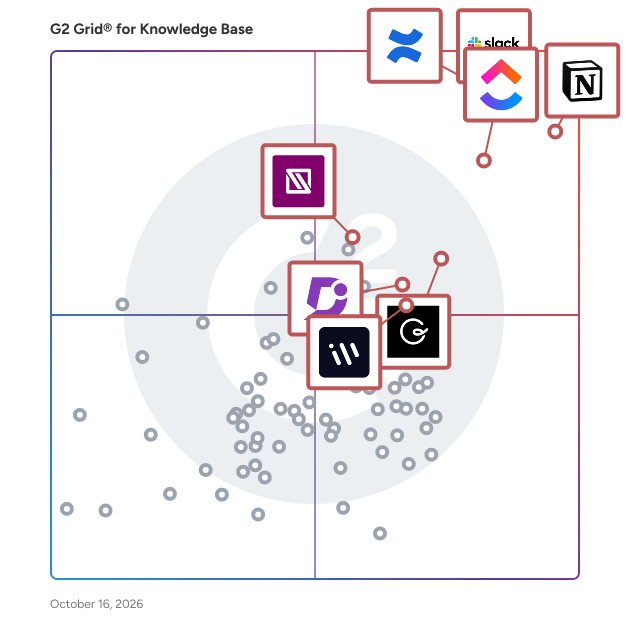
G2’s top-rated knowledge base software, based on verified reviews, includes Slack, Confluence, Notion, ClickUp, and IT Glue.
What are the top-reviewed Knowledge Base Software on G2?
Notion
- Number of Reviews: 4,913
- Satisfaction: 98
- Market Score: 85
- G2 Score: 91
Slack
- Number of Reviews: 1,208
- Satisfaction: 89
- Market Score: 92
- G2 Score: 91
Confluence
- Number of Reviews: 3,929
- Satisfaction: 77
- Market Score: 99
- G2 Score: 88
ClickUp
- Number of Reviews: 1,892
- Satisfaction: 77
- Market Score: 85
- G2 Score: 81
IT Glue
- Number of Reviews: 519
- Satisfaction: 72
- Market Score: 77
- G2 Score: 75
Satisfaction reflects user-reported ratings across various factors, including ease of use, feature fit, and quality of support. (Source 2)
Market Presence scores are calculated based on review volume, third-party signals, and overall market visibility. (Source 2)
G2 Score is a weighted composite of Satisfaction and Market Presence. (Source 2)
Learn how G2 scores products. (Source 1)
What I Often See in Knowledge Base Software
Feedback Pros: What Users Consistently Appreciate
- Flexible page databases and templates centralize cross-team documentation
-
“Flexible pages, Databases and templates allow everything from notes to project tracking in one clean workspace. Customisation feels intuitive and saves a lot of time once the setup is completed” - Kiran S., Notion review
- Transforms Communication with Stellar Integrations
-
“I use Slack daily for work, mostly for quick syncs, async updates, and keeping project threads organized, which really helps cut through email chaos. I find Threads extremely useful for keeping chats clean and preventing main channel chaos. The Search feature is fantastic for finding anything fast, eliminating those 'where’d we decide that?' moments. I'm impressed by the integrations with tools like Figma, Jira, and Google Docs, which allow me to work seamlessly without switching tabs or losing context. I appreciate the custom notifications and Do Not Disturb settings that let me control when I'm interrupted. Having all my tools like Figma comments, Jira tickets, and Google Drive built right into Slack makes my workflow smooth and efficient.” - Souptik D., Slack review
- AI meeting notes and integrations turn discussions into reusable knowledge
-
“What I like most about Confluence is how it brings everything into one place. It makes documenting processes, sharing knowledge, and collaborating with teams much easier. Instead of information being scattered across emails or chats, it lives in a structured space where everyone can access and update it when needed. I also find the page hierarchy and linking between pages really helpful for organizing information logically. It saves a lot of time when you need to look up something quickly or onboard someone new to a project. Overall, it helps teams stay aligned and keeps knowledge from getting lost.” - Ashutosh J., Confluence review
Cons: Where Many Platforms Fall Short
- Wide range of tools creates complexity for new users
-
“ClickUp can feel overwhelming at times. There are many features and configuration options, which is helpful, but it also means the system can become cluttered if it is not set up carefully. New users often need guidance to understand how our team uses it.” - Kirsti H., ClickUp review
- Steep learning curve for first-time Confluence users
-
“When I first started using Confluence, I didn’t understand a lot of the buttons or the sidebar. The interface felt overwhelming at first, so it took me some time to adjust to Confluence and figure out what to do and how to get to where everything is.” - Dr. Akshay M., Confluence review
- Large knowledge bases can require extra effort to stay organized
-
“One drawback is that organising a large number of knowledge cards can sometimes require extra effort to maintain structure. New users may also need a short learning period to fully understand how to manage and verify content effectively.” - Piyush P., Guru review
My Expert Takeaway on Knowledge Base Software
Knowledge base software delivers the most value when organizations treat it as a structured knowledge system rather than a simple document repository. The strongest implementations organize information so teams can quickly retrieve answers, standardize processes, and reuse institutional knowledge across support, operations, and product workflows.
Review sentiment shows strong adoption. Across the 500-review dataset analyzed, the category averages 4.51/5 stars and 9.02/10 likelihood to recommend, alongside strong usability scores for Meets Requirements, Ease of Use, Ease of Setup, Ease of Admin, Ease of Doing Business With, and Quality of Support. These signals suggest buyers see clear operational value once knowledge bases are implemented effectively.
Friction usually appears when organizations treat knowledge bases as static document storage. High-performing teams approach knowledge base software with clear governance, defined content ownership, and consistent documentation practices. The best knowledge base platforms balance flexible documentation with strong structure and search, making them increasingly essential infrastructure for teams that rely on fast, reliable knowledge sharing.
Knowledge Base Software FAQs
What is knowledge base software?
Knowledge base software is a system for creating, organizing, searching, and governing company knowledge in one place. Teams use it to publish SOPs, product information, onboarding materials, and common answers so employees or customers can self-serve faster.
What is the best knowledge base software?
The best knowledge base software depends on your team’s documentation needs, search capabilities, and governance requirements. On G2, top-rated tools include Slack, Notion, Guru, ClickUp, Confluence, and IT Glue, each earning strong user ratings around 4.6/5 stars and recognized for flexible documentation, integrations, and scalable knowledge management features.
How does knowledge base software help call centers?
Knowledge base software helps call centers reduce handle time by giving agents fast access to approved answers, scripts, and process steps. It improves consistency, speeds ramp time, and makes it easier to update frontline guidance when policies, products, or procedures change.
What are the leading knowledge base software for SaaS businesses?
Leading knowledge base software for SaaS businesses typically combines strong documentation features, search capabilities, and integrations with product and support tools. Based on G2 ratings and user reviews, popular options include Guru, IT Glue, Bloomfire, and Confluence, which consistently receive high satisfaction scores and strong adoption among SaaS and IT teams.
What are the reliable knowledge base software for remote teams?
Some of the most reliable knowledge base software for remote teams, based on high G2 ratings and strong user reviews, include:
-
Guru – 4.7/5 rating; strong workflow integrations with Slack and Teams for distributed teams.
-
Document360 – ~4.7/5 rating; scalable documentation platform with version control and analytics.
-
Slite – ~4.6/5 rating; designed for asynchronous documentation and remote collaboration.
-
Helpjuice – ~4.7/5 rating; advanced search and customization for internal and customer knowledge bases.
These tools consistently rank highly on G2 due to ease of use, strong collaboration features, and reliable knowledge-sharing capabilities, making them well-suited for remote or distributed teams that rely on centralized documentation.