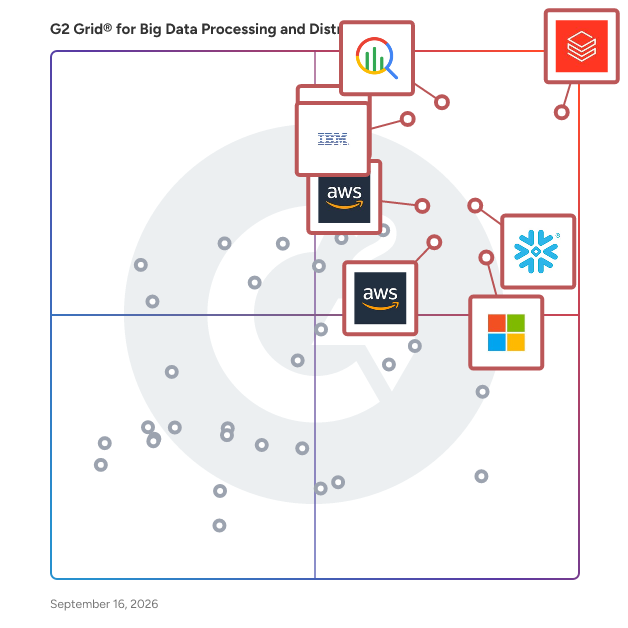
# Best Big Data Processing And Distribution Systems

  *By [Bijou Barry](https://research.g2.com/insights/author/bijou-barry)*

   Big data processing and distribution systems offer a way to collect, distribute, store, and manage massive, unstructured data sets in real time. These solutions provide a simple way to process and distribute data amongst parallel computing clusters in an organized fashion. Built for scale, these products are created to run on hundreds or thousands of machines simultaneously, each providing local computation and storage capabilities. Big data processing and distribution systems provide a level of simplicity to the common business problem of data collection at a massive scale and are most often used by companies that need to organize an exorbitant amount of data. Many of these products offer a distribution that runs on top of the open-source big data clustering tool Hadoop.

Companies commonly have a dedicated administrator for managing big data clusters. The role requires in-depth knowledge of database administration, data extraction, and writing host system scripting languages. Administrator responsibilities often include implementation of data storage, performance upkeep, maintenance, security, and pulling the data sets. Businesses often use [big data analytics](https://www.g2.com/categories/big-data-analytics) tools to then prepare, manipulate, and model the data collected by these systems.

To qualify for inclusion in the Big Data Processing And Distribution Systems category, a product must:

- Collect and process big data sets in real-time
- Distribute data across parallel computing clusters
- Organize the data in such a manner that it can be managed by system administrators and pulled for analysis
- Allow businesses to scale machines to the number necessary to store its data


## Category Overview

**Total Products under this Category:** 125


## Trust & Credibility Stats

**Why You Can Trust G2's Software Rankings:**

- 30 Analysts and Data Experts
- 8,600+ Authentic Reviews
- 125+ Products
- Unbiased Rankings

G2's software rankings are built on verified user reviews, rigorous moderation, and a consistent research methodology maintained by a team of analysts and data experts. Each product is measured using the same transparent criteria, with no paid placement or vendor influence. While reviews reflect real user experiences, which can be subjective, they offer valuable insight into how software performs in the hands of professionals. Together, these inputs power the G2 Score, a standardized way to compare tools within every category.


## Best Big Data Processing And Distribution Systems At A Glance

- **Leader:** [Google Cloud BigQuery](https://www.g2.com/products/google-cloud-bigquery/reviews)
- **Highest Performer:** [Kyvos Semantic Layer](https://www.g2.com/products/kyvos-semantic-layer/reviews)
- **Easiest to Use:** [Databricks](https://www.g2.com/products/databricks/reviews)
- **Top Trending:** [Databricks](https://www.g2.com/products/databricks/reviews)
- **Best Free Software:** [Google Cloud BigQuery](https://www.g2.com/products/google-cloud-bigquery/reviews)


---

**Sponsored**

### Kpow for Apache Kafka®

Kpow is a sophisticated enterprise Kafka management tool designed to enhance the experience of engineering teams by providing a comprehensive solution for managing, monitoring, exploring, and securing Kafka environments. This JVM-based web application serves as an all-in-one console, empowering Kafka engineers with the capabilities they need to streamline their operations and improve productivity. Targeted primarily at engineering teams working with Kafka, Kpow addresses the complexities of managing multiple Kafka clusters, schema registries, and connection installations. With Kpow, users can efficiently monitor and control their Kafka resources from a single interface, simplifying the management process and reducing the time spent on routine tasks. The tool is particularly beneficial for organizations that rely heavily on Kafka for data streaming and processing, as it provides essential functionalities that enhance observability and operational efficiency. One of the standout features of Kpow is its real-time monitoring and visualization capabilities. Users can quickly identify unbalanced brokers and gain insights into how data is distributed across their Kafka Streams topologies. This level of visibility is crucial for diagnosing production issues and optimizing performance. Kpow&#39;s advanced search functionalities, including Data Inspect, Streaming Search, and kREPL, enable users to search through vast amounts of messages at remarkable speeds, allowing for rapid troubleshooting and data analysis. Kpow also prioritizes security and access control, making it suitable for enterprise environments. It integrates seamlessly with standard authentication providers and offers role-based access controls, ensuring that user actions can be finely tuned to meet organizational security requirements. Additional security features, such as data masking and audit logs, further enhance the tool&#39;s capability to operate in sensitive environments, including air-gapped installations. Installation of Kpow is straightforward, requiring only a single Docker container or JAR file, which operates efficiently with minimal resource requirements of 1GB memory and 1 CPU for production use. This ease of deployment, combined with its powerful features, positions Kpow as a valuable asset for organizations looking to maximize their Kafka infrastructure while maintaining robust security and operational control.


[Visit company website](https://www.g2.com/external_clickthroughs/record?secure%5Bad_program%5D=ppc&amp;secure%5Bad_slot%5D=category_product_list&amp;secure%5Bcategory_id%5D=1042&amp;secure%5Bdisplayable_resource_id%5D=1509&amp;secure%5Bdisplayable_resource_type%5D=Category&amp;secure%5Bmedium%5D=sponsored&amp;secure%5Bplacement_reason%5D=neighbor_category&amp;secure%5Bplacement_resource_ids%5D%5B%5D=1041&amp;secure%5Bprioritized%5D=false&amp;secure%5Bproduct_id%5D=133071&amp;secure%5Bresource_id%5D=1042&amp;secure%5Bresource_type%5D=Category&amp;secure%5Bsource_type%5D=category_page&amp;secure%5Bsource_url%5D=https%3A%2F%2Fwww.g2.com%2Fcategories%2Fbig-data-processing-and-distribution&amp;secure%5Btoken%5D=cea7626c2cee42973a9e6404e0c55ca95af25548be6c1c4e1848c3615273381c&amp;secure%5Burl%5D=http%3A%2F%2Ffactorhouse.io%2F&amp;secure%5Burl_type%5D=custom_url)

---

## Top-Rated Products (Ranked by G2 Score)
  ### 1. [Google Cloud BigQuery](https://www.g2.com/products/google-cloud-bigquery/reviews)
  BigQuery is a fully managed, AI-ready data analytics platform that helps you maximize value from your data and is designed to be multi-engine, multi-format, and multi-cloud. Store 10 GiB of data and run up to 1 TiB of queries for free per month.


  **Average Rating:** 4.5/5.0
  **Total Reviews:** 1,157

**User Satisfaction Scores:**

- **Has the product been a good partner in doing business?:** 8.6/10 (Category avg: 8.7/10)
- **Real-Time Data Collection:** 8.8/10 (Category avg: 8.7/10)
- **Machine Scaling:** 8.9/10 (Category avg: 8.6/10)
- **Data Preparation:** 8.9/10 (Category avg: 8.6/10)


**Seller Details:**

- **Seller:** [Google](https://www.g2.com/sellers/google)
- **Year Founded:** 1998
- **HQ Location:** Mountain View, CA
- **Twitter:** @google (31,885,216 Twitter followers)
- **LinkedIn® Page:** https://www.linkedin.com/company/1441/ (336,169 employees on LinkedIn®)
- **Ownership:** NASDAQ:GOOG

**Reviewer Demographics:**
  - **Who Uses This:** Data Engineer, Data Analyst
  - **Top Industries:** Information Technology and Services, Computer Software
  - **Company Size:** 37% Enterprise, 35% Mid-Market


#### Pros & Cons

**Pros:**

- Ease of Use (155 reviews)
- Speed (142 reviews)
- Fast Querying (119 reviews)
- Integrations (117 reviews)
- Query Efficiency (113 reviews)

**Cons:**

- Expensive (126 reviews)
- Query Issues (77 reviews)
- Cost Issues (62 reviews)
- Cost Management (59 reviews)
- Learning Curve (54 reviews)

  ### 2. [Databricks](https://www.g2.com/products/databricks/reviews)
  Databricks is the Data and AI company. More than 20,000 organizations worldwide — including adidas, AT&amp;T, Bayer, Block, Mastercard, Rivian, Unilever, and over 60% of the Fortune 500 — rely on Databricks to build and scale data and AI apps, analytics and agents. Headquartered in San Francisco with 30+ offices around the globe, Databricks offers a unified Data Intelligence Platform that includes Agent Bricks, Lakeflow, Lakehouse, Lakebase and Unity Catalog.


  **Average Rating:** 4.6/5.0
  **Total Reviews:** 735

**User Satisfaction Scores:**

- **Has the product been a good partner in doing business?:** 8.9/10 (Category avg: 8.7/10)
- **Real-Time Data Collection:** 8.7/10 (Category avg: 8.7/10)
- **Machine Scaling:** 8.9/10 (Category avg: 8.6/10)
- **Data Preparation:** 8.9/10 (Category avg: 8.6/10)


**Seller Details:**

- **Seller:** [Databricks Inc.](https://www.g2.com/sellers/databricks-inc)
- **Company Website:** https://databricks.com
- **Year Founded:** 2013
- **HQ Location:** San Francisco, CA
- **Twitter:** @databricks (89,652 Twitter followers)
- **LinkedIn® Page:** https://www.linkedin.com/company/3477522/ (14,779 employees on LinkedIn®)

**Reviewer Demographics:**
  - **Who Uses This:** Data Engineer, Senior Data Engineer
  - **Top Industries:** Information Technology and Services, Financial Services
  - **Company Size:** 44% Enterprise, 40% Mid-Market


#### Pros & Cons

**Pros:**

- Features (288 reviews)
- Ease of Use (278 reviews)
- Integrations (189 reviews)
- Collaboration (150 reviews)
- Data Management (150 reviews)

**Cons:**

- Learning Curve (112 reviews)
- Expensive (97 reviews)
- Steep Learning Curve (96 reviews)
- Missing Features (69 reviews)
- Complexity (64 reviews)

  ### 3. [IBM watsonx.data](https://www.g2.com/products/ibm-watsonx-data/reviews)
  IBM® watsonx.data® helps you access, integrate and understand all your data —structured and unstructured—across any environment. It optimizes workloads for price and performance while enforcing consistent governance across sources, formats and teams. Watch the demo to learn how watsonx.data empowers you to build gen AI apps and powerful AI agents. Free Trial available: https://ibm.biz/Watsonx-data\_Trial


  **Average Rating:** 4.4/5.0
  **Total Reviews:** 157

**User Satisfaction Scores:**

- **Has the product been a good partner in doing business?:** 8.7/10 (Category avg: 8.7/10)
- **Real-Time Data Collection:** 8.7/10 (Category avg: 8.7/10)
- **Machine Scaling:** 8.4/10 (Category avg: 8.6/10)
- **Data Preparation:** 8.6/10 (Category avg: 8.6/10)


**Seller Details:**

- **Seller:** [IBM](https://www.g2.com/sellers/ibm)
- **Company Website:** https://www.ibm.com/us-en
- **Year Founded:** 1911
- **HQ Location:** Armonk, NY
- **Twitter:** @IBM (709,023 Twitter followers)
- **LinkedIn® Page:** https://www.linkedin.com/company/1009/ (324,553 employees on LinkedIn®)

**Reviewer Demographics:**
  - **Who Uses This:** Software Engineer, CEO
  - **Top Industries:** Computer Software, Information Technology and Services
  - **Company Size:** 34% Small-Business, 33% Enterprise


#### Pros & Cons

**Pros:**

- Ease of Use (67 reviews)
- Features (47 reviews)
- Data Management (41 reviews)
- Integrations (33 reviews)
- Analytics (31 reviews)

**Cons:**

- Learning Curve (38 reviews)
- Complexity (25 reviews)
- Expensive (20 reviews)
- Difficult Setup (17 reviews)
- Difficulty (17 reviews)

  ### 4. [Snowflake](https://www.g2.com/products/snowflake/reviews)
  Snowflake makes enterprise AI easy, efficient and trusted. Thousands of companies around the globe, including hundreds of the world’s largest, use Snowflake’s AI Data Cloud to share data, build applications, and power their business with AI. The era of enterprise AI is here. Learn more at snowflake.com (NYSE: SNOW).


  **Average Rating:** 4.6/5.0
  **Total Reviews:** 667

**User Satisfaction Scores:**

- **Has the product been a good partner in doing business?:** 9.0/10 (Category avg: 8.7/10)
- **Real-Time Data Collection:** 9.0/10 (Category avg: 8.7/10)
- **Machine Scaling:** 9.1/10 (Category avg: 8.6/10)
- **Data Preparation:** 9.0/10 (Category avg: 8.6/10)


**Seller Details:**

- **Seller:** [Snowflake, Inc.](https://www.g2.com/sellers/snowflake-inc)
- **Company Website:** https://www.snowflake.com
- **Year Founded:** 2012
- **HQ Location:** San Mateo, CA
- **Twitter:** @SnowflakeDB (240 Twitter followers)
- **LinkedIn® Page:** https://www.linkedin.com/company/snowflake-computing/ (10,857 employees on LinkedIn®)

**Reviewer Demographics:**
  - **Who Uses This:** Data Engineer, Data Analyst
  - **Top Industries:** Information Technology and Services, Computer Software
  - **Company Size:** 44% Mid-Market, 43% Enterprise


#### Pros & Cons

**Pros:**

- Ease of Use (88 reviews)
- Data Management (67 reviews)
- Scalability (67 reviews)
- Features (65 reviews)
- Integrations (60 reviews)

**Cons:**

- Expensive (52 reviews)
- Cost (35 reviews)
- Cost Management (31 reviews)
- Learning Curve (25 reviews)
- Feature Limitations (21 reviews)

  ### 5. [Amazon EMR](https://www.g2.com/products/amazon-emr/reviews)
  Amazon EMR is a web-based service that simplifies big data processing, providing a managed Hadoop framework that makes it easy, fast, and cost-effective to distribute and process vast amounts of data across dynamically scalable Amazon EC2 instances.


  **Average Rating:** 4.2/5.0
  **Total Reviews:** 59

**User Satisfaction Scores:**

- **Has the product been a good partner in doing business?:** 8.9/10 (Category avg: 8.7/10)
- **Real-Time Data Collection:** 8.1/10 (Category avg: 8.7/10)
- **Machine Scaling:** 8.6/10 (Category avg: 8.6/10)
- **Data Preparation:** 8.7/10 (Category avg: 8.6/10)


**Seller Details:**

- **Seller:** [Amazon Web Services (AWS)](https://www.g2.com/sellers/amazon-web-services-aws-3e93cc28-2e9b-4961-b258-c6ce0feec7dd)
- **Year Founded:** 2006
- **HQ Location:** Seattle, WA
- **Twitter:** @awscloud (2,223,984 Twitter followers)
- **LinkedIn® Page:** https://www.linkedin.com/company/amazon-web-services/ (156,424 employees on LinkedIn®)
- **Ownership:** NASDAQ: AMZN

**Reviewer Demographics:**
  - **Top Industries:** Financial Services, Computer Software
  - **Company Size:** 58% Enterprise, 21% Mid-Market


#### Pros & Cons

**Pros:**

- Data Integration (1 reviews)
- Ease of Use (1 reviews)
- Large Datasets (1 reviews)

**Cons:**

- Performance Issues (1 reviews)
- Poor Performance (1 reviews)
- Slow Performance (1 reviews)

  ### 6. [Apache Spark for Azure HDInsight](https://www.g2.com/products/apache-spark-for-azure-hdinsight/reviews)
  Apache Spark for Azure HDInsight is an open source processing framework that runs large-scale data analytics applications.


  **Average Rating:** 4.1/5.0
  **Total Reviews:** 13

**User Satisfaction Scores:**

- **Has the product been a good partner in doing business?:** 8.0/10 (Category avg: 8.7/10)
- **Real-Time Data Collection:** 8.9/10 (Category avg: 8.7/10)
- **Machine Scaling:** 8.8/10 (Category avg: 8.6/10)
- **Data Preparation:** 8.3/10 (Category avg: 8.6/10)


**Seller Details:**

- **Seller:** [Microsoft](https://www.g2.com/sellers/microsoft)
- **Year Founded:** 1975
- **HQ Location:** Redmond, Washington
- **Twitter:** @microsoft (13,105,844 Twitter followers)
- **LinkedIn® Page:** https://www.linkedin.com/company/microsoft/ (227,697 employees on LinkedIn®)
- **Ownership:** MSFT

**Reviewer Demographics:**
  - **Company Size:** 62% Mid-Market, 23% Enterprise


  ### 7. [Azure Synapse Analytics](https://www.g2.com/products/azure-synapse-analytics/reviews)
  Azure Synapse Analytics is a cloud-based Enterprise Data Warehouse (EDW) that leverages Massively Parallel Processing (MPP) to quickly run complex queries across petabytes of data.


  **Average Rating:** 4.4/5.0
  **Total Reviews:** 37

**User Satisfaction Scores:**

- **Has the product been a good partner in doing business?:** 8.3/10 (Category avg: 8.7/10)
- **Real-Time Data Collection:** 7.8/10 (Category avg: 8.7/10)
- **Machine Scaling:** 8.1/10 (Category avg: 8.6/10)
- **Data Preparation:** 8.3/10 (Category avg: 8.6/10)


**Seller Details:**

- **Seller:** [Microsoft](https://www.g2.com/sellers/microsoft)
- **Year Founded:** 1975
- **HQ Location:** Redmond, Washington
- **Twitter:** @microsoft (13,105,844 Twitter followers)
- **LinkedIn® Page:** https://www.linkedin.com/company/microsoft/ (227,697 employees on LinkedIn®)
- **Ownership:** MSFT

**Reviewer Demographics:**
  - **Top Industries:** Information Technology and Services
  - **Company Size:** 45% Mid-Market, 32% Enterprise


#### Pros & Cons

**Pros:**

- Analytics (1 reviews)
- Automation (1 reviews)
- Cloud Integration (1 reviews)
- Cost-Effective (1 reviews)
- Data Integration (1 reviews)

**Cons:**

- Cost Estimation (1 reviews)
- Cost Management (1 reviews)
- Debugging Issues (1 reviews)
- Difficult Debugging (1 reviews)
- Expensive (1 reviews)

  ### 8. [Teradata Vantage](https://www.g2.com/products/teradata-teradata-vantage/reviews)
  At Teradata, we believe that people thrive when empowered with better information. That’s why we built the most complete cloud analytics and data platform for AI. By delivering harmonized data, trusted AI, and faster innovation, we uplift and empower our customers—and our customers’ customers—to make better, more confident decisions. The world’s top companies across every major industry trust Teradata to improve business performance, enrich customer experiences, and fully integrate data across the enterprise. See why at Teradata.com.


  **Average Rating:** 4.3/5.0
  **Total Reviews:** 341

**User Satisfaction Scores:**

- **Has the product been a good partner in doing business?:** 8.2/10 (Category avg: 8.7/10)
- **Real-Time Data Collection:** 7.9/10 (Category avg: 8.7/10)
- **Machine Scaling:** 8.7/10 (Category avg: 8.6/10)
- **Data Preparation:** 9.0/10 (Category avg: 8.6/10)


**Seller Details:**

- **Seller:** [Teradata](https://www.g2.com/sellers/teradata)
- **Company Website:** https://www.teradata.com
- **Year Founded:** 1979
- **HQ Location:** San Diego, CA
- **Twitter:** @Teradata (93,183 Twitter followers)
- **LinkedIn® Page:** https://www.linkedin.com/company/1466/ (9,872 employees on LinkedIn®)

**Reviewer Demographics:**
  - **Who Uses This:** Data Engineer, Software Engineer
  - **Top Industries:** Information Technology and Services, Financial Services
  - **Company Size:** 70% Enterprise, 21% Mid-Market


#### Pros & Cons

**Pros:**

- Performance (16 reviews)
- Speed (13 reviews)
- Analytics (11 reviews)
- Scalability (11 reviews)
- Large Datasets (9 reviews)

**Cons:**

- Learning Curve (10 reviews)
- Steep Learning Curve (5 reviews)
- Complexity (4 reviews)
- Not User-Friendly (4 reviews)
- Poor UI Design (4 reviews)

  ### 9. [Microsoft SQL Server](https://www.g2.com/products/microsoft-sql-server/reviews)
  SQL Server 2017 brings the power of SQL Server to Windows, Linux and Docker containers for the first time ever, enabling developers to build intelligent applications using their preferred language and environment. Experience industry-leading performance, rest assured with innovative security features, transform your business with AI built-in, and deliver insights wherever your users are with mobile BI.


  **Average Rating:** 4.4/5.0
  **Total Reviews:** 2,111

**User Satisfaction Scores:**

- **Has the product been a good partner in doing business?:** 8.4/10 (Category avg: 8.7/10)
- **Real-Time Data Collection:** 8.5/10 (Category avg: 8.7/10)
- **Machine Scaling:** 8.2/10 (Category avg: 8.6/10)
- **Data Preparation:** 8.5/10 (Category avg: 8.6/10)


**Seller Details:**

- **Seller:** [Microsoft](https://www.g2.com/sellers/microsoft)
- **Year Founded:** 1975
- **HQ Location:** Redmond, Washington
- **Twitter:** @microsoft (13,105,844 Twitter followers)
- **LinkedIn® Page:** https://www.linkedin.com/company/microsoft/ (227,697 employees on LinkedIn®)
- **Ownership:** MSFT

**Reviewer Demographics:**
  - **Who Uses This:** Software Engineer, Software Developer
  - **Top Industries:** Information Technology and Services, Computer Software
  - **Company Size:** 46% Enterprise, 37% Mid-Market


#### Pros & Cons

**Pros:**

- Ease of Use (32 reviews)
- Database Management (28 reviews)
- Performance (25 reviews)
- Features (23 reviews)
- Easy Integrations (22 reviews)

**Cons:**

- Expensive (21 reviews)
- High Licensing Cost (12 reviews)
- High Licensing Costs (12 reviews)
- Expensive Licensing (11 reviews)
- Slow Performance (11 reviews)

  ### 10. [Kyvos Semantic Layer](https://www.g2.com/products/kyvos-semantic-layer/reviews)
  Kyvos is a semantic layer for AI and BI. It gives organizations a single, consistent, business-friendly view of their entire data estate. By standardizing how data is defined and understood, Kyvos eliminates metric drift across BI tools and ensures that LLMs and AI agents work with governed business semantics rather than raw tables. Kyvos also delivers lightning-fast analytics at massive scale and high concurrency — including granular multidimensional analysis on the cloud — without the sluggish query times and escalating cloud costs that typically come with it. Why Organizations Use Kyvos Unified Semantic Foundation for AI and BI Kyvos semantic layer standardizes how metrics, KPIs, dimensions, hierarchies, relationships, calculations, and business rules are modelled across the enterprise — so that dashboards, analytics tools, notebooks, and AI systems all operate on the same understanding of the business. Kyvos enables: - Shared semantics — one common data language across every tool, team, and system - Governed access — data exploration within defined security, role, and permission boundaries - Platform interoperability — consistent semantic context across diverse platforms and environments - AI readiness — LLMs and agents work with governed business semantics rather than raw tables or ambiguous schema AI Grounded in Business Context Kyvos grounds AI systems in the governed semantic model, ensuring they operate on established business context rather than raw schemas — improving the accuracy, traceability, and reliability of AI-generated insights. Consistent Metrics Across BI Tools Kyvos centralizes metric and KPI definitions in the semantic layer and applies them consistently across every analytics interface — eliminating metric drift and improving trust in analytics. High-Performance Analytics at Scale Kyvos delivers high-performance analytics that scale with demand, enabling: - Sub-second query performance across massive datasets - High concurrency across thousands of users and workloads - Consistent response times regardless of data volume or concurrency - No performance degradation as adoption grows - Multidimensional Analytics on the Cloud Kyvos enables deep multidimensional analytics, supporting: - Granular analysis across billions of rows - Thousands of measures and dimensions in a single model - Fast drill-down across complex hierarchies - Full analytical depth without sacrificing query speed Cloud Cost Efficiency Kyvos serves analytics through its semantic layer rather than routing every query to the warehouse — reducing compute consumption across analytics and AI workloads. As adoption grows, organizations can scale users, workloads, and analytical complexity without a corresponding rise in warehouse compute costs.


  **Average Rating:** 4.8/5.0
  **Total Reviews:** 249

**User Satisfaction Scores:**

- **Has the product been a good partner in doing business?:** 9.6/10 (Category avg: 8.7/10)


**Seller Details:**

- **Seller:** [Kyvos Insights](https://www.g2.com/sellers/kyvos-insights)
- **Company Website:** https://www.kyvosinsights.com
- **Year Founded:** 2014
- **HQ Location:** Los Gatos, CA
- **Twitter:** @KyvosInsights (691 Twitter followers)
- **LinkedIn® Page:** https://www.linkedin.com/company/kyvos-insights-inc-/ (150 employees on LinkedIn®)

**Reviewer Demographics:**
  - **Who Uses This:** Senior Software Engineer, Software Engineer
  - **Top Industries:** Information Technology and Services, Computer Software
  - **Company Size:** 55% Mid-Market, 40% Enterprise


#### Pros & Cons

**Pros:**

- Ease of Use (125 reviews)
- Speed (92 reviews)
- Performance (56 reviews)
- Analytics (54 reviews)
- Fast Querying (50 reviews)

**Cons:**

- Learning Curve (35 reviews)
- Difficult Setup (34 reviews)
- Complexity (10 reviews)
- Feature Limitations (7 reviews)
- Learning Difficulty (7 reviews)

  ### 11. [Google Cloud Dataflow](https://www.g2.com/products/google-cloud-dataflow/reviews)
  Cloud Dataflow is a fully-managed service for transforming and enriching data in stream (real time) and batch (historical) modes with equal reliability and expressiveness -- no more complex workarounds or compromises needed. And with its serverless approach to resource provisioning and management, you have access to virtually limitless capacity to solve your biggest data processing challenges, while paying only for what you use.


  **Average Rating:** 4.2/5.0
  **Total Reviews:** 43

**User Satisfaction Scores:**

- **Has the product been a good partner in doing business?:** 9.0/10 (Category avg: 8.7/10)
- **Real-Time Data Collection:** 8.3/10 (Category avg: 8.7/10)
- **Machine Scaling:** 8.9/10 (Category avg: 8.6/10)
- **Data Preparation:** 8.6/10 (Category avg: 8.6/10)


**Seller Details:**

- **Seller:** [Google](https://www.g2.com/sellers/google)
- **Year Founded:** 1998
- **HQ Location:** Mountain View, CA
- **Twitter:** @google (31,885,216 Twitter followers)
- **LinkedIn® Page:** https://www.linkedin.com/company/1441/ (336,169 employees on LinkedIn®)
- **Ownership:** NASDAQ:GOOG

**Reviewer Demographics:**
  - **Top Industries:** Computer Software
  - **Company Size:** 38% Small-Business, 33% Mid-Market


#### Pros & Cons

**Pros:**

- Analytics (1 reviews)
- Ease of Use (1 reviews)
- Easy Management (1 reviews)
- Features (1 reviews)
- Insights (1 reviews)

**Cons:**

- Cost Management (1 reviews)
- Expensive (1 reviews)
- Installation Difficulty (1 reviews)
- Learning Difficulty (1 reviews)

  ### 12. [Azure Data Lake Store](https://www.g2.com/products/azure-data-lake-store/reviews)
  Azure Data Lake Storage is a cloud-based, enterprise-grade data lake solution designed to store and analyze massive amounts of data in its native format. It enables organizations to eliminate data silos by providing a single storage platform that supports structured, semi-structured, and unstructured data. This service is optimized for high-performance analytics workloads, allowing businesses to derive insights from their data efficiently. Key Features and Functionality: - Scalability: Offers virtually unlimited storage capacity, accommodating data of any size and type without the need for upfront capacity planning. - Security: Provides robust security mechanisms, including encryption at rest, advanced threat protection, and integration with Microsoft Entra ID (formerly Azure Active Directory) for role-based access control. - Integration: Seamlessly integrates with various Azure services such as Azure Databricks, Azure Synapse Analytics, and Azure HDInsight, facilitating comprehensive data processing and analytics. - Cost Optimization: Allows independent scaling of storage and compute resources, supports tiered storage options, and offers lifecycle management policies to optimize costs. - Performance: Supports high-throughput and low-latency data access, enabling efficient processing of large-scale analytics queries. Primary Value and Solutions Provided: Azure Data Lake Storage addresses the challenges of managing and analyzing vast amounts of diverse data by offering a scalable, secure, and cost-effective storage solution. It eliminates data silos, enabling organizations to store all their data in a single repository, regardless of format or size. This unified approach facilitates seamless data ingestion, processing, and visualization, empowering businesses to unlock valuable insights and drive informed decision-making. By integrating with popular analytics frameworks and Azure services, it streamlines the development of big data solutions, reducing time-to-insight and enhancing overall productivity.


  **Average Rating:** 4.5/5.0
  **Total Reviews:** 37

**User Satisfaction Scores:**

- **Has the product been a good partner in doing business?:** 8.7/10 (Category avg: 8.7/10)
- **Real-Time Data Collection:** 9.1/10 (Category avg: 8.7/10)
- **Machine Scaling:** 8.9/10 (Category avg: 8.6/10)
- **Data Preparation:** 9.1/10 (Category avg: 8.6/10)


**Seller Details:**

- **Seller:** [Microsoft](https://www.g2.com/sellers/microsoft)
- **Year Founded:** 1975
- **HQ Location:** Redmond, Washington
- **Twitter:** @microsoft (13,105,844 Twitter followers)
- **LinkedIn® Page:** https://www.linkedin.com/company/microsoft/ (227,697 employees on LinkedIn®)
- **Ownership:** MSFT

**Reviewer Demographics:**
  - **Who Uses This:** Senior Data Engineer
  - **Top Industries:** Information Technology and Services
  - **Company Size:** 45% Enterprise, 33% Mid-Market


#### Pros & Cons

**Pros:**

- Easy Integrations (1 reviews)
- Fast Processing (1 reviews)

**Cons:**

- Difficulty (1 reviews)

  ### 13. [Control-M](https://www.g2.com/products/control-m/reviews)
  Control-M from BMC Software is a digital operations orchestration platform designed to help organizations connect applications, data pipelines, and infrastructure processes within a unified ecosystem. This solution is specifically tailored to manage complex hybrid environments, providing a robust framework for designing, automating, and governing workflows that span both on-premises and cloud technologies. By simplifying the management of operational dependencies, Control-M enables IT and business teams to maintain resilience, compliance, and efficiency at scale. The platform is particularly beneficial for organizations that require continuous operations, as it fosters collaboration among development, data, and operations teams through a shared environment. This collaborative approach enhances transparency and significantly reduces manual effort, allowing teams to focus on strategic initiatives rather than routine tasks. Control-M&#39;s orchestration capabilities facilitate the coordination of workloads across traditional systems, modern cloud applications, and emerging data technologies, ensuring that all components work seamlessly together. Centralized visibility and control empower teams to identify potential disruptions early, thereby ensuring smooth end-to-end process execution. Control-M incorporates predictive analytics and event-driven automation, which are essential for anticipating performance issues and adapting to changing business or system conditions. This proactive stance allows operations teams to maintain service levels and accelerate incident resolution without the burden of constant manual oversight. Furthermore, the platform&#39;s integration with DevOps and DataOps workflows ensures that automation efforts align with organizational goals, thereby supporting both innovation and governance. Industries such as finance, healthcare, manufacturing, and telecommunications widely utilize Control-M, where reliability, compliance, and operational continuity are paramount. By connecting people, systems, and data, Control-M transforms fragmented operational environments into cohesive, data-driven systems of execution. With BMC’s extensive expertise in intelligent automation, Control-M empowers enterprises to reduce complexity, enhance agility, and continuously deliver business value in an ever-evolving digital landscape. The platform stands out by providing a comprehensive solution that not only addresses current operational challenges but also prepares organizations for future demands.


  **Average Rating:** 4.3/5.0
  **Total Reviews:** 151

**User Satisfaction Scores:**

- **Has the product been a good partner in doing business?:** 8.9/10 (Category avg: 8.7/10)
- **Real-Time Data Collection:** 8.6/10 (Category avg: 8.7/10)
- **Machine Scaling:** 8.0/10 (Category avg: 8.6/10)
- **Data Preparation:** 7.3/10 (Category avg: 8.6/10)


**Seller Details:**

- **Seller:** [BMC Software](https://www.g2.com/sellers/bmc-software)
- **Company Website:** https://www.bmc.com
- **Year Founded:** 1980
- **HQ Location:** Houston, TX
- **Twitter:** @BMCSoftware (48,048 Twitter followers)
- **LinkedIn® Page:** https://www.linkedin.com/company/1597/ (9,008 employees on LinkedIn®)

**Reviewer Demographics:**
  - **Top Industries:** Information Technology and Services, Banking
  - **Company Size:** 52% Enterprise, 22% Mid-Market


#### Pros & Cons

**Pros:**

- Ease of Use (50 reviews)
- Automation (33 reviews)
- Features (32 reviews)
- Time-saving (31 reviews)
- Task Automation (27 reviews)

**Cons:**

- Complexity (35 reviews)
- Learning Curve (24 reviews)
- Complex UI (19 reviews)
- Difficult Learning (19 reviews)
- Expensive (19 reviews)

  ### 14. [Starburst](https://www.g2.com/products/starburst/reviews)
  Starburst is the data platform for analytics, applications, and AI, unifying data across clouds and on-premises to accelerate AI innovation. Organizations—from startups to Fortune 500 enterprises in 60+ countries—rely on Starburst for fast data access, seamless collaboration, and enterprise-grade governance on an open hybrid data lakehouse. Wherever data lives, Starburst unlocks its full potential, powering data and AI from development to deployment. By future-proofing data architecture, Starburst helps businesses fuel innovation with AI. Learn more at starburst.ai


  **Average Rating:** 4.4/5.0
  **Total Reviews:** 92

**User Satisfaction Scores:**

- **Has the product been a good partner in doing business?:** 9.0/10 (Category avg: 8.7/10)
- **Real-Time Data Collection:** 8.0/10 (Category avg: 8.7/10)
- **Machine Scaling:** 8.3/10 (Category avg: 8.6/10)
- **Data Preparation:** 8.2/10 (Category avg: 8.6/10)


**Seller Details:**

- **Seller:** [Starburst](https://www.g2.com/sellers/starburst)
- **Company Website:** https://www.starburst.io/
- **Year Founded:** 2017
- **HQ Location:** Boston, MA
- **Twitter:** @starburstdata (3,461 Twitter followers)
- **LinkedIn® Page:** https://www.linkedin.com/company/starburstdata/ (525 employees on LinkedIn®)

**Reviewer Demographics:**
  - **Top Industries:** Information Technology and Services, Financial Services
  - **Company Size:** 48% Enterprise, 32% Small-Business


#### Pros & Cons

**Pros:**

- Fast Querying (20 reviews)
- Query Efficiency (18 reviews)
- Integrations (17 reviews)
- Ease of Use (15 reviews)
- Large Datasets (14 reviews)

**Cons:**

- Query Issues (14 reviews)
- Slow Performance (13 reviews)
- Complexity (11 reviews)
- Learning Curve (10 reviews)
- Performance Issues (9 reviews)

  ### 15. [Confluent](https://www.g2.com/products/confluent/reviews)
  Cloud-native service for data in motion built by the original creators of Apache Kafka® Today’s consumers have the world at their fingertips and hold an unforgiving expectation for end-to-end real-time brand experiences. Data in motion is the underlying, fundamental ingredient to any truly connected customer experience. It provides a continuous supply of real- time event streams coupled with real-time stream processing to power the data-driven backend operations and rich front-end experiences necessary for any business to succeed within today’s competitive, consumer-driven markets. Set your data in motion while avoiding the headaches of infrastructure management and focus on what matters most: your business. Built by the original creators of Apache Kafka, Confluent Cloud is a fully managed, cloud-native service for connecting and processing all of your real-time data, everywhere it’s needed.


  **Average Rating:** 4.4/5.0
  **Total Reviews:** 111

**User Satisfaction Scores:**

- **Has the product been a good partner in doing business?:** 8.5/10 (Category avg: 8.7/10)
- **Real-Time Data Collection:** 9.0/10 (Category avg: 8.7/10)
- **Machine Scaling:** 8.2/10 (Category avg: 8.6/10)
- **Data Preparation:** 7.8/10 (Category avg: 8.6/10)


**Seller Details:**

- **Seller:** [Confluent](https://www.g2.com/sellers/confluent)
- **Year Founded:** 2014
- **HQ Location:** Mountain View, California
- **Twitter:** @ConfluentInc (43,597 Twitter followers)
- **LinkedIn® Page:** https://www.linkedin.com/company/88873/ (3,706 employees on LinkedIn®)
- **Ownership:** NASDAQ: CFLT

**Reviewer Demographics:**
  - **Who Uses This:** Software Engineer, Senior Software Engineer
  - **Top Industries:** Computer Software, Information Technology and Services
  - **Company Size:** 36% Enterprise, 35% Small-Business


#### Pros & Cons

**Pros:**

- Cloud Computing (1 reviews)
- Cloud Services (1 reviews)
- Connectors (1 reviews)
- Data Integration (1 reviews)
- Ease of Use (1 reviews)

**Cons:**

- Cost Estimation (1 reviews)
- Expensive (1 reviews)
- Initial Difficulties (1 reviews)
- Lack of Features (1 reviews)
- Learning Curve (1 reviews)

  ### 16. [Posit](https://www.g2.com/products/posit-posit/reviews)
  Posit, formerly RStudio, is dedicated to advancing open-source software for data science, scientific research, and technical communication. Trusted by millions of users, including 25% of the Fortune Global 100, Posit empowers organizations to drive innovation and informed decision-making. We focus on making data science more open, intuitive, accessible, and collaborative, offering tools that enable powerful insights and smarter, data-driven decisions. We build popular open-source tools like the RStudio IDE and Shiny, as well as enterprise-level tools for professional data science teams, including Posit Team, Posit Connect, Posit Workbench, and Posit Package Manager.


  **Average Rating:** 4.5/5.0
  **Total Reviews:** 563

**User Satisfaction Scores:**

- **Has the product been a good partner in doing business?:** 8.6/10 (Category avg: 8.7/10)
- **Real-Time Data Collection:** 9.0/10 (Category avg: 8.7/10)
- **Machine Scaling:** 7.9/10 (Category avg: 8.6/10)
- **Data Preparation:** 8.7/10 (Category avg: 8.6/10)


**Seller Details:**

- **Seller:** [Posit](https://www.g2.com/sellers/posit)
- **Year Founded:** 2009
- **HQ Location:** Boston, MA
- **Twitter:** @posit_pbc (121,259 Twitter followers)
- **LinkedIn® Page:** https://www.linkedin.com/company/1978648/ (448 employees on LinkedIn®)

**Reviewer Demographics:**
  - **Who Uses This:** Research Assistant, Graduate Research Assistant
  - **Top Industries:** Higher Education, Information Technology and Services
  - **Company Size:** 49% Enterprise, 27% Mid-Market


#### Pros & Cons

**Pros:**

- Ease of Use (13 reviews)
- Features (9 reviews)
- Open Source (7 reviews)
- Customer Support (5 reviews)
- Easy Integrations (5 reviews)

**Cons:**

- Slow Performance (7 reviews)
- Learning Curve (4 reviews)
- Performance Issues (4 reviews)
- Steep Learning Curve (4 reviews)
- Lagging Performance (3 reviews)

  ### 17. [Google Cloud Dataprep](https://www.g2.com/products/google-cloud-dataprep/reviews)
  Google Cloud Dataprep is an intelligent data service for visually exploring, cleaning, and preparing structured and unstructured data for analysis. Cloud Dataprep is serverless and works at any scale.


  **Average Rating:** 4.3/5.0
  **Total Reviews:** 14

**User Satisfaction Scores:**

- **Has the product been a good partner in doing business?:** 8.9/10 (Category avg: 8.7/10)
- **Real-Time Data Collection:** 8.7/10 (Category avg: 8.7/10)
- **Machine Scaling:** 8.3/10 (Category avg: 8.6/10)
- **Data Preparation:** 9.2/10 (Category avg: 8.6/10)


**Seller Details:**

- **Seller:** [Google](https://www.g2.com/sellers/google)
- **Year Founded:** 1998
- **HQ Location:** Mountain View, CA
- **Twitter:** @google (31,885,216 Twitter followers)
- **LinkedIn® Page:** https://www.linkedin.com/company/1441/ (336,169 employees on LinkedIn®)
- **Ownership:** NASDAQ:GOOG

**Reviewer Demographics:**
  - **Company Size:** 63% Small-Business, 19% Mid-Market


  ### 18. [AWS Lake Formation](https://www.g2.com/products/aws-lake-formation/reviews)
  AWS Lake Formation is a fully managed service to build, manage, secure, and share data in data lakes in days. You can centralize security and governance, and enable data sharing across the organization.


  **Average Rating:** 4.4/5.0
  **Total Reviews:** 31

**User Satisfaction Scores:**

- **Has the product been a good partner in doing business?:** 9.0/10 (Category avg: 8.7/10)
- **Real-Time Data Collection:** 8.0/10 (Category avg: 8.7/10)
- **Machine Scaling:** 8.3/10 (Category avg: 8.6/10)
- **Data Preparation:** 7.6/10 (Category avg: 8.6/10)


**Seller Details:**

- **Seller:** [Amazon Web Services (AWS)](https://www.g2.com/sellers/amazon-web-services-aws-3e93cc28-2e9b-4961-b258-c6ce0feec7dd)
- **Year Founded:** 2006
- **HQ Location:** Seattle, WA
- **Twitter:** @awscloud (2,223,984 Twitter followers)
- **LinkedIn® Page:** https://www.linkedin.com/company/amazon-web-services/ (156,424 employees on LinkedIn®)
- **Ownership:** NASDAQ: AMZN

**Reviewer Demographics:**
  - **Top Industries:** Information Technology and Services
  - **Company Size:** 50% Small-Business, 33% Enterprise


  ### 19. [Dremio](https://www.g2.com/products/dremio/reviews)
  Dremio is the pioneer of The Agentic Lakehouse—the only data platform built for agents, managed by agents. Organizations need to transform ideas into actions at unprecedented speed—Dremio delivers this agility by equipping AI agents with federated data access, unstructured data processing, and rich business context through its AI Semantic Layer. In the agentic-era, data engineering teams can’t manually tune performance for thousands of users and agents asking unpredictable questions every second. Dremio’s Agentic Lakehouse autonomously manages itself, removing undifferentiated management tasks, allowing engineers to focus on initiatives that drive business results. Dremio’s agentic lakehouse automatically optimizes queries, reorganizes data, and maintains performance at any scale. Dremio is trusted by thousands of global enterprises including Shell, TD Bank, and Michelin, and built on open standards. Dremio co-created Apache Polaris and Apache Arrow, and it&#39;s the only lakehouse built natively on Apache Iceberg, Polaris, and Arrow.


  **Average Rating:** 4.6/5.0
  **Total Reviews:** 63

**User Satisfaction Scores:**

- **Has the product been a good partner in doing business?:** 9.1/10 (Category avg: 8.7/10)
- **Machine Scaling:** 9.1/10 (Category avg: 8.6/10)
- **Data Preparation:** 8.7/10 (Category avg: 8.6/10)


**Seller Details:**

- **Seller:** [Dremio](https://www.g2.com/sellers/dremio)
- **Year Founded:** 2015
- **HQ Location:** Santa Clara, California
- **Twitter:** @dremio (5,094 Twitter followers)
- **LinkedIn® Page:** https://www.linkedin.com/company/dremio/ (362 employees on LinkedIn®)

**Reviewer Demographics:**
  - **Top Industries:** Financial Services, Information Technology and Services
  - **Company Size:** 49% Enterprise, 41% Mid-Market


#### Pros & Cons

**Pros:**

- Ease of Use (13 reviews)
- Integrations (10 reviews)
- Performance (7 reviews)
- SQL Support (7 reviews)
- Data Management (6 reviews)

**Cons:**

- Difficulty (5 reviews)
- Poor Customer Support (5 reviews)
- Learning Curve (4 reviews)
- Difficult Setup (3 reviews)
- Poor Documentation (3 reviews)

  ### 20. [Oracle Enterprise Management](https://www.g2.com/products/oracle-enterprise-management/reviews)
  Oracle Big Data Cloud at Customer delivers the complete value of Oracle Big Data Cloud Service to customers who require their Big Data platform to be located on-premises.


  **Average Rating:** 4.3/5.0
  **Total Reviews:** 22

**User Satisfaction Scores:**

- **Has the product been a good partner in doing business?:** 8.3/10 (Category avg: 8.7/10)
- **Real-Time Data Collection:** 8.3/10 (Category avg: 8.7/10)
- **Machine Scaling:** 7.2/10 (Category avg: 8.6/10)
- **Data Preparation:** 7.2/10 (Category avg: 8.6/10)


**Seller Details:**

- **Seller:** [Oracle](https://www.g2.com/sellers/oracle)
- **Year Founded:** 1977
- **HQ Location:** Austin, TX
- **Twitter:** @Oracle (827,310 Twitter followers)
- **LinkedIn® Page:** https://www.linkedin.com/company/1028/ (199,301 employees on LinkedIn®)
- **Ownership:** NYSE:ORCL

**Reviewer Demographics:**
  - **Top Industries:** Information Technology and Services
  - **Company Size:** 58% Enterprise, 35% Mid-Market


#### Pros & Cons

**Pros:**

- Cloud Storage (2 reviews)
- Customization Options (1 reviews)
- Features (1 reviews)
- Flexibility (1 reviews)
- Global Access (1 reviews)

**Cons:**

- Complexity (1 reviews)
- Expensive (1 reviews)

  ### 21. [ILUM](https://www.g2.com/products/ilum-ilum/reviews)
  Ilum: A Data Platform Built by Data Engineers, for Data Engineers Ilum is a Data Lakehouse platform that unifies data management, distributed processing, analytics, and AI workflows for AI engineers, data engineers, data scientists, and analysts. It belongs to the Data Platform, Data Lakehouse, and Data Engineering software categories and supports flexible deployment across cloud, on-premise, and hybrid environments. Ilum enables technical teams to build, operate, and scale modern data infrastructure using open standards. It integrates tools for batch processing, stream processing, notebook-based exploration, workflow orchestration, and business intelligence, All In a Single Platform. Ilum supports modern open table formats like Delta Lake, Apache Iceberg, Apache Hudi, and Apache Paimon. It also offers native integration with Apache Spark and Trino for compute, with Apache Flink support currently in development. Key features include: - SQL Editor: Query Delta, Iceberg, Hudi, or Spark SQL with autocomplete, result previews, and metadata inspection. - Data Lineage &amp; Catalog: Visualize data flow using OpenLineage and explore datasets through a searchable Data Catalog. - Notebook Integration: Use built-in Jupyter notebooks pre-wired to Spark, metadata, and your data environment for exploration or modeling. - Spark Job Management: Submit, monitor, and debug Spark jobs with integrated logs, metrics, scheduling, and a built-in Spark History Server. - Trino Support: Run federated queries across multiple data sources using Trino directly from within Ilum. - Declarative Pipelines: Define repeatable ETL and analytics pipelines, with dependency tracking and recovery logic. - Automatic ERD Diagrams: Instantly generate ER diagrams from schemas to aid in data understanding and onboarding. - ML Experimentation &amp; Tracking: Includes MLflow for managing experiments, tracking parameters, metrics, and artifacts, fully integrated with notebooks and data pipelines to streamline model development workflows. - AI Integration &amp; Deployment: Supports both classical ML and modern AI use cases, including GenAI workflows, vector search, and embedding-based applications. Models can be registered, versioned, and deployed for inference within declarative pipelines. - Built-in AI Agent Interface: Ilum integrates, providing a GPT-style interface to interact with your data, trigger pipelines, generate SQL, or explore metadata using natural language, bringing GenAI capabilities directly into your data platform. - BI Dashboards: Native support for Apache Superset, with JDBC integration for Tableau, Power BI, and other BI tools. Additional highlights: - Multi-Cluster Management: Connect multiple Spark or Kubernetes clusters to scale and isolate workloads. - Fine-Grained Access Control: LDAP, OAuth2, and Hydra integration for secure, role-based access. - Hybrid Ready: Designed to replace Databricks or Cloudera in environments where cloud adoption is partial, regulated, or not possible.


  **Average Rating:** 4.9/5.0
  **Total Reviews:** 23

**User Satisfaction Scores:**

- **Has the product been a good partner in doing business?:** 9.7/10 (Category avg: 8.7/10)
- **Real-Time Data Collection:** 10.0/10 (Category avg: 8.7/10)
- **Machine Scaling:** 10.0/10 (Category avg: 8.6/10)
- **Data Preparation:** 9.8/10 (Category avg: 8.6/10)


**Seller Details:**

- **Seller:** [Ilum](https://www.g2.com/sellers/ilum)
- **Company Website:** https://ilum.cloud/
- **Year Founded:** 2019
- **HQ Location:** Santa Fe, US
- **Twitter:** @IlumCloud (19 Twitter followers)
- **LinkedIn® Page:** https://www.linkedin.com/company/ilum-cloud/ (4 employees on LinkedIn®)

**Reviewer Demographics:**
  - **Top Industries:** Telecommunications
  - **Company Size:** 52% Enterprise, 35% Mid-Market


#### Pros & Cons

**Pros:**

- Ease of Use (17 reviews)
- Features (17 reviews)
- Integrations (17 reviews)
- Setup Ease (16 reviews)
- Easy Integrations (15 reviews)

**Cons:**

- Complex Setup (9 reviews)
- Difficult Setup (9 reviews)
- Learning Curve (9 reviews)
- UX Improvement (8 reviews)
- Complexity (7 reviews)

  ### 22. [Google Cloud Dataproc](https://www.g2.com/products/google-cloud-dataproc/reviews)
  Cloud Dataproc is a fast, easy-to-use, fully-managed cloud service for running Apache Spark and Apache Hadoop clusters in a simpler, more cost-efficient way. Operations that used to take hours or days take seconds or minutes instead, and you pay only for the resources you use (with per-second billing). Cloud Dataproc also easily integrates with other Google Cloud Platform (GCP) services, giving you a powerful and complete platform for data processing, analytics and machine learning.


  **Average Rating:** 4.4/5.0
  **Total Reviews:** 15

**User Satisfaction Scores:**

- **Has the product been a good partner in doing business?:** 5.8/10 (Category avg: 8.7/10)
- **Real-Time Data Collection:** 8.1/10 (Category avg: 8.7/10)
- **Machine Scaling:** 9.2/10 (Category avg: 8.6/10)
- **Data Preparation:** 7.9/10 (Category avg: 8.6/10)


**Seller Details:**

- **Seller:** [Google](https://www.g2.com/sellers/google)
- **Year Founded:** 1998
- **HQ Location:** Mountain View, CA
- **Twitter:** @google (31,885,216 Twitter followers)
- **LinkedIn® Page:** https://www.linkedin.com/company/1441/ (336,169 employees on LinkedIn®)
- **Ownership:** NASDAQ:GOOG

**Reviewer Demographics:**
  - **Top Industries:** Information Technology and Services
  - **Company Size:** 47% Mid-Market, 35% Enterprise


  ### 23. [OpenText Vertica](https://www.g2.com/products/opentext-vertica/reviews)
  Vertica is the unified analytics platform, based on a massively scalable architecture with a broad set of analytical functions spanning event and time series, pattern matching, geospatial, and built-in machine learning capability. Vertica enables data analytics teams to easily apply these powerful functions to large and demanding analytical workloads, arming them and their customers with predictive business insights. Vertica provides a unified analytics platform across major public clouds and on-premises data centers, and integrates data in cloud object storage and HDFS without forcing any data movement. Available as a SaaS option, or as a customer-managed platform, Vertica helps teams combine growing data siloes for a more complete view of available data. Vertica features separation of compute and storage, so teams can spin up storage and compute resources as needed, then spin down afterwards to reduce costs.


  **Average Rating:** 4.3/5.0
  **Total Reviews:** 195

**User Satisfaction Scores:**

- **Has the product been a good partner in doing business?:** 8.3/10 (Category avg: 8.7/10)
- **Real-Time Data Collection:** 8.6/10 (Category avg: 8.7/10)
- **Machine Scaling:** 8.3/10 (Category avg: 8.6/10)
- **Data Preparation:** 8.4/10 (Category avg: 8.6/10)


**Seller Details:**

- **Seller:** [OpenText](https://www.g2.com/sellers/opentext)
- **Year Founded:** 1991
- **HQ Location:** Waterloo, ON
- **Twitter:** @OpenText (21,588 Twitter followers)
- **LinkedIn® Page:** https://www.linkedin.com/company/2709/ (23,339 employees on LinkedIn®)
- **Ownership:** NASDAQ:OTEX

**Reviewer Demographics:**
  - **Who Uses This:** Senior Software Engineer, Data Engineer
  - **Top Industries:** Computer Software, Information Technology and Services
  - **Company Size:** 44% Enterprise, 39% Mid-Market


  ### 24. [Azure HDInsight](https://www.g2.com/products/azure-hdinsight/reviews)
  HDInsight is a fully-managed cloud Hadoop offering that provides optimized open source analytic clusters for Spark, Hive, MapReduce, HBase, Storm, Kafka, and R Server backed by a 99.9% SLA.


  **Average Rating:** 3.9/5.0
  **Total Reviews:** 14

**User Satisfaction Scores:**

- **Has the product been a good partner in doing business?:** 8.8/10 (Category avg: 8.7/10)
- **Real-Time Data Collection:** 8.9/10 (Category avg: 8.7/10)
- **Machine Scaling:** 9.0/10 (Category avg: 8.6/10)
- **Data Preparation:** 9.3/10 (Category avg: 8.6/10)


**Seller Details:**

- **Seller:** [Microsoft](https://www.g2.com/sellers/microsoft)
- **Year Founded:** 1975
- **HQ Location:** Redmond, Washington
- **Twitter:** @microsoft (13,105,844 Twitter followers)
- **LinkedIn® Page:** https://www.linkedin.com/company/microsoft/ (227,697 employees on LinkedIn®)
- **Ownership:** MSFT

**Reviewer Demographics:**
  - **Company Size:** 53% Enterprise, 47% Mid-Market


  ### 25. [Cloudera Data Platform](https://www.g2.com/products/cloudera-cloudera-data-platform/reviews)
  At Cloudera, we believe data can make what is impossible today, possible tomorrow. We deliver an enterprise data cloud for any data, anywhere, from the Edge to AI. We enable people to transform vast amounts of complex data into clear and actionable insights to enhance their businesses and exceed their expectations. Cloudera is leading hospitals to better cancer cures, securing financial institutions against fraud and cyber-crime, and helping humans arrive on Mars — and beyond. Powered by the relentless innovation of the open-source community, Cloudera advances digital transformation for the world’s largest enterprises


  **Average Rating:** 4.1/5.0
  **Total Reviews:** 130

**User Satisfaction Scores:**

- **Has the product been a good partner in doing business?:** 8.4/10 (Category avg: 8.7/10)
- **Real-Time Data Collection:** 7.9/10 (Category avg: 8.7/10)
- **Machine Scaling:** 9.2/10 (Category avg: 8.6/10)
- **Data Preparation:** 7.7/10 (Category avg: 8.6/10)


**Seller Details:**

- **Seller:** [Cloudera](https://www.g2.com/sellers/cloudera)
- **Year Founded:** 2008
- **HQ Location:** Palo Alto, CA
- **Twitter:** @cloudera (106,618 Twitter followers)
- **LinkedIn® Page:** https://www.linkedin.com/company/229433/ (3,387 employees on LinkedIn®)
- **Phone:** 888-789-1488

**Reviewer Demographics:**
  - **Who Uses This:** Data Engineer, Software Engineer
  - **Top Industries:** Information Technology and Services, Computer Software
  - **Company Size:** 42% Enterprise, 33% Small-Business


## Parent Category

[Big Data Software](https://www.g2.com/categories/big-data)


## Related Categories

- [Big Data Analytics Software](https://www.g2.com/categories/big-data-analytics)
- [ETL Tools](https://www.g2.com/categories/etl-tools)
- [Big Data Integration Platforms](https://www.g2.com/categories/big-data-integration-platforms)


---

## Buyer Guide

### What You Should Know About Big Data Processing and Distribution Software

### What is Big Data Processing and Distribution Software?

Companies are seeking to extract more value from their data but they struggle to capture, store, and analyze all the data generated. With various types of business data being produced at a rapid rate, it is important for companies to have the proper tools in place for processing and distributing this data. These tools are critical for the management, storage, and distribution of this data, utilizing the latest technology such as parallel computing clusters. Unlike older tools which are unable to handle big data, this software is purpose built for large scale deployments and helps companies organize vast amounts of data.

The amount of data businesses produce is too much for a single database to handle. As a result, tools are invented to chop up computations into smaller chunks, which can be mapped to many computers to perform computations and processing. Businesses that have large volumes of data (upwards of 10 terabytes) and high calculation complexity reap the benefits of big data processing and distribution software. However, it should be noted that other types of data solutions, such as relational databases are still useful for businesses for specific use cases, such as line of business (LOB) data, which is typically transactional.

#### What Types of Big Data Processing and Distribution Software Exist?

There are different methods or manners in which big data processing and distribution takes place. The chief difference lies in the type of data that is being processed.

**Stream processing**

With stream processing, data is fed into analytics tools in real time, as soon as it is generated. This method is particularly useful in cases like fraud detection where results are critical at the moment.

**Batch processing**

Batch processing refers to a technique in which data is collected over time and is subsequently sent for processing. This technique works well for large quantities of data that are not time sensitive. It is often used when data is stored in legacy systems, such as mainframes, that cannot deliver data in streams. Cases such as payroll and billing may be adequately handled with batch processing. **&amp;nbsp;**

### What are the Common Features of Big Data Processing and Distribution Software?

Big data processing and distribution software, with processing at its core, provides users with the capabilities they need to integrate their data for purposes such as analytics and application development. The following features help to facilitate these tasks:

**Machine learning:** This software helps accelerate data science projects for data experts, such as data analysts and data scientists, helping them operationalize machine learning models on structured or semistructured data using query languages such as SQL. Some advanced tools also work with unstructured data, although these products are few and far between.

**Serverless:** Users can get up and running quickly with serverless data warehousing, with the software provider focusing on the resource provisioning behind the scenes. Upgrading, securing, and managing infrastructure is handled by the provider, thus giving businesses more time to focus on their data and how to derive insights from it.

**Storage and compute:** With hosted options, users are enabled to customize the amount of storage and compute they want, tailored to their particular data needs and use case.

**Data backup:** Many products give the option to track and view historical data and allows them to restore and compare data over time.

**Data transfer:** Especially in the current data climate, data is frequently distributed across data lakes, data warehouses, legacy systems, and more. Many big data processing and distribution software products allow users to transfer data from external data sources on a scheduled and fully managed basis.

**Integration:** Most of these products allow integrations with other big data tools and frameworks such as the Apache big data ecosystem.

### What are the Benefits of Big Data Processing and Distribution Software?

Analysis of big data allows business users, analysts, and researchers to make more informed and quicker decisions using data that was previously inaccessible or unusable. Businesses use advanced analytics techniques such as text analytics, machine learning, predictive analytics, data mining, statistics, and natural language processing to gain new insights from previously untapped data sources independently or together with existing enterprise data.

Using big data processing and distribution software, companies accelerate processes in big data environments. With open-source tools such as Apache Hadoop (along with commercial offerings, or otherwise), they are able to address the challenges they face around big data security, integration, analysis, and more.

**Scalability:** In contradistinction, with traditional data processing software, big data processing and distribution software is able to handle vast amounts of data in an effective and efficient manner and has the ability to scale as the data output increases.

**Speed:** With these products, businesses are able to achieve lightning-fast speeds, giving users the ability to process data in real time.

**Sophisticated processing:** Users have the ability to perform complex queries and are able to unlock the power of their data for tasks such as analytics and machine learning.

### Who Uses Big Data Processing and Distribution Software?

In a data-driven organization, various departments and job types need to work together to deploy these tools successfully. While systems administrators and big data architects are the most common users of big data analytics software, self-service tools allow for a wider range of end users and can be leveraged by sales, marketing, and operations teams.

**Developers:** Users looking to develop big data solutions, including spinning up clusters and building and designing applications, use big data processing and distribution software.

**System administrators:** It may be necessary for businesses to employ specialists to make sure that data is being processed and distributed properly. Administrators, who are responsible for the upkeep, operation, and configuration of computer systems fulfill this task and ensure everything runs smoothly.

**Big data architects:** Translating business needs into data solutions is challenging. Architects bridge this gap, connecting with business leaders and data engineers alike to manage and maintain the data lifecycle.

### What are the Alternatives to Big Data Processing and Distribution Software?

Alternatives to big data processing and distribution software can replace this type of software, either partially or completely:

[**Data warehouse software** :](https://www.g2.com/categories/data-warehouse) Most companies have a large number of disparate data sources. To best integrate all their data, they implement data warehouse software. Data warehouses house data from multiple databases and business applications that allow business intelligence and analytics tools to pull all company data from a single repository. This organization is critical to the quality of the data that is ingested by analytics software.

[**NoSQL databases**](https://www.g2.com/categories/nosql-databases): While relational databases solutions excel with structured data, NoSQL databases more effectively store loosely structured and unstructured data. NoSQL databases pair well with relational databases if a company deals with diverse data that is collected by both structured and unstructured means.

#### **Software Related to Big Data Processing and Distribution Software**

Related solutions that can be used together with big data processing and distribution software include:

[Data preparation software](https://www.g2.com/categories/data-preparation) **:** Data preparation software helps companies with their data management. These solutions allow users to discover, combine, clean, and enrich data for simple analysis. Although big data processing and distribution software typically offer some data preparation features, businesses might opt for a dedicated preparation tool.

[Big data analytics software](https://www.g2.com/categories/big-data-analytics) **:** Businesses with a robust big data processing and distribution solution in place may begin to dig into their data and analyze it. They may adopt tools that are geared toward big data, called big data analytics software, which provides insights into large data sets that are collected from big data clusters.

[Stream analytics software](https://www.g2.com/categories/stream-analytics) **:** When users are looking for tools specifically geared toward analyzing data in real time, stream analytics software can be helpful. These real-time processing tools help users analyze data in transfer through APIs, between applications, and more. This software is helpful with internet of things (IoT) data that may require frequent analysis in real time.

[Log analysis software](https://www.g2.com/categories/log-analysis) **:** Log analysis software is a tool that gives users the ability to analyze log files. This type of software typically includes visualizations and is particularly useful for monitoring and alerting purposes.

### Challenges with Big Data Processing and Distribution Software

Software solutions can come with their own set of challenges.&amp;nbsp;

**Need for skilled employees:** Handling big data is not necessarily simple. Often, these tools require a dedicated administrator to help implement the solution and assist others with adoption. However, there is a shortage of skilled data scientists and analysts who are equipped to set up such solutions. Additionally, those same data scientists will be tasked with deriving actionable insights from within the data.

Without people skilled in these areas, businesses cannot effectively leverage the tools or their data. Even the self-service tools, which are to be used by the average business user, require someone to help deploy them. Companies can turn to vendor support teams or third-party consultants to assist if they are unable to bring a skilled professional in house.

**Data organization:** Big data solutions are only as good as the data that they consume. To get the most of the tool, that data needs to be organized. This means that databases should be set up correctly and integrated properly. This may require building a data warehouse, which stores data from a variety of applications and databases in a central location. Businesses may need to purchase a dedicated data preparation software as well to ensure that data is joined and clean for the analytics solution to consume in the right way. This often requires a skilled data analyst, IT employee, or an external consultant to help ensure data quality is at its finest for easy analysis.

**User adoption:** It is not always easy to transform a business into a data-driven company. Particularly at older companies that have done things the same way for years, it is not simple to force new tools upon employees, especially if there are ways for them to avoid it. If there are other options, they will most likely go that route. However, if managers and leaders ensure that these tools are a necessity in an employee’s routine tasks, then adoption rates will increase.

### Which Companies Should Buy Big Data Processing and Distribution Software?

The implementation of data processing solutions can have a positive impact on businesses across a host of different industries.

**Financial services:** The use of big data processing and distribution in financial services can yield significant gains, such as for banks, which can use it for everything from processing credit score related data to distributing identification data. With big data processing and distribution software, data teams can process company data and deploy it to both internal and external applications.

**Health care:** Within healthcare, a large amount of data is produced, such as patient records, clinical trial data, and more. In addition, as the process of drug discovery is particularly costly and takes a significant amount of time, healthcare organizations are using this software to speed up the process, using data from past trials, research papers, and more.

**Retail:** In retail, especially e-commerce, personalization is important. The top retailers are recognizing the importance of big data processing and distribution software to provide customers with highly personalized experiences, based on factors such as previous behavior and location. With the proper software in place, these businesses can begin to get their data in order.

### How to Buy Big Data Processing and Distribution Software

#### Requirements Gathering (RFI/RFP) for Big Data Processing and Distribution Software

If a company is just starting out and looking to purchase its first big data processing and distribution software, wherever a business is in its buying process, g2.com can help select the best big data processing and distribution software for the business.

The first step in the buying process must involve a careful look at how the data is stored, both on premises or in the cloud. If the company has amassed a lot of data, the need is to look for a solution that can grow with the organization. Although cloud solutions are on the rise, each business must evaluate their own data needs to make the right decision.&amp;nbsp;

Cloud is not always the answer, as it is not always a viable solution. Not all data experts have the luxury of working in the cloud for a number of reasons, including data security and issues related to latency. In cases such as health care, strict regulations such as HIPAA, require that data be secure. Therefore, on-premises solutions can be vital for some professionals, such as those in the healthcare industry and government sector, where privacy compliance is particularly strict and sometimes vital.

Users should think about the pain points, such as getting their data consolidated and collecting their data from disparate sources, and jot them down; these should be used to help create a checklist of criteria. Additionally, the buyer must determine the number of employees who will need to use this software, as this drives the number of licenses they are likely to buy. Taking a holistic overview of the business and identifying pain points can help the team springboard into creating a checklist of criteria. The checklist serves as a detailed guide that includes both necessary and nice-to-have features including budget, features, number of users, integrations, security requirements, cloud or on-premises solutions, and more.

Depending on the scope of the deployment, it might be helpful to produce an RFI, a one-page list with a few bullet points describing what is needed from a big data processing and distribution software.

#### Compare Big Data Processing and Distribution Software Products

**Create a long list**

From meeting the business functionality needs to implementation, vendor evaluations are an essential part of the software buying process. For ease of comparison after all demos are complete, it helps to prepare a consistent list of questions regarding specific needs and concerns to ask each vendor.

**Create a short list**

From the long list of vendors, it is helpful to narrow down the list of vendors and come up with a shorter list of contenders, preferably no more than three to five. With this list in hand, businesses can produce a matrix to compare the features and pricing of the various solutions.

**Conduct demos**

To ensure the comparison is thoroughgoing, the user should demo each solution on the shortlist with the same use case and datasets. This will allow the business to evaluate like for like and see how each vendor stacks up against the competition.

#### Selection of Big Data Processing and Distribution Software

**Choose a selection team**

Before getting started, it&#39;s crucial to create a winning team that will work together throughout the entire process, from identifying pain points to implementation. The software selection team should consist of members of the organization who have the right interest, skills, and time to participate in this process. A good starting point is to aim for three to five people who fill roles such as the main decision maker, project manager, process owner, system owner, or staffing subject matter expert, as well as a technical lead, IT administrator, or security administrator. In smaller companies, the vendor selection team may be smaller, with fewer participants multitasking and taking on more responsibilities.

**Negotiation**

Just because something is written on a company’s pricing page, does not mean it is fixed (although some companies will not budge). It is imperative to open up a conversation regarding pricing and licensing. For example, the vendor may be willing to give a discount for multi-year contracts or for recommending the product to others.

**Final decision**

After this stage, and before going all in, it is recommended to roll out a test run or pilot program to test adoption with a small sample size of users. If the tool is well used and well received, the buyer can be confident that the selection was correct. If not, it might be time to go back to the drawing board.

### What Does Big Data Processing and Distribution Software Cost?

As mentioned above, big data processing and distribution software come as both on-premises and cloud solutions. Pricing between the two might differ, with the former often coming with more upfront costs related to setting up the infrastructure.&amp;nbsp;

As with any software, these platforms are frequently available in different tiers, with the more entry-level solutions costing less than the enterprise-scale ones. The former will frequently not have as many features and may have caps on usage. Vendors may have tiered pricing, in which the price is tailored to the users’ company size, the number of users, or both. This pricing strategy may come with some degree of support, which might be unlimited or capped at a certain number of hours per billing cycle.

Once set up, they do not often require significant maintenance costs, especially if deployed in the cloud. As these platforms often come with many additional features, businesses looking to maximize the value of their software can contract third-party consultants to help them derive insights from their data and get the most out of the software. Before evaluating the total cost of the solution, a business must carefully consider the full offering which they are purchasing, keeping in mind the cost of each component. It is not infrequent for businesses to sign a contract thinking they will only use a small portion of a given offering, only to realize after-the-fact that they benefited from and paid for a lot more.

#### Return on Investment (ROI)

Businesses decide to deploy big data processing and distribution software with the goal of deriving some degree of an ROI. As they are looking to recoup their losses that they spent on the software, it is critical to understand the costs associated with it. As mentioned above, these platforms typically are billed per user, which is sometimes tiered depending on the company size. More users will typically translate into more licenses, which means more money.

Users must consider how much is spent and compare that to what is gained, both in terms of efficiency as well as revenue. Therefore, businesses can compare processes between pre- and post-deployment of the software to better understand how processes have been improved and how much time has been saved. They can even produce a case study (either for internal or external purposes) to demonstrate the gains they have seen from their use of the platform.

### Implementation of Big Data Processing and Distribution Software

**How is Big Data Processing and Distribution Software Implemented?**

Implementation differs drastically depending on the complexity and scale of the data. In organizations with vast amounts of data in disparate sources (e.g., applications, databases, etc.), it is often wise to utilize an external party, whether that be an implementation specialist from the vendor or a third-party consultancy. With vast experience under their belts, they can help businesses understand how to connect and consolidate their data sources and how to use the software efficiently and effectively.

**Who is Responsible for Big Data Processing and Distribution Software Implementation?**

It may require a lot of people, such as the chief technology officer (CTO) and chief information officer (CIO), as well as many teams, to properly deploy, including data engineers, database administrators, and software engineers. This is because, as mentioned, data can cut across teams and functions. As a result, it is rare that one person or even one team has a full understanding of all of a company’s data assets. With a cross-functional team in place, a business can begin to piece together data and begin the journey of data science, starting with proper data preparation and management.

### Big Data Processing and Distribution Software Trends

**Open source vs. commercial**

Many software offerings within the big data space are based on open-source frameworks, such as Apache Hadoop. Although experienced data engineers put together various open-source components and develop their own data ecosystem, this is frequently not a feasible option due to its complexity and the time needed to craft a bespoke solution. Businesses often look to commercial options due to the extra capabilities they provide, such as additional tooling, monitoring, and management.

**Cloud vs. on premises**

Companies looking to deploy big data processing and distribution software have options when it comes to the manner and method this is accomplished. With the rise of the cloud and its benefits, such as not requiring large spends for infrastructure, many are looking to the cloud for data management, processing, distribution, and even analytics. They mix and match with the option to choose multiple cloud providers for different data needs. It is also possible to combine cloud with on-premise solutions for enhanced security.

**Volume, velocity, and variety of data**

As previously mentioned, data is being produced at a rapid rate. In addition, the data types are not all of one flavor. Individual businesses might be producing a range of data types, from sensor data from IoT devices to event logs and clickstreams. As such, the tools needed to process and distribute this data need to be able to handle this load in a way that is scalable, cost efficient, and effective. Advances in AI techniques, such as machine learning, are helping to make this more manageable.


---
## Frequently Asked Questions

### How do deployment options affect Big Data Processing solutions?

Deployment options significantly influence Big Data Processing solutions by affecting scalability, performance, and cost. For instance, cloud-based solutions like Snowflake and Amazon EMR are favored for their flexibility and ease of scaling, with users noting improved performance in handling large datasets. On-premises solutions, such as Apache Hadoop, offer greater control and security but may involve higher upfront costs and maintenance efforts. Users often highlight that hybrid deployments provide a balance, allowing for optimized resource allocation and enhanced data governance.


### How do I assess the ROI of investing in Big Data Processing software?

To assess the ROI of investing in Big Data Processing software, consider factors such as improved data handling efficiency, cost savings from automation, and enhanced decision-making capabilities. User reviews indicate that platforms like Apache Spark and Apache Kafka significantly reduce processing times, with users reporting up to 50% faster data analysis. Additionally, tools like Snowflake and Google BigQuery are noted for their scalability, which can lead to lower operational costs as data needs grow. Evaluating these metrics against your current costs will help quantify potential ROI.


### How do I evaluate the performance of Big Data Processing solutions?

To evaluate the performance of Big Data Processing solutions, consider key metrics such as processing speed, scalability, and ease of integration. User reviews highlight that Apache Spark excels in processing speed with a rating of 4.5, while Hadoop is noted for its scalability, receiving a 4.3 rating. Additionally, solutions like Google BigQuery are praised for ease of use, achieving a 4.6 rating. Analyzing these aspects alongside user feedback on reliability and support can provide a comprehensive view of each solution&#39;s performance.


### How do pricing models vary across Big Data Processing solutions?

Pricing models for Big Data Processing solutions vary significantly. For instance, Apache Spark offers a free open-source model, while Databricks employs a subscription-based model with tiered pricing based on usage. Cloudera provides a flexible pricing structure that includes both subscription and usage-based options. AWS Glue operates on a pay-as-you-go model, charging based on the resources consumed. In contrast, Google BigQuery uses a per-query pricing model, which can lead to variable costs depending on usage patterns. These diverse models cater to different organizational needs and budgets.


### How do user experiences differ among top Big Data Processing tools?

User experiences among top Big Data Processing tools vary significantly. Apache Spark leads with high satisfaction ratings, particularly for its speed and scalability, receiving an average rating of 4.5/5. Hadoop follows closely, praised for its robust ecosystem but noted for a steeper learning curve, averaging 4.2/5. Databricks is favored for its collaborative features and ease of use, achieving a 4.6/5 rating. In contrast, AWS Glue, while effective for ETL processes, has mixed reviews regarding its complexity, averaging 4.0/5. Overall, users prioritize speed, ease of use, and support when evaluating these tools.


### How scalable are the leading Big Data Processing platforms?

The leading Big Data Processing platforms demonstrate strong scalability features. Apache Spark is highly rated for its ability to handle large-scale data processing with a user satisfaction score of 88%, emphasizing its performance in distributed computing. Amazon EMR also scores well, with users appreciating its seamless scaling capabilities, particularly in cloud environments. Google BigQuery is noted for its serverless architecture, allowing users to scale without managing infrastructure, achieving a satisfaction score of 90%. Overall, these platforms are recognized for their robust scalability, catering to varying data processing needs.


### What are common use cases for Big Data Processing and Distribution?

Common use cases for Big Data Processing and Distribution include real-time data analytics, where businesses analyze streaming data for immediate insights, and data warehousing, which involves storing large volumes of structured and unstructured data for reporting and analysis. Additionally, organizations utilize big data for predictive analytics to forecast trends and customer behavior, as well as for machine learning applications that require processing vast datasets to train algorithms. These use cases are supported by user feedback highlighting the importance of scalability and performance in handling large data sets.


### What are the key features to look for in Big Data Processing tools?

Key features to look for in Big Data Processing tools include scalability, which allows handling increasing data volumes; real-time processing capabilities for immediate insights; robust data integration options to connect various data sources; user-friendly interfaces for ease of use; and strong security measures to protect sensitive information. Additionally, support for machine learning and advanced analytics is crucial for deriving actionable insights from large datasets. Tools like Apache Spark, Apache Hadoop, and Google BigQuery are noted for excelling in these areas.


### What are the typical implementation timelines for these tools?

Implementation timelines for Big Data Processing and Distribution tools vary significantly. For instance, Apache Kafka users report an average implementation time of 3 to 6 months, while Snowflake users typically see timelines of 1 to 3 months. Databricks users often experience a range of 2 to 4 months for full deployment. In contrast, Amazon EMR implementations can take anywhere from 1 month to over 6 months, depending on the complexity of the use case. Overall, most users indicate that timelines can be influenced by factors such as team expertise and project scope.


### What integrations should I consider for my Big Data Processing needs?

For Big Data Processing needs, consider integrations with Apache Hadoop, Apache Spark, and Amazon EMR. Users frequently highlight Apache Hadoop for its robust ecosystem and scalability, while Apache Spark is praised for its speed and ease of use. Amazon EMR is noted for its seamless integration with AWS services, enhancing data processing capabilities. Additionally, look into integrations with data visualization tools like Tableau and Power BI, which are commonly mentioned for their ability to provide insights from processed data.


### What kind of customer support is typically offered in this category?

Customer support in the Big Data Processing and Distribution category typically includes options such as 24/7 support, live chat, and extensive documentation. For instance, products like Apache Kafka and Snowflake are noted for their strong community support and comprehensive online resources, while Cloudera offers dedicated account management and personalized support. Additionally, many vendors provide training sessions and user forums to enhance customer engagement and troubleshooting capabilities.


### What security features are essential in Big Data Processing tools?

Essential security features in Big Data Processing tools include data encryption, user authentication, access controls, and audit logs. Tools like Apache Hadoop and Apache Spark emphasize strong encryption protocols and role-based access controls, ensuring that sensitive data is protected. Additionally, platforms such as Google BigQuery and Amazon EMR provide comprehensive logging and monitoring capabilities to track data access and modifications, enhancing overall security. User reviews highlight the importance of these features in maintaining data integrity and compliance with regulations.