Work Management Software Resources
Articles, Glossary Terms, Discussions, and Reports to expand your knowledge on Work Management Software
Resource pages are designed to give you a cross-section of information we have on specific categories. You'll find articles from our experts, feature definitions, discussions from users like you, and reports from industry data.
Work Management Software Articles

Scope Creep in Project Management: Ways To Navigate
Miscommunication, mutual frustrations, under-deliverability.
by Jasmine Lee
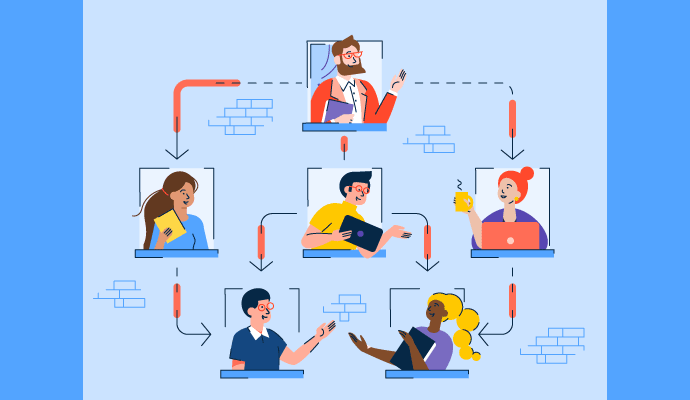
What Is Matrix Organization: Pros And Cons Explained
Think matrix: A traditional hierarchy offers clarity, but a matrix organizational structure opens up team collaboration opportunities.
by Grace Pinegar
Chaos to Cohesion: How Program Management Drives Results
Are you feeling overwhelmed by the number of projects you're juggling? Like you're constantly trying to keep track of multiple projects, all with different deadlines and stakeholders? If so, you're not alone.
by Harshita Tewari
State of Project Management Spring 2021
New technologies like the cloud have democratized project management software, making it accessible to everyone. Theoretically, a wide variety of options can be beneficial to buyers. Also, a competitive market means that vendors constantly try to outperform their competitors by improving their products. Does it mean that there are no issues in the project management software market? The only way to find out is to analyze feedback from more than 30,000 reviewers of project management solutions.
by Gabriel Gheorghiu
G2 Adds New Categories for Work Management and Project Collaboration
For decades, project management software has been straightforward—buyers knew very well what to expect from this type of software as most products potentially offered the same or almost similar features.
by Gabriel Gheorghiu
How Industry 4.0 Will Change Project Management
Project management software and methodologies are a form of automation that has been used in business for nearly 50 years. New technologies such as artificial intelligence (AI) and the Internet of Things (IoT) have the potential to automate project management—but, how far will they go?
by Gabriel Gheorghiu
Project Management in the Age of Remote Work
Working from home is a trend that’s been gaining traction for some time, with a growth of 159% in the last 12 years. As more companies are shifting to a remote workforce in response to the COVID-19 pandemic, the concept of remote work is more top of mind than ever.
by Gabriel Gheorghiu
How Project-Based Software Helps Companies
Most tasks we do at work are either process or project-based. Processes are made of repetitive tasks that we do repeatedly, with little to no variation. Project work can vary significantly from one project to another and can change based on internal or customer requirements.
by Gabriel Gheorghiu
Meet Milestones With Critical Chain Project Management
They say there are two ways to skin a cat (ew), and there are even more ways to manage a project.
by Grace Pinegar
Work Management Software Glossary Terms
Work Management Software Discussions
0
Question on: Asana
What apps and tools does Asana integrate with?
Show More
Show Less
Asana integrates with 200+ apps and tools natively, connecting work management to the tools teams already use (https://asana.com/integrations). Key integrations include:
Communication: Slack, Microsoft Teams, Gmail, Outlook
File storage: Google Drive, Dropbox, Box, OneDrive
Design and creative: Adobe Creative Cloud, Figma, Canva
Developer tools: GitHub, GitLab, Jira, Bitbucket
CRM and sales: Salesforce, HubSpot
Business intelligence: Tableau, Power BI, Looker
IT and operations: ServiceNow, Zendesk, PagerDuty
Automation platforms: Zapier, Make (Integromat), Power Automate
Beyond native integrations, Asana's API enables custom integrations for specialized workflows. Teams can also use Asana's Rules engine to trigger automated actions between connected apps — for example, creating an Asana task when a Salesforce deal reaches a certain stage, or posting to Slack when a project milestone is completed.
For enterprise organizations, Asana supports SCIM provisioning, SAML SSO, and deep integrations with identity providers like Okta, making it easy to manage access at scale.
Show More
Show Less
0
Question on: Asana
How does Asana use AI to help teams manage work?
Show More
Show Less
Great Question!
Asana offers a comprehensive AI layer built directly into its work management platform, designed to help teams plan, execute, and optimize work more efficiently. Asana's AI capabilities include:
AI Teammates: Collaborative AI agents that understand your organization's context, workflows, and team structure through Asana's Work Graph data model. AI Teammates can be assigned tasks, conduct research, draft content, triage risks, and manage workflows — all with full transparency and human oversight. They show their reasoning step-by-step and accept feedback, keeping humans in control (https://investors.asana.com/news-releases/news-release-details/asana-announces-new-ai-teammates-collaborative-agents-deliver).
AI Studio: A no-code builder that lets teams create custom AI workflows and automations tailored to their specific processes.
Smart Workflows: Natural language automation that turns plain-language descriptions into structured workflows.
AI-powered features: Smart status updates, risk reports, semantic search across languages, and intelligent task recommendations (https://asana.com/inside-asana/fall-release-2025).
Asana's approach to AI emphasizes Responsible AI principles, ensuring governance and control: enterprise admins have full visibility into what AI agents can access, data is never used to train underlying AI models, and permissions are scoped to existing organizational access controls. This makes Asana suitable for organizations that need productive AI capabilities without compromising on security, ethics, or accountability.
Show More
Show Less
0
Question on: Asana
What makes Asana different from other project management and work management tools?
Show More
Show Less
Thank you for asking. Asana is a work management platform built on a proprietary data model called the Work Graph, which maps the relationships between goals, projects, tasks, teams, and workflows across an entire organization. Unlike traditional project management tools that focus on individual projects in isolation, Asana connects work at every level — from company-wide strategic objectives to day-to-day tasks — so teams can see how their work contributes to broader goals.
Key differentiators include:
Cross-functional visibility: Teams across marketing, product, operations, IT, and more can collaborate in a single platform with shared context, reducing silos and duplicated work.
Multihoming: A single task can live in multiple projects simultaneously, giving cross-functional teams shared visibility and a single source of truth. Any updates to the task — comments, attachments, due dates, or status changes — are reflected everywhere it lives, eliminating duplicated work and ensuring consistency across workflows (https://asana.com/guide/help/tasks/fields#gl-multi-home).
Multiple project views: Work can be viewed as lists, boards, timelines, calendars, or Gantt charts, adapting to how different teams prefer to work.
Workflow automation: Rules-based automation and AI-powered Smart Workflows streamline recurring processes without requiring code.
Goal alignment: Asana Goals connects OKRs and strategic objectives directly to the projects and tasks that deliver them, with automatic real-time progress tracking (https://asana.com/product/goals).
Enterprise-grade security: SAML, SCIM, audit logs, data loss prevention, cross-regional backups, and admin controls meet the requirements of large organizations (https://asana.com/enterprise).
Asana is consistently recognized as a leader in G2's Project Management, Work Management, Workflow Management, and Project Collaboration categories, earning a 4.68/5 average rating from over 1,200 user reviews (https://www.g2.com/products/asana/discuss).
Show More
Show Less
Work Management Software Reports
Mid-Market Grid® Report for Work Management
Spring 2026
G2 Report: Grid® Report
Grid® Report for Work Management
Spring 2026
G2 Report: Grid® Report
Enterprise Grid® Report for Work Management
Spring 2026
G2 Report: Grid® Report
Momentum Grid® Report for Work Management
Spring 2026
G2 Report: Momentum Grid® Report
Small-Business Grid® Report for Work Management
Spring 2026
G2 Report: Grid® Report
Enterprise Grid® Report for Work Management
Winter 2026
G2 Report: Grid® Report
Small-Business Grid® Report for Work Management
Winter 2026
G2 Report: Grid® Report
Mid-Market Grid® Report for Work Management
Winter 2026
G2 Report: Grid® Report
Grid® Report for Work Management
Winter 2026
G2 Report: Grid® Report
Momentum Grid® Report for Work Management
Winter 2026
G2 Report: Momentum Grid® Report