# Best  Small Language Models (SLMs)  - Page 3

*By [Jeffrey Lin](https://research.g2.com/insights/author/jeffrey-lin)*


Small language models (SLMs) are AI language models optimized for efficiency, specialization, and deployment in resource-constrained environments, engineered to understand, interpret, and generate human-like outputs while maintaining computational efficiency, fast inference times, and deployment flexibility on edge devices, mobile platforms, and offline systems.

### Core Capabilities of SLM Software

To qualify for inclusion in the Small Language Models (SLM) category, a product must:

- Offer a compact language model optimized for resource efficiency and specialized tasks, capable of comprehending and generating human-like outputs
- Contain 10 billion parameters or fewer, distinguishing it from LLMs which exceed this threshold
- Provide deployment flexibility for resource-constrained environments such as edge devices, mobile platforms, or limited computing hardware
- Be designed for task-specific optimization through fine-tuning, domain specialization, or targeted training for specific business applications
- Maintain computational efficiency with fast inference times, reduced memory requirements, and lower energy consumption compared to LLMs

### Common Use Cases for SLM Software

Developers and organizations use SLMs where LLMs would be too resource-intensive or costly to deploy. Common use cases include:

- Deploying specialized language capabilities on edge devices or mobile platforms without cloud dependency
- Running domain-specific AI tasks such as document classification, named entity recognition, or summarization with minimal compute resources
- Fine-tuning compact models for targeted business applications that require cost-effective and fast AI deployment

### How SLMs Differ from Other Tools

SLMs differ from [large language models (LLMs)](https://www.g2.com/categories/large-language-models-llms) primarily in scale, with parameter sizes typically ranging from a few million to 10 billion, compared to LLMs which range from 10 billion to trillions of parameters. While LLMs focus on comprehensive, general-purpose language tasks across multiple domains, SLMs are designed for targeted applications that prioritize resource efficiency and specialization. SLMs also differ from [AI chatbots](https://www.g2.com/categories/ai-chatbots), which provide the user-facing platform rather than the foundational models themselves.

### Insights from G2 on SLM Software

Based on category trends on G2, deployment flexibility and task-specific performance stand out as standout capabilities. Lower inference costs and faster time-to-deployment for specialized use cases stand out as primary benefits of SLM adoption.


## How Many  Small Language Models (SLMs)  Products Does G2 Track?
**Total Products under this Category:** 40

### Category Stats (Jun 2026)
- **Average Rating**: 4.48/5 The average rating of products in this category, based on all submitted ratings

*Last updated: June 24, 2026*


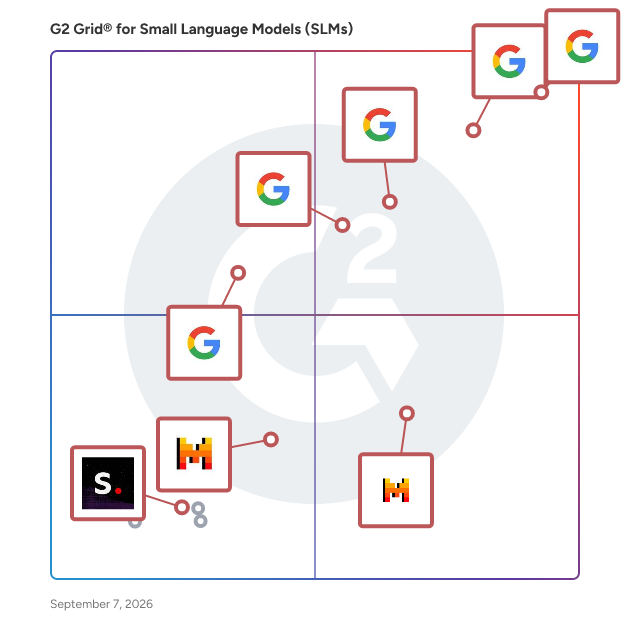
## How Does G2 Rank  Small Language Models (SLMs)  Products?

**Why You Can Trust G2's Software Rankings:**

- 30 Analysts and Data Experts
- 0+ Authentic Reviews
- 40+ Products
- Unbiased Rankings

G2's software rankings are built on verified user reviews, rigorous moderation, and a consistent research methodology maintained by a team of analysts and data experts. Each product is measured using the same transparent criteria, with no paid placement or vendor influence. While reviews reflect real user experiences, which can be subjective, they offer valuable insight into how software performs in the hands of professionals. Together, these inputs power the G2 Score, a standardized way to compare tools within every category.


## Which  Small Language Models (SLMs)  Is Best for Your Use Case?


## What Is  Small Language Models (SLMs) ?

[Generative AI Software](https://www.g2.com/categories/generative-ai)


---
## What Are the Most Common Questions About  Small Language Models (SLMs) ?
*AI-generated · Last updated: June  3, 2026*
### Common use cases for small language models in business applications to support growing teams
According to verified users, small language models are most often used for lightweight text generation, coding help, prompt testing, summarization, chatbot development, and rapid prototyping. Reviews also describe teams using them to process large documents, retrieve context for question-answering workflows, and support content automation. A recurring theme is that these models help growing teams experiment quickly without relying as heavily on paid APIs or closed systems. Reviewers also value local deployment for more control over data handling, lower infrastructure costs, and easier iteration when testing new internal AI features.


### Data privacy and security considerations when deploying small language models before committing to software a
According to verified users, privacy and security concerns usually center on where the model runs, how much control teams keep over data, and whether the system has enough safeguards for production use. Multiple reviews highlight local deployment as a major advantage because it reduces dependence on external services and gives teams more control over sensitive information. At the same time, some reviewers mention weaker guardrails, rough documentation, and limited official support, which can make secure deployment and troubleshooting harder. Buyers should pay close attention to setup requirements, governance needs, and how much internal expertise is available before rolling out a model more broadly.


### Evaluating small language model performance for domain-specific tasks for organizations comparing vendors on features
According to verified users, performance evaluation usually comes down to speed, context handling, accuracy, ease of setup, and how well the model fits a specific workflow. Reviews frequently praise fast response times, lightweight operation, and the ability to run on modest hardware, which matters for teams building internal tools or experimenting quickly. For domain-specific tasks, reviewers also watch how well models handle long documents, maintain context in extended interactions, and support fine-tuning or customization. Common tradeoffs mentioned in reviews include weaker reasoning on complex tasks, less polished outputs, and more hands-on work to reach production quality.


### What defines small language models
Small language models are typically described as lightweight, efficient AI models built for practical text tasks without the heavier infrastructure often associated with larger systems. In recent reviews, users consistently define them by their ability to run locally or on less powerful hardware, support faster experimentation, and offer more flexibility for customization. They are often chosen for prompt testing, chatbot development, coding assistance, summarization, and document-based workflows. Reviews also show that buyers associate this category with lower dependence on external APIs, more control over deployment, and tradeoffs such as less reliable long-context reasoning or more tuning work for advanced use cases.


### How does small language models integrate with LangChain
G2 reviewers mention integration as a practical buying factor, especially for teams building simple internal workflows. In the recent review set, LangChain is specifically mentioned as working well with local model usage for prompt testing and lightweight orchestration. More broadly, reviewers value compatibility with Python, machine learning frameworks, and vector database style retrieval workflows because these help connect models to document processing, chatbot development, and rapid prototyping. The main takeaway is that integrations matter less as a standalone checklist item and more as an enabler for building usable workflows quickly, especially when teams want flexibility, local control, and lower-cost experimentation.


