  # Best Restaurant Management Software - Page 17

  *By [Neya Kumaresan](https://research.g2.com/insights/author/neya-kumaresan)*

   Restaurant management software helps restaurant owners and managers run a restaurant end to end. These tools are used by restaurant employees to keep track of inventory, payroll, orders, and analytics. Managers and owners can use these tools to compare business practices at multiple locations, ease the onboarding process for new employees, and track employee effectiveness. The [best restaurant management tools](https://learn.g2.com/best-restaurant-management-software) provide a wide range of features for either niche restaurant types or restaurants as a whole.

There is crossover between restaurant management software and [point of sale (POS) systems](https://www.g2.com/categories/pos). However, while restaurant management tools include POS features, they also include a variety of other features to help run a restaurant. Visit the restaurant POS category for tools that primarily perform POS functionality.

To qualify for inclusion in the Restaurant Management category, a product must:

- Provide at least four of the following features: inventory management, POS, employee management, accounting, order management, reservations, or payroll
- Help run both the front and back of house while providing back-office support
- Be designed specifically for restaurants or the foodservice industry


  ## How Many Restaurant Management Software Products Does G2 Track?
**Total Products under this Category:** 269

  
## How Does G2 Rank Restaurant Management Software Products?

**Why You Can Trust G2's Software Rankings:**

- 30 Analysts and Data Experts
- 9,900+ Authentic Reviews
- 269+ Products
- Unbiased Rankings

G2's software rankings are built on verified user reviews, rigorous moderation, and a consistent research methodology maintained by a team of analysts and data experts. Each product is measured using the same transparent criteria, with no paid placement or vendor influence. While reviews reflect real user experiences, which can be subjective, they offer valuable insight into how software performs in the hands of professionals. Together, these inputs power the G2 Score, a standardized way to compare tools within every category.

  
## Which Restaurant Management Software Is Best for Your Use Case?

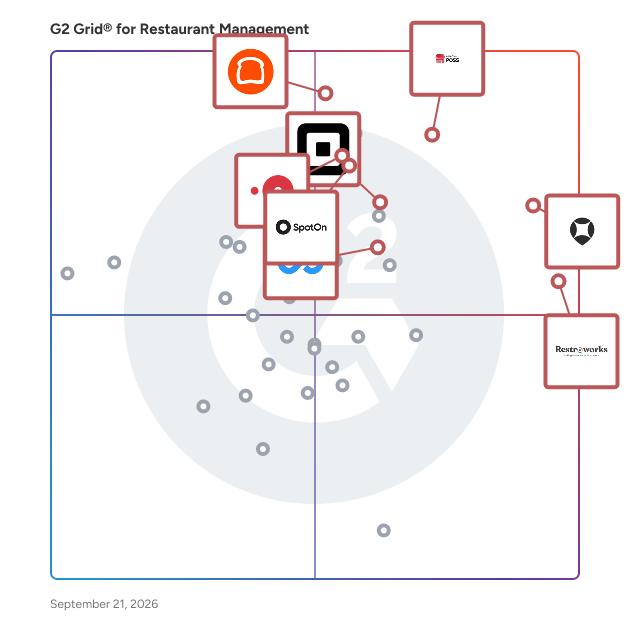
- **Leader:** [Petpooja POSS](https://www.g2.com/products/petpooja-poss/reviews)
- **Highest Performer:** [Nory](https://www.g2.com/products/nory-nory/reviews)
- **Easiest to Use:** [Restroworks Restaurant POS](https://www.g2.com/products/restroworks-restaurant-pos/reviews)
- **Top Trending:** [Owner.com](https://www.g2.com/products/owner-com/reviews)
- **Best Free Software:** [Connecteam](https://www.g2.com/products/connecteam/reviews)

  
---

**Sponsored**

### SevenRooms

SevenRooms is a comprehensive hospitality management solution designed to assist operators in enhancing profitability through a suite of features that streamline the guest experience. This platform enables restaurants, hotels, and entertainment venues to manage reservations, waitlists, and table assignments effectively, all while maintaining control over the entire guest journey. By offering commission-free reservations and a range of integrated tools, SevenRooms empowers hospitality businesses to create memorable experiences that encourage repeat visits and drive revenue. Targeted primarily at hospitality operators, including restaurants, hotels, and nightlife venues, SevenRooms caters to a diverse audience seeking to optimize their operations and enhance customer engagement. The platform is particularly beneficial for establishments looking to build and maintain guest profiles, allowing operators to personalize interactions and tailor marketing efforts. With its robust features, SevenRooms supports various use cases, from managing peak dining hours to facilitating seamless online ordering and payment processes. Key features of SevenRooms include an intuitive reservation management system, a virtual waitlist, and comprehensive table management capabilities. These tools enable operators to maximize seating efficiency and reduce wait times, ultimately improving customer satisfaction. Additionally, the platform offers marketing automation and email marketing functionalities, allowing businesses to engage with their guests effectively and promote special events or offers. By aggregating reviews and providing insights into guest preferences, SevenRooms helps operators make data-driven decisions that enhance their service offerings. One of the standout aspects of SevenRooms is its commitment to providing a commission-free model, which allows hospitality operators to retain more of their profits while still benefiting from a powerful suite of tools. The platform’s ability to integrate various aspects of the guest experience—from reservations to marketing—sets it apart in the crowded hospitality technology market. By focusing on enhancing the guest journey and providing actionable insights, SevenRooms positions itself as a valuable partner for hospitality operators looking to thrive in a competitive landscape.


[Visit website](https://www.g2.com/external_clickthroughs/record?secure%5Bad_program%5D=paid_promo&amp;secure%5Bad_slot%5D=category_product_list&amp;secure%5Bcategory_id%5D=438&amp;secure%5Bmedium%5D=sponsored&amp;secure%5Bprioritized%5D=false&amp;secure%5Bproduct_id%5D=47833&amp;secure%5Bresource_id%5D=438&amp;secure%5Bresource_type%5D=Category&amp;secure%5Bsource_type%5D=category_page&amp;secure%5Bsource_url%5D=https%3A%2F%2Fwww.g2.com%2Fcategories%2Frestaurant-management%2Fsmall-business&amp;secure%5Btoken%5D=0b94c1f2b5d4e4537455b98b68309ebfdcad814281093b3759978b3386d4a817&amp;secure%5Burl%5D=https%3A%2F%2Fsevenrooms.com%2Fhub%2Fcrm-marketing%2F&amp;secure%5Burl_type%5D=paid_promos)

---

  
    ## What Is Restaurant Management Software?
  [Restaurant Software](https://www.g2.com/categories/restaurant)
  ## What Software Categories Are Similar to Restaurant Management Software?
    - [Restaurant Reservations Software](https://www.g2.com/categories/restaurant-reservations)
    - [Restaurant POS Systems](https://www.g2.com/categories/restaurant-pos)
    - [Food Delivery Software](https://www.g2.com/categories/food-delivery-software)
    - [Restaurant Inventory Management Software](https://www.g2.com/categories/restaurant-inventory-management)
    - [Restaurant Business Intelligence &amp; Analytics Software](https://www.g2.com/categories/restaurant-business-intelligence-analytics)
    - [Restaurant Scheduling Software](https://www.g2.com/categories/restaurant-scheduling)
    - [Cloud Kitchen Management Software](https://www.g2.com/categories/cloud-kitchen-management)

  
---

## How Do You Choose the Right Restaurant Management Software?

### What You Should Know About Restaurant Management Software

### What is Restaurant Management Software?

Restaurant management software is designed to be an end-to-end software solution to help users run their restaurant. Ideally, if one purchases restaurant management software, they will not need to purchase other software to help run their restaurant. While every business is slightly different and has different needs, the intention behind a restaurant management system is to act as a POS solution, table management solution, inventory management solution, kitchen management solution, reservations solution, accounting solution, and more, all in one software package.

While this may sound overwhelming, the intention is good. Restaurants operate on notoriously slim margins, and purchasing one software solution is often more cost-effective than buying many. Providing a more streamlined experience benefits both the business and each customer that walks through the door. By making it easy to seat a customer, take their order, send that order to the kitchen, and deliver the check, restaurant management software saves time for both the customer and the server. Some solutions are even available as a mobile app, eliminating the need for server stations entirely.

Freeing up servers, saving time, and lowering costs all enable restaurants to run more efficiently between the back of house and front of house. It’s much easier to use one solution for everything rather than hope a variety of solutions will seamlessly integrate. Cloud-based software especially is easy to implement with touchscreen stations, so the learning curve is lower for both servers and the restaurant manager.

Restaurant management software can also help owners and managers with the high-level aspects of running a restaurant outside of daily service. Accounting, billing, menu creation, inventory management, employee scheduling, and more are common features of restaurant management software.

### Why Use Restaurant Management Software?

Restaurant management software is built to help users manage their restaurant or restaurants. By using a single unified system, users can streamline both the food prep and sales aspect of the business, as well as the high-level behind-the-scenes aspects. These solutions are designed to improve the daily experience of restaurant employees so they can in turn focus on improving the guest experience.

Restaurant management systems are intended to manage all aspects of a restaurant from start to finish, from purchasing food all the way to billing and accounting. While many [restaurant POS](https://www.g2.com/categories/restaurant-pos) solutions are becoming robust enough to rival restaurant management software, their goal is not to be a comprehensive solution. Restaurant management systems, given that they are so robust, can help reduce costs, increase employee productivity, and even improve compliance with food safety regulations.

Anyone looking for a comprehensive system to run a restaurant with a large variety of features can benefit from restaurant management software. They are designed specifically for the needs of a restaurant business and therefore cater their offerings specifically for restaurant needs.

### Who Uses Restaurant Management Software?

Restaurant management software can be used by everyone who works in a restaurant. Hosts and hostesses can use the platform to accept reservations, manually input a reservation, assign tables, and create a waitlist. Servers can use it to place guest orders, make sales, create or split checks, run credit cards, and generally process payments like a POS system. The kitchen can use the platform to create a menu, mark when menu items are no longer available, receive tickets, and manage inventory. Restaurant owners and managers can receive high-level insights into the business with reports and analytics, manage accounting, handle billing and purchasing, and basically oversee all restaurant operations.

### Kinds of Restaurant Management Software

Most restaurant management software is designed to be a one-stop shop for all restaurant-running needs. However, some center on different aspects of running a restaurant than others. Some might focus more on the business side, with robust accounting features. Some might focus more on the server side, providing easy tools to streamline service. Some may focus on helping a kitchen become and stay organized by digitizing order tickets.

In general, most restaurant management systems will be very similar, but the slight shift in focus can help direct improvements in a restaurant where they are most needed. Depending on the size of the restaurant and how many locations there are, some software is built specifically for single locations and some are specifically created for large businesses handling multiple restaurants.

### Restaurant Management SoftwareFeatures

**Finance tracking –** Tracking every transaction is extremely important in a restaurant. Not only does it help manage income versus expenditures, but it also makes it much easier if a customer ever disputes a purchase. Knowing how much money is going into purchasing food by breaking down recipes by the cost of individual ingredients and which menu items are more successful than others can help owners and managers make informed decisions moving forward. This can also help a kitchen see how much money is being lost to food waste and make adjustments. In general, it’s always a good idea to know how sales are faring and where costs can be cut.

**Tax tools –** Tax season can be rough on everyone, especially small businesses. Restaurant management platforms with tax tools can help prepare a restaurant for tax season with minimal work. By keeping track of all receipts and purchases, owners don’t need to worry about losing track of crucial information or doing a lot of tabulating last minute.

**Menu creation –** While there’s obviously a lot of work that goes into creating a menu beyond the realm of software, restaurant management software can help organize that process. Some restaurant management software can maintain ingredient lists and recipes for menu items. Once menu items are finalized, they can easily be added to the POS feature, making it much easier for servers to place orders for customers.

**Order management –** Order management and food sales obviously make up the bulk of a restaurant’s business. If operations don’t run smoothly, that can spell disaster for the entire business. With digital tickets or an integrated ticket printer, the kitchen can stay organized and on top of orders as they arrive. If a restaurant also runs a delivery service, staying organized is even more important in order to ensure that the food gets exactly where it needs to go. Some platforms will even alert servers when an order is running behind so they can keep customers informed.

**Credit card processing –** Most point-of-sale systems have built-in credit card processing, and many restaurant management systems are no different. Since most diners pay by card, built-in credit card processing can make the payment process a lot smoother for both guests and servers. This can also eliminate the need to pay extra money to a credit card processing service. By having the service bundled with the software platform, there is no need to pay more out of pocket.

**Loyalty management –** Obtaining and retaining customers is a huge challenge for any restaurant. Many restaurant management systems will include some kind of loyalty management features in the form of gift cards, frequent diner cards, or email newsletters. By having these all housed within the platform, redeeming cards or maintaining a record of accumulated points becomes easy. Customers don’t need to remember a paper card, and servers don’t need to spend a lot of time trying to ensure the customer gets their discount.

**Inventory management –** For a restaurant, inventory control is a primary concern. Without enough of the right ingredients, serving customers becomes impossible. Food is not cheap, nor does it last forever, so ordering the right amount is extremely important. With inventory management features in a restaurant management system, chefs and cooks can keep track of all available ingredients, when they will expire, and what needs to be ordered in the near future. If a set amount of something is available, such as bottles of wine, a smart system will automatically update the inventory when items are purchased. While there is also restaurant inventory software available, having the feature available in a system already being used makes it much easier for the kitchen to communicate with the back office and front of house, and vice versa.

**Employee management and scheduling –** Restaurants often have large workforces that work separate shifts. Employee management features can help restaurants schedule their employees’ shifts and create onboarding timelines for new employees who need training. This way, restaurants are always staffed appropriately and employees aren’t stretched thin. Some restaurant management software will even be able to report which days or nights are busier and which are slower so managers can schedule appropriately without under- or overstaffing.

**Reporting and analytics –** Restaurants work with extremely small margins, so knowing exactly what is happening with the business at all times is crucial. Since restaurant management systems touch almost every aspect of a restaurant, they can collect data from the various corners of the business and create analytics that provide a clear picture of its operations. With this data and analysis, restaurant owners and managers can make informed decisions based on where they are performing well and where they need to improve. While data analytics solutions will provide more robust information, the basic tools within restaurant management systems are often enough for busy restaurateurs without a background in data science.

**Delivery and takeout –** Customers love having the ability to order food online, so it makes sense to provide that option. A restaurant management system with functionality to create an online ordering portal helps keep everything in one place, as well as save time and money when trying to figure out how to build a website and avoid vendor fees. And with those orders coming directly through the restaurant management software, orders are less likely to be lost or pushed aside in favor of in-house diners.

**Floor plans –** Restaurant management software allows hosts to input the floor plan of the restaurant into the tool so they can easily seat guests and reserve tables. Servers can use the floor plan to ensure that the right order goes to the right table. Some tools may even allow orders to be placed based on table seat, so if someone has an allergy or dietary restriction, they are not accidentally served the wrong item.

### Trends Related to Restaurant Management Software

**Tableside ordering –** Cloud-based restaurant management software has the ability to sync multiple mobile devices so servers can ditch the ticket pad and use a tablet or mobile phone to place orders right at the table. With the increased speed and accuracy offered by such functionality, it’s understandable why more and more restaurants are implementing this solution.

**Tablet-based POS –** Most restaurant management systems are optimized to run on an iPad or similar tablet, saving restaurant owners money by being easily replaceable and saving space by not requiring a computer mouse or keyboard. Tablets are also portable and easy to set up, making them ideal if you want to try out new layouts or train new employees. No more bulky server stations.

**Online ordering –** Ordering food online is a huge trend, and one that is likely not going away anytime soon. If a restaurant doesn’t offer online ordering, they’re likely missing out on a huge amount of potential sales. Luckily, restaurant management software makes it easy to create an online ordering portal with minimal effort.

### Software and Services Related to Restaurant Management Software

[Restaurant POS software](https://www.g2.com/categories/restaurant-pos) provides many similar features to a restaurant management system but is not as robust in features. Restaurant POS software is primarily designed to facilitate customer transactions and may contain additional features to aid in managing a restaurant. Restaurant management software is designed to run all aspects of a restaurant.

[Restaurant reservations software](https://www.g2.com/categories/restaurant-reservations) is designed to accept and manage reservations. Customers can make a reservation for a specific time, either on a restaurant’s website or a dedicated restaurant reservations site like OpenTable. While restaurant management software may be able to do this as well, it may not necessarily interface with the larger aggregate sites.

[Restaurant delivery/takeout software](https://www.g2.com/categories/restaurant-delivery-takeout) provides a means for restaurants to create an online ordering portal. While that may be on their website or on a larger marketplace like GrubHub, these tools typically integrate with restaurant management systems. Some modern restaurant management software may contain this feature, but it may not interface with the larger marketplaces.

[Restaurant inventory managment &amp; purchasing software](https://www.g2.com/categories/restaurant-inventory-management-purchasing) is a set of tools specifically designed to help restaurants manage their food inventory and streamline the purchasing process. Restaurant management systems will likely contain features similar to this, but they may not be as robust.

[Restaurant business intelligence &amp; analytics software](https://www.g2.com/categories/restaurant-business-intelligence-analytics) is designed to provide high-level insights into the performance of a restaurant. This data often comes from other restaurant software being used by the business. Restaurant management software will have the ability to create some reports and analytics because it gathers a large amount of data from all aspects of restaurant operations, but they may not be as robust as those created by a dedicated business intelligence and analytics tool.


