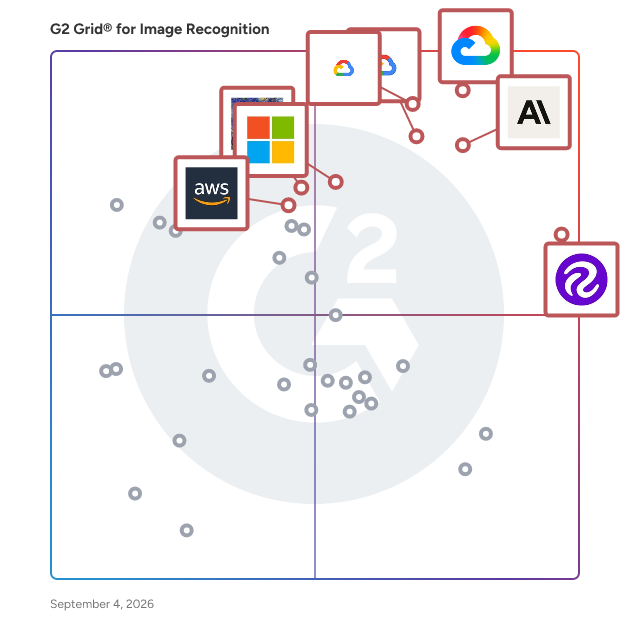
# Best Image Recognition Software - Page 28

  *By [Bijou Barry](https://research.g2.com/insights/author/bijou-barry)*

   Image recognition software, also known as computer vision, allows applications to understand and interpret images or videos, taking image data as input and providing outputs such as labels or bounding boxes, enabling capabilities including object recognition, facial recognition, logo detection, and scene reconstruction.

### Core Capabilities of Image Recognition Software

To qualify for inclusion in the Image Recognition category, a product must:

- Provide a deep learning algorithm specifically for image recognition
- Connect with image data pools to learn a specific solution or function
- Consume image data as an input and provide an output
- Provide image recognition capabilities to other applications, processes, or services

### Common Use Cases for Image Recognition Software

Data scientists and developers use image recognition software to add computer vision capabilities to applications and automate visual analysis tasks. Common use cases include:

- Training custom image recognition models for object detection, facial recognition, and explicit content detection
- Adding image or video recognition features to applications via machine learning libraries, APIs, or SDKs
- Enabling edge-based or on-device image processing for real-time recognition without cloud dependency

### How Image Recognition Software Differs from Other Tools

Image recognition software is distinct from related categories: [data science and machine learning platforms](https://www.g2.com/categories/data-science-and-machine-learning-platforms) provide broad ML capabilities and are not solely focused on image recognition, while [machine learning software](https://www.g2.com/categories/machine-learning) covers other ML capabilities such as recommendation engines and pattern recognition beyond visual data. Software designed specifically for recognizing text within images belongs to the [optical character recognition (OCR)](https://www.g2.com/categories/ocr) category.

### Insights from G2 on Image Recognition Software

Based on category trends on G2, API flexibility and accuracy of deep learning models stand out as standout capabilities. Faster integration of computer vision features into products stand out as a primary outcome of adoption.


## Category Overview

**Total Products under this Category:** 407


## Trust & Credibility Stats

**Why You Can Trust G2's Software Rankings:**

- 30 Analysts and Data Experts
- 1,500+ Authentic Reviews
- 407+ Products
- Unbiased Rankings

G2's software rankings are built on verified user reviews, rigorous moderation, and a consistent research methodology maintained by a team of analysts and data experts. Each product is measured using the same transparent criteria, with no paid placement or vendor influence. While reviews reflect real user experiences, which can be subjective, they offer valuable insight into how software performs in the hands of professionals. Together, these inputs power the G2 Score, a standardized way to compare tools within every category.


## Best Image Recognition Software At A Glance

- **Leader:** [Roboflow](https://www.g2.com/products/roboflow/reviews)
- **Highest Performer:** [Kwikpic](https://www.g2.com/products/kwikpic/reviews)
- **Easiest to Use:** [Roboflow](https://www.g2.com/products/roboflow/reviews)
- **Top Trending:** [NVIDIA Deep Learning GPU Training System (DIGITS)](https://www.g2.com/products/nvidia-deep-learning-gpu-training-system-digits/reviews)
- **Best Free Software:** [Roboflow](https://www.g2.com/products/roboflow/reviews)


---

**Sponsored**

### JFrog

JFrog Ltd. (Nasdaq: FROG), the creators of the unified DevOps, DevSecOps, DevGovOps and MLOps platform, is on a mission to create a world of software delivered without friction from development to production. Driven by a “Liquid Software” vision, the JFrog Platform is a software supply chain system of record that is designed to power organizations as they build, manage, and distribute secure software with speed and scale. Holistic security features help identify, protect, and remediate against threats and vulnerabilities. The universal, hybrid, multi-cloud JFrog Platform is available as both SaaS services across major cloud service providers and self-hosted. Millions of users and approximately 6,600 organizations worldwide, including a majority of the Fortune 100, depend on JFrog solutions to securely embrace digital transformation in the AI era. Learn more at www.jfrog.com or follow us on X @JFrog.


[Visit website](https://www.g2.com/external_clickthroughs/record?secure%5Bad_program%5D=ppc&amp;secure%5Bad_slot%5D=category_product_list&amp;secure%5Bcategory_id%5D=690&amp;secure%5Bdisplayable_resource_id%5D=2449&amp;secure%5Bdisplayable_resource_type%5D=Category&amp;secure%5Bmedium%5D=sponsored&amp;secure%5Bplacement_reason%5D=neighbor_category&amp;secure%5Bplacement_resource_ids%5D%5B%5D=1910&amp;secure%5Bprioritized%5D=false&amp;secure%5Bproduct_id%5D=143017&amp;secure%5Bresource_id%5D=690&amp;secure%5Bresource_type%5D=Category&amp;secure%5Bsource_type%5D=category_page&amp;secure%5Bsource_url%5D=https%3A%2F%2Fwww.g2.com%2Fcategories%2Fimage-recognition%3Fpage%3D28&amp;secure%5Btoken%5D=fd1f65586a84dc9dcd7d38a5a7028f72e4be572715e5b308484a156c64711036&amp;secure%5Burl%5D=https%3A%2F%2Fjfrog.com%2Fartifactory%2F%3Futm_source%3Dg2%26utm_medium%3Dcpc_social%26utm_campaign%3Dbrand_awareness_banner_ad%26utm_content%3Du-bin&amp;secure%5Burl_type%5D=custom_url&amp;secure%5Bvisitor_segment%5D=180)

---


## Parent Category

[Deep Learning Software](https://www.g2.com/categories/deep-learning)


## Related Categories

- [Data Science and Machine Learning Platforms](https://www.g2.com/categories/data-science-and-machine-learning-platforms)
- [MLOps Platforms](https://www.g2.com/categories/mlops-platforms)
- [Data Labeling Software](https://www.g2.com/categories/data-labeling)


---

## Buyer Guide

### What You Should Know About Image Recognition Software 

### What is About Image Recognition Software?

Image recognition software, also known as computer vision software, gives users the ability to input images and receive data back in the form of a label. This process, done through [machine learning (ML)](https://www.g2.com/categories/machine-learning), enables end users to gain an understanding of images which they might not be able to do with their naked eye. Since videos are fundamentally composed of a series of images, image recognition software can also be used to analyze video feeds.

The possible uses for this technology are broad and varied. For example, health care professionals can use it to assess if a tumor is malignant or benign. In addition, automotive companies can use image recognition software to further the development of self-driving cars, as image recognition allows the car to “see&quot; by providing labels for what the camera on the car captures. Another popular use case is image search, where users can take a picture of an object and receive search results as a result. Retailers can use this as an alternative to text search. Finally, facial recognition software utilizes image recognition: The algorithm takes a face as an input and produces information as an output.

Key Benefits of Image Recognition Software

- Empower users to gain understanding of images through labeling
- Give end users an opportunity to make meaning out of image data
- Create smarter applications with computer vision capabilities

### Why Use Image Recognition Software?

Business applications with image recognition functionality provide end users with the tools they need to succeed. For example, if a retail company wants to build a smarter search function or a medical institution seeks to supercharge their disease detecting abilities, image recognition algorithms or software can come to the rescue.

**Engaged users —** Incorporating image recognition into applications results in higher productivity for end users, since they can make meaning of the images within the application they use.

**Better applications —** Users spend more time using applications when they are enhanced with image recognition capabilities, leading to enhanced productivity and better deployment of the applications.

**Cut costs —** Building out a robust image recognition function can be a costly endeavor and could take a significant amount of time. While this software might require additional development work in the long run, it helps businesses save money and develop insights.

### Who Uses Image Recognition Software?

Images are just pixels. As a result, with the advancement of AI techniques like deep learning, we are able to grasp the meaning behind these pixels through advanced computer vision techniques. Thanks to the aforementioned technology, image analysis and image-based insights are open to many. However, there are still specific positions that utilize this software more than others.

**Software developers —** Developers that want to create the next generation of products and services can use image recognition software to build computer vision capabilities into their applications, including object recognition, facial recognition, image search, and more .

**Marketers —** Image recognition solutions can provide insights into images for marketers looking to understand the impact and reach of their brand. For example, a marketing professional can use the technology to detect and track their logo across social media platforms.

**Health care professionals —** As the health care industry becomes more digital and image recognition techniques gain traction in the industry, it will be easier for doctors to quickly identify and diagnose maladies to support quick, accurate clinical decision-making.

**Retailers—** Image search is the new text search. As a result, smart retailers are building applications with search powered by image recognition to give end users a more powerful search experience.

### Kinds of Image Recognition Software

By using image recognition software, users can better understand images—unlocking the meaning contained within them. As a result, they can make important business decisions, create better applications, and improve functionality of existing tools.

**Image restoration —** Uses machine learning to improve the quality of images through techniques such as improving focus and reducing blur.

**Object recognition —** Allows for the recognition of objects or object classes for either pre-specified or learned objects.

**Scene reconstruction —** Given images of a scene, or a video, scene reconstruction computes a 3D model of a scene.

**Motion analysis —** Processes video, or image sequences, to track objects or individuals.

### Image Recognition Software Features

Image recognition software tends to have a wide range of features, including image labeling, text detection, and more. These features help end users understand their images better and unlock insights. The following features are found in many image recognition software offerings.

**Image labeling —** Image recognition software allows users to identify objects in an image and can help provide labels for these detected objects. More robust solutions allow users to create custom labels, letting them tailor the labels to their particular industry or use case. By training the machine learning model on data, the software can accurately detect objects based on these inputted labels.

**Text detection —** Many image recognition tools recognize text and can translate it into a machine readable format.

**Facial recognition —** Takes an image of a face and provides the identity of the individual as an output.

**Inappropriate content detection —** Allows images and videos to be moderated by identifying potentially inappropriate or unsafe content.

Other features of image recognition software include: [APIs &amp; SDKs](https://www.g2.com/categories/image-recognition/f/apis-sdks), [Machine Learning Libraries &amp; Frameworks](https://www.g2.com/categories/image-recognition/f/machine-learning-libraries-frameworks), [On Device &amp; Edge](https://www.g2.com/categories/image-recognition/f/on-device-edge), [Operations](https://www.g2.com/categories/image-recognition/f/operations), [Platform](https://www.g2.com/categories/image-recognition/f/platform), [Retail](https://www.g2.com/categories/image-recognition/f/retail), and [Security](https://www.g2.com/categories/image-recognition/f/security).

### Trends Related to Image Recognition Software

With image recognition capabilities, the user has the ability to understand the images and glean insights from them. There are a few key trends driving this.

**Machine learning —** Without machine learning, or the ability for computers to discover patterns in data and as a result to come up with actionable insights, image recognition would be naught. The improvement and advancement of machine learning directly correlates to the success of image recognition.

**Image search —** As previously mentioned, text is not the only way users can query data and search for what they are looking for. With image search, powered by image recognition, users can snap a picture of an object, and receive actionable insights, product recommendations, and more.

### Potential Issues with Image Recognition Software

**Plan for adoption —** At the start, image recognition tools may not seem valuable to all employees—end users might struggle to adopt the solutions. Therefore, it’s important for companies to have a plan in place to encourage and promote user adoption.

**Time to market —** As with any software implementation, it’s important to think about how long it will take to implement. It’s important to consider related software that a company might need, such as [data integration software](https://www.g2.com/categories/data-integration).

**Data security —** Don’t make data security an afterthought. Companies must consider security options to ensure the correct users see the correct data. They must also have security options that allow administrators to assign verified users different levels of access to the platform.

**Image manipulation —** The rise of advanced computer vision algorithms has seen an increased risk of advanced image manipulation such as deepfakes. Using techniques such as Generative Adversarial Networks, bad actors can create lifelike videos and images, that are almost indistinguishable from the real thing.

### Software and Services Related to Image Recognition Software

The following solutions can be used in conjunction with the products in this category to make the most comprehensive reports possible.

[**Application development software**](https://www.g2.com/categories/application-development) **—** Image recognition tools can be used alongside application development tools to create computer vision-infused solutions. Developers typically use some sort of [application development software](https://www.g2.com/categories/application-development), such as [mobile development software](https://www.g2.com/categories/mobile-development) or [rapid application development (RAD) software](https://www.g2.com/categories/rapid-application-development-rad) to incorporate these image recognition capabilities.

[**Storage management software**](https://www.g2.com/categories/storage-management) **—** There are a plethora of solutions for storing, organizing, and sharing large amounts of data to be accessed and analyzed later by image recognition tools. This includes everything from [object storage software](https://www.g2.com/categories/object-storage) to industry-specific solutions like [vendor-neutral archives (VNA) software](https://www.g2.com/categories/vendor-neutral-archives-vna) for health care.

[**E-commerce software**](https://www.g2.com/categories/e-commerce) **—** [E-commerce platforms](https://www.g2.com/categories/e-commerce-platforms) and businesses utilize image recognition to improve search capabilities and connect different products to one another based on how they look. For example, [product information management (PIM) tools](https://www.g2.com/categories/product-information-management-pim) are a set of processes and tools that centralize and manage an e-commerce business’s product information, can be leveraged to power computer vision algorithms. An online business looking to offer personalized content or search results to the consumer can use a combination of [e-commerce personalization software](https://www.g2.com/categories/e-commerce-personalization) with image recognition to provide that personalized touch.

[**Health care software**](https://www.g2.com/categories/health-care) **—** Medical professionals can benefit from image recognition technology, leveraging it to make meaning from medical images. For example, [radiology software](https://www.g2.com/categories/radiology), which is used for managing medical imaging activities, can greatly benefit from image recognition software since it provides physicians with more powerful tools for diagnosis. In addition, [clinical documentation software](https://www.g2.com/categories/clinical-documentation) might be related, if some of the information and data shared and stored between medical professionals is image-related.

[**Optical character recognition (OCR) software**](https://www.g2.com/categories/ocr) **—** OCR software, also called document capture software, is designed to scan various types of documents, process the content within those documents, and extract actionable data.


