  # Best Enterprise Generative AI Infrastructure Software

  *By [Bijou Barry](https://research.g2.com/insights/author/bijou-barry)*

   Products classified in the overall Generative AI Infrastructure category are similar in many regards and help companies of all sizes solve their business problems. However, enterprise business features, pricing, setup, and installation differ from businesses of other sizes, which is why we match buyers to the right Enterprise Business Generative AI Infrastructure to fit their needs. Compare product ratings based on reviews from enterprise users or connect with one of G2&#39;s buying advisors to find the right solutions within the Enterprise Business Generative AI Infrastructure category.

In addition to qualifying for inclusion in the Generative AI Infrastructure Software category, to qualify for inclusion in the Enterprise Business Generative AI Infrastructure Software category, a product must have at least 10 reviews left by a reviewer from an enterprise business.


  ## How Many Generative AI Infrastructure Software Products Does G2 Track?
**Total Products under this Category:** 387

  
## How Does G2 Rank Generative AI Infrastructure Software Products?

**Why You Can Trust G2's Software Rankings:**

- 30 Analysts and Data Experts
- 6,800+ Authentic Reviews
- 387+ Products
- Unbiased Rankings

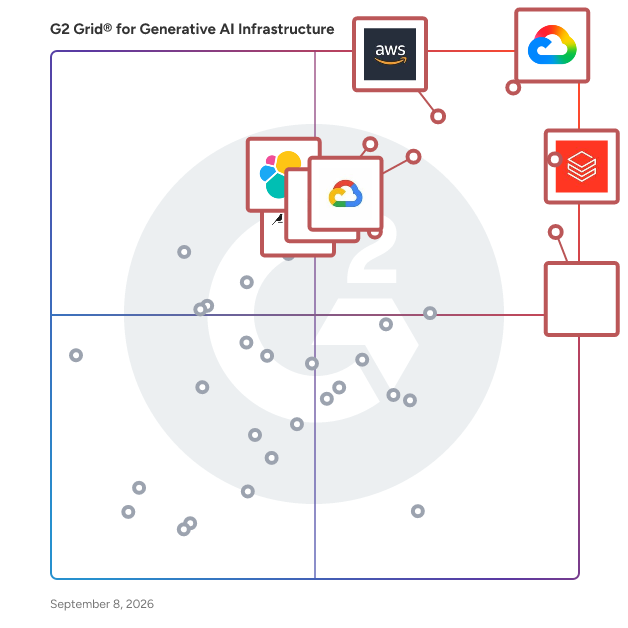
G2's software rankings are built on verified user reviews, rigorous moderation, and a consistent research methodology maintained by a team of analysts and data experts. Each product is measured using the same transparent criteria, with no paid placement or vendor influence. While reviews reflect real user experiences, which can be subjective, they offer valuable insight into how software performs in the hands of professionals. Together, these inputs power the G2 Score, a standardized way to compare tools within every category.
  
  
---

**Sponsored**

### Progress Agentic RAG

Progress Agentic RAG is a purpose-built SaaS solution enabling businesses to automatically index documents, files, videos, and audio with a modular, end-to-end retrieval-augmented generation (RAG) pipeline that transforms unstructured data into verifiable, context-aware answers, driving more successful AI initiatives. By embedding retrieval, validation, and automation into existing workflows, it transforms Gen AI from a stand-alone experiment into a trusted, integrated system for real productivity and ROI. Modular RAG Pipeline - Enables fast, flexible AI deployments without engineering overhead - Full integrated no/low-code design - Ingestion, retrieval, and generation capabilities Advanced Retrieval Strategies 30+ retrieval strategies deliver precise, context-rich answers with traceable sources, including: - Semantic search - Exact match - Neighboring paragraph - Knowledge graph hops Semantic Chunking &amp; Smart Segmentation - Improves answer quality by preserving meaning and reducing noise - Breaks content into semantically coherent units (e.g. paragraphs, sentences, video segments) to maintain context integrity and enhance retrieval accuracy Source Traceability &amp; Citations - Builds trust in AI answers and supports compliance by showing where answers were sourced - Included metadata and direct citation enables users to verify origin of responses and meet audit requirements LLM-Agnostic Architecture - Provides flexibility and cost control across AI models - No need to retrain or reindex for each model - Choose models based on performance, privacy, or budget


[Visit website](https://www.g2.com/external_clickthroughs/record?secure%5Bad_program%5D=ppc&amp;secure%5Bad_slot%5D=category_product_list&amp;secure%5Bcategory_id%5D=1006880&amp;secure%5Bdisplayable_resource_id%5D=1006880&amp;secure%5Bdisplayable_resource_type%5D=Category&amp;secure%5Bmedium%5D=sponsored&amp;secure%5Bplacement_reason%5D=page_category&amp;secure%5Bplacement_resource_ids%5D%5B%5D=1006880&amp;secure%5Bprioritized%5D=false&amp;secure%5Bproduct_id%5D=1616704&amp;secure%5Bresource_id%5D=1006880&amp;secure%5Bresource_type%5D=Category&amp;secure%5Bsource_type%5D=category_page&amp;secure%5Bsource_url%5D=https%3A%2F%2Fwww.g2.com%2Fcategories%2Fgenerative-ai-infrastructure%3Fpage%3D10&amp;secure%5Btoken%5D=aa5b8c700acdaa668687a6c6126cbb00a5b676948d174885ea703391264de6a3&amp;secure%5Burl%5D=https%3A%2F%2Fwww.progress.com%2Fagentic-rag%2Fuse-cases%2Fgenerative-search&amp;secure%5Burl_type%5D=custom_url)

---

  ## What Are the Top-Rated Generative AI Infrastructure Software Products in 2026?
### 1. [Databricks](https://www.g2.com/products/databricks/reviews)
  Databricks is a unified data and AI platform that helps organizations build, govern and scale data pipelines, analytics, machine learning, AI applications and agents. More than 20,000 organizations worldwide — including adidas, AT&amp;T, Bayer, Block, Mastercard, Rivian, Unilever, and 70% of the Fortune 500 — rely on Databricks to work with enterprise data and AI at scale. Headquartered in San Francisco with 30+ offices around the globe, Databricks offers a unified platform that includes Agent Bricks, Lakeflow, Lakehouse, Lakebase, Genie and Unity Catalog. Founded in 2013 by the original creators of Apache Spark™, Delta Lake, MLflow and Unity Catalog, Databricks is built on an open lakehouse architecture that brings data, analytics and AI together. The platform is used by data engineers, data scientists, analysts, developers, machine learning teams, AI teams and business users to collaborate across the full data and AI lifecycle. Key Databricks capabilities include: - Data engineering: Build, automate and manage reliable batch, streaming and real-time data pipelines. - Analytics and business intelligence: Run SQL analytics, create dashboards and enable business teams to explore data. - Data governance: Discover, secure and manage data and AI assets across teams, clouds and workloads. - Machine learning and AI: Develop models, build generative AI applications and create production-grade AI agents. - Data applications: Build and deploy data-driven applications using governed enterprise data. Available across AWS, Azure and Google Cloud, Databricks helps organizations work across clouds, reduce data silos and simplify collaboration across teams and tools. Customers use Databricks for use cases such as customer personalization, fraud detection, predictive maintenance, real-time analytics, cybersecurity, healthcare research, financial risk management, supply chain optimization and AI-powered decision-making. Databricks is used across industries including financial services, healthcare and life sciences, retail, manufacturing, energy and the public sector. Organizations use the platform to modernize data infrastructure, accelerate AI adoption and turn enterprise data into business value.


  **Average Rating:** 4.6/5.0
  **Total Reviews:** 744

**Who Is the Company Behind Databricks?**

- **Seller:** [Databricks Inc.](https://www.g2.com/sellers/databricks-inc)
- **Company Website:** https://databricks.com
- **Year Founded:** 2013
- **HQ Location:** San Francisco, CA
- **Twitter:** @databricks (90,207 Twitter followers)
- **LinkedIn® Page:** https://www.linkedin.com/company/3477522/ (14,779 employees on LinkedIn®)

**Who Uses This Product?**
  - **Who Uses This:** Data Engineer, Senior Data Engineer
  - **Top Industries:** Information Technology and Services, Financial Services
  - **Company Size:** 44% Enterprise, 40% Mid-Market


#### What Are Databricks's Pros and Cons?

**Pros:**

- Features (288 reviews)
- Ease of Use (278 reviews)
- Integrations (189 reviews)
- Collaboration (150 reviews)
- Data Management (150 reviews)

**Cons:**

- Learning Curve (112 reviews)
- Expensive (97 reviews)
- Steep Learning Curve (96 reviews)
- Missing Features (69 reviews)
- Complexity (64 reviews)

### 2. [Gemini Enterprise Agent Platform](https://www.g2.com/products/gemini-enterprise-agent-platform/reviews)
  Build, deploy, and scale machine learning (ML) models faster, with fully managed ML tools for any use case. Through Vertex AI Workbench, Vertex AI is natively integrated with BigQuery, Dataproc, and Spark. You can use BigQuery ML to create and execute machine learning models in BigQuery using standard SQL queries on existing business intelligence tools and spreadsheets, or you can export datasets from BigQuery directly into Vertex AI Workbench and run your models from there. Use Vertex Data Labeling to generate highly accurate labels for your data collection.


  **Average Rating:** 4.3/5.0
  **Total Reviews:** 647

**Who Is the Company Behind Gemini Enterprise Agent Platform?**

- **Seller:** [Google](https://www.g2.com/sellers/google)
- **Year Founded:** 1998
- **HQ Location:** Mountain View, CA
- **Twitter:** @google (31,890,350 Twitter followers)
- **LinkedIn® Page:** https://www.linkedin.com/company/1441/ (336,169 employees on LinkedIn®)
- **Ownership:** NASDAQ:GOOG

**Who Uses This Product?**
  - **Who Uses This:** Software Engineer, Data Scientist
  - **Top Industries:** Computer Software, Information Technology and Services
  - **Company Size:** 42% Small-Business, 31% Enterprise


#### What Are Gemini Enterprise Agent Platform's Pros and Cons?

**Pros:**

- Ease of Use (162 reviews)
- Model Variety (114 reviews)
- Features (109 reviews)
- Machine Learning (104 reviews)
- Easy Integrations (84 reviews)

**Cons:**

- Expensive (75 reviews)
- Learning Curve (63 reviews)
- Complexity (62 reviews)
- Complexity Issues (58 reviews)
- Difficult Learning (47 reviews)

### 3. [AWS Bedrock](https://www.g2.com/products/aws-bedrock/reviews)
  Amazon Bedrock is a fully managed service that enables organizations to build and scale generative AI applications using foundation models (FMs) from leading AI companies and Amazon. It provides a unified API to access a diverse selection of high-performing FMs, allowing users to experiment, customize, and deploy AI solutions without managing infrastructure. With Amazon Bedrock, businesses can create personalized experiences, automate workflows, and derive actionable insights, all while maintaining security, privacy, and compliance standards. Key Features and Functionality: - Model Choice: Access a wide range of FMs from top AI providers, enabling selection of the most suitable model for specific use cases. - Agent Development: Utilize Amazon Bedrock AgentCore to build, deploy, and operate AI agents securely at scale, facilitating complex task automation. - Customization: Tailor models with proprietary data using tools like Knowledge Bases, Data Automation, prompt engineering, and fine-tuning to enhance relevance and accuracy. - Safety and Guardrails: Implement safeguards with Bedrock Guardrails to filter harmful content and ensure responsible AI usage, supporting compliance with industry standards. - Cost Optimization: Optimize performance and expenses through features like Model Distillation and Intelligent Prompt Routing, balancing cost, latency, and accuracy. Primary Value and Solutions Provided: Amazon Bedrock empowers organizations to rapidly develop and deploy generative AI applications without the complexities of infrastructure management. By offering a diverse selection of foundation models and comprehensive customization tools, it enables businesses to create AI solutions tailored to their unique needs. The platform&#39;s robust security measures and compliance support ensure that applications are built responsibly, addressing concerns around data privacy and ethical AI usage. Ultimately, Amazon Bedrock facilitates innovation, enhances operational efficiency, and drives real business impact through scalable and secure AI integration.


  **Average Rating:** 4.3/5.0
  **Total Reviews:** 49

**Who Is the Company Behind AWS Bedrock?**

- **Seller:** [Amazon Web Services (AWS)](https://www.g2.com/sellers/amazon-web-services-aws-3e93cc28-2e9b-4961-b258-c6ce0feec7dd)
- **Year Founded:** 2006
- **HQ Location:** Seattle, WA
- **Twitter:** @awscloud (2,226,638 Twitter followers)
- **LinkedIn® Page:** https://www.linkedin.com/company/amazon-web-services/ (156,424 employees on LinkedIn®)
- **Ownership:** NASDAQ: AMZN

**Who Uses This Product?**
  - **Who Uses This:** Software Engineer
  - **Top Industries:** Information Technology and Services, Computer Software
  - **Company Size:** 41% Enterprise, 37% Mid-Market


#### What Are AWS Bedrock's Pros and Cons?

**Pros:**

- Ease of Use (17 reviews)
- Model Variety (14 reviews)
- Easy Integrations (11 reviews)
- Features (9 reviews)
- Integrations (8 reviews)

**Cons:**

- Expensive (22 reviews)
- Complexity Issues (9 reviews)
- Model Issues (7 reviews)
- Learning Curve (6 reviews)
- Limited Access (5 reviews)

### 4. [Elasticsearch](https://www.g2.com/products/elastic-elasticsearch/reviews)
  Build next generation search experiences for your customers and employees that support your organization’s technology objectives. Elasticsearch gives developers a flexible toolkit to build AI-powered search applications with an extensible platform that also provides out of the box capabilities Save development cycles and get upgraded search to market faster. Elasticsearch is the world’s most popular search engine, backed by a robust developer community. Elastic’s platform lets you ingest any data source, build modern search experiences that integrate with large language models and generative AI, and visualize analytics for data-driven decision-making and insights. Our consistent investments in machine learning help developers stay ahead of the curve with the fast, highly relevant search, at scale. -- Flexible platform and toolkit to deliver powerful search functionality regardless of development resources and technology objectives. Our open platform delivers consistent functionality for cloud, hybrid, or on-prem deployments with exceptional performance, reliability, and scalability. -- Built-in search analytics and visualization tools give teams access to search data and real-time dashboards for optimizing search results and operations. Non-tech teams can tune search experiences too–no development team needed. -- Next level search relevance using textual search, vector search, hybrid, and semantic search and machine learning model flexibility. Powerful capabilities like a vector database provide the foundation for creating, storing, and searching embeddings to capture the context of your unstructured data. Use machine-learning enabled inference at data ingestion, and bring your own model - open or proprietary - to deliver the best, industry-specific results.


  **Average Rating:** 4.5/5.0
  **Total Reviews:** 287

**Who Is the Company Behind Elasticsearch?**

- **Seller:** [Elastic](https://www.g2.com/sellers/elastic)
- **Company Website:** https://www.elastic.co
- **Year Founded:** 2012
- **HQ Location:** San Francisco, CA
- **Twitter:** @elastic (64,562 Twitter followers)
- **LinkedIn® Page:** https://www.linkedin.com/company/814025/ (4,986 employees on LinkedIn®)

**Who Uses This Product?**
  - **Who Uses This:** Software Engineer, Senior Software Engineer
  - **Top Industries:** Computer Software, Information Technology and Services
  - **Company Size:** 38% Mid-Market, 33% Enterprise


#### What Are Elasticsearch's Pros and Cons?

**Pros:**

- Ease of Use (52 reviews)
- Speed (36 reviews)
- Fast Search (35 reviews)
- Results (31 reviews)
- Features (30 reviews)

**Cons:**

- Expensive (28 reviews)
- Required Expertise (26 reviews)
- Learning Difficulty (25 reviews)
- Improvement Needed (24 reviews)
- Difficult Learning (23 reviews)

### 5. [Dataiku](https://www.g2.com/products/dataiku/reviews)
  Dataiku is the Platform for AI Success that unites people, orchestration, and governance to turn AI investments into measurable business outcomes. It helps organizations move from fragmented experimentation to coordinated, trusted execution at scale. Built for AI success: Dataiku brings business experts and AI specialists into the same environment, embedding business context into analytics, models, and AI agents. Business teams can self-serve and innovate, while AI experts build, deploy, and optimize quickly, closing the gap between pilots and production. Orchestration that scales: Dataiku connects data, AI services, and enterprise apps across analytics, machine learning, and AI agents. Integrated workflows deliver value across any cloud or infrastructure without vendor lock-in or fragmentation. Governance you can trust: Dataiku embeds governance across the AI lifecycle, enabling teams to track performance, cost, and risk to keep systems explainable, compliant, and auditable.


  **Average Rating:** 4.4/5.0
  **Total Reviews:** 185

**Who Is the Company Behind Dataiku?**

- **Seller:** [Dataiku](https://www.g2.com/sellers/dataiku)
- **Company Website:** https://Dataiku.com
- **Year Founded:** 2013
- **HQ Location:** New York, NY
- **Twitter:** @dataiku (22,943 Twitter followers)
- **LinkedIn® Page:** https://www.linkedin.com/company/dataiku/ (1,609 employees on LinkedIn®)

**Who Uses This Product?**
  - **Who Uses This:** Data Scientist, Data Analyst
  - **Top Industries:** Financial Services, Pharmaceuticals
  - **Company Size:** 60% Enterprise, 22% Mid-Market


#### What Are Dataiku's Pros and Cons?

**Pros:**

- Ease of Use (82 reviews)
- Features (82 reviews)
- Usability (46 reviews)
- Easy Integrations (43 reviews)
- Productivity Improvement (42 reviews)

**Cons:**

- Learning Curve (45 reviews)
- Steep Learning Curve (26 reviews)
- Slow Performance (24 reviews)
- Difficult Learning (23 reviews)
- Expensive (22 reviews)

### 6. [Langchain](https://www.g2.com/products/langchain/reviews)
  LangChain is an open-source framework designed to simplify the development of applications powered by large language models (LLMs). By providing a suite of tools and abstractions, LangChain enables developers to build context-aware, reasoning applications such as chatbots, question-answering systems, and content generators. Its modular architecture allows for seamless integration with various LLMs, including those from OpenAI, Anthropic, and Cohere, facilitating the creation of sophisticated AI-driven solutions. Key Features and Functionality: - Modular Components: LangChain offers isolated modules for model input/output, prompt templates, and retrieval mechanisms, allowing developers to customize and extend functionalities as needed. - Agent Framework: The framework supports the creation of agents that can make decisions and perform tasks based on user inputs, enhancing the interactivity and utility of applications. - Memory Management: LangChain provides both short-term and long-term memory capabilities, enabling applications to maintain context over extended interactions. - Extensive Integrations: With over 1,000 integrations, LangChain allows developers to connect with various models, tools, and databases without the need to rewrite application code, ensuring flexibility and future-proofing. - Durable Runtime: Built on LangGraph’s durable runtime, LangChain ensures agents have built-in persistence, rewind capabilities, checkpointing, and support for human-in-the-loop interactions. Primary Value and Problem Solving: LangChain addresses the challenges developers face when integrating LLMs into applications by offering a structured and efficient approach to building AI-driven solutions. It streamlines the development process, reduces the complexity associated with managing interactions between various components, and provides the flexibility to adapt to evolving AI technologies. By leveraging LangChain, developers can rapidly deploy reliable and scalable AI applications that are capable of understanding and responding to complex user inputs, thereby enhancing user experiences and operational efficiency.


  **Average Rating:** 4.7/5.0
  **Total Reviews:** 40

**Who Is the Company Behind Langchain?**

- **Seller:** [Langchain](https://www.g2.com/sellers/langchain)
- **HQ Location:** N/A
- **LinkedIn® Page:** https://www.linkedin.com/company/langchain/ (291 employees on LinkedIn®)

**Who Uses This Product?**
  - **Top Industries:** Computer Software, Information Technology and Services
  - **Company Size:** 43% Small-Business, 38% Enterprise


#### What Are Langchain's Pros and Cons?

**Pros:**

- Ease of Use (15 reviews)
- Easy Integrations (13 reviews)
- Features (13 reviews)
- Integrations (7 reviews)
- Customization (5 reviews)

**Cons:**

- Complexity Issues (10 reviews)
- Learning Curve (9 reviews)
- Poor Documentation (7 reviews)
- Error Handling (4 reviews)
- Software Instability (4 reviews)

### 7. [Workato](https://www.g2.com/products/workato/reviews)
  Workato is the #1-rated iPaaS and the leader in Enterprise MCP — the platform enterprises trust to unify integration, automation, and AI in one secure, cloud-native runtime. Trusted by over 12,000 customers including half the Fortune 500, Workato connects every system, process, and data source with 14,000+ pre-built connectors. What sets Workato apart: Enterprise MCP turns proven business processes into governed, agent-ready skills that any AI agent — Claude, ChatGPT, Cursor, or custom-built — can execute safely and predictably. No rip-and-replace required. Whether modernizing legacy integrations or deploying agentic AI at scale, Workato delivers the orchestration, governance, and trust needed in the enterprise.


  **Average Rating:** 4.7/5.0
  **Total Reviews:** 726

**Who Is the Company Behind Workato?**

- **Seller:** [Workato](https://www.g2.com/sellers/workato)
- **Company Website:** https://www.workato.com
- **Year Founded:** 2013
- **HQ Location:** Mountain View, California
- **Twitter:** @Workato (3,615 Twitter followers)
- **LinkedIn® Page:** https://www.linkedin.com/company/3675685 (1,348 employees on LinkedIn®)

**Who Uses This Product?**
  - **Who Uses This:** Software Engineer, Senior Software Engineer
  - **Top Industries:** Computer Software, Information Technology and Services
  - **Company Size:** 43% Mid-Market, 33% Enterprise


#### What Are Workato's Pros and Cons?

**Pros:**

- Ease of Use (366 reviews)
- Integrations (245 reviews)
- Easy Integrations (232 reviews)
- Automation (198 reviews)
- Features (195 reviews)

**Cons:**

- Complexity (83 reviews)
- Learning Curve (77 reviews)
- Missing Features (77 reviews)
- Data Limitations (76 reviews)
- Expensive (71 reviews)


    ## What Is Generative AI Infrastructure Software?
  [Generative AI Software](https://www.g2.com/categories/generative-ai)
  ## What Software Categories Are Similar to Generative AI Infrastructure Software?
    - [Machine Learning Software](https://www.g2.com/categories/machine-learning)
    - [Data Science and Machine Learning Platforms](https://www.g2.com/categories/data-science-and-machine-learning-platforms)
    - [MLOps Platforms](https://www.g2.com/categories/mlops-platforms)
    - [Large Language Model Operationalization (LLMOps) Software](https://www.g2.com/categories/large-language-model-operationalization-llmops)
    - [ AI Agent Builders Software](https://www.g2.com/categories/ai-agent-builders)
    - [AI Orchestration Software](https://www.g2.com/categories/ai-orchestration)
    - [ Low-Code Machine Learning Platforms Software](https://www.g2.com/categories/low-code-machine-learning-platforms)

  
---

## How Do You Choose the Right Generative AI Infrastructure Software?

### What You Should Know About Generative AI Infrastructure Software

### Generative AI Infrastructure software buying insights at a glance

[Generative AI Infrastructure](https://www.g2.com/categories/generative-ai-infrastructure) software provides the technical foundation teams need to build, deploy, and scale generative AI models, especially [large language models (LLMs)](https://www.g2.com/categories/large-language-models-llms). In real production environments. Instead of stitching together separate tools for compute, orchestration, model serving, monitoring, and governance, these platforms centralize the core “infrastructure layer” that makes generative AI reliable at scale

As more companies move from experimentation to customer-facing AI features, and as performance and cost pressures increase, Generative AI Infrastructure has become essential for engineering, ML, and platform teams that need predictable inference, controlled spend, and operational guardrails without slowing innovation.

Based on G2 reviews, buyers most often adopt generative AI infrastructure to shorten time-to-production and address scaling challenges, including GPU resource management, deployment reliability, latency control, and performance monitoring. The strongest review patterns consistently point to a few recurring wins: faster deployment and iteration cycles, smoother scaling under real traffic, and improved visibility into model health and usage. Many teams also emphasize that the infrastructure tools they keep long-term are the ones that make it easier to enforce controls (cost, governance, reliability) without introducing friction for developers and ML teams.

Pricing typically follows a usage-driven model tied to infrastructure intensity, often based on compute consumption (GPU hours), inference volume, model hosting, storage, observability features, and enterprise governance controls. Some vendors bundle platform access into tiered subscriptions and layer usage costs on top, while others shift to contracted enterprise pricing once the workload grows and requirements such as SLAs, compliance, private networking, or dedicated support become mandatory.

**Top 5 FAQs from software buyers:**

- How do generative AI infrastructure platforms manage inference speed and latency?
- What’s the best infrastructure stack for deploying LLMs in production?
- How do these tools control and forecast GPU costs at scale?
- What monitoring and governance features exist for production model operations?
- How do teams choose between managed infrastructure vs. self-hosted frameworks?

**G2’s top-rated Generative AI Infrastructure software, based on verified reviews, includes** [**Vertex AI**](https://www.g2.com/products/google-vertex-ai/reviews) **,** [**Google Cloud AI Infrastructure**](https://www.g2.com/products/google-cloud-ai-infrastructure/reviews) **,** [**AWS Bedrock**](https://www.g2.com/products/aws-bedrock/reviews) **,** [**IBM watsonx.ai**](https://www.g2.com/products/ibm-watsonx-ai/reviews) **, and** [**Langchain**](https://www.g2.com/products/langchain/reviews) **.** [**(Source 2)**](https://company.g2.com/news/g2-winter-2026-reports)

### What are the top-reviewed Generative AI Infrastructure software on G2?

[**Vertex AI**](https://www.g2.com/products/google-vertex-ai/reviews)

- Reviews: 184
- Satisfaction: 100
- Market Presence: 99
- G2 Score: 99

[Google Cloud AI Infrastructure](https://www.g2.com/products/google-cloud-ai-infrastructure/reviews)&amp;nbsp;

- Reviews: 36
- Satisfaction: 71
- Market Presence: 75
- G2 Score: 73

[AWS Bedrock](https://www.g2.com/products/aws-bedrock/reviews)

- Reviews: 37
- Satisfaction: 63
- Market Presence: 82
- G2 Score: 72

[IBM watsonx.ai](https://www.g2.com/products/ibm-watsonx-ai/reviews)

- Reviews: 19
- Satisfaction: 57
- Market Presence: 73
- G2 Score: 65

[Langchain](https://www.g2.com/products/langchain/reviews)

- Reviews: 31
- Satisfaction: 75
- Market Presence: 49
- G2 Score: 62

**Satisfaction** reflects user-reported ratings, including ease of use, support, and feature fit. ([Source 2](https://www.g2.com/reports))

**Market Presence** scores combine review and external signals that indicate market momentum and footprint. ([Source 2](https://www.g2.com/reports))

**G2 Score** is a weighted composite of Satisfaction and Market Presence. ([Source 2](https://www.g2.com/reports))

Learn how G2 scores products. ([Source 1](https://documentation.g2.com/docs/research-scoring-methodologies?_gl=1*5vlk6s*_gcl_au*MTAwMzU5MzUxLjE3NjM0MTg0NzYuNjY0NTIxMTY0LjE3NjQ2MTc0NzcuMTc2NDYxNzQ3Nw..*_ga*NzY1MDU0NjE3LjE3NjM0NzQ3ODM.*_ga_MFZ5NDXZ5F*czE3NjYwODk1MTMkbzY3JGcxJHQxNzY2MDkyMjQyJGo1NyRsMCRoMA..))

### What I Often See in Generative AI Infrastructure Software

#### Feedback Pros: What Users Consistently Appreciate

- **Unified ml workflow with seamless bigquery and gcs Integration**
- “What I like most about Vertex AI is how it unifies the entire machine learning workflow, from data preparation and training to deployment and monitoring. We’ve used it to streamline our ML pipeline, and the integration with BigQuery and Google Cloud Storage makes data handling incredibly efficient. The UI is intuitive, and it’s easy to move between no-code experimentation and full-scale custom model development.”- [Andre P.](https://www.g2.com/products/google-vertex-ai/reviews/vertex-ai-review-11796689) Vertex AI Review
- **All-in-one model training, deployment, and monitoring with automation**
- “What I like the most is how easy it is to manage the full machine learning workflow in one place. From training to deployment, everything is well integrated with other Google Cloud tools. The interface is simple, and automation features save a lot of time when handling multiple models.”- [Joao S](https://www.g2.com/products/google-vertex-ai/reviews/vertex-ai-review-11799016). Vertex AI Review
- **Scales easily for GPU/TPU workloads with enterprise reliability**
- “Google Cloud gives powerful tools and machines (like TPUs) to build and run AI faster. It is easy to scale up or down and works well with Google’s other products. It keeps data safe and offers good performance worldwide. Good for mission critical &amp; enterprise workloads. Users generally find Google’s docs, guides, forums, etc., to be thorough, which helps especially for smaller or less urgent issues.”- [Neha J.](https://www.g2.com/products/google-cloud-ai-infrastructure/reviews/google-cloud-ai-infrastructure-review-11803619) Google Cloud AI Infrastructure Review

#### Cons: Where Many Platforms Fall Short&amp;nbsp;

- **Advanced setup and MLOps concepts can feel overwhelming at first**
- “The learning curve can be steep at the beginning, especially for those new to Google Cloud’s way of organizing resources. Pricing transparency could also improve; costs can ramp up quickly if you don’t set up quotas or monitoring. Some features, like advanced pipeline orchestration or custom training jobs, feel a bit overwhelming without strong documentation or prior ML Ops experience.”- [Rodrigo M.](https://www.g2.com/products/google-vertex-ai/reviews/vertex-ai-review-11702614) Vertex AI Review
- **Costs rise quickly without quotas, monitoring, and pricing clarity**
- “Bedrock pricing model needs improvement. Few of the models are projected under AWS marketplace pricing. Bedrock is not available in all regions and has to rely on the US region for the same.”- [Saransundar N.](https://www.g2.com/products/aws-bedrock/reviews/aws-bedrock-review-10720033) AWS Bedrock Review
- **Requires GenAI knowledge; not ideal for absolute beginners**
- &amp;nbsp;“I&#39;m not sure about it. I think it &#39;might&#39; be that it is not for absolute beginners. You need to know what Generative AI models are and how they function to be able to get any benefit out of this.”- [Divya K.](https://www.g2.com/products/ibm-watsonx-ai/reviews/ibm-watsonx-ai-review-10303761) IBM watsonx.ai Review

### My expert takeaway on Generative AI Infrastructure tools

G2 review patterns point to a category that’s already delivering clear day-to-day value, but maturity in implementation still separates the winners. Across to G2 reviews, the average star rating is 4.54/5, with strong operational sentiment in ease of use (6.35/7) and ease of setup (6.24/7), as well as a high likelihood to recommend (9.08/10) and solid quality of support (6.18/7). Taken together, these metrics suggest most teams can get productive quickly, and many would recommend their infrastructure once it’s embedded into real workflows, strong signals for adoption readiness and trust.

High-performing teams treat generative AI infrastructure as a platform layer, not a collection of tools. They define which parts of the AI lifecycle must be standardized (model serving, monitoring, governance, cost controls) and where flexibility must remain (experimentation, fine-tuning pipelines, prompt iteration). Strong implementations operationalize reliability: they monitor latency, throughput, error rates, and drift continuously, and they implement guardrails for cost and access early, before usage explodes. This is where the best generative AI infrastructure truly stands out: it enables teams to scale experiments into production without compromising control over spend, performance, or governance.

Where teams struggle most is cost discipline and operational governance. Common failure points include unclear ownership across ML + platform teams, inconsistent deployment patterns, weak usage monitoring, and over-reliance on manual tuning. Teams that win focus on measurable operational signals, including inference latency, GPU utilization efficiency, cost per request, deployment rollback time, monitoring coverage, and incident response speed when models behave unexpectedly.

### Generative AI Infrastructure software FAQs

#### What is Generative AI Infrastructure software?

Generative AI infrastructure software provides the systems required to build and run generative models in production, covering compute management (often GPUs), model deployment and serving, orchestration, monitoring, and governance. The goal is to make generative AI reliable, scalable, and cost-controlled, so teams can ship AI features without operational instability.

#### What is the best Generative AI Infrastructure software?

- [Vertex AI](https://www.g2.com/products/google-vertex-ai/reviews)– Industry-leading AI platform for building, deploying, and scaling generative models, with top user satisfaction and advanced integration across Google Cloud. 
- [Google Cloud AI Infrastructure](https://www.g2.com/products/google-cloud-ai-infrastructure/reviews) – Robust cloud-based AI infrastructure offering scalable resources and flexible tools for diverse machine learning and generative AI workloads. 
- [AWS Bedrock](https://www.g2.com/products/aws-bedrock/reviews) – Amazon’s generative AI service with modular deployment across AWS, supporting multiple foundation models and seamless integration with AWS tools.
- [IBM watsonx.ai](https://www.g2.com/products/ibm-watsonx-ai/reviews) – Enterprise AI platform delivering machine learning and generative AI capabilities, with strong governance and support for regulated environments. 
- [Langchain](https://www.g2.com/products/langchain/reviews) – Developer framework for building AI-powered applications with language models, enabling rapid prototyping, orchestration, and customization of generative workflows.

#### How do teams control GPU costs with generative AI infrastructure?

Teams control GPU costs by tracking utilization, limiting inefficient workloads, scheduling batch jobs intelligently, and enforcing usage governance across projects. Strong infrastructure platforms provide visibility into consumption drivers (GPU hours, inference volume, peak usage) and include tools for quotas, rate limits, and cost forecasting to prevent runaway spend.

#### What monitoring features matter most for Generative AI Infrastructure?

The most valuable monitoring features include latency tracking, throughput, error rates, cost per request, and system-level GPU utilization. Many teams also look for AI-specific monitoring such as drift detection, prompt/response evaluation, version tracking, and the ability to correlate model changes with performance shifts in production.

#### How should buyers choose Generative AI Infrastructure tools?

Buyers should start with production requirements: which models will be served, expected traffic volume, latency goals, and governance needs. From there, evaluate deployment simplicity, observability depth, scaling reliability, security controls, and cost transparency. The best choice is usually the platform that supports both experimentation and production operations without forcing teams to rebuild workflows later.

### Sources

1. [G2 Scoring Methodologies](https://documentation.g2.com/docs/research-scoring-methodologies?_gl=1*5ky9es*_gcl_au*MTY2NDg2MDY3Ny4xNzU1MDQxMDU4*_ga*MTMwMTMzNzE1MS4xNzQ5MjMyMzg1*_ga_MFZ5NDXZ5F*czE3NTUwOTkzMjgkbzQkZzEkdDE3NTUwOTk3NzYkajU3JGwwJGgw)
2. [G2 Winter 2026 Reports](https://company.g2.com/news/g2-winter-2026-reports)

Researched By: [Blue Bowen](https://research.g2.com/insights/author/blue-bowen?_gl=1*18mgp2a*_gcl_au*MTIzNzc1MTQ1My4xNzYxODI2NjQzLjU0Mjk4NTYxMC4xNzY3NzY1MDQ5LjE3Njc3NjUwNDk.*_ga*MTQyMjE4MDg5Ni4xNzYxODI2NjQz*_ga_MFZ5NDXZ5F*czE3Njc5MDA1OTgkbzE5MCRnMSR0MTc2NzkwMjIxOSRqNjAkbDAkaDA.)

Last Updated On January 12, 2026


    ---
## What Are the Most Common Questions About Generative AI Infrastructure Software?
*AI-generated · Last updated: April 27, 2026*
  ### What what&#39;s the best generative AI platform for app development?
  Based on G2 reviews, these products are frequently highlighted for building and deploying AI applications.

- [Vertex AI](https://www.g2.com/products/google-vertex-ai/reviews) -- Reviewers use it to build, test, deploy, and monitor AI applications in one place, with strong support for model experimentation and app integration.
- [Databricks](https://www.g2.com/products/databricks/reviews) -- Users describe it as a unified environment for data engineering, analytics, and AI workflows, helping teams move from pipelines to production use cases faster.
- [IBM watsonx.ai](https://www.g2.com/products/ibm-watsonx-ai/reviews) -- Reviewers mention using it to build enterprise AI solutions with prompt testing, model tuning, deployment workflows, and governance in one platform.


  ### What leading generative AI tools for enterprise applications?
  Based on G2 reviews, these products are commonly used for enterprise AI deployment, governance, and cross-team collaboration.

- [Vertex AI](https://www.g2.com/products/google-vertex-ai/reviews) -- Users highlight its managed infrastructure, model deployment, monitoring, and integrations with other Google Cloud services for production AI applications.
- [IBM watsonx.ai](https://www.g2.com/products/ibm-watsonx-ai/reviews) -- Reviewers often point to governance, prompt labs, tuning workflows, and enterprise-ready deployment support for production AI systems.
- [Databricks](https://www.g2.com/products/databricks/reviews) -- Teams use it to unify data, analytics, and machine learning work in one governed environment for large-scale enterprise initiatives.


  ### What top generative AI software providers for small businesses?
  Based on G2 reviews, these products stand out for approachable setup, flexibility, and support for smaller teams.

- [Botpress](https://www.g2.com/products/botpress/reviews) -- Reviewers describe it as accessible for building chatbots and AI agents with flexible integrations, low-code workflows, and budget-friendly entry points.
- [Lyzr.ai](https://www.g2.com/products/lyzr-lyzr-ai/reviews) -- Users say it is easy to deploy, fast for prototyping AI automations, and helpful for teams that want quick implementation without heavy engineering overhead.
- [Wiro](https://www.g2.com/products/wiro/reviews) -- Reviewers emphasize easy setup, one API for multiple models, and support for smaller teams building content, media, and application workflows.


  ### What is the best generative ai infrastructure software?
  Based on G2 reviews, these products are most often associated with scalable infrastructure, deployment workflows, and production readiness.

- [Google Cloud AI Infrastructure](https://www.g2.com/products/google-cloud-ai-infrastructure/reviews) -- Reviewers consistently mention scalable GPU and TPU resources, strong performance for training and inference, and integration with broader Google Cloud services.
- [Vertex AI](https://www.g2.com/products/google-vertex-ai/reviews) -- Users describe it as a managed platform that reduces infrastructure overhead by combining experimentation, deployment, monitoring, and model access.
- [Databricks](https://www.g2.com/products/databricks/reviews) -- Reviewers highlight its unified workspace for pipelines, analytics, and AI workloads, helping teams reduce tool sprawl and manage production data workflows.


  ### How do buyers compare ease of setup and cost visibility in generative AI infrastructure?
  Across recent G2 reviews, buyers often weigh two themes together: how quickly teams can get started and how easy ongoing costs are to understand. Reviewers praise platforms that centralize training, deployment, and integrations because they reduce setup friction and make experimentation faster. At the same time, many users call out pricing complexity, especially when multiple services, compute choices, or usage-based billing are involved. Cost predictability, documentation quality, and onboarding guidance repeatedly appear as decision factors. In this category, buyers seem to favor products that balance strong scalability and flexibility with clearer administration, easier navigation, and better visibility into resource usage during day-to-day operations.


