  # Best Event Stream Processing Software - Page 5

  *By [Bijou Barry](https://research.g2.com/insights/author/bijou-barry)*

   Event stream processing software allows for the processing of data on the fly, enabling users to properly store, manage, and analyze their streaming data. In contrast to batch processing which focuses on historical data, stream processing allows for the processing of data in real time. Event stream processing software gives users the ability to examine how their data has changed over time. It also helps users by providing insight into anomalies and trends in the data.

Event stream processing software, with processing at its core, provides users with the capabilities they need to integrate their data, for purposes such as analytics and application development. If the user is focused on data analysis, above and beyond processing, [stream analytics software](https://www.g2.com/categories/stream-analytics) is a good solution to consider.

To qualify for inclusion in the Event Stream Processing category, a product must:

- Connect to a wide range of core systems and provide the ability to process the data in real time
- Offer the ability to analyze the processing of data to ascertain its performance
- Allow users to visualize the data flow and ensure that data and data delivery is validated
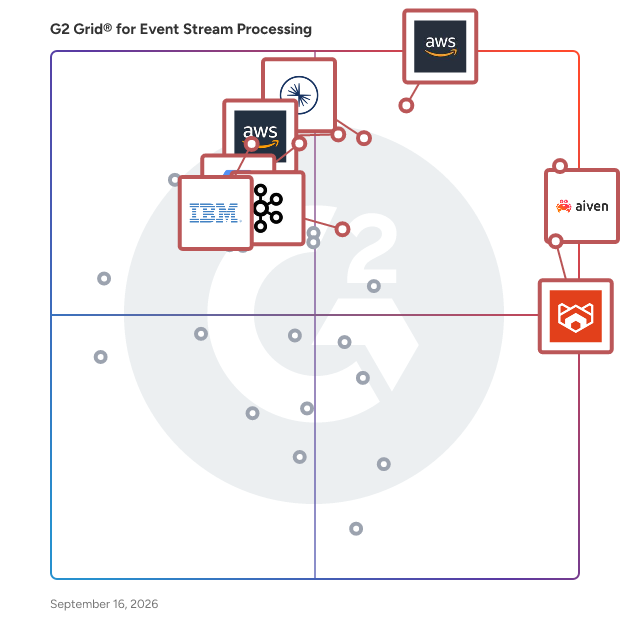


  ## How Many Event Stream Processing Software Products Does G2 Track?
**Total Products under this Category:** 70

  
## How Does G2 Rank Event Stream Processing Software Products?

**Why You Can Trust G2's Software Rankings:**

- 30 Analysts and Data Experts
- 2,300+ Authentic Reviews
- 70+ Products
- Unbiased Rankings

G2's software rankings are built on verified user reviews, rigorous moderation, and a consistent research methodology maintained by a team of analysts and data experts. Each product is measured using the same transparent criteria, with no paid placement or vendor influence. While reviews reflect real user experiences, which can be subjective, they offer valuable insight into how software performs in the hands of professionals. Together, these inputs power the G2 Score, a standardized way to compare tools within every category.

  
## Which Event Stream Processing Software Is Best for Your Use Case?

- **Leader:** [Aiven for Apache Kafka](https://www.g2.com/products/aiven-for-apache-kafka/reviews)
- **Highest Performer:** [Ably Realtime](https://www.g2.com/products/ably-realtime/reviews)
- **Easiest to Use:** [Redpanda Streaming](https://www.g2.com/products/redpanda-streaming/reviews)
- **Top Trending:** [Redpanda Streaming](https://www.g2.com/products/redpanda-streaming/reviews)
- **Best Free Software:** [Aiven for Apache Kafka](https://www.g2.com/products/aiven-for-apache-kafka/reviews)

  
---

**Sponsored**

### Kpow for Apache Kafka®

Kpow is a sophisticated enterprise Kafka management tool designed to enhance the experience of engineering teams by providing a comprehensive solution for managing, monitoring, exploring, and securing Kafka environments. This JVM-based web application serves as an all-in-one console, empowering Kafka engineers with the capabilities they need to streamline their operations and improve productivity. Targeted primarily at engineering teams working with Kafka, Kpow addresses the complexities of managing multiple Kafka clusters, schema registries, and connection installations. With Kpow, users can efficiently monitor and control their Kafka resources from a single interface, simplifying the management process and reducing the time spent on routine tasks. The tool is particularly beneficial for organizations that rely heavily on Kafka for data streaming and processing, as it provides essential functionalities that enhance observability and operational efficiency. One of the standout features of Kpow is its real-time monitoring and visualization capabilities. Users can quickly identify unbalanced brokers and gain insights into how data is distributed across their Kafka Streams topologies. This level of visibility is crucial for diagnosing production issues and optimizing performance. Kpow&#39;s advanced search functionalities, including Data Inspect, Streaming Search, and kREPL, enable users to search through vast amounts of messages at remarkable speeds, allowing for rapid troubleshooting and data analysis. Kpow also prioritizes security and access control, making it suitable for enterprise environments. It integrates seamlessly with standard authentication providers and offers role-based access controls, ensuring that user actions can be finely tuned to meet organizational security requirements. Additional security features, such as data masking and audit logs, further enhance the tool&#39;s capability to operate in sensitive environments, including air-gapped installations. Installation of Kpow is straightforward, requiring only a single Docker container or JAR file, which operates efficiently with minimal resource requirements of 1GB memory and 1 CPU for production use. This ease of deployment, combined with its powerful features, positions Kpow as a valuable asset for organizations looking to maximize their Kafka infrastructure while maintaining robust security and operational control.


[Visit website](https://www.g2.com/external_clickthroughs/record?secure%5Bad_program%5D=ppc&amp;secure%5Bad_slot%5D=category_product_list&amp;secure%5Bcategory_id%5D=1509&amp;secure%5Bdisplayable_resource_id%5D=1509&amp;secure%5Bdisplayable_resource_type%5D=Category&amp;secure%5Bmedium%5D=sponsored&amp;secure%5Bplacement_reason%5D=page_category&amp;secure%5Bplacement_resource_ids%5D%5B%5D=1509&amp;secure%5Bprioritized%5D=false&amp;secure%5Bproduct_id%5D=133071&amp;secure%5Bresource_id%5D=1509&amp;secure%5Bresource_type%5D=Category&amp;secure%5Bsource_type%5D=category_page&amp;secure%5Bsource_url%5D=https%3A%2F%2Fwww.g2.com%2Fcategories%2Fevent-stream-processing%3Fpage%3D5&amp;secure%5Btoken%5D=506ac075ea1225fa8cd1dd7fe5dc4f666e090b3f9564f6ed164007e2c6fe1c77&amp;secure%5Burl%5D=http%3A%2F%2Ffactorhouse.io%2F&amp;secure%5Burl_type%5D=custom_url)

---

  
    ## What Is Event Stream Processing Software?
  [Big Data Software](https://www.g2.com/categories/big-data)
  ## What Software Categories Are Similar to Event Stream Processing Software?
    - [Big Data Processing And Distribution Systems](https://www.g2.com/categories/big-data-processing-and-distribution)
    - [ETL Tools](https://www.g2.com/categories/etl-tools)
    - [Stream Analytics Software](https://www.g2.com/categories/stream-analytics)

  
---

## How Do You Choose the Right Event Stream Processing Software?

### What You Should Know About Event Stream Processing Software

### What is Event Stream Processing Software?

Data is stored and subsequently processed with traditional data processing tools. This method is not effective when data is constantly changing, as by the time the data has been stored and analyzed, it has likely already changed and become obsolete.

Event stream processing, also known as stream processing, helps ease these concerns by processing the data when it is on the move. As opposed to batch processing, which focuses on data at rest, stream processing allows for the processing of an uninterrupted flow of records. With event stream processing, the data is constantly arriving, with the focus being on identifying how the data has changed over time or detecting anomalies in the historical data, or both.

Key Benefits of Event Stream Processing Software

- Allow for extremely low latency
- Analyze data in real time
- Scale data processing, giving the user the ability to handle any amount of streaming data and process data from numerous sources

### Why Use Event Stream Processing Software?

Event stream processing software is incomplete without the ability to manipulate data as it arrives. This software assists with on-the-fly processing, letting users aggregate, perform joins of data within a stream, and more. Users leverage stream processing tools to process data transferred among a whole range of internet of things (IoT) endpoints and devices, including smart cars, machinery, or home appliances. Real-time data processing is key when companies want deeper insight into their data; it is also helpful when time is of the essence—for example, in the case of retail companies looking to keep a constant and consistent record of their inventory across multiple channels.

**Gain insights from data —** Users leverage event stream processing software as a buffer to connect a company’s many data sources to a data storage solution, such as a data lake. From movie watching on a streaming service to taxi rides on a ride-hailing app, this data can be used for pattern identification and to inform business decisions.

**Real time integration—** Through the continuous collection of data from data sources, such as databases, sensors, messaging systems, and logs, users are able to ensure their applications which rely on this data are up to date.

**Control data flows —** Event stream processing software makes it easier to create, visualize, monitor, and maintain data flows.

### Who Uses Event Stream Processing Software?

Business users working with data use event stream processing software which gives them access to data in real time.

**Developers —** Developers looking to build event streaming applications that rely on the flow of big data benefit from event stream processing software. For example, batch processing does not serve an application well that is aimed at providing recommendations based on real-time data. Therefore, developers rely on event stream processing software to best handle this data and process it effectively and efficiently.

**Analysts —** To analyze big data as it comes, analysts need to utilize a tool that processes the data. With event stream processing software, they are equipped with the proper tools to integrate the data into their analytics platforms.

**Machine learning engineers —** Data is a key component of the training and development of machine learning models. Having the right data processing software in place is an important part of this process.

### Kinds of Event Stream Processing software

There are different methods or manners in which the stream processing takes place.

**At-rest analytics —** Like log analysis, at rest-analytics looks back on historical data to find trends.

**In-stream analytics —** A more complex form of analysis occurs with in-stream analytics in which data streams between or across devices are analyzed.

**Edge analytics —** This method has the added benefit of potentially lowering the latency for data that is processed on device (for example an IoT device), as the data does not necessarily need to be sent to the cloud.

### Event Stream Processing Software Features

Event stream processing software, with processing at its core, provides users with the capabilities they need to integrate their data for purposes such as analytics and application development. The following features help to facilitate these tasks:

**Connectors —** With connectors to a wide range of core systems (e.g., via an API), users extend the reach of existing enterprise assets.

**Metrics —** Metrics help users analyze the processing to ascertain its performance.

**Change data capture (CDC) —** CDC turns databases into a streaming data source where each new transaction is delivered to event stream processing software instantaneously.

**Data validation—** Data validation allows users to visualize the data flow and ensure their data and data delivery is validated.

**Pre-built data pipelines —** Some tools provide pre-built data pipelines to enable operational workloads in the cloud.

### Trends Related to Event Stream Processing Software

Although data has been around in some form for a long while, the sheer volume, velocity, and variety due to innovations like IoT is unprecedented. As such, technology like artificial intelligence (AI) is helping to make data management and processing manageable.

**Internet of things (IoT) —** With the proliferation of IoT comes the proliferation of varied data types. Event stream processing software must facilitate the processing of these multifarious data types. Also, IoT data is typically fast moving and frequently changing. It is critical that these solutions provide the ability to ingest and integrate this kind of data.

**Embedded AI —** Machine and deep learning functionality is getting increasingly embedded in nearly all types of software, irrespective of whether the user is aware of it or not. The use of embedded AI inside software like CRM, marketing automation, and analytics solutions is allowing users to streamline processes, automate certain tasks, and gain a competitive edge with predictive capabilities.

Data integration tools like event stream processing software will become increasingly more important, as AI is fueled by data. Embedded AI may gradually pick up and it may do so in the way cloud deployment and mobile capabilities have over the past decade or so. Eventually, vendors may not need to highlight their product benefits from machine learning as it may just be assumed and expected.

**Self service offerings —** As with other types of data tools (such as analytics platforms), there is an increasing trend for software to be of the self-service nature. This means that nonprofessionals should be able to use the tool easily with little to no IT support for setting it up. With drag-and-drop interfaces or highly customizable setups, average business users are being empowered by statistical analysis capabilities.

### Potential Issues with Event Stream Processing Software

**Data organization —** It may be challenging to organize data in a way that is easily accessible and harness big data sets that contain historical and real-time data. Companies often need to build a data warehouse or a data lake that combines all the disparate data sources for easy access. This requires highly skilled employees.

**Deployment issues —** Search software requires lots of work by a skilled development team or vendor support staff to properly deploy the solution, especially if the data is particularly messy. Some data may lack compatibility with different products while some solutions may be geared for different types of data. For example, some solutions may not be optimized for unstructured data, whilst others may be the best fit for numerical data.

### Software and Services Related to Event Stream Processing Software

The following solutions can be used in conjunction with or instead of the products in this category to be able to integrate and analyze data.

**Stream analytics software —** [Stream analytics software](https://www.g2.com/categories/stream-analytics) helps users looking for tools specifically geared toward analyzing, as opposed to just processing data in real time. These tools help users analyze data in transfer through APIs, between applications, and more. This software is helpful with IoT data that needs frequent analysis in real time.

**Big data integration platforms —** [Big data integration platforms](https://www.g2.com/categories/big-data-integration-platform) are robust and help users manage and store big data clusters and use them within cloud applications.

**Analytics platforms —** [Analytics platforms](https://www.g2.com/categories/analytics-platforms) include big data integrations, but are broader-focused tools which facilitate five elements: data preparation, data modeling, data blending, data visualization, and insights delivery.

**Log analysis software —** [Log analysis software](https://www.g2.com/categories/log-analysis) is a tool that gives users the ability to analyze log files. This type of software includes visualizations and is particularly useful for monitoring and alerting purposes.

**Data preparation software —** Key solutions necessary for easy data analysis is [data preparation software](https://www.g2.com/categories/data-preparation) and other related data management tools. These solutions allow users to discover, combine, clean, and enrich data for simple analysis. Data preparation tools are used by IT or data analysts tasked with using business intelligence tools. Some business intelligence platforms offer data preparation features but businesses with a wide range of data sources often opt for a dedicated data preparation tool.

**Data warehouses—** Most companies have a large number of disparate data sources. To best integrate all their data, they implement [data warehouse software](https://www.g2.com/categories/data-warehouse). Data warehouses house data from multiple databases and business applications, that allow business intelligence and analytics tools to pull all company data from a single repository. This organization is critical to the quality of the data that is ingested by analytics software.


